• Skip to primary navigation
  • Skip to main content
  • Skip to primary sidebar

Carnegie Museum of Natural History

One of the Four Carnegie Museums of Pittsburgh

  • Visit
    • Buy Tickets
    • Visitor Information
    • Exhibitions
    • Events
    • Dining at the Museum
    • Celebrate at the Museum
    • Powdermill Nature Reserve
    • Event Venue Rental
  • Learn
    • Field Trips
    • Educator Information
    • Programs at the Museum
    • Bring the Museum to You
    • Guided Programs FAQ
    • Programs Online
    • Climate and Rural Systems Partnership
  • Research
    • Scientific Sections
    • Science Stories
    • Science Videos
    • Senior Science & Research Staff
    • Museum Library
    • Science Seminars
    • Scientific Publications
    • Specimen and Artifact Identification
  • About
    • Mission & Commitments
    • Directors Team
    • Museum History
  • Tickets
  • Give
  • Shop

Section of Mammals

October 6, 2020 by wpengine

Sympathy for the Devil

Bats and devils are among the most popular topics associated with Hallowe’en.  Of course, the research collection in the Section of Mammals has worldwide examples of bats species, but we don’t find them scary and we think about bats and their vital ecological roles all year long.  Perhaps more mysterious and less well-known are the two Devil specimens stored among the wombats, kangaroos, and koalas in our collection.  Even school children have heard about *our* kind of devils.  Yes, the Tasmanian devil (Sarcophilus harrisii) is a marsupial – a pouched mammal, like our opossum – that is found only on the island of Tasmania, located some 140 miles off the southeast coast of Australia.  Fossil evidence tells us that it once lived on the Australian mainland, but it may have been wiped out on the continent by the introduction of the Dingo, Australia’s legendary wild dog.
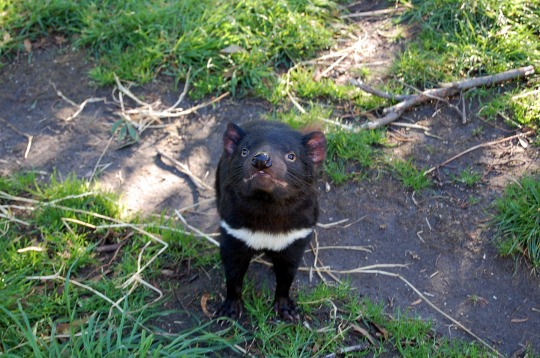
photograph of Tasmanian devil

The Tasmanian devil is a stocky mammal with short legs, short black fur and a distinctive white throat patch. Its head is noticeably large for the size of the body. An adult male may weigh up to 20 lbs. They are nocturnal with a good sense of sight, smell, and touch. Devils are known to cover significant distances nightly, in search of carrion or prey. They can move surprisingly fast and seem to enjoy swimming. In the wild, individuals can live between five and seven years, but many die within the first year of birth. Although it is the largest living marsupial carnivore, the Tasmanian devil is predominantly a scavenger.
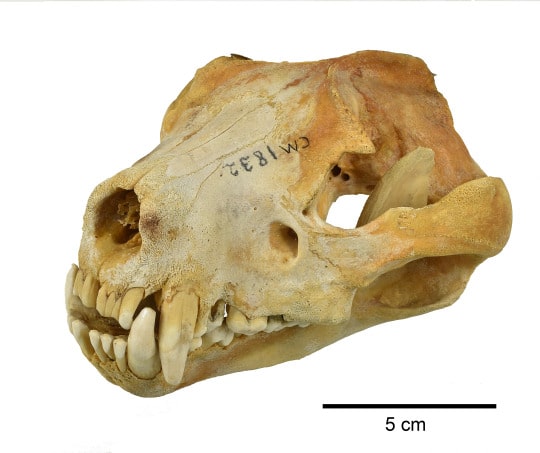
Tasmanian devil skull

A close look at the skull shows evidence of space on the side of the head for large jaw muscles. For its size, the Tasmanian devil has the strongest bite force of any mammal – more powerful than even a hyena! With the large masseter muscles and especially large molars, it can easily crush bone. In fact, devils are such efficient carrion-eaters that they willingly consume an entire carcass, including the fur.

Although this animal gained a reputation for having a bad disposition, it is speculated that this impression was derived from the poor conditions it was kept in when first captured for observations. Since then, it sometimes has been kept humanely as a pet and been found to be much friendlier than initially reported. Tasmanian devils do not seek each other’s company except during the mating period. However, they often come together to feed on a dead animal, where vocalizations and as many as nineteen different behavioral cues are used for communication. These communal gatherings are characterized by aggression and loud sounds, described as “frequent growling” and “blood-curdling screams”!

In 1996, a sad chapter began in the existence of the Tasmanian devil. A deadly infectious cancer called devil facial tumor disease, began to spread within the population. In 2012, the Australian government transferred 30 disease-free individuals to tiny Maria Island off the coast of Tasmania, in what was called ‘island insurance’, while researchers worked on perfecting a vaccine. By 2017, the disease had led to a 90% extinction rate on Tasmania. In hopeful news, by 2019 there were indications that surviving individuals’ immune systems may be undergoing modifications to fight the disease. In early September 2020, a consortium of conservation groups released 11 Tasmanian devils to a wildlife sanctuary in the state of New South Wales, placing the Tasmanian devil on the Australian mainland for the first time in more than 3000 years.  An additional 15 devils were released in early October and more releases are planned.

Currently, the Tasmanian devil is not extinct, but its recovery hangs in the balance. It would be tragic if we are left only with museum specimens and Taz, the Looney Tunes cartoon image, of this fascinating mammal.

Suzanne B. McLaren is the Collection Manager in the Section of Mammals at Carnegie Museum of Natural History. Museum employees are encouraged to share their unique experiences from working at the museum.
Related Content

Scientists Live: Mammalogist Suzanne McLaren on Bats

Vampire Squid: Cutest Dracula

Do Snakes Believe in the Tooth Fairy?

Filed Under: Blog Tagged With: mammals, Museum from Home, Science News, Section of Mammals, Suzanne McLaren

March 19, 2019 by wpengine

March Mammal Madness Update

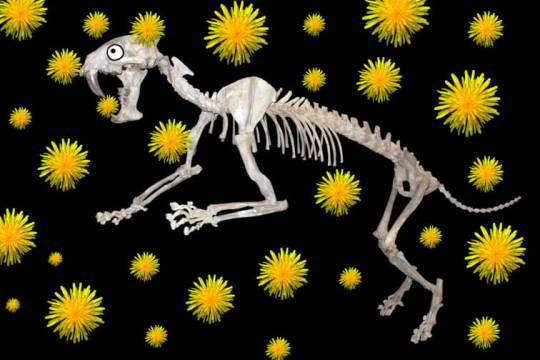
sabertooth cat fossil on black background with yellow dandelions

It’s time to break out the big cats.

Last night’s matches pitted various “cats” against each other, although some cats were only cats in name (for example, the catfish and antlion).

Our most anticipated match had a nimravid (a fossil false sabertooth cat) versus a dandelion. We weren’t sure if the nimravid would only be fossilized bones and stand little chance against the dandelion, or if the nimravid would come to life and be allergic to dandelions. So when the contest began, the nimravid was alive but it began sneezing and as a by-product bit down decapitating the fearsome dandelion. If you fancy seeing a real nimravid, there is one on display in Cenozoic Hall at the Carnegie Museum of Natural History.

For more details on this year’s tournament, click here.

Blog post courtesy of the Section of Mammals. 

Filed Under: Blog Tagged With: Age of Mammals, Cenozoic Hall, fossils, mammals, paleontology, Section of Mammals, Vertebrate Paleontology

July 23, 2018 by wpengine

Giant Sable Antelope

By Lisa Miriello

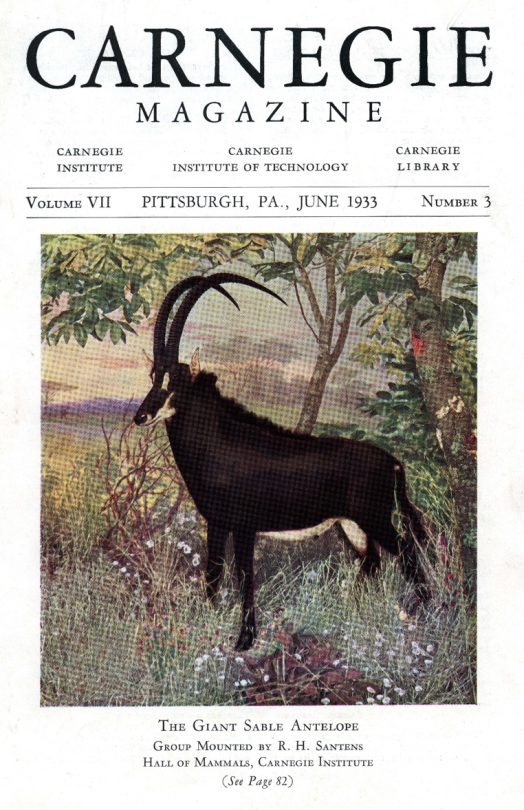
Carnegie magazine cover with giant sable antelope

In 1930, New York publisher Ralph Pulitzer recruited Rudyerd Boulton, the Carnegie Museum of Natural History’s ornithologist, to accompany him to the Portuguese colony of Angola in search of the Giant Sable Antelope. Few American zoologists had explored this region of Africa but Boulton had traveled there in 1925 with the American Museum of Natural History and his knowledge of the territory was invaluable to the Pulitzer party.

Hippotragus niger variani was named as a new subspecies less than fifteen years before the Pulitzer expedition and interest in the scientific community, as well as with big game hunters, grew rapidly. Portuguese authorities soon created new game laws to help protect this rare and impressive animal. Never numerous, today the Giant Sable is critically endangered, threatened by habitat loss, civil war, and poachers. Active conservation efforts continue, but population estimates indicate there are less than a hundred mature individuals, found only in Angola’s Cangandala National Park and the Luando Nature Reserve.

The Carnegie Museum of Natural History is one of only a handful of museums in the country where specimens of the Giant Sable have been preserved. The male collected by Pulitzer was expertly prepared by renowned taxidermy artist R. H. Santens and is exhibited on the museum’s second floor.

Lisa Miriello is the scientific preparator in the Section of Mammals at the Carnegie Museum of Natural History. Museum employees are encouraged to blog about their unique experiences and knowledge gained from working at the museum.

Filed Under: Blog Tagged With: Carnegie Magazine, Hall of African Wildlife, Lisa Miriello, mammals, Section of Mammals

July 17, 2018 by wpengine

Annals of Carnegie Museum

By John Wible

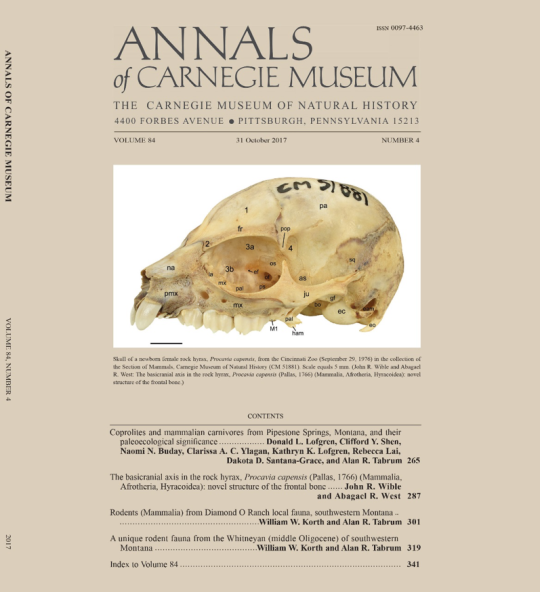
Annals of Carnegie Museum contents page

The Carnegie Museum of Natural History produces a scientific journal entitled Annals of Carnegie Museum that first appeared in print in March 1901. Its purpose is to promote the research and collections of the museum. This issue from October 2017 has the skull of a newborn rock hyrax, Procavia capensis, from the collection of the Section of Mammals on the cover. The image is from an article in the issue on aspects of the skull morphology of hyraxes by myself and Rea Postdoctoral Fellow Abagael West. For more information about the Annals, click here.


John Wible, PhD, is the curator of the Section of Mammals at Carnegie Museum of Natural History and editor of Annals of Carnegie Museum. John’s research is focused on the tree of life of mammals, understanding the evolutionary relationships between living and extinct taxa, and how the mammalian fauna on Earth got to be the way it is today. He uses his expertise on the anatomy of living mammals to reconstruct the lifeways of extinct mammals. John lives with his wife and two sons in a house full of cats and rabbits in Ross Township.

Filed Under: Blog Tagged With: John Wible, Section of Mammals

sidebar

About

  • Mission & Commitments
  • Directors Team
  • Museum History

Get Involved

  • Volunteer
  • Membership
  • Carnegie Discoverers
  • Donate
  • Employment
  • Events

Bring a Group

  • Groups of 10 or More
  • Birthday Parties at the Museum
  • Field Trips

Powdermill

  • Powdermill Nature Reserve
  • Powdermill Field Trips
  • Powdermill Staff
  • Research at Powdermill

More Information

  • Image Permission Requests
  • Science Stories
  • Accessibility
  • Shopping Cart
  • Contact
  • Visitor Policies
One of the Four Carnegie Museums | © Carnegie Institute | Privacy Policy | Terms of Use | Accessibility
Rad works here logo