• Skip to primary navigation
  • Skip to main content
  • Skip to primary sidebar

Carnegie Museum of Natural History

One of the Four Carnegie Museums of Pittsburgh

  • Visit
    • Buy Tickets
    • Visitor Information
    • Exhibitions
    • Events
    • Dining at the Museum
    • Celebrate at the Museum
    • Powdermill Nature Reserve
    • Event Venue Rental
  • Learn
    • Field Trips
    • Educator Information
    • Programs at the Museum
    • Bring the Museum to You
    • Guided Programs FAQ
    • Programs Online
    • Climate and Rural Systems Partnership
  • Research
    • Scientific Sections
    • Science Stories
    • Science Videos
    • Senior Science & Research Staff
    • Museum Library
    • Science Seminars
    • Scientific Publications
    • Specimen and Artifact Identification
  • About
    • Mission & Commitments
    • Directors Team
    • Museum History
  • Tickets
  • Give
  • Shop

snakes

April 5, 2019 by wpengine

What Makes Reptiles So Unique?

What makes reptiles so unique? Curator of Amphibians and Reptiles, Jennifer Sheridan, shares some of her favorite facts about the unique adaptations of reptiles including flying lizards and flying snakes. She also addresses how human activities impact reptiles like turtles, and how they adapt to changes in climate.

Ask a Scientist is a video series where we ask our research staff questions about the millions of amazing objects and specimens stored in our museum collection. Tune in on YouTube, and submit your own questions at https://carnegiemnh.org/visitor/ask-a-scientist-videos/
Filed Under: Blog Tagged With: amphibians and reptiles, Anthropocene, herpetology, Jennifer Sheridan, Lizards, reptiles, snakes

March 1, 2019 by wpengine

The Enduring Appeal of Snakes

by Jennifer A. Sheridan

As a herpetologist, I’m often asked whether I see a lot of snakes. To be clear, seeing snakes is always an exciting treat for me. But I’ve come to learn that when people ask this question, they’re usually not asking because they want to hear about all the gorgeous ones I’ve seen, but because they want to gauge how “dangerous” it is to be out and about in the forests where I work. I always explain that snakes are fairly skittish and most will quickly move away from humans, but that yes, I do have the good fortune of seeing some excellent individuals. I especially love Danum Valley, one of my field sites in Borneo, for this reason. Depending on the year, I may be lucky enough to see several species within a short time, and last October I had some great sightings.

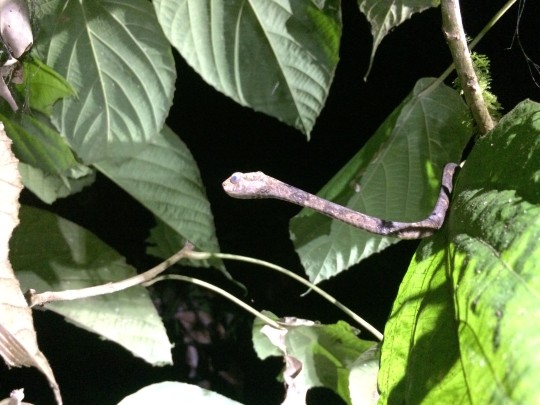
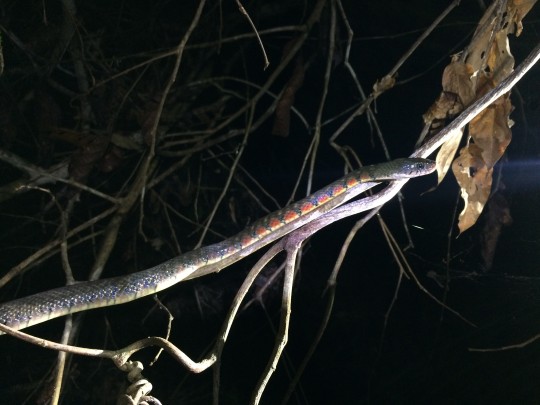
Because I focus on amphibians, most of my work is at night, and mostly along streams. Often, we see snakes on branches as we come into the stream, like this lovely triangle keelback (Xenochrophis triangularis):

snake on a branch at night

Or in the middle of our search for frogs along the stream transect, like this blunt-headed snail-eating snake (Aplopeltura boa):

snake in a tree at night

This species is one of my favorites because it has a big fat head that it uses to hunt for snails. It unhinges its jaw and inserts the lower jaw into the shell to pull out the meat. Sorry, Tim Pearce! 😉

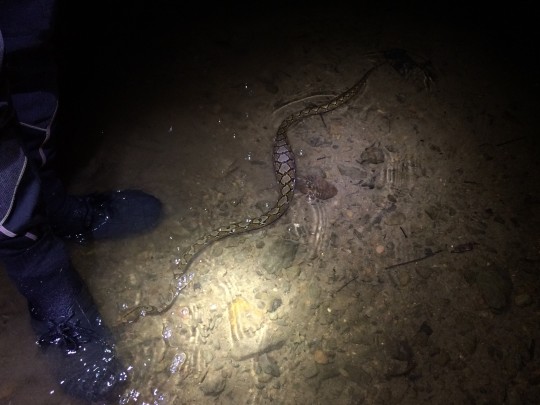
Other times we see snakes swimming in the water as we’re walking upstream, like this baby Python reticulatus:

snake in the water

This was one of the highlights of the trip because a) baby pythons are so cute and b) it had clearly just eaten, so it had a large belly bulge (I feel you, python). When it tried to dive under water, its belly kept floating at the surface and it didn’t really have much luck in hiding away from us. Adorable. (It eventually made its way over to the bank and up into the forest.)

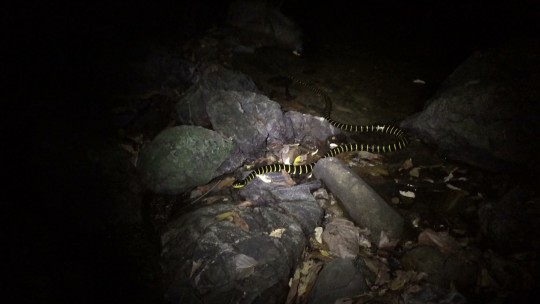
One of the most striking sights, however, had to be this mangrove snake (Boiga dendrophila) swimming downstream towards us, head held up above the water, jet black body lithely undulating behind it. Because of its bright yellow chin and underside, it is extremely striking at night.

snake on rocky ground at night

One time, years ago, I was in the middle of a transect and the batteries in my headlamp had started to die. I stopped, turned off my light, and changed them out while my teammates continued the survey upstream. When I got my headlamp back on my head and switched it on, a Boigadendrophilawas between my feet. While I am fairly calm in the field, I have to admit that this gave me quite a start! But he went on his way and I went on mine, neither of us all that bothered by the other. So while many people fear snakes, for the vast majority of species if you don’t bother them, they really won’t bother you.

Jennifer A. Sheridan is the Assistant Curator in the Section of Herpetology at the Carnegie Museum of Natural History. Museum employees are encouraged to blog about their unique experiences and knowledge gained from working at the museum.

Related Content

Do Snakes Believe in the Tooth Fairy?

Is This What They Call Overkill? Toxin and Venom in the Herp World

Ask a Scientist: What is an Alcohol House?

Carnegie Museum of Natural History Blog Citation Information

Blog author: Sheridan, Jennifer A.
Publication date: March 1, 2019

Share this post!

  • Share on Twitter Share on Twitter
  • Share on Facebook Share on Facebook
  • Share on Pinterest Share on Pinterest
  • Share on LinkedIn Share on LinkedIn
  • Share on Reddit Share on Reddit
  • Share via Email Share via Email

Filed Under: Blog Tagged With: amphibians and reptiles, Borneo, herpetology, Jennifer Sheridan, reptiles, snakes

September 13, 2018 by wpengine

A Herp Collection Mystery

by Jennifer Sheridan

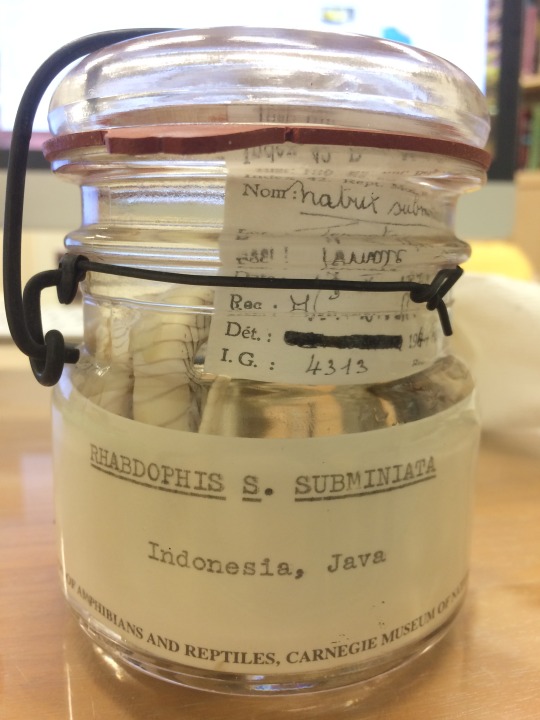
snake specimen

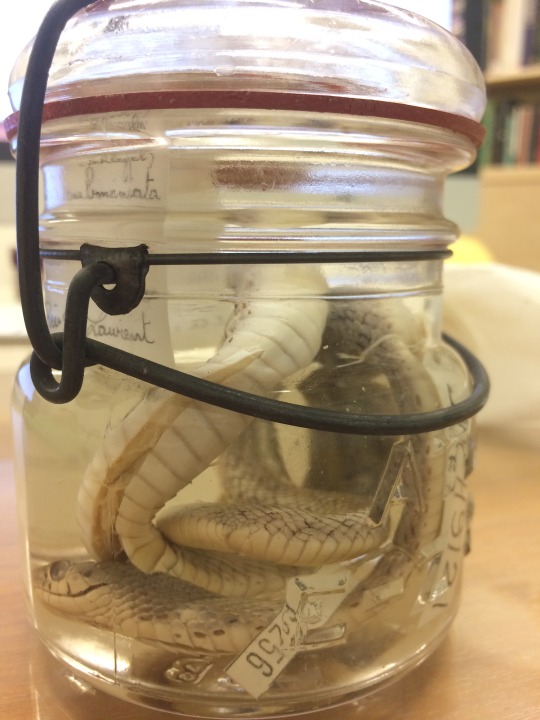
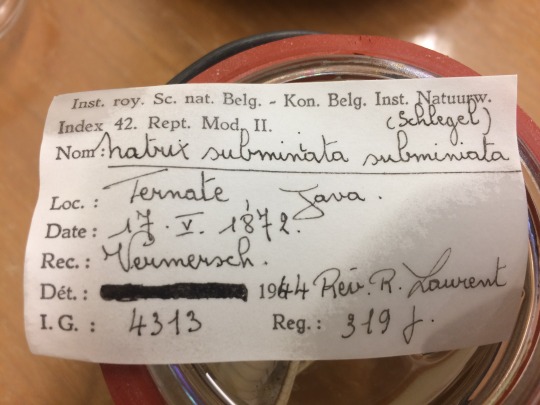
Part of the fun of being a new curator is getting to know the collections. In preparing for an upcoming talk (Scientists Live on Facebook on September 19th), I was sorting through our collections database to see what specimens we have from Southeast Asia, where I do most of my research. I came across a record that intrigued me: a fairly common snake (Rhabdophis subminiatus) from a potentially uncommon locality. The jar label says “Indonesia, Java”—Java being one of the islands in the Indonesian archipelago, which also happens to be the world’s most populous island. But the exact location detail is what caught my eye: Ternate.

snake specimen from Indonesia

If you happen to be from Southeast Asia or you’re a biogeography buff, you may know that Ternate is not in fact on Java, but is itself a tiny island in eastern Indonesia, off the coast of Halmahera, which is part of the Maluku group. Biogeographically this area is interesting because it lies just east of Wallace’s Line, an imaginary dividing line that separates the flora and fauna of Sundaland (mainland Southeast Asia) from that of Austronesia (Australia, New Guinea, and associated islands). This area played a key role in our understanding of biogeography because it was while he was traveling across Indonesia that Alfred Russel Wallace noticed that there was a very distinct change in the species of plants and animals found in Borneo and Bali (west of the line), compared to those on Sulawesi and Lombok (east of the line), despite the fact that those islands are not separated by a large distance. He noted this in his journals and scientists later named this dividing line after him, once they learned that the plants and animals west of the line originated in mainland SE Asia, while those east of the line originated in Australia.

But Ternate is interesting not simply because of its geographic location, but because of Wallace’s relationship to it. Ternate is where Wallace was when he wrote his famous letter to Charles Darwin in 1858, while laid up in bed with fever, explaining to Darwin his idea of evolution by natural selection. Amazingly these two people had arrived at the same idea totally independently of one another, half a world apart. They had shared correspondence prior to 1858, and it was this letter from Wallace that prompted Darwin to jointly publish his own work alongside Wallace’s, thus introducing to the world for the first time the idea of evolution by natural selection, which has allowed us to understand the natural world.

notes about the snake specimen from Indonesia

Coming back to the specimen, I had been hoping that perhaps it was collected by Wallace or one of his team, but the record is from 1872, ten years after Wallace had returned to England. The listed collector, Vermersch, is not a collector known to me or other herpetologists I’ve checked with who work in SE Asia, and we have no additional details on the specimen. Given that I cannot find a record of a city called Ternate on the island of Java, and the fact that all of Indonesia may have been known as the Java Sultanate at the time, my guess is that this specimen is actually from Ternate, and not Java proper. This specimen also has the distinction of being one of our oldest, so for me, and anyone else studying biogeography of SE Asia, this specimen becomes doubly interesting and valuable, and will definitely be one of the highlights of any upcoming tours of the Alcohol House! I’m looking forward to finding more secret treasures as I get to know our collection.

Jennifer A. Sheridan is the Assistant Curator in the Section of Herpetology at the Carnegie Museum of Natural History. Museum employees are encouraged to blog about their unique experiences and knowledge gained from working at the museum.

Filed Under: Blog Tagged With: Alfred Russel Wallace, amphibians, amphibians and reptiles, herpetology, Mason Heberling, reptiles, snakes

June 20, 2018 by wpengine

Snakes, snails, and puppy dog tails

By: Kaylin Martin, M.Sc. and Timothy A. Pearce, PhD

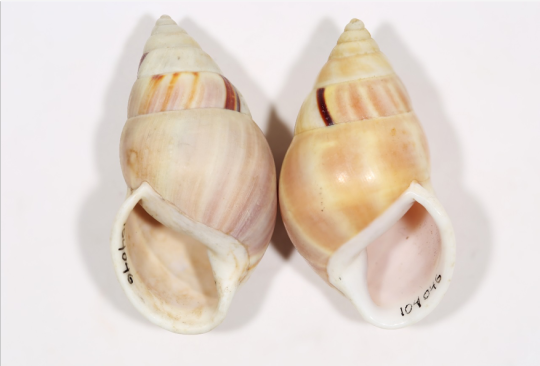
Asymmetries in nature are noteworthy because they usually mean something interesting is going on. Most snail-eating snakes in the family Pareidae are remarkable for having more teeth on the right lower jaw than on the left. The vast majority of snails worldwide coil clockwise (dextral) while, in contrast, the counter-clockwise coiling (sinistral) snails tend to be scarce, usually on the order of 1/10,000 to 1/100,000.

Sinistral (left) versus dextral (right) of shells Amphidromus inversus. CM 104046.
Sinistral (left) versus dextral (right) of shells Amphidromus inversus. CM 104046. Photo by Kaylin Martin, M.Sc., 2018.

Recent experiments demonstrate that pareid snakes are more successful at eating dextrally coiling snails, evidently because having more teeth in the right jaw helps the snake to extract the snail’s body from the shell. Upon striking a dextral snail, with the aperture on the right, the snake advances and retracts its mandibles along the snail’s forebody. The sequential movements of this mandibular walk extract the snail’s soft body from its shell. Conversely, when a pareid snake strikes a sinistrally coiled snail, it finds the snail’s aperture on the left, and consequently the snake’s stereotypical right-handed behavior is less successful at grasping the snail’s body. The asymmetry in the snake’s mandibles means that sinistrally coiled snails escape predation by these snakes more often than do dextrally coiled snails.

Could the pareid snakes be an evolutionary force that favors sinistrally coiled snails? The ranges of Pareidae and Amphidromus almost entirely overlap, both groups occurring in Southeast Asia from China to Indonesia. Quite a few other land snail species in that part of the world are known to coil sinistrally, although in most of these other genera, the whole species is sinistral, rather than showing polymorphism (showing both forms) for coiling direction. The two facts, that sinistrally coiled snails escape predation more often, and that the ranges of the predator and the prey largely overlap, both support the idea that the asymmetry in the snake’s jaw provides an evolutionary force resulting in a greater proportion of sinistral snails in Southeast Asia. This conclusion was also reached in a study by Hoso et al. (2010).

The snake Pareas carinatus and the snail Amphidromus inversus are both tree-dwelling. In controlled lab experiments, the snake is known to eat Amphidromus, as well as other genera of snails. However, we are not sure whether the snake actually eats Amphidromus inthe wild because data are scarce on Pareas diets in their natural environment. So, whether the snake could have influenced the unusual predominance of left handedness in Amphidromus species makes logical sense, but remains unresolved.

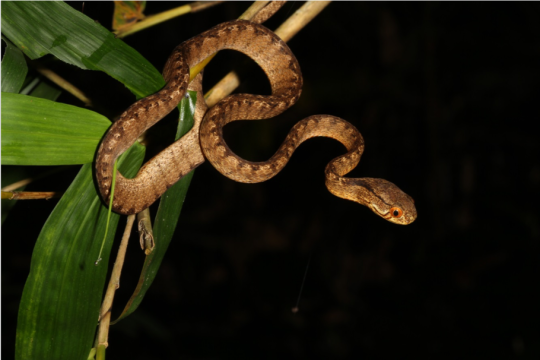
Pareas carinatus from Cat Tien, Vietnam
Pareas carinatus from Cat Tien, Vietnam.  Photo by Paul S. Freed, 2011.

Dozens of other snail eating snakes exist, for example many species in the genus Sibon throughout the tropical Americas, but their jaws do not show asymmetry, so they would not influence snail coiling direction.

We know of no other predator that is known to specialize in prey that have a particular “handedness.” Further studies on diets of pareid snakes would advance scientific understanding of specialized predator-prey interactions, ecological adaptation, and coevolution between the arboreal snakes and snails of southeast Asia.

And given that we are talking about snakes and snails, we must also mention puppy dog tails. The tails of many dogs do coil, and of those that coil, many of them coil off to the side. As judged by a survey of coiling dog tails in a Google Image search, dog tails that coil to the left or to the right appear to be about equally represented. So, puppy dog tail coiling direction also appears to be polymorphic…

Timothy A. Pearce, PhD, is the head and curator of collections of the Section of Mollusks at Carnegie Museum of Natural History. Kaylin Martin, M.Sc, is the curatorial assistant in the Section of Amphibians and Reptiles. Museum employees are encouraged to blog about their unique experiences and knowledge gained from working at the museum.

Literature Cited

Hoso, M., Kameda, Y., Wu, S.P., Asami, T., Kato, M. & Hori, M. 2010. A speciation gene for left–right reversal in snails results in anti-predator adaptation. Nature Communications, 1:133; DOI: 10.1038/ncomms1133.

Filed Under: Blog Tagged With: amphibians and reptiles, mollusks, reptiles, snails, snakes

August 18, 2017 by wpengine

Snakes large and small!

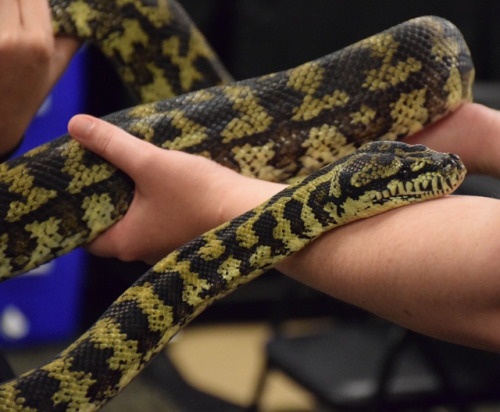
Python
Python
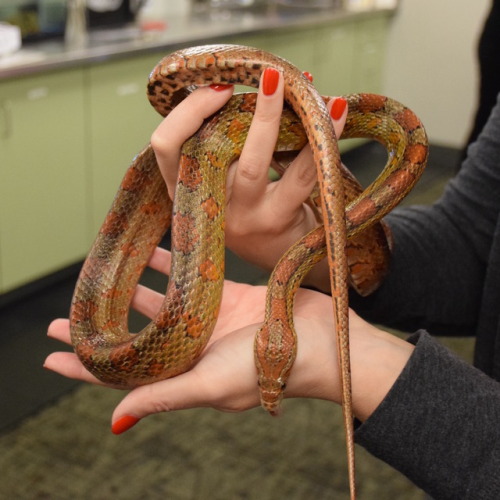
Cornsnake, a yellow and orange snake
Cornsnake
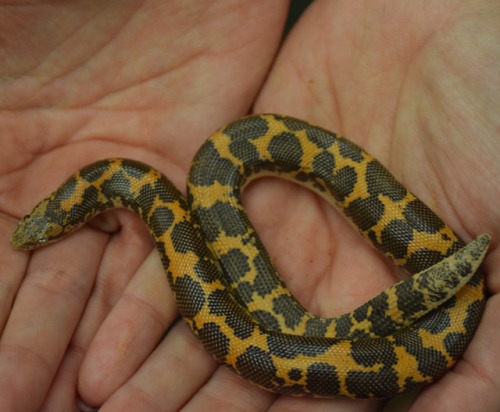
small black and yelow snake
Kenyan sand boa

Carnegie Museum of Natural History is home to snakes large and small. Our living collection is home to a Kenyan sand boa, a corn snake, and even a 6-foot-long python! The snakes are well cared for by our experts here at the museum. You can sometimes meet them as part of the rotating cast of our daily Live Animal Encounters.

Filed Under: Blog Tagged With: snakes

June 8, 2016 by wpengine

A Holotype with a History

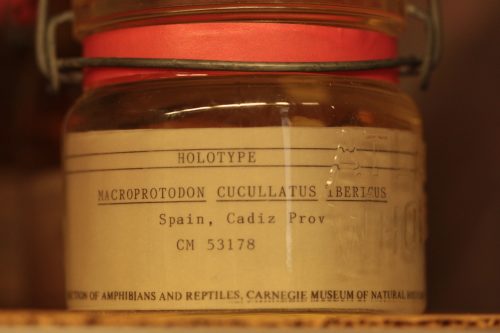
jar with a label that reads "Macroprotodon cucullatus iberius"by José Padial

This jar contains the holotype of Macroprotodon cucullatus iberius, a subspecies of false smooth snake, in the herpetology collection of Carnegie Museum of Natural History.

The holotype is the name-bearer of a species and every species recognized by scientists is associated to an holotype.

The specimen was collected in Cadiz Province, Spain by American herpetologist Stephen Busack. Because of his knowledge of
Spanish, Stephen Busack was deployed in Rota Naval Base during the Vietnam War, and he used his spare time to research the area’s poorly known local fauna of amphibians and reptiles.

His research revealed new species, and the precise locality data he collected is now key to demonstrate the radical transformation that the environment of the area has experienced during the last 40 years.

Many of the populations studied by Busack are now gone. Populations from Cadiz Province are now considered to belong to the species Macroprotodon brevis and it is the smaller and rarest snake of the Iberian Peninsula. It feeds on lizards, baby snakes, blind snakes, and even individuals of its own species!

José Padial is the William and Ingrid Rea Assistant Curator of Herpetology at Carnegie Museum of Natural History. He most recently traveled to the remote Vilcabamba mountains of Peru in the pursuit of biodiversity research. Read more at www.tumblr.com/blog/expeditions-carnegiemnh.

Filed Under: Blog Tagged With: collections, conservation, herpetology, museums, Pittsburgh, snakes

sidebar

About

  • Mission & Commitments
  • Directors Team
  • Museum History

Get Involved

  • Volunteer
  • Membership
  • Carnegie Discoverers
  • Donate
  • Employment
  • Events

Bring a Group

  • Groups of 10 or More
  • Birthday Parties at the Museum
  • Field Trips

Powdermill

  • Powdermill Nature Reserve
  • Powdermill Field Trips
  • Powdermill Staff
  • Research at Powdermill

More Information

  • Image Permission Requests
  • Science Stories
  • Accessibility
  • Shopping Cart
  • Contact
  • Visitor Policies
One of the Four Carnegie Museums | © Carnegie Institute | Privacy Policy | Terms of Use | Accessibility
Rad works here logo