• Skip to primary navigation
  • Skip to main content
  • Skip to primary sidebar

Carnegie Museum of Natural History

One of the Four Carnegie Museums of Pittsburgh

  • Visit
    • Buy Tickets
    • Visitor Information
    • Exhibitions
    • Events
    • Dining at the Museum
    • Celebrate at the Museum
    • Powdermill Nature Reserve
    • Event Venue Rental
  • Learn
    • Field Trips
    • Educator Information
    • Programs at the Museum
    • Bring the Museum to You
    • Guided Programs FAQ
    • Programs Online
    • Climate and Rural Systems Partnership
  • Research
    • Scientific Sections
    • Science Stories
    • Science Videos
    • Senior Science & Research Staff
    • Museum Library
    • Science Seminars
    • Scientific Publications
    • Specimen and Artifact Identification
  • About
    • Mission & Commitments
    • Directors Team
    • Museum History
  • Tickets
  • Give
  • Shop

Taking Flight

January 27, 2021 by wpengine

Detecting Objects with Invisible Waves: Using Radar, Sonar, and Echolocation to “See”

The ability to see visible waves of light can be beneficial for determining the size, shape, distance, and speed of things in our surrounding environments. But in many situations, reliance on sight might not be the best option for the remote detection of objects. For example, most animals do not have eyes on the backs of their heads; many cannot see very well at night; and some live in the depths of the ocean where visible light doesn’t reach. Yet these conditions don’t hinder the ability to sense objects for many animals. So, how do humans and other animals “see” distant objects without depending on the use of sight?

One answer is that other types of waves outside of visible light exist and animals have developed methods for detecting them. Two of these methods, sonar and radar, are man-made detection systems that allow us to “see” what our eyes can’t. The other, echolocation, is a natural way for some animals to detect motion through sound waves.

Radar

Radar is a system used to detect, locate, track, and recognize objects from a considerable distance. R.A.D.A.R is an acronym for “radio detection and ranging.” It was initially developed in the 1930s and 1940s for military use, but is now common for civilian purposes as well. Some of these uses include weather observation, air traffic control, and surveillance of other planets.
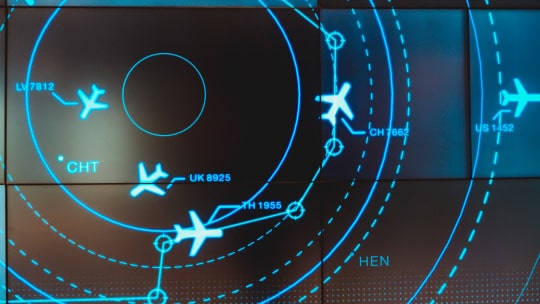
air traffic control radar with blue circles and airplanes on black background
Air traffic control radar.

Radar works by sending out radio waves, a type of electromagnetic wave, in pulses through a radio transmitter. The waves are reflected off of objects in their path back toward a receiver that can detect those reflections. Radar devices usually use the same antenna for transmitting and receiving, which means the device switches between being active and passive. The received radio wave information can help observers determine the distance and location of the object, how fast it is moving in relation to the receiver, the direction of travel, and sometimes the shape and size of the objects, too.

Radio waves have the longest wavelengths and lowest frequencies of all electromagnetic waves. Because they move slower and require less energy, they travel well through adverse weather conditions like fog, rain, snow, etc. Detection systems like lidar that operate through infrared and visible waves with shorter wavelengths and higher frequencies do not function well in such conditions.

While radar can effectively move through or around various environmental conditions, it is much less effective underwater. The electromagnetic waves of radar are absorbed in large bodies of water within feet of transmission. Instead, we use Sonar in underwater applications.

Sonar

S.O.N.A.R, an acronym for “sound navigation and ranging,” is a similar system to radar in terms of transmitting and receiving waves through pulses to determine distance and speed. However, it functions through the use of sound waves and is highly effective underwater.

Sound waves are mechanical waves, which means they are oscillations, or back and forth movements at regular speeds, of matter. When a mechanical wave strikes an obstacle or comes to the end of the medium it travels in, some portion of the wave is reflected back into the original medium. Water turns out to be a fantastic medium – albeit a slow one – for carrying mechanical waves long distances, making Sonar the top choice for underwater object detection.

Echolocation

Echolocation is a natural sound wave transmission and detection method used by animals to accomplish the same goal of object detection. Though sometimes referred to as sonar in casual conversation, echolocation requires no human-made device to function and is used both above and below water. Animals use echolocation by sending out sound waves in the air or water before them. They can then determine information about objects in their path through the echoes produced when those sounds are reflected.

Echolocation can be utilized by any animal with sound-producing and sensing capabilities. Humans have been known to develop methods of systematically tapping canes or clicking their tongues to produce the sounds needed for echolocation. However, echolocation is more generally associated with the use of ultrasound by non-human animals. Ultrasound is sound that has a mechanical wave frequency higher than the human ear can detect though they operate the same as audible sound waves.
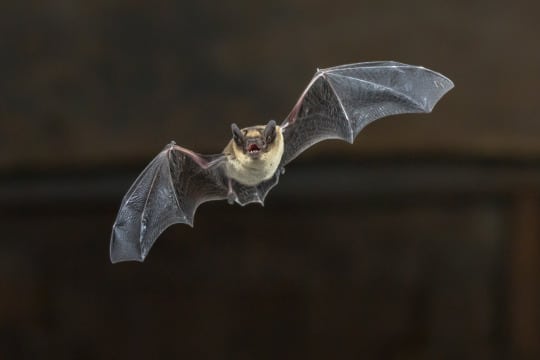
bat flying

Bats are among the most well-known users of echolocation. They use relatively high, mostly ultrasonic wavelengths and some can create echolocating sounds up to 140 decibels – higher than a military jet taking off only 100 feet away. In order to handle such intense sound wave vibrations, bats turn off their middle ears by just before calling to avoid being deafened by their own calls. They use muscles in their middle ear to pull apart bones that carry sound waves to the inner ear leaving no path for the sound waves to damage the cochlea. Similar to radar devices switching between active transmitters and passive receivers, Bats restore their full hearing a split second later to listen for echoes.

Most of the more than 1300 species of bats use echolocation to hunt and navigate in poor lighting conditions. Fossil evidence indicates that this capability developed in bats at least 52 million years ago. They can detect an insect up to 15 feet away and determine its size, shape, hardness, and direction of travel through their skillful use of echolocation.

Wave Echoes

Animals have long been able to detect objects at a distance through the manipulation of nonvisible waves using technologies like radar and sonar or natural echolocation. Though each of these methods operates a little differently and relies on various shapes, sizes, and types of waves, they each work by emitting waves then determining characteristics based upon the echoes of those waves.

Try it at Home

Go to a corner of a quiet room and close your eyes. Without moving your body too much, try turning your head while making clicking noises with your mouth. Can you tell when you are turned more toward a wall or if there are any objects near you through the way the clicking sound changes? Try holding your hand up in front of your face and moving it back and forth while you click. Can you tell how far away it is or which direction it is moving by the sound? Get creative and try it with different types of objects and different locations!

Jane Thaler is a Gallery Experience Presenter in CMNH’s Life Long Learning Department. Museum staff, volunteers, and interns are encouraged to blog about their unique experiences and knowledge gained from working at the museum.

Related Content

Super Squid! Flying Marvels of the Natural World

Fancy Feathers: An Unexplained Complexity in Evolutionary History

Ask a Scientist: What’s the difference between ravens and crows?
Filed Under: Blog Tagged With: Museum from Home, Super Science, Taking Flight

January 26, 2021 by wpengine

Fancy Feathers: An Unexplained Complexity in Evolutionary History

One of the most complex and highly intricate wonders of the flying world owes nothing to DaVinci’s studies on mechanical flight, the Wright brothers’ pioneering of aviation, or any other human-derived aeronautic technology. The most sophisticated piece of engineering used for flight has its origins in the Age of Dinosaurs and is one of the most common sights in our everyday lives: feathers.

Feathers as We Know Them

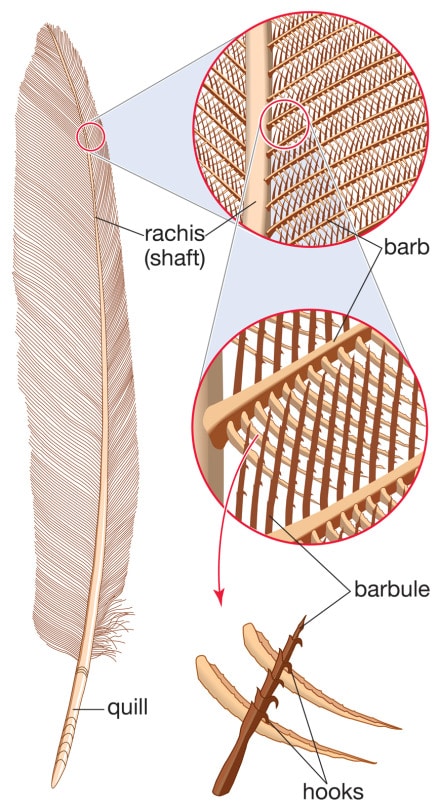
Modern-day feathers come in a seemingly infinite variety of sizes, shapes, and textures. Though their diversity is immense, each type is made of beta-keratin, a structural protein found in the skin of both reptiles and birds, and their branching structures have the same basic parts. The main shaft is composed of a hollow barbless base, known as the calamus or quill, and a central shaft, called the rachis. The rachis branches into main barbs and they branch even further into barbules.

illustration of feathers showing the quill, rachis, barb, barbule, and hooks

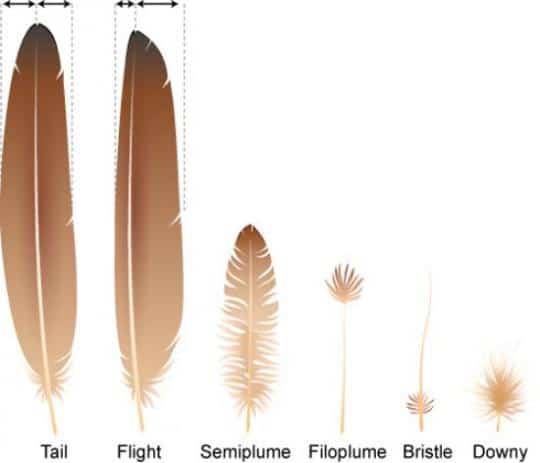
The variety of feathers comes from small modifications to this basic branching structure to serve different functions. Feathers fall into a few general categories, which will be briefly describe here, and many more specific subcategories.

illustration of six feathers from longest to shortest: Tail, Flightl, Semiplume, Filoplume, Bristle, and Downy

Bristles have a simple, stiff, and tapered rachis with few barbs. They are usually found on a bird’s head around their mouth, nostrils, and eyelids. Some experts think they are for protection much like eyelashes, others believe they serve a sensory function as evidenced by the nerve endings found at their base, and many support both theories.

Filoplumes are also simple and mostly bare of barbs except a tuft at the tip. They are found near contour feathers. Given their placement and the presence of unmyelinated nerve fibers, which are those that support peripheral sensory functions in their base, filoplumes act like whiskers by sensing the position of contour feathers.

Semiplume and down feathers are mostly hidden underneath outer feathers. Their loose branching structures appears fluffy and is highly effective for insulation.

Contour feathers include those that cover the surface of the bird. As their name suggests, these feathers follow the shape of the body, streamlining and weatherproofing it along the way like overlapping shingles. From the central shaft extends a series of slender barbs, each sprouting smaller barbules that are lined with tiny hooks. When these grasp on to the hooks of neighboring barbules, they create a structural network that is almost weightless yet remarkably strong. As the outer visage, these feathers also support decoration and camouflage.

Contour feathers also include the amazing evolutionary innovations mentioned in the introduction: flight feathers. Flight feathers are long, stiff, asymmetrically shaped, but symmetrically paired feathers on the wings or tail of a bird. They are built for durability, shaped for precision, and combined with musculature to produce the ultimate flying tool. The wing feathers, known as remiges, have uniform windproof surfaces, or vanes, on either side of the central shaft created by the interlocked hooks found on the barbules. These feathers are asymmetric with a shorter, less flexible leading edge that support stability and maneuverability. Similarly structured tail feathers, known as retrices, are arranged in a fan shape that allows for precision steering during flight.

While we can simulate some of these characteristics with our flying technologies, we have yet to create a machine that is as versatile, efficient, and effective as bird feathers in flight. Even more impressive, birds are not stuck with one set of feathers for their whole lives. Damaged or worn feathers can be replaced through the process of molting. During a periodic molt, old feathers are shed and new ones grow in their place keeping birds in top flying shape. You can’t say that about any of our manmade flying machines.

The Question of the Evolution of Feathers

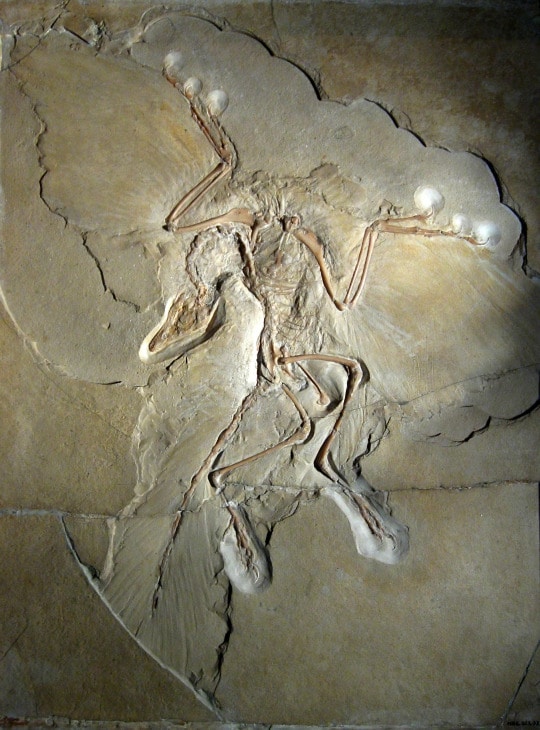
avian fossil

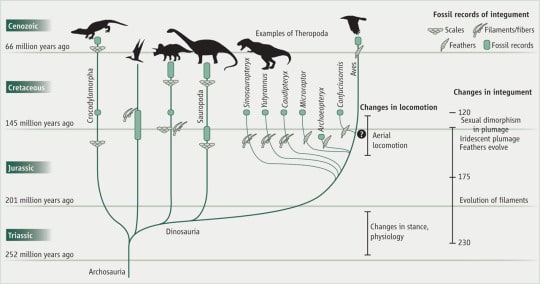
The consensus among paleontologists is that birds, known taxonomically as the class Aves, are a group of maniraptoran theropod dinosaurs. Evidence found in the fossil record suggests that most major lineages of modern birds arose near the end of or right after the Cretaceous period (between 65-60 million years ago). Feathers now exclusively occur in avian dinosaurs (e.g., birds), but that was not always the case. With the discovery of the bird-like dinosaur Archaeopteryx in the 1860s and confirmed with further feathered dinosaur discoveries in the 1990s, feathers have been found on much earlier, non-avian species suggesting that their evolutionary beginnings stem at least as far back as the Jurassic.

illustration of feather evolution from the Triassic to Cenozoic

Several theories have been explored and subsequently unraveled in recent years regarding the origin of birds and the evolution of feathers. Once the link between birds and reptiles was evidenced, some scientists theorized that birds did not evolve from dinosaurs. Instead, they are related by a distant common ancestor that has yet to be discovered. This theory, however, does not account for the striking similarities between the skeletons of birds and those of the highly feathered theropods.

Others theorized that maybe scales and feathers were both flat because feathers were an elongation of scales with frayed edges that eventually became the feathers we see today. They supposed that this growth over generations could have been prompted as an adaptation for flight. Maybe they helped these reptiles live in tree canopies by aiding gliding, which turned into the capability of flight. Such a “feathers-to-flight” theory would nicely tie up answers to all of the questions posed above and was fairly long-lived. With the discovery of hundreds of feathered, ground-running theropods, however, this theory proved to be discardable. So, too, dinosaurs far removed from theropods and even further removed from birds have been found with feathers that were not used for flight.

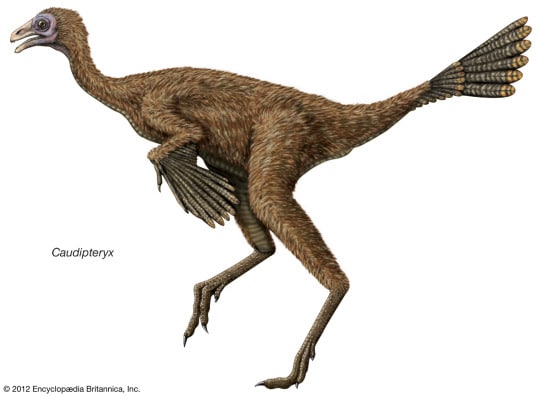
illustration of Caudipteryx

The feathers on the earliest non-avian dinosaurs did not look like the modern-day feathers described above. This fact has led to a new line of thinking about the transition from scales to feathers. From what we know from the fossil records, the earliest feathers, sometimes called protofeathers, were small, hollow filaments that appeared more like fuzz than feathers. Studying feathered specimens chronologically, the feathers slowly became more and more complex over time possibly because of an evolutionary impetus. The study of this feather development has prompted a new look into the genomic manipulation of placodes. Integumentary placodes are embryonic structures involved in the development of hair follicles, feathers, and teeth. Recent studies using modern genomic methods to identify feather-associated placodes have demonstrated the ability to turn scales into feathers. By turning key molecular circuits on and off at critical stages of scale development, researchers have been able to stimulate feather-like growths in alligator skin cells.

placodes

Though interesting, indeed, and something to keep an eye out for in new studies, none of this research is conclusive. Other studies suggest that convergent evolution might solve some of these riddles or more digging for fossils might be the best option. In any case, there is still much to learn about how the feathered dinosaur that you watch at your birdfeeder or hear outside your window evolved into what it is today.

Jane Thaler is a Gallery Experience Presenter in CMNH’s Life Long Learning Department. Museum staff, volunteers, and interns are encouraged to blog about their unique experiences and knowledge gained from working at the museum.

Related Content

Ask a Scientist: How are birds like dinosaurs?

Super Science Activity: DIY Catapult

Snow White Bird Search

Filed Under: Blog Tagged With: Museum from Home, Super Science, Taking Flight

January 25, 2021 by Kathleen

Super Science Activity: DIY Catapult

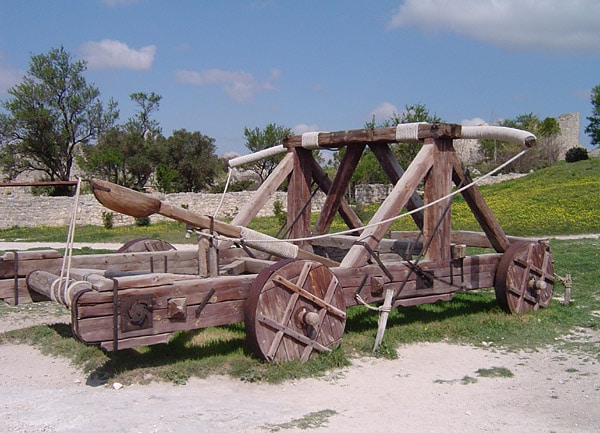
Petraria Arcatinus catapult replica

By Jane Thaler

Flight is possible because of the four basic forces of aerodynamics: lift, weight, thrust, and drag.
Lift and weight are opposing forces that, when controlled, allow things to stay up in the air. Thrust and drag are similarly opposing forces that either pull or resist movement through space. To be able to get into the air, animals and machines must be able to produce the two forces of lift and thrust against the forces of weight and drag.

model of the four forces of flight: thrust, lift, drag, and weight

Birds and helicopters have mechanisms that produce lift and thrust simultaneously. Birds do this through a twisting of their wings and helicopters accomplish the same idea through a single rotor. This allows them to conveniently take off for flight by moving straight up into the air. Not all flying machines can do this, however, and most require some sort runway to gain enough speed for taking off amongst all these flying forces. This can be fairly inconvenient when you don’t have a lot of time or space. Say you are trying to takeoff from an aircraft carrier in the sea for example that only has 300 feet of runway instead of the 2,300 feet needed for your average aircraft to takeoff. What you need, and what engineers have built, is a machine that can get those planes from 0 to 170 miles in less than 2 seconds. Aircraft carriers use steam-powered catapults to shortcut the force-based issues of flight takeoff.

Spring loaded catapults were used to launch aircraft beginning in 1903 and catapults were used on U.S. Navy ships as early as 1915, but their history as a tool for launching objects into the air for a distance began in 400 BC as weapons in siege warfare. Catapults work through a sudden release, or conversion, of stored potential energy to propel objects through the air. Essentially, energy stored as tension or torsion is converted during the release and transferred to the launched object. This energy of motion creates enough lift to get an object in the air while the force and angle of release provide the thrust necessary to cover long distances.

Let’s see how they work by building our own catapult! In this activity you will being using elastic potential energy stored in the tension of a wooden craft stick.

DIY Catapult supplies
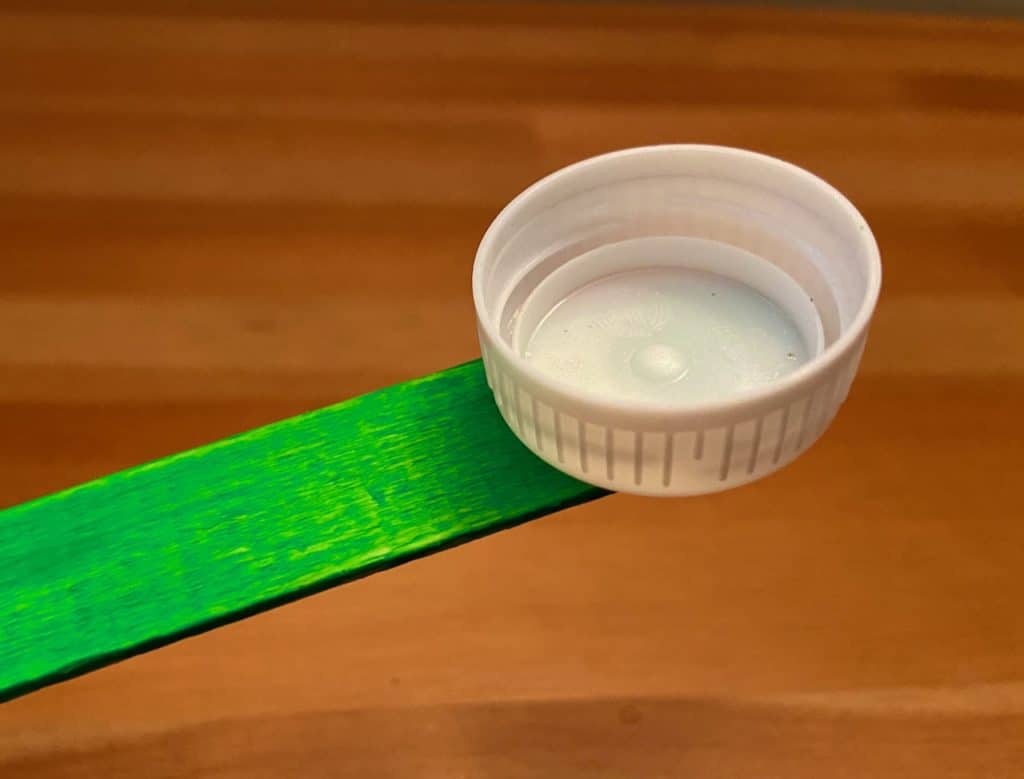
popsicle stick with plastic bottle cap glued on end
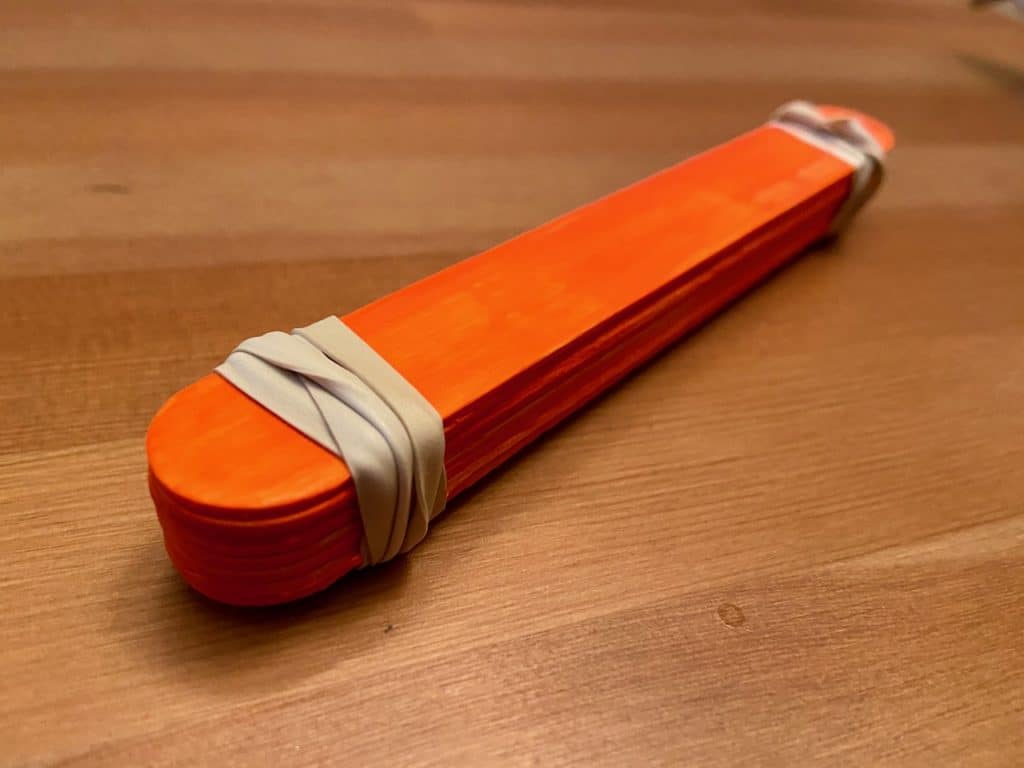
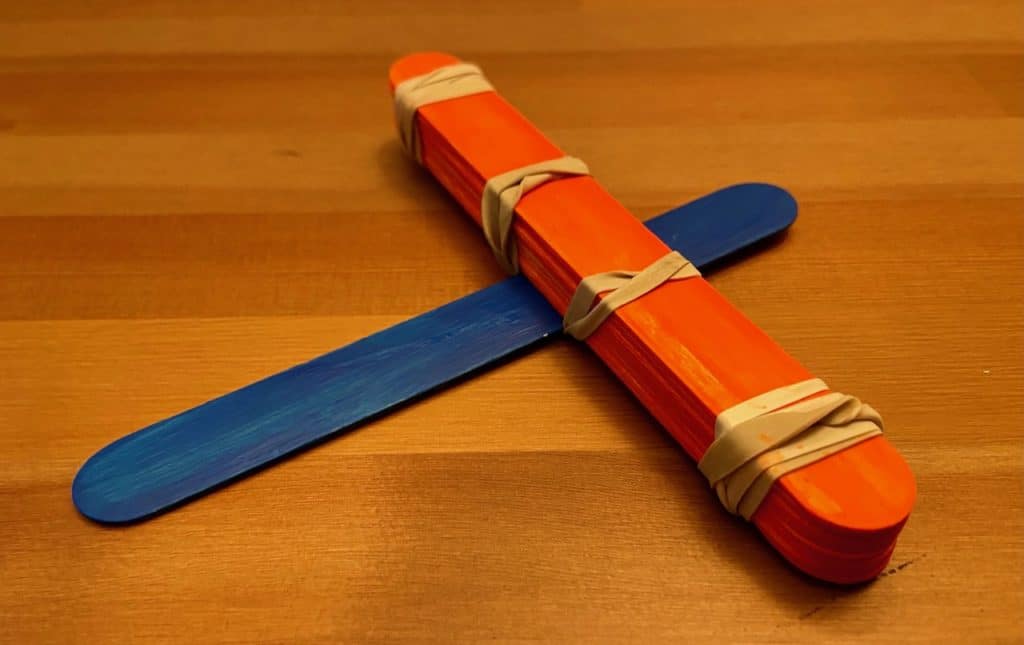
Eight popsicle sticks tied together with rubber bands

What You’ll Need to Make Your Own Catapult

• 10 craft sticks
• Rubber bands
• Plastic bottle cap – Or some other small, lightweight bucket
• Glue
• A cotton ball or small ball of crumpled paper
• Paint, markers, or other decorations – This is entirely optional

Directions

  1. (Optional) Decorate the craft sticks and bottle cap to your liking and wait till dry. It is much easier to do this before you begin assembling your catapult.
  2. Glue plastic bottle cap on the end of a craft stick facing up like a cup. Place aside to let dry. This will be the launching stick.
  3. Stack 8 craft sticks together. Wrap both ends of the stack with rubber bands to secure them together.
  4. Place a single craft stick on the bottom of the main stack at a perpendicular angle. Secure this cross shape with rubber bands wrapped in an X around the center.
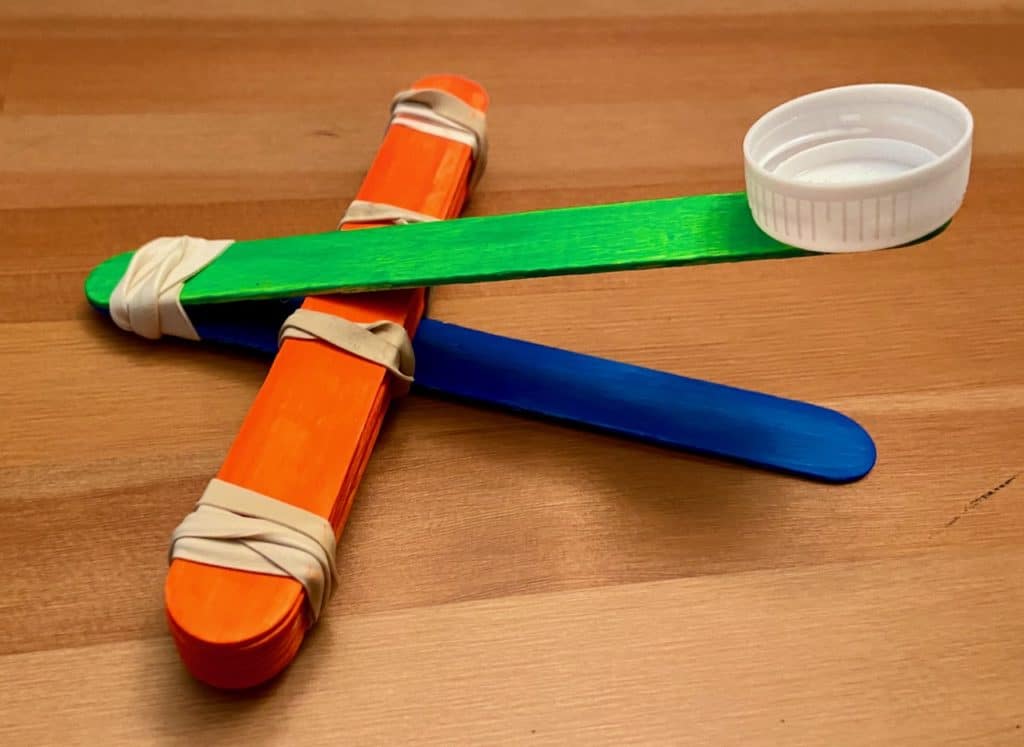
  5. Attach your launching stick (bucket side up) on the other side of the stack, also perpendicular so that is lines up with the bottom stick. Attach the launching stick to the bottom stick using a rubber band. This will create a V-shape.
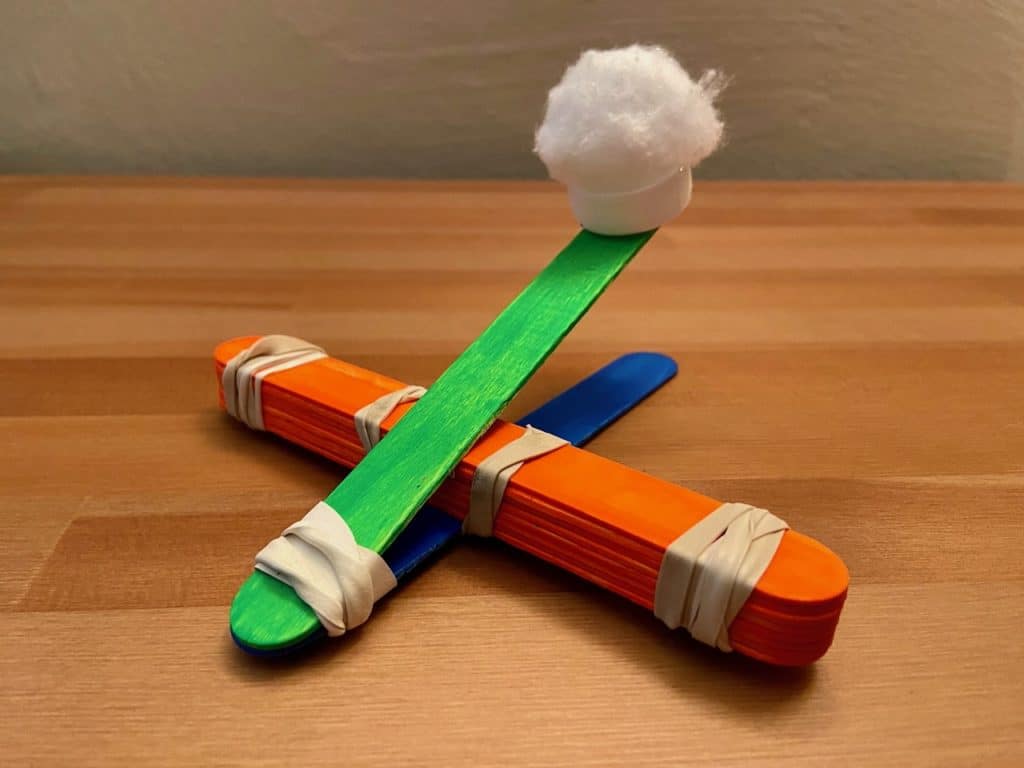
  6. Put your catapult on a flat area in an open space and place a cotton ball in the cup on the launching stick.
  7. Push the cup down a little bit and let go. Try changing up the how far you push the cup down before launching.

Observe:
Does your ball fly higher or lower when you push down a lot compared with when you push down a little? Does it land farther or nearer? Did the flight path change? What else do you observe?

Jane Thaler is a Gallery Experience Presenter in CMNH’s Life Long Learning Department. Museum staff, volunteers, and interns are encouraged to blog about their unique experiences and knowledge gained from working at the museum.

Stacked popsicle sticks attached to base popsicle stick
catapult cap stick attached to stacked popsicle stick perpendicularly
cotton ball in the catapult ready to launch!

Sponsors

Super Science Saturdays are sponsored by PA Cyber and Tender Care Learning Centers, a proud partner of Carnegie Museums of Pittsburgh. PAcyber The Pennsylvania Cyber Charter School LogoTendercare Learning Center logo

Filed Under: Blog Tagged With: Super Science Days, Taking Flight

January 25, 2021 by wpengine

Super Squid! Flying Marvels of the Natural World

Look up in the sky—it’s a bird! No, a plane! It’s…it’s…a squid?!  Most people wouldn’t expect a squid to fly, but truth is sometimes stranger than comic book fiction. The natural world is full of wonderful surprises, including many creatures that seemingly have no business being airborne. They can live in very different habitats, ranging from beneath the ocean waves to high up in the tree tops of a rainforest. Yet all these animals have expertly managed to adapt to their environments and utilize flight as a successful survival tool.

Flying Mammals

Wouldn’t it be a strange world if mice and rats could fly? Besides being a housecat’s worst nightmare, this notion also seems unbelievable. But out in the amazing world of wildlife, this isn’t so far from the truth! Gliding mammals can be found around the globe, from the tiniest of these arboreal aerialists, the Mighty-Mouse-sized Feathertail Glider, which lives in Australia, to the largest, the 16-inch-long Colugo, sailing through the tree tops of the rainforests of South East Asia.

The Southern Flying Squirrel (also called the assapan) measures 10 inches long from nose to tail and covers a wide range of the eastern side of North America. It lives in the deciduous forests that stretch from Southeast Canada to Florida. Their habitat is like that of the Gray Squirrel, but we often don’t see them because they’re nocturnal.

These squirrels are nocturnal, and eat a variety of fruits, nuts, insects, spiders, flowers, and seeds. They’ll also eat bird eggs and gastropods like snails and slugs!

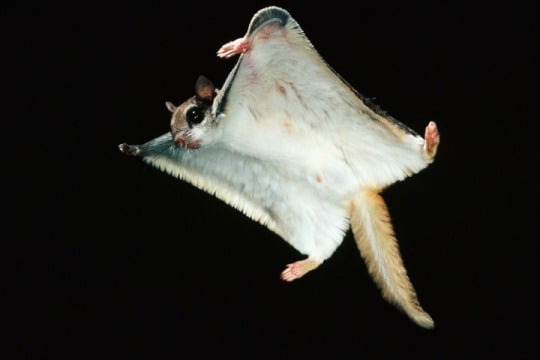
Flying squirrels, like all gliding mammals, has specialized flight gear that enables it to take to the skies. This unique flying tool is called a patagium, which is a stretchy cape of loose skin that starts at their wrists, extends along their body, and attaches at their ankles. To become airborne, they usually like to take a running start from a tree top. But they can also take off from a stationary jumping point by pulling in their limbs and head close to their body. Then, like releasing energy from a coiled spring, they push off and propel into the air. Once they’re in the air, they stretch out their arms and legs to create an “X” shape with their body. This causes their patagium to billow up and stretch into a square shape. This allows them to turn into furry little pilots, expertly maneuvering around obstacles and trees. They can even manage to make last- second, hair-raising 90-degree turns!

When preparing to land, they raise up their flattened tail, which acts like the stabilizer on a kite or airplane. This allows them to adjust their trajectory and hone in on their landing site. By pulling their limbs in front of them, the squirrel’s patagium transforms into a parachute and slows them down when they reach the limb of their choice. Although they’re clumsy walkers because of their patagium, the Southern Flying Squirrel’s ability to glide is an effective adaptation for traveling long distances, and a great tactic for evading predators.

Flying Reptiles

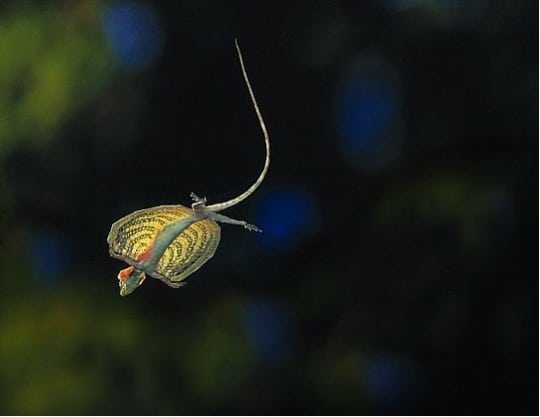
It’s not just mammals that can sail through the wild blue yonder; reptiles have their superhero moments, too. When you think of a flying reptile, the first thing that might come to mind is a menacing winged serpent or dragon out of some mythical Medieval legend. But these captivating creatures don’t just live in the land of fairytales—they inhabit our world, too. The Draco Lizard, also called the Flying Dragon, makes its home in the jungles of Southeast Asia and Southern India. Measuring a mere 8 inches from head to tail, it’s astounding that they can fly through the forest for up to 100 feet! They accomplish this by using folds of skin that rest against their body. When unfurled, this skin acts as wings. This tiny “dragon” can travel quickly from tree to tree using their wings for lift and their long, slender tail for steering. Their airborne expediency is very useful for avoiding danger, finding mates, and tracking down meals.

You wouldn’t think this little lizard could be airborne, but they can glide distances up to 10 times their body length!

Another gliding reptile is the nocturnal Flying Gecko, which lives in the tropical forests of Malaysia, Thailand, and Indonesia. Measuring up to 8 inches, they can fly for up to 200 feet! They have special webbing that surrounds their neck, limbs, feet, trunk, and rudder-like tail. When the gecko stretches itself out, this webbing acts as flaps that create surface area and generate lift.

Lastly, there is one brave reptile that seems to break all the rules of flight and aerodynamics. It’s the flying snake. There are currently five recognized species, and they range from Western India to Indonesia. Scientists are not quite sure why snakes fly. Maybe it’s to escape predators, hunt prey, or quickly move from tree to tree. Whatever their reasons, it is an amazing sight to see. The Paradise Tree Snake of Southeast Asia will slither to the end of a branch, dangle in a J shape, then spring off using the lower half of its body. Then they use the speed of free fall to fly. In midair, it flattens its body into a concave “C” shape to trap air and provide lift. As it glides, it undulates side to side in an “S” shape. This action increases stabilization so that it can cover more horizontal distance. No other gliding animal maintains stability like this. At just 4 feet long, the Paradise Tree Snake can fly for up to 330 feet! It’s quite an achievement for a reptile with no legs or wings.

Flying Sea Life

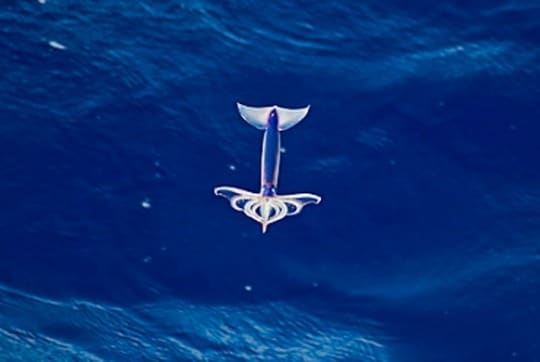
Most people think that dolphins and whales are the only aquatic acrobats of the animal world. But there are many other sea creatures that peek above the ocean waves from time to time. Perhaps you’ve heard of the flying fish. There are 40 known species that inhabit the Atlantic, Pacific, and Indian Oceans. Their streamlined, torpedo-shaped bodies can be as long as 18 inches. They’ll rapidly beat their forked tails to break the water’s surface and propel themselves through the air at 35 miles per hour. Using their unusually large pectoral fins as wings, they can glide for up to 655 feet before re-entering the water. It’s an astonishing feat that seems incomparable, but there has been a recent discovery of another flying marvel of the seas…Super Squid! All joking aside, this mollusk is called a flying squid. Scientists think that there are possibly dozens of species of squid that can fly, some of which are the Neon Flying Squid, the Orangeback Squid, and the Argentine Shortfin Squid.

Although there are several different species of flying squid, they most likely all evolved their mantles and funnels similarly for the most effective speed and aerodynamics when airborne.

A flying squid launches itself out of the water like a rocket by using its mantle and funnel. A mantle is a cloak of soft, muscular tissue that surrounds its body. When the squid contracts its mantle, it sends water shooting through the funnel, a tube below its head. It blasts out of the water like a jet and can travel as far as 100 feet in 3 seconds and fly as high as 10 feet above the water’s surface! It glides by spreading out its fins and flapping. But it also forms wings by spreading out its tentacles in a radial pattern. A membrane between their tentacles enables them to catch air, and this creates lift. Upon re-entry into the water, the squid folds back its fins and dives under the waves. Scientists have observed groups of over twenty squid flying together, and they’ve noticed that the squid don’t just glide passively. They change posture based on their distance from the water and their phase of flight. Scientists also think, more than likely, squids fly as a defense method for predatory escape.

So, the next time you’re outdoors, take a moment to look up into the sky and imagine seeing a snake, a squirrel, a lizard, or a squid sailing high above your head. It’s seems utterly inconceivable, but these amazing animals really do exist. And no, none of them wear a little red cape and have an “S” on their chest. And they’re not able to leap tall buildings in a single bound. But that doesn’t make their gravity-defying feats of flight any less super.

Shelby Wyzykowski is a Gallery Experience Presenter in CMNH’s Life Long Learning Department. Museum staff, volunteers, and interns are encouraged to blog about their unique experiences and knowledge gained from working at the museum.

Related Content

Flying Snakes? Unique Reptile Adaptations

Stuffed Animal Safari: Giraffe

A Hop, Skip, and a Stomp

Sponsors

Super Science Saturdays are sponsored by PA Cyber and Tender Care Learning Centers, a proud partner of Carnegie Museums of Pittsburgh. PAcyber The Pennsylvania Cyber Charter School LogoTendercare Learning Center logo

Filed Under: Blog Tagged With: Super Science, Super Science Days, Taking Flight

  • « Go to Previous Page
  • Page 1
  • Page 2

sidebar

About

  • Mission & Commitments
  • Directors Team
  • Museum History

Get Involved

  • Volunteer
  • Membership
  • Carnegie Discoverers
  • Donate
  • Employment
  • Events

Bring a Group

  • Groups of 10 or More
  • Birthday Parties at the Museum
  • Field Trips

Powdermill

  • Powdermill Nature Reserve
  • Powdermill Field Trips
  • Powdermill Staff
  • Research at Powdermill

More Information

  • Image Permission Requests
  • Science Stories
  • Accessibility
  • Shopping Cart
  • Contact
  • Visitor Policies
One of the Four Carnegie Museums | © Carnegie Institute | Privacy Policy | Terms of Use | Accessibility
Rad works here logo