By Joylette Portlock
Earth Day this year, April 22nd, was the nation’s forty-ninth (though many were calling it the “48th Anniversary”), and my first as Associate Director of Science and Research at Carnegie Museum of Natural History. Even in the short time I’ve been in my role here, this place has afforded me fascinating new ways to think about this very special, extremely wet, rocky ball in space that we, and many millions of other species of mainly surface-and-ocean-dwelling living things call home.
You can’t talk about Earth as a whole without talking about connections. Especially when it comes to the Anthropocene, upon which our museum is newly focused, “connection” is a critically important concept. We often think of our actions and how they affect Earth as though the planet and nature were somehow separable from us, or we from it. Our option, urgent and essential, is to see ourselves as we are: an integrated part of the world around us. Only then can we imagine and build a responsible future. And, to get to that future, one that fulfills the promise of the first Earth Day, we must connect to each other, ask and answer tough questions, spark conversation, learn and work together.
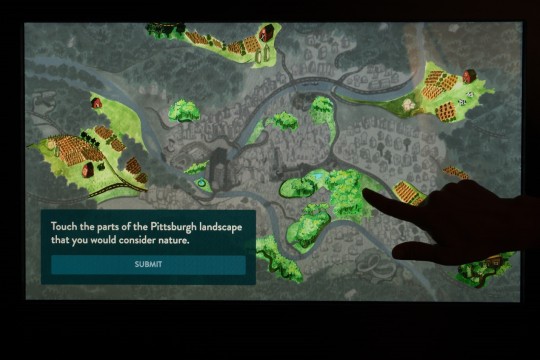
Here, we live in a place with a very strong sense of identity and pride; Steeler Country is also a beautiful region of rivers, trees, and hills. And, it is a place inextricably marked, and in some ways defined, by human manipulation of our resources. It’s possible to see the cultural achievements, the sheer natural beauty, and the presence of expansive industry all at once, see the connections between them, and understand how these things exist, in the same place and at the same time, here and around the world.
It’s true that fossil fuel extraction and use has historically led to economic success in the region. (Fun fact, with apologies to Dippy: coal and natural gas, fossil fuels, generally existed long before the dinosaurs.) However, many of our local wild places still bear the scars from our use of these resources in the form of degraded streams, partitioned forests, poor air quality, changing climate, and shifting, sunken land.
“Connection” also means, of course, understanding connections between Earth systems – connecting our actions to global impact. As but one of many examples shown eloquently in the We Are Nature exhibition, rising temperatures and increasing carbon dioxide in the air from burning fossil fuels (atmosphere) are both absorbed by water, leading to warmer, more acidic oceans (hydrosphere), which in turn leads to marine ecosystem damage and danger to coral reefs (biosphere) – a long way away from Pennsylvania.
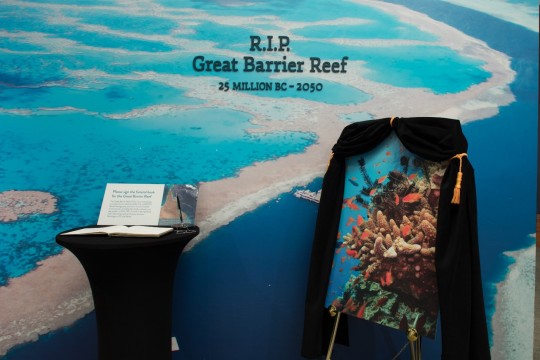
There is much to remain hopeful about, however. These are all stories that are still being written. This Earth Day, I’m remembering that this is a beautiful planet… and it’s the only one we’ve got. The systems that govern it are interconnected, complicated, and in some ways, surprisingly delicate. I’m also remembering that the solutions to many of today’s environmental challenges lie in our thoughtful reevaluation and improvement of all the kinds of connections, starting with the first one I mentioned: exploring, learning, and working together.
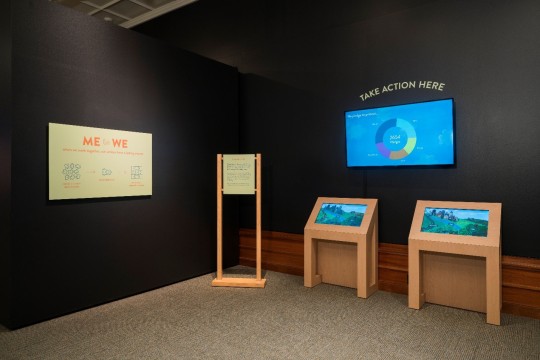
I invite you to both check out We Are Nature before it leaves this fall and stay tuned for what’s next as more work on the Anthropocene at the museum ramps up.
Or, should I say, stay connected.
–Joylette Portlock, Ph.D., is associate director of science and research at Carnegie Museum of Natural History. She is also executive director of Communitopia, a nonprofit focused on climate change communication, and holds many other roles in the community.
