In 2012, a tornado felled trees in four places at Carnegie Museum’s field station, Powdermill Nature Reserve in southwestern Pennsylvania, about 1-hour drive East of Pittsburgh. Each blowdown was 3-6 ha (8-15 acres), within 3 km (2 miles) of each other. These blowdowns provide natural replicates to examine land snail response to habitat change. Given that some snail species are known to occur in forests and others in meadows, we might expect the snail species composition to shift when the wind turns part of a forest into a meadow.
Samples taken in 2016 showed differences in snail species community composition between the blowdown areas and the adjacent, intact forest. However, other statistical tests did not show differences that were significant, but they were nearly significant.
A good scientist should readily accept “no difference” when statistical results show that the differences are not significant. However, when the differences are tantalizingly close to significant, one might wonder whether “no difference” is real, or if a larger sample size might have demonstrated a significant difference.
So, we sampled again this year and took more samples. We are still processing the samples, so results are not in yet, but with the larger sample size, we will accept “no difference” if that is what the statistics tell us.
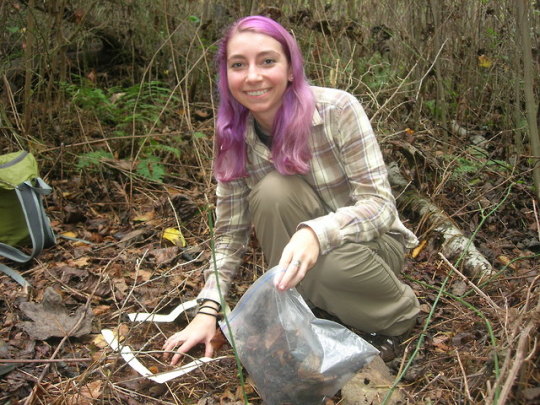
In the photo, Abbey is collecting leaf litter (containing snails) at the Laurel Run blowdown. The sample she collected contained 23 snails, of five species: Glyphyalinia indentata, Punctum minutissimum, Striatura ferrea, Striatura milium, and Zonitoides arboreus.
Timothy A. Pearce, PhD, is the Head of the Section of Mollusks and Abbey Hines is a Gallery Experience Presenter at Carnegie Museum of Natural History. Museum employees are encouraged to blog about their unique experiences and knowledge gained from working at the museum.
