by Stephen Rogers
November is the month best known for the holiday celebrated on the fourth Thursday of the month, Thanksgiving, which revolves around one of the classiest of birds in Pennsylvania, the Wild Turkey. Most people are familiar with the local, reasonably tame, birds that roam around Pittsburgh, but few know the history of this noble bird. By the early 1900s habitat loss and over-hunting had left the species in dire shape. Wild turkeys disappeared at one point from Ohio, New York, as well as 16 other states of its original range. The Pennsylvania Game Commission (PGC) can be credited with bringing back the species in the state. The birds became more common field and forest scenery beginning in the mid-1980’s as the agency abandoned a turkey farm that produced captive-bred birds for stocking, and focused restorations efforts on trapping wild turkeys from the areas with sustainable populations, notably northcentral PA and the mountainous areas of Somerset and Westmoreland counties, and re-locating them to areas with suitable habitat. The PGC continues to set the hunting seasons within the state, expanding or restricting both the time periods and locations for hunting to maintain a healthy wild turkey population.
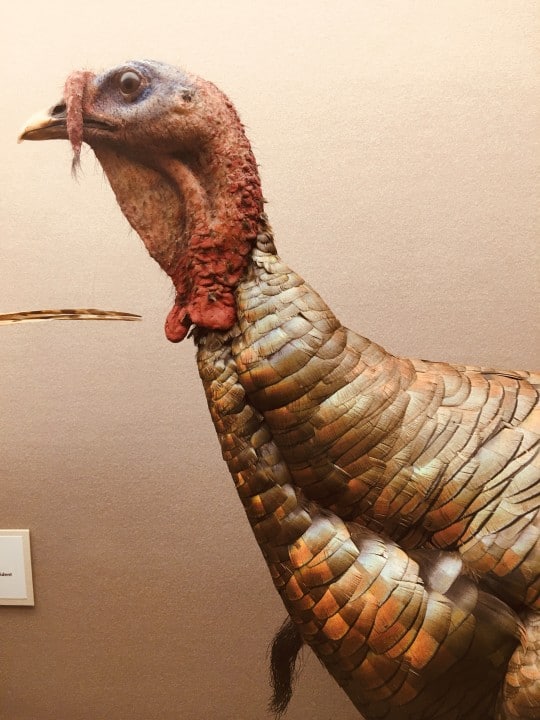
Carnegie Museum of Natural History has wild turkey egg sets, skeletons, study skins, taxidermy mounts, and some fluid-preserved specimens from eight states as well as a couple from the failed PGC turkey farm. I was raised in northcentral PA and have contributed two turkey specimens to the collection over my years of working for the museum. One of these, a preserved fluid head, had the distinction of being dissected to study its brain by an ornithologist at the Smithsonian Institution who worked with a CMNH curator, Brad Livezey. They studied higher-level phylogeny and their publication can be seen here.
In recent years the PGC has brought back turkey hunting for two days around Thanksgiving throughout that state as an addition to regional seasons that vary depending on population levels. Because we are encouraged to blog, I thought I would relate a Thanksgiving Turkey tale here.
Among my most memorable Thanksgivings was the holiday 49 years ago, in 1971, when our family had the family of my mother’s twin sister over for dinner. Hunting was what occupied most of my waking thoughts in those days, but my hunting partner, my dad, had to work that morning and it became my task to take my Uncle John and cousin Ronnie out in four inches of new snow that had fallen the day before. My aunt, who was undergoing breast cancer treatment, wanted to spend time with her twin to celebrate perhaps their last holiday together. For these sisters and their daughters, getting the “menfolk” out of the way seemed to be the best way to create the proper atmosphere.
I had never hunted with Uncle John or Ronnie before, but I knew where to find a turkey flock. After a mile-long hike we busted up a flock and John promptly missed one of the scattering big birds. At this point we split up, hoping to run into lone turkeys as they tried to regroup. I headed in the direction of some of the fleeing birds to use a turkey call, while John and Ronnie sat amid the large laurel thicket we had rousted the flock from.
After a period of time, Uncle John had to do what bears are notoriously known for doing in the woods. An experienced hunter would always keep his shotgun handy anywhere while hunting, but John leaned his gun against a tree and went a few feet away to do his business. Of course, out came a few turkeys into a clearing just yards away from him, looking at him with apparent wonder at what he was doing with his pants down.
We never got a turkey that day, but among the many Thanksgivings I have experienced it was the most memorable. As we all ate turkey around the ping-pong table in the basement that evening, Uncle John took his ribbing with great humility, and the banter took my aunt’s thoughts away from the cancer which was late stage at that time.
As we commemorated Breast Cancer Awareness last month, it should be on everyone’s mind that mammograms should still be done in this era of COVID.
I hope to take my gun out for a walk this Thanksgiving, but I imagine the turkeys will socially distance from me. Shooting a bird isn’t the end all of a hunt, it’s the memories we make afield.
For more history on the wild turkey see:
History of the Wild Turkey in North America
Stephen Rogers is Collection Manager in the Section of Birds at Carnegie Museum of Natural History. Museum employees are encouraged to blog about their unique experiences and knowledge gained from working at the museum.
Related Content
Ravens and Crows, What’s the Difference?
Powerlifting Poultry and Mallards That Marathon
Carnegie Museum of Natural History Blog Citation Information
Blog author: Rogers, StephenPublication date: November 3, 2020
