By John Wible
Noolbenger is the Aboriginal name for the honey possum. So, what is a honey possum? A honey possum, Tarsipes rostratus, is a mouse sized marsupial found in the coastal plains of southwestern Australia. It can only survive in environments where flowers bloom 12 months of the year, because it lives entirely on nectar! They are particularly fond of Banksiaor Australian honeysuckle and are important pollinators. Some bats are also exclusively nectivorous, but their mode of locomotion (i.e., flight) allows them to have large home ranges for feeding. The honey possum accomplishes this entirely on foot at night, scampering from plant to plant. Not surprisingly, it is an adept climber with a prehensile tail acting as a fifth limb. A protrusible tongue with a keratinized brush tip is the main nectar collecting organ. Bucking the usual trend in mammals where males are larger than females, the male honey possum is roughly two-thirds the size of the female.
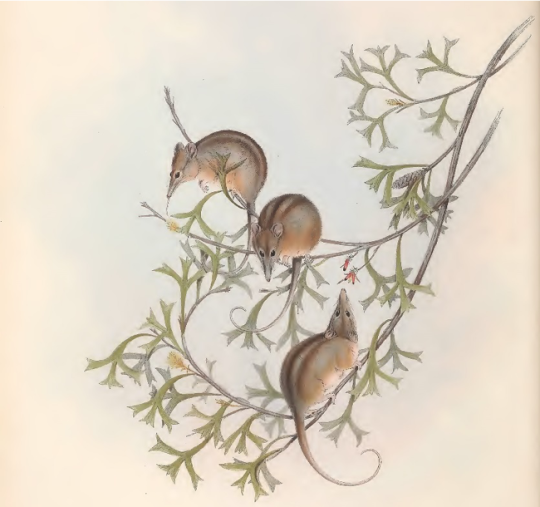
From John Gould’s The Mammals of Australia (1863).
The Section of Mammals of Carnegie Museum of Natural History has eight specimens of this unusual mammal, which has a very un-mammal-like skull. The bones of the skull are paper thin, reminiscent of a hummingbird skull. It has a long and pointy snout, the better to sniff flowers with. The lower jaw is essentially a thin rod. The upper and lower teeth are reduced in number and size and resemble simple translucent pegs, because you don’t need big complex teeth to grind nectar for digestion. And there is essentially no place on the skull for chewing muscle attachment, again because chewing is not mandatory for feeding.
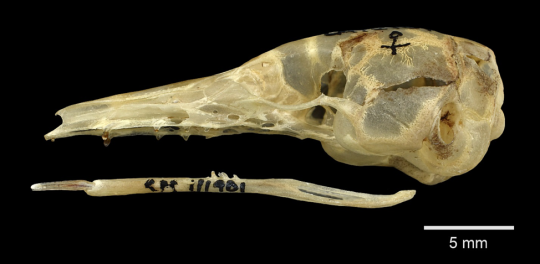
Tarsipes rostratus, CM 111901.
Honey possums are not considered to be endangered or even threatened. So far, the major concern to their continued existence is wildfires.
John Wible, PhD, is the curator of the Section of Mammals at Carnegie Museum of Natural History. John’s research is focused on the tree of life of mammals, understanding the evolutionary relationships between living and extinct taxa, and how the mammalian fauna on Earth got to be the way it is today. He uses his expertise on the anatomy of living mammals to reconstruct the lifeways of extinct mammals. John lives with his wife and two sons in a house full of cats and rabbits in Ross Township. Museum employees are encouraged to blog about their unique experiences and knowledge gained from working at the museum.
