by John Wible
Once discovered, every organism on Earth ends up with a formal scientific name in addition to an informal common name. Sometimes those informal common names are used for more than one organism, such as squirrel or fox. That is why scientists give different squirrels and foxes formal scientific names so that the animals can be distinguished.
The scientific name, usually Latin or Greek derived, may tell us something. For example, Tyrannosaurus
rex is Greek for ‘terrible lizard’ and Latin for ‘king.’ Common names are embedded in cultural traditions, have long histories, and may be downright confusing. Bat is one of my favorite examples. How did a flying mammal get to be called a bat? Isn’t a bat a piece of sports equipment in baseball and cricket? The Germans have a much better common name, Fliedermaus, which translates to ‘flying mouse.’
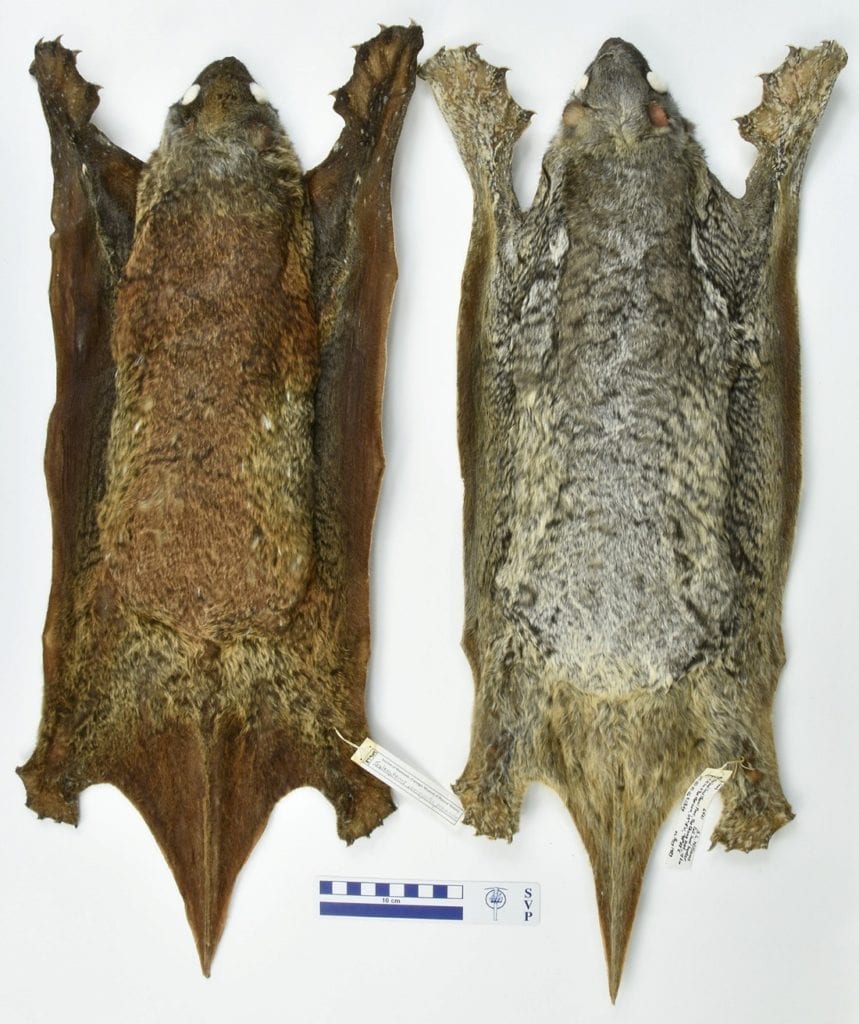
The cat-sized mammals pictured here are colorfully distinct male (left) and female (right) of the same species, with a scientific name of Galeopterus variegatus and with a very misleading common name … flying lemur. First, it does not fly! Instead, it glides, using its wing membrane to parachute between trees. Second, it is not a lemur! Lemurs are primates from Madagascar. Galeopterus variegatus is from Southeast Asia and is one of two species in the smallest mammalian order, Dermoptera, itself a very cool name that means ‘skin-wing’ in Greek. Luckily, the flying lemur has another common name, colugo, which doesn’t mean anything to me, although it may be a piece of sports equipment somewhere else.
John Wible, Ph.D. is Curator of Mammals. He studies the evolutionary history of mammals and lives in a house full of them, some human (wife and two sons) and some non-human (cats, rabbits, and guinea pigs).
