By Will Vincett
As a research volunteer in the Section of Invertebrate Paleontology, I am interested in learning about the evolution of life and the diversity of the fossil record. Invertebrate Paleontology collections are very thorough and document a wide range of taxa over the last 600 million years of geologic time. My assignment is to investigate the famous Hunsrück Slate fossil collection from Bundenbach, a village in the Rhine valley of southwestern Germany.
The Hunsrück Slate of Germany is a 390 million-year-old metamorphosed black shale from the early Devonian Period known for its exceptional fossil preservation called Lagerstätten. A Lagerstätten is a fossil unit where fossils are preserved remarkably well. The Hunsrück Slate is the same age as the Marcellus Shale in Pennsylvania. Roman structures used slate as a roof material, but it is unknown if Romans used the Hunsrück Slate specifically. The earliest evidence of Hunsrück Slate mining is from the year 1300 CE, but during the 18th-20thcenturies the mining of the Hunsrück Slate became a successful business. The slate was used for domestic roofing and for export to other European countries. Most German quarries are now closed due to economic reasons, as cheaper slate mines from Portugal and Spain, as well as alternative synthetic roofing products, are available.
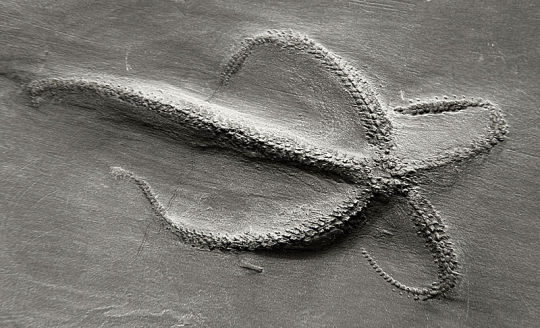
Geologically, the Hunsrück Slate sediments were sourced from an eroding Devonian age landmass called the Old Red Sandstone Continent centered in Great Britain and northwestern Europe. These sediments were carried by rivers into a relatively shallow ocean called the Lizard-Giessen-Harz/Rheno-Hercynian Ocean. Not all fossil found in the Hunsrück Slate are complete specimens-in fact most are broken fossil pieces. One theory for the great preservation of certain Hunsrück Slate fossils is that underwater landslides caused great sediment plumes that quickly buried the organisms. Only some of the animals that lived in the ocean were buried, likely the ones that were stationary or couldn’t free themselves before they died.
The Hunsrück fossils are especially significant because they preserve some of the soft parts of the organisms as well as the hard parts giving paleontologists a window into the animal’s body architecture. The micro-bacteria that lived within the seawater would digest the calcium carbonate in the absence of oxygen, converting the shell into pyrite, or FeS2. This left a golden color of bright yellow like ‘fool’s gold’ that stands out against the black color of the slate.
There are thirty-six Hunsrück invertebrates in the Carnegie Museum of Natural History collection that are assigned to eleven echinoderm genera, Furcaster, Eospondylus, Ophiurina, Loriolaster, Euzonosoma, Taeniaster, Meduaster, Urasterella, Helianthaster, Palaeosolaster, and Encrinaster, and five crinoid genera, Poteriocrinites, Imitatocrinus, Calycanthocrinus, Codiacrinus, and Parisangulocrinus. In addition, there are two corals specimens assigned to the genus ‘Zaphrentis.’
Will Vincett is a Research Volunteer in the Section of Invertebrate Paleontology. Museum employees are encouraged to blog about their unique experiences and knowledge gained from working at the museum.
