Fancy yourself on the hottest day in summer in the hottest spot of such a place without water — without an animal and scarce an insect astir — without a single flower to speak pleasant things to you and you will have some idea of the utter loneliness of the Bad Lands.” Thaddeus Culbertson, 1850
When Lucien Stilwell stepped off the stagecoach on September 25, 1879, he was not your typical visitor to Deadwood. Photos of Stilwell in later years show a thin scholarly figure with glasses. In 1879, Deadwood, Dakota Territories was known for gold prospecting, gambling and lawlessness. Just three years prior, Wild Bill Hickock had been shot in the back while playing poker here. It would be a few more years until Seth Bullock, first sheriff of Deadwood, would begin to bring order to town.
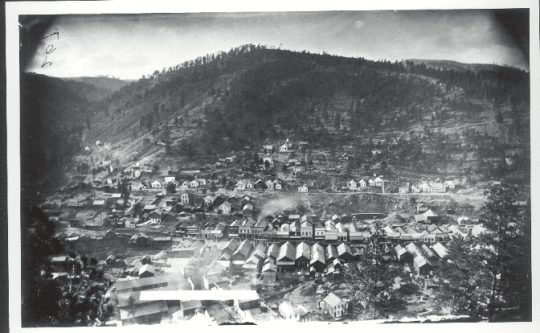
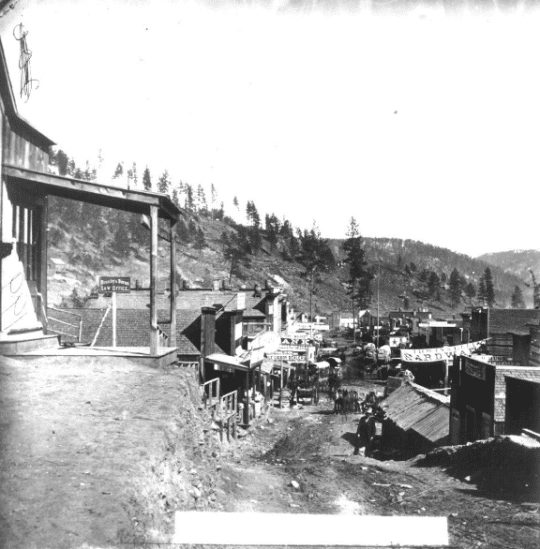
As Stilwell stepped off the stagecoach, he was leaving a fifteen-year career in the grocery and grain business in Cairo, Illinois. A yellow fever epidemic blanketing parts of the United Sates prompted him to uproot his life. He arrived just one day before a fire destroyed over 300 buildings and displaced over 2000 people in Deadwood. According to Michael Runge, City Archivist of Deadwood South Dakota, photos of Deadwood in 1879 (Figures 1 and 2), were taken just before the great fire. If you look closely at Figure 2, you can see a law office, hardware store, liquor store, and city market.
Despite the great fire and the dangers of Deadwood, Lucien W. Stilwell found a job at a bank, brought his family to town and built a home. Along the way, he became fascinated by the fossils in the surrounding Black Hills. He began a careful study of the region and developed relationships with other fossil collectors. Eventually, he turned his hobby into a side business.
Prior to leaving the bank in 1890, Stilwell began selling Badland fossils and minerals. In a correspondence to the Baron de Bayet of Brussels dated January 12, 1889, Stilwell said, “I tried to catch your meaning in your last letter. As I understand it, you wanted one of every specie and variety of fossils I had, excepting the large and costly specimens of mammals.”
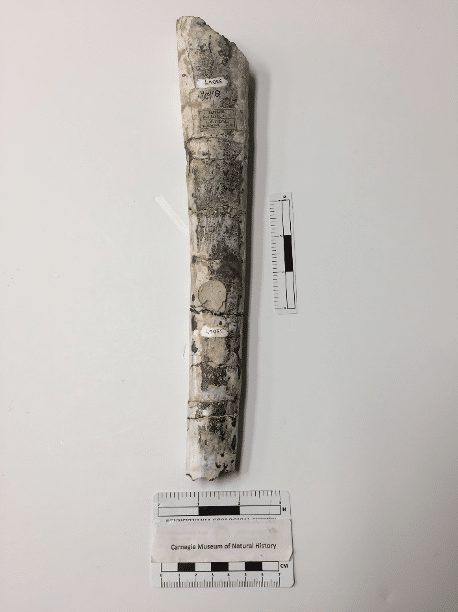
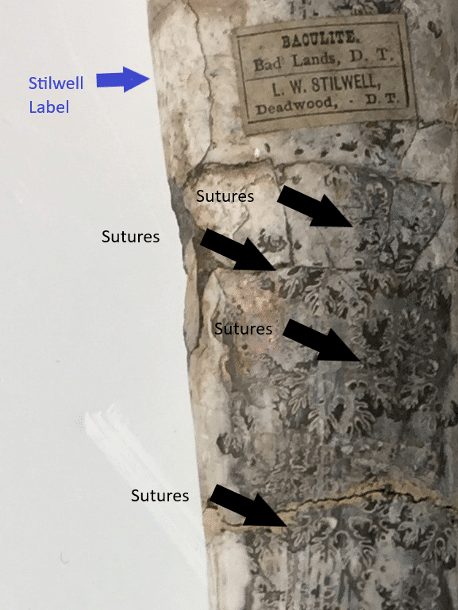
In one letter to Bayet, Stilwell wrote, “I put in a number of baculites, all of which have some different interest. One is to show fine sutures another to show iridescence to rare degree, another to show size, another to show form so differing as to be a specie of baculite by another name…” Albert Kollar of the Section of Invertebrate Paleontology explained that in circumstances when the exact stratigraphic locality is questionable, having the original fossil labels as seen in Fig. 4 are critical to accurate fossil identification. Stillwell was a capable researcher because of his grasp of the geology and paleontology of the Badlands region. Figures 3 and 4 show a baculites sold by Stilwell to Bayet. There are 100 Stilwell fossils in the 130,000 specimen Bayet collection.
The next post in this series will explore why dealers such as Lucien W. Stilwell, found so many fossils in the Badlands.
Many thanks to the generous assistance of Michael Runge, Archivist for the City of Deadwood, South Dakota.
Joann Wilson is an Interpreter for the Department of Education and a volunteer with the Section of Invertebrate Paleontology. Albert Kollar is Collections Manager for the Section of Invertebrate Paleontology. Museum employees are encouraged to blog about their unique experiences and knowledge gained from working at the museum.
