With a collection of over 13.5 million specimens, some could say that the Section of Invertebrate Zoology “loves” bugs. We’ve amassed an enormous volume of arthropods (including bugs) in all shapes, sizes, varieties, forms, variants, and life cycles. We’ve preserved them to the best of our abilities, away from many of the activities and threats that would do them harm. However, one not-so-loved bug in our section is the dermestid beetle, a pest that threatens many museum collections worldwide.
In the taxonomic order Coleoptera, the beetle family Dermestidae is a group of about 500-700 species from all over the world and are sometimes known colloquially as “Carpet Beetles.” This holometabolous group has an especially destructive larval stage, feeding on dead animal or plant matter. An infestation of these beetles can easily wipe out a small collection, so to preserve the integrity of our collection, we are ever vigilant in our efforts to prevent this irksome critter.
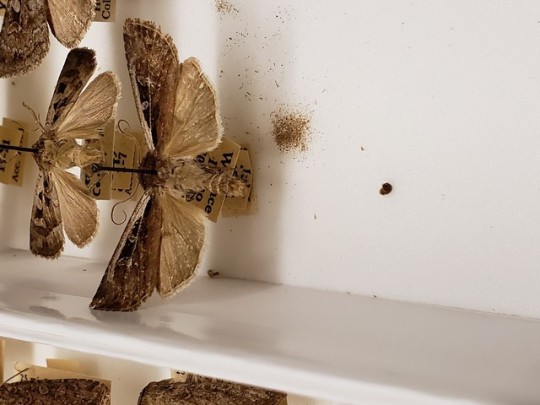
Dermestid beetles are relatively small, sometimes measuring just a few millimeters at their largest. Spotting them can be difficult; often, they’re only detected after damage has already occurred. Figure 1 shows their frass, a light brown/tan powdery substance left over from a feeding session. Other dermestid signs are their exuvial skins, shown in Figure 2. These are left behind when a larvae molts, typically growing larger each time (although some species in the genus Trogoderma have been known to molt backwards, growing smaller each time, if food is scarce).

While the dermestid beetle is certainly a resilient insect, there are a few ways to eliminate it; through severe cold or complete desiccation (i.e., 0% humidity). My predecessor used to freeze at-risk portions of our Holland Room in chest freezers, which reach only about -8°F. Up until last year, the most feasible option for our collection was to spot check and freeze at-risk areas, as well as freeze all specimens coming into the building, no matter the source.
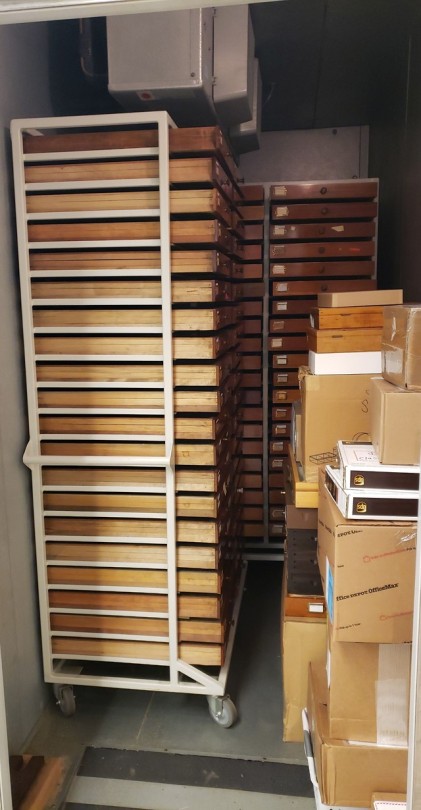
In April of 2018, the IZ staff began an extensive integrated pest management protocol involving the freezing of the entire pinned insect collection. This was the first time the section has attempted to methodically freeze all of its various parts and pieces. This massive undertaking took over 17 months to complete, and hundreds of hours of staff time, as we shuffled roughly 30,000 drawers in and out of our walk-in freezers.

Beginning in the Holland Room, we systematically placed drawers onto freezer carts, shown in Figures 3 and 4. These metal carts can house 40 drawers per cart, one per slot. We arranged these carts to fit in our walk-in Kolpak freezers (a size akin to something like a restaurant meat freezer). These freezers reach down to -16°F, and live dermestid beetles in a drawer will perish at that temperature. Once freezing is complete, dermestized drawers are cleaned prior to returning them to their place in the collection. We froze cyclically every Monday, Wednesday, and Friday, leaving drawers in the freezer for 2–3 days. After removing carts from the freezer, the drawers were thawed to prevent the introduction of moisture, which may damage the specimens, and they were put back into the collection in the same order they were initially retrieved. Maintaining drawer order is especially important in curated sections of the collection, as one proceeding drawer may contain specimens from the same group as the next, and so forth.
Although our protocol may seem straightforward, with all the different methods of storage in our section (See my blog on different Drawer Types housed here in IZ), freezing from one session to the next could entail a multitude of different drawer types, heights, and sizes. At our most productive, we froze 5 freezer carts at a time, moving 400 drawers per freeze day (200 in, 200 out). We concluded the freezing earlier this year on 13 September 2019, and we anticipate the next time we’ll start a complete freezing of the collection again will be in January 2021.
Catherine Giles is the Curatorial Assistant of Invertebrate Zoology at the Carnegie Museum of Natural History. Museum employees are encouraged to blog about their unique experiences working at the museum.
Related Content
Risk Assessment, or How to Keep Your Collection Intact
Reptiles and Amphibians and Bones? Oh My!
Do No Harm: Dealing with Spotted Lanternflies
Carnegie Museum of Natural History Blog Citation Information
Blog author: Giles, CatherinePublication date: November 4, 2019
