• Skip to primary navigation
  • Skip to main content
  • Skip to primary sidebar

Carnegie Museum of Natural History

One of the Four Carnegie Museums of Pittsburgh

  • Visit
    • Buy Tickets
    • Visitor Information
    • Exhibitions
    • Events
    • Dining at the Museum
    • Celebrate at the Museum
    • Powdermill Nature Reserve
    • Event Venue Rental
  • Learn
    • Field Trips
    • Educator Information
    • Programs at the Museum
    • Bring the Museum to You
    • Guided Programs FAQ
    • Programs Online
    • Climate and Rural Systems Partnership
  • Research
    • Scientific Sections
    • Science Stories
    • Science Videos
    • Senior Science & Research Staff
    • Museum Library
    • Science Seminars
    • Scientific Publications
    • Specimen and Artifact Identification
  • About
    • Mission & Commitments
    • Directors Team
    • Museum History
  • Tickets
  • Give
  • Shop

December 15, 2023 by

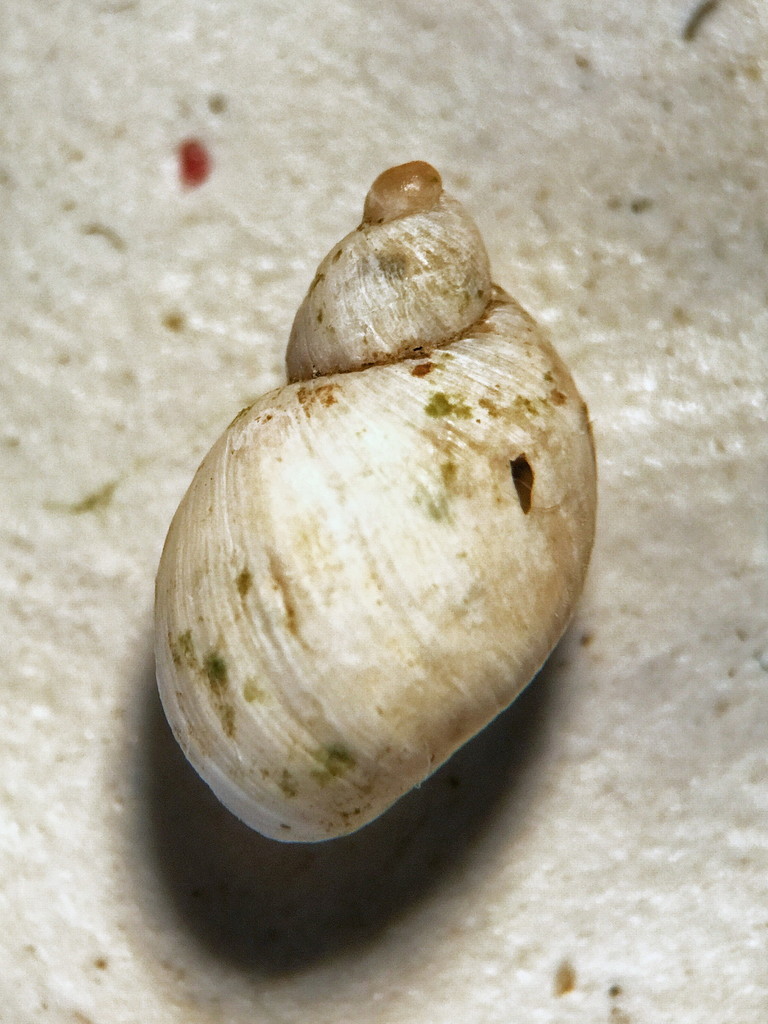
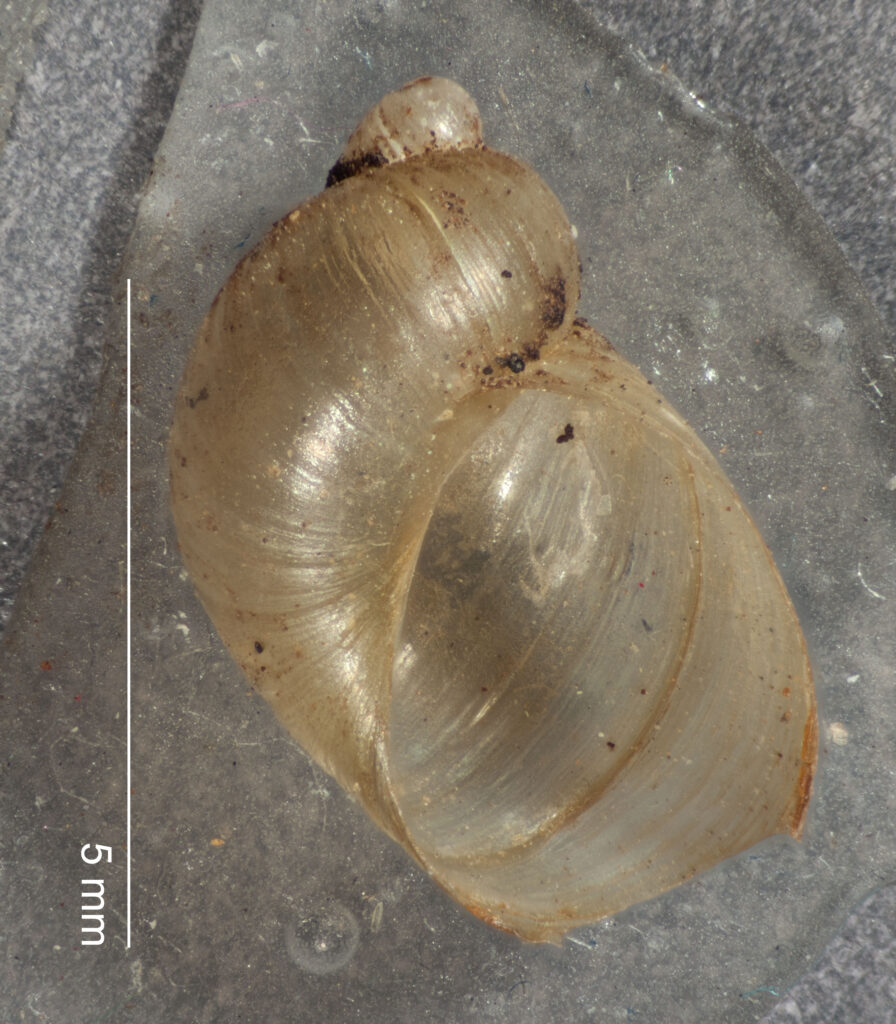
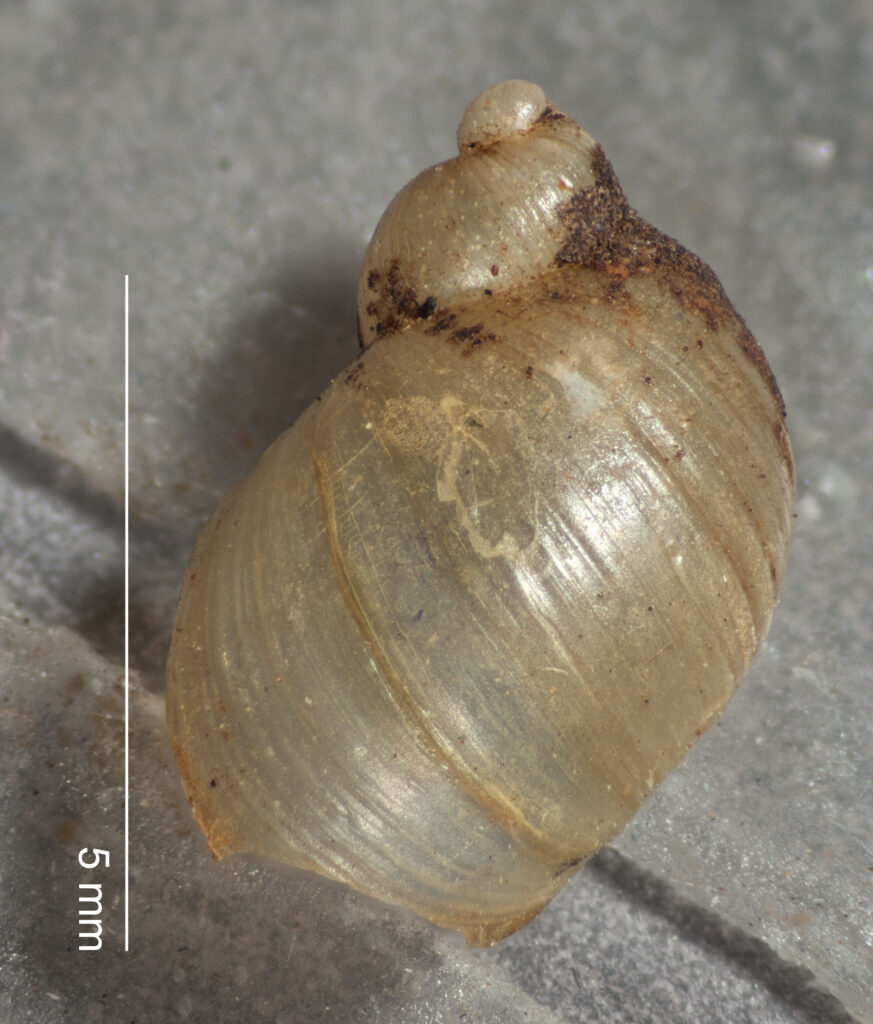
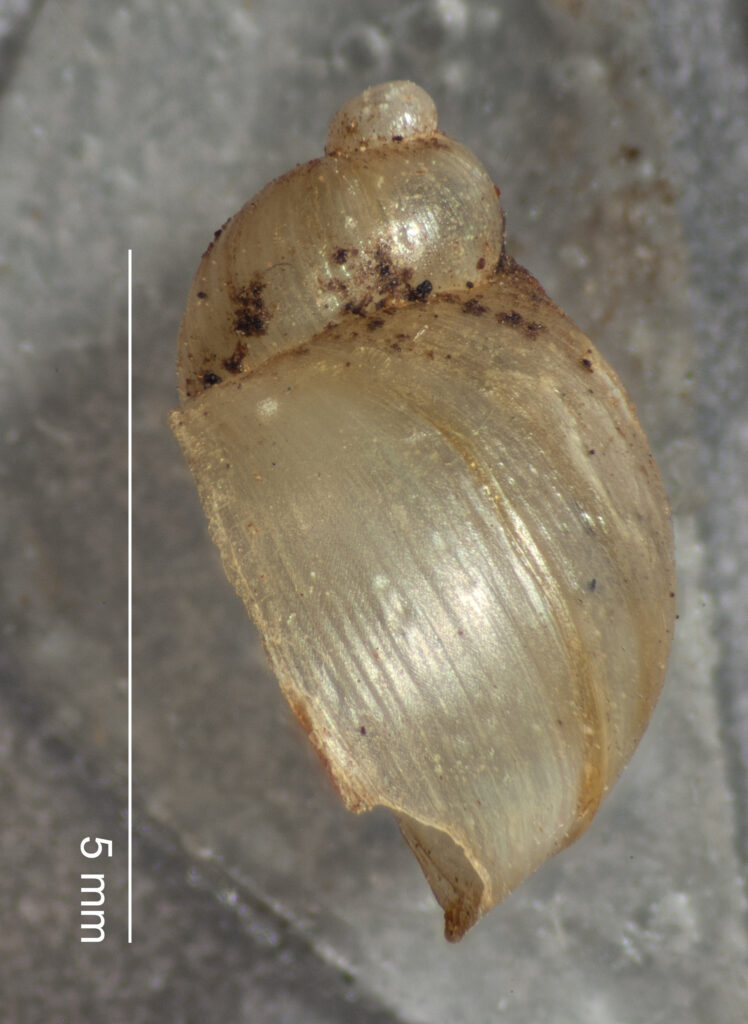
Mediappendix vermeta

  • Field Museum of Natural History
  • CC BY-NC 3.0 DEED
  • Field Museum Copyright Information
  • For additional information about this specimen, please contact: Rüdiger Bieler, Curator (rbieler@fieldmuseum.org)

Family: Succineidae

Common name: Suboval Ambersnail

Discovery: Say, 1829

Identification

Width: 4.0-6.8 mm
Height: 7-11 mm
Whorls: 3+

This is the smallest member of the Succineidae in the state. Its pale shell has dramatically convex whorls, deep sutures, and a shorter aperture relative to the rest of its shell. Shells often appear dull gray as they are frequently coated with mud.

Ecology

A denizen of lowland streams and wetlands, Mediappendix vermeta is sometimes found in numbers upon soaked logs, in damp seasonal channels, old beaver ponds, wet meadows, or along the margins of ponds and swamps. It can be found in both shady and sunlit microhabitats (Hubricht, 1985).

Taxonomy

Synonyms for Mediappendix vermeta include Catinella avara, Succinea avara, S. a. Say forma alba, S. a. var. compacta, S. a. var. major, S. illinoisensis, S. poeyensis, S. venusta, S. vermeta, and S. wardiana.

Distribution

Mediappendix vermeta is widespread across the lower 48 continental United States and southern Canada, reaching west to British Columbia and California, east to Nova Scotia, and south to Texas and Florida. In Virginia this animal is found mainly in the western mountains and Coastal Plain.

Conservation

NatureServe Global Rank: G5, Secure.
December 15, 2023 by

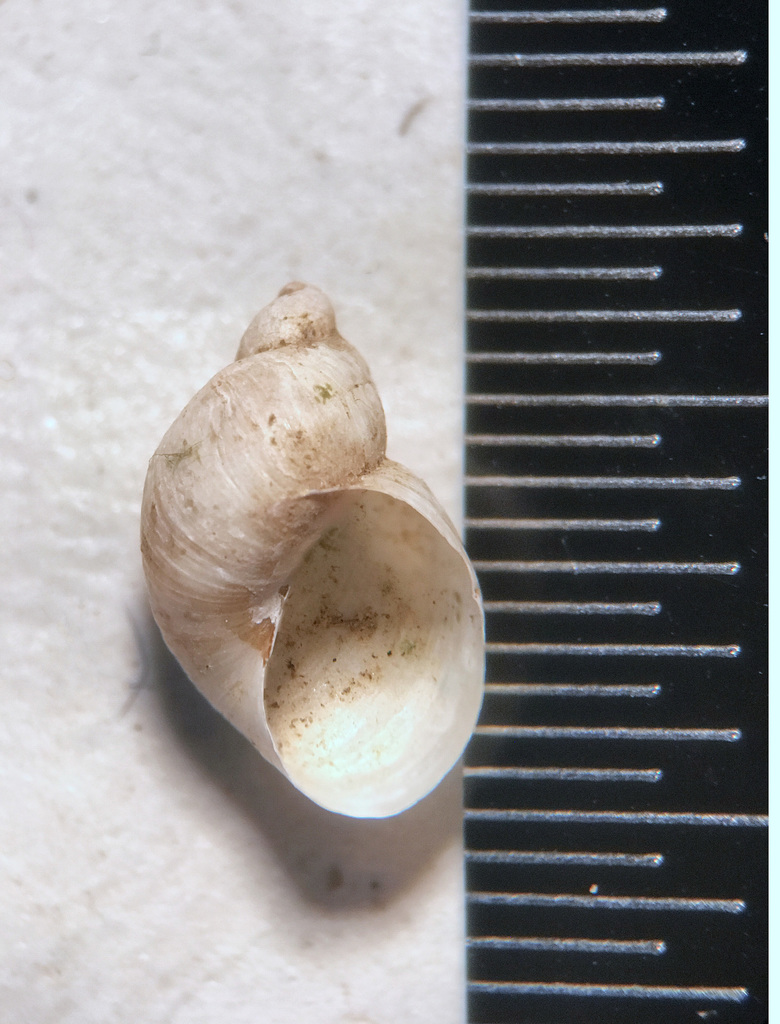
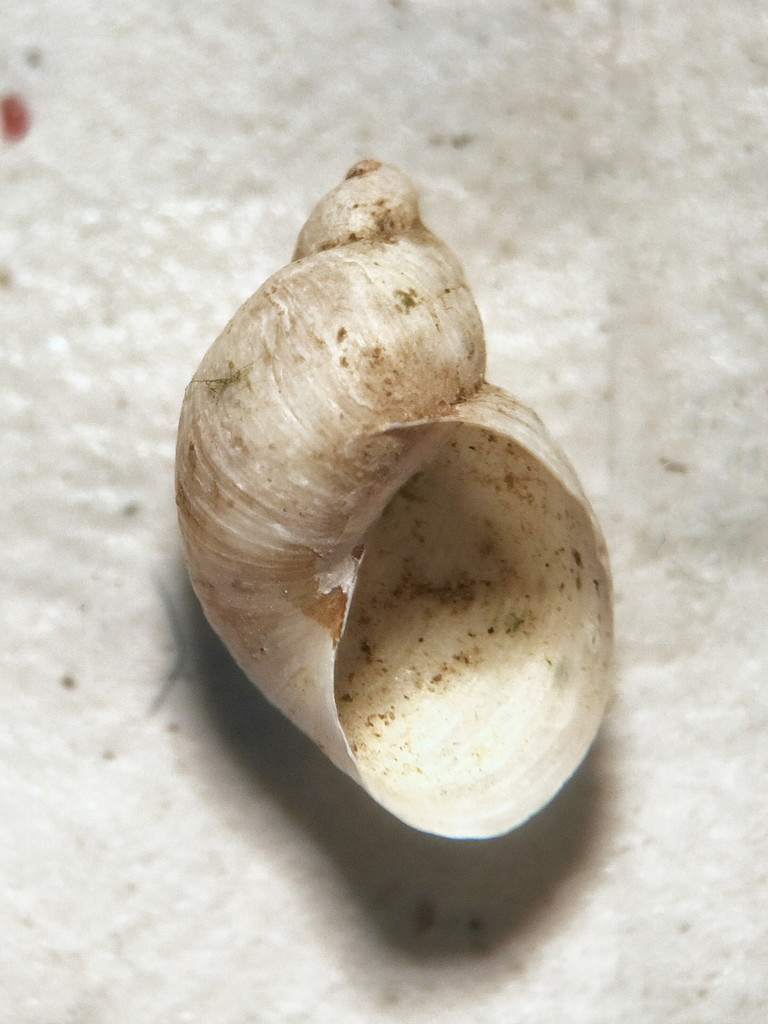
Mediappendix vagans

Family: Succineidae

Common name: Mudbank Ambersnail

Discovery: Pilsbry, 1900

Identification

Width: 5-6.4 mm
Height: 7.6-10.8 mm
Whorls: 2-3

Mediappendix vagans has an elongate, inflated shell that is translucent amber and has a very large, ovate aperture. The aperture is most of the fragile shell’s length, and the shell’s first (nuclear) whorl is quite low. The snail’s body markings consist of dark speckles or bands on a cream-colored background (Pilsbry, 1948; Franzen, 1981).

Ecology

This snail is found on damp soil or mud, sometimes among litter, at the edge of freshwater ponds (Franzen, 1981).

Taxonomy

Taxonomy of succineid snails is problematic, with many described species and forms that are not easily distinguished. A variety of this species in North Carolina recognized by Pilsbry (1948) was later described as Catinella waccamawensis Franzen, 1981. Hubricht (1985) treated this species as part of M. oklahomarum.

Distribution

The distribution of Mediappendix vagans is very poorly known – previously it has been reported at Cape May, New Jersey (the type locality), and widely in Kansas (Leonard, 1959). In Virginia, putative specimens of M. vagans have been collected only at Yorktown.

Conservation

NatureServe Global Rank: G3, Vulnerable.
NatureServe State Rank: New Jersey, S1S3; not listed in Delaware or Virginia.

December 15, 2023 by

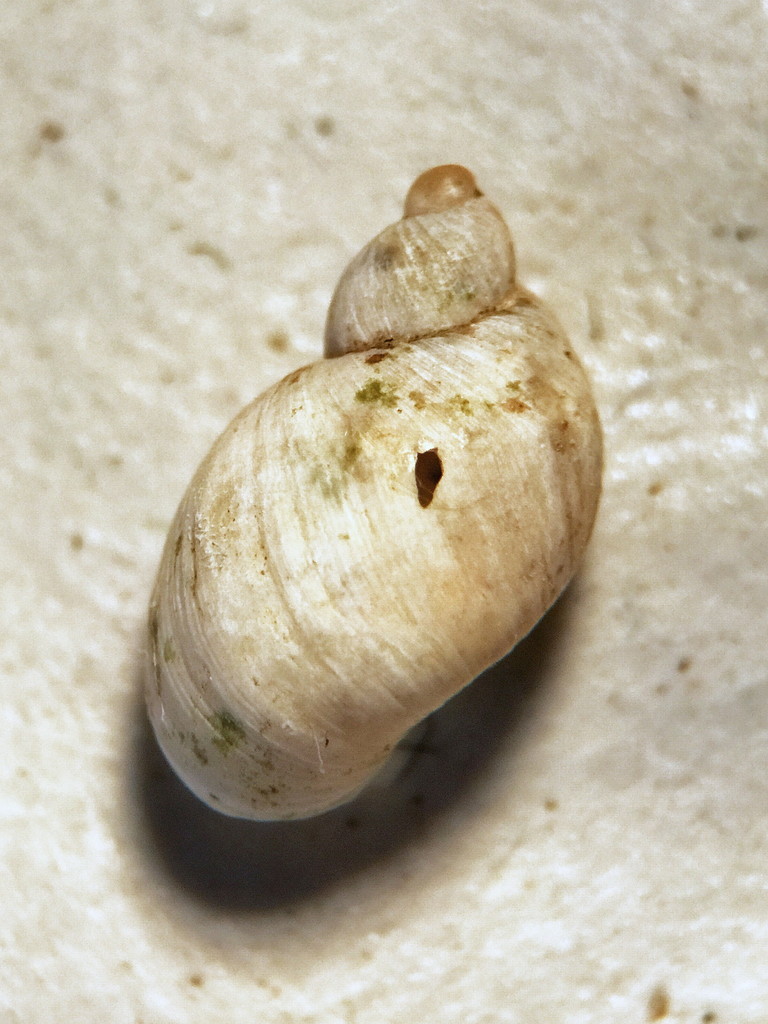
Mediappendix oklahomarum

Image Usage Information

  • David Lang
  • CC BY-NC 4.0 DEED
  • Additional information about this specimen

Family: Succineidae

Common name: Detritus Ambersnail

Discovery: Webb, 1953

Identification

Width: 4-5 mm
Height: 6-8 mm
Whorls: 2.75+

Mediappendix oklahomarum has a yellowish, somewhat translucent shell with a wide aperture and deep sutures. It is proportionally longer than the shell of M hubrichti, and marked with uneven growth lines. The shell is wider than that of M. vermeta, with a proportionally shorter spire and longer aperture (Grimm, 1960).

Ecology

This snail prefers to live in small numbers under leaf litter on acid soil. It is a denizen of open pine woods near the east coast. It can also be found sparsely in hilly forests further inland (Hubricht, 1985) and is associated with greenbriar, honeysuckle, and prickly pear (Grimm, 1960).

Taxonomy

Mediappendix oklahomarum has also been known as Mediappendix pinicola, M. vagans, and Quickella oklahomarum.

Distribution

Mediappendix oklahomarum is apparently widespread in the southeastern United States, with the caution that succineid taxonomy is not well-understood. It ranges from Oklahoma in the west to Maryland in the northeast and Florida in the southeast. In Virginia it is reported from the eastern shore of the Chesapeake Bay and scattered western counties.

Conservation

NatureServe Global Rank: G5, Secure.
December 15, 2023 by

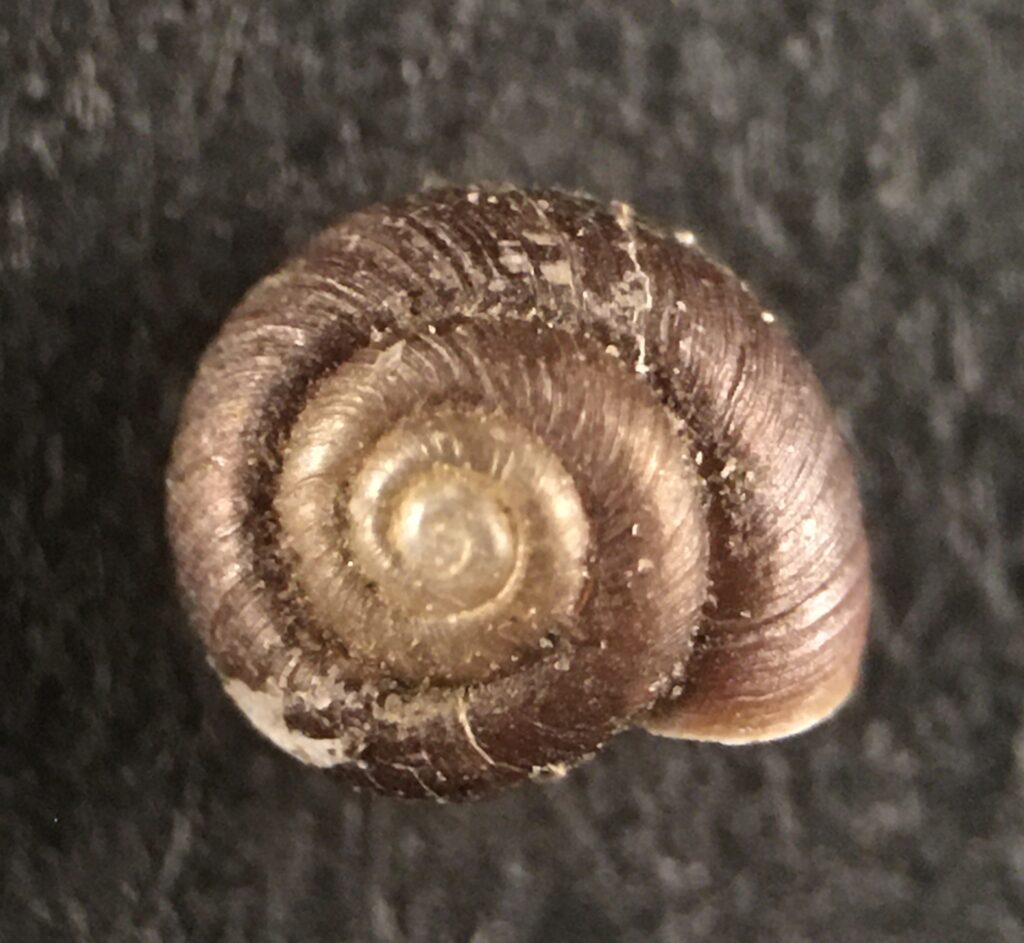
Mediappendix hubrichti

Family: Succineidae

Common name: Snowhill Ambersnail

Discovery: Grimm, 1960

Identification

Width: 4.5-5.6 mm
Height: 6.5-9.0 mm
Whorls: 2.5+

Mediappendix hubrichti has a translucent, greenish-yellow shell that is glossy and smooth, with a low, sharp spire. The aperture is expanded at the base. The animal has a yellowish body speckled with gray. The skin has minute flecks of orange.

Ecology

This animal lives in brackish marshes, where it can be found climbing on plants (Hubricht 1985), or among wet leaf litter in muddy areas near creeks (Grimm 1960).

Taxonomy

There are no synonyms. This species appears to be a Mid-Atlantic coastal endemic, with the caveat that succineid taxonomy is not well-understood.

Distribution

Mediappendix hubrichti ranges along the east coast from Delaware in the north to South Carolina. It is reported in Virginia only from James City.

Conservation

NatureServe Global Rank: G3, Vulnerable
NatureServe State Rank: Virginia, S1S3
Virginia’s wildlife action plan: Tier II
Delaware SNR, not ranked
Maryland SNR, not ranked

December 15, 2023 by

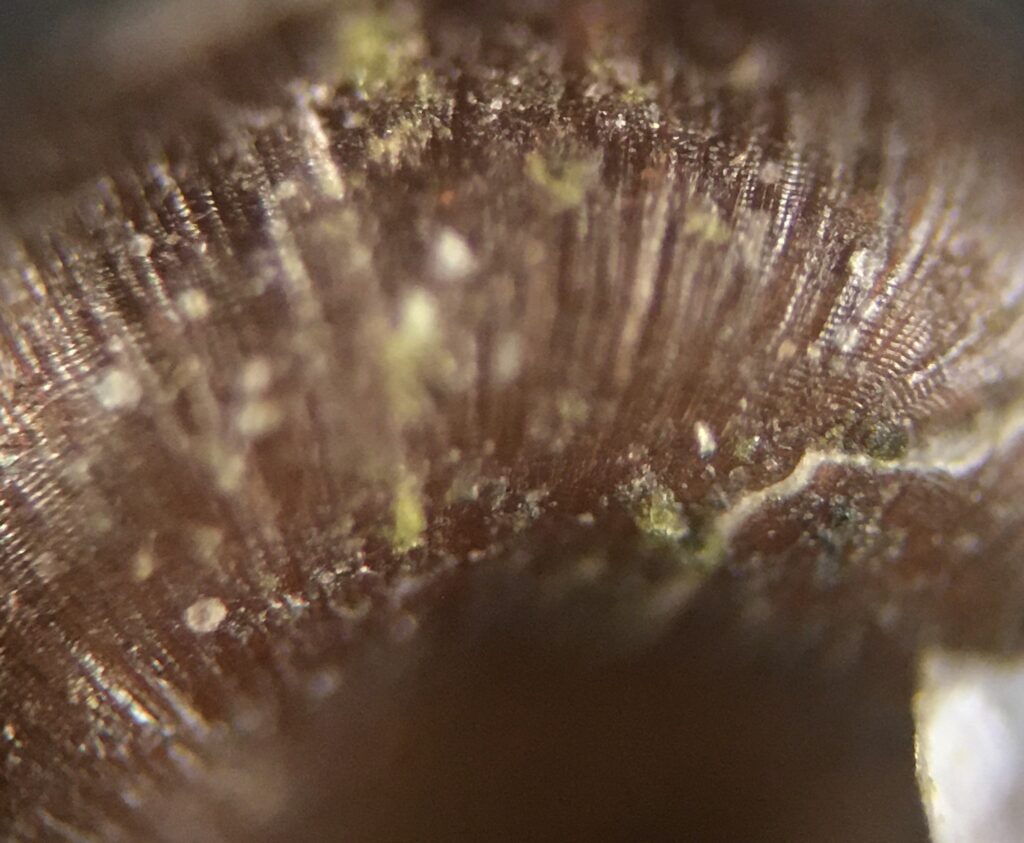
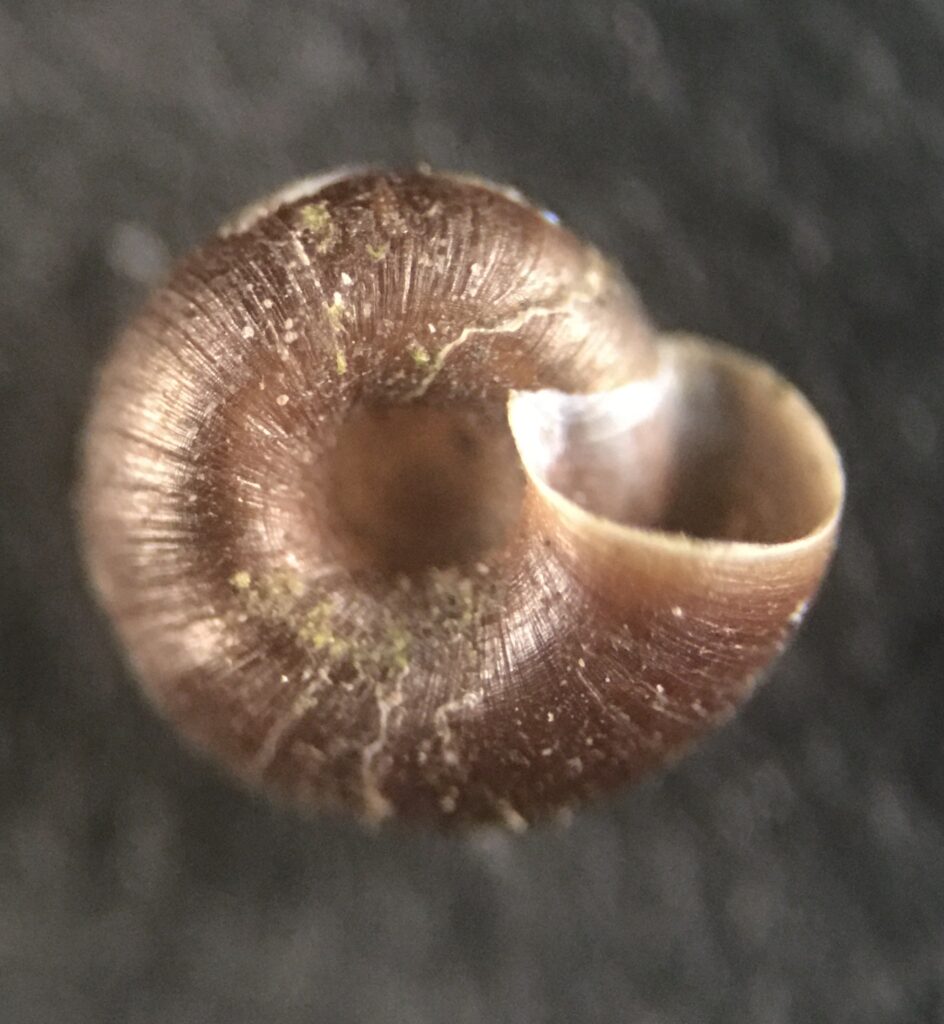
Paralaoma servilis

Image Usage Information

  • lagabrielle
  • CC BY-NC 4.0 DEED
  • Additional information about this specimen

Family: Punctidae

Common name:  Pinhead Spot Snail

Discovery: Shuttleworth, 1852

Identification

Width: 2.1 mm
Height: 1.3 mm
Whorls: 4

Paralaoma servilis has a shell sculpture of rather distinct radial riblets that are set widely apart. Between these are microscopic spiral striae (Pilsbry, 1948). The shell is slightly depressed, with a thin lip, and the open umbilicus is about ¼ the shell diameter or slightly wider.

Paralaoma servilis is similar to Punctum vitreum, but they can be separated because Paralaoma servilis is slightly taller, the ribs are less distinct, and the umbilicus is smaller than in Punctum vitreum.

Ecology

This species lives in leaf litter, often in areas more disturbed by human activity.

Taxonomy

Synonyms include Helix caputspinulae, Helix conspectum, Helix pusilla,·Paralaoma caputspinulae, Punctum conspectum, and Toltecia pusilla.

Distribution

Paralaoma servilis is originally from New Zealand and due to human mediated dispersal might now be the most widely distributed land snail species in the world. It is reported from Washington, DC and New York City, and some records on the Delmarva Peninsula reported as Punctum vitreum are likely to be Paralaoma servilis.

Conservation

NatureServe Global Rank: G5

Author: Tim Pearce
Publication date: 11/2023

December 14, 2023 by

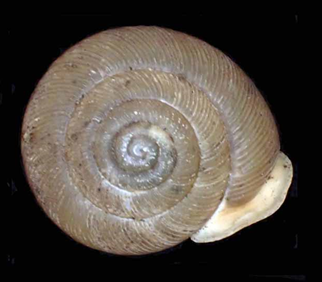
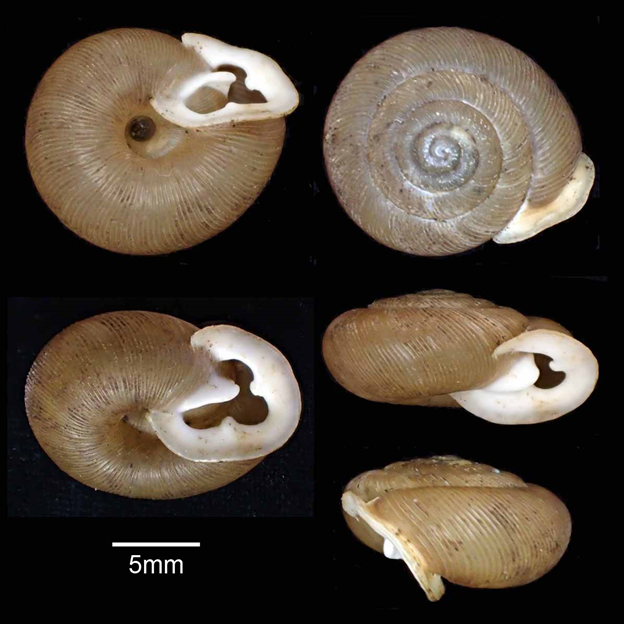
Triodopsis juxtidens robinae

Image Usage Information

  • Charles F. Sturm
  • All rights reserved

Family: Polygyridae

Common name: Brush Creek Threetooth

Discovery: Hotopp, 2015

Identification

Width: 13.1-17.6 mm
Height: 7-9 mm
Whorls: 4.76-5.5

As with Triodopsis juxtidens juxtidens, this snail possesses a typical threetooth shell, with three tooth-like barriers in the aperture and the shell has a microsculpture of fine ridges and an open umbilicus on a depressed heliciform shell. Both T.j. juxtidens and T.j. robinae differ from the similar T. tridentata by having a parietal tooth that points at or above its palatal tooth, when viewed perpendicular to the aperture plane. T.j. robinae differs from T.j. juxtidens in having a more triangular aperture, a basal denticle sitting on a buttress, with an exceptionally wide lip especially near the base, and from the upper lip attachment, the lip initially extends upwards more strongly in T.j. robinae. The basal denticle is deeper than wide, set perpendicular to the aperture upon a horizontal buttress, the buttress usually taller to the palatal side of the tooth. No other Triodopsis has a triangular aperture along with a parietal lamella pointing at the palatal denticle and a basal denticle upon a buttress (Hotopp 2015).

Ecology

Triodopsis juxtidens robinae occurs on and in leaf litter on steep, rocky, mesic forested slopes, among cliffs, upon sandstone talus; forest of mixed eastern hemlock (Tsuga canadensis L.(Carr.) )-hardwood forest.

Taxonomy

No synonyms.

Distribution

Triodopsis juxtidens robinae occurs on forested slopes of the Bluestone River Valley and tributaries in Mercer and Summers Counties, West Virginia, U.S.A. (Hotopp 2015).

Conservation

NatureServe Global Rank: T1, Critically Imperiled — At very high risk of extinction
NatureServe State Rank: S1, Critically Imperiled — At very high risk of extirpation

  • « Go to Previous Page
  • Page 1
  • Page 2
  • Page 3
  • Page 4
  • Interim pages omitted …
  • Page 53
  • Go to Next Page »

sidebar

About

  • Mission & Commitments
  • Directors Team
  • Museum History

Get Involved

  • Volunteer
  • Membership
  • Carnegie Discoverers
  • Donate
  • Employment
  • Events

Bring a Group

  • Groups of 10 or More
  • Birthday Parties at the Museum
  • Field Trips

Powdermill

  • Powdermill Nature Reserve
  • Powdermill Field Trips
  • Powdermill Staff
  • Research at Powdermill

More Information

  • Image Permission Requests
  • Science Stories
  • Accessibility
  • Shopping Cart
  • Contact
  • Visitor Policies
One of the Four Carnegie Museums | © Carnegie Institute | Privacy Policy | Terms of Use | Accessibility
Rad works here logo