• Skip to primary navigation
  • Skip to main content
  • Skip to primary sidebar

Carnegie Museum of Natural History

One of the Four Carnegie Museums of Pittsburgh

  • Visit
    • Buy Tickets
    • Visitor Information
    • Exhibitions
    • Events
    • Dining at the Museum
    • Celebrate at the Museum
    • Powdermill Nature Reserve
    • Event Venue Rental
  • Learn
    • Field Trips
    • Educator Information
    • Programs at the Museum
    • Bring the Museum to You
    • Guided Programs FAQ
    • Programs Online
    • Climate and Rural Systems Partnership
  • Research
    • Scientific Sections
    • Science Stories
    • Science Videos
    • Senior Science & Research Staff
    • Museum Library
    • Science Seminars
    • Scientific Publications
    • Specimen and Artifact Identification
  • About
    • Mission & Commitments
    • Directors Team
    • Museum History
  • Tickets
  • Give
  • Shop

December 22, 2023 by

Land Snails Resources – Sources of Specimens

  • Land Snails Home
  • Land Snails by State
  • Land Snails Ecology
  • Land Snails Resources

Terminology

References

Citing this Resource

About the Authors

Sources of Specimen Records

Sources of Specimen Records

Museum records used for land snail range mapping
Digital museum records were compiled from major institutions primarily in the Northeast, Southeast, and Midwest. Several museums’ records are now conveniently available online through data aggregators such as InvertEBase.org and GBIF.org.

In most cases, the specimens upon which these records are based have not been inspected by the authors and are taken at face value. While we tried to scrutinize suspicious records, there are likely to be identification mistakes, taxonomic confusions, and other sources of error in these records.

New records can become available through recent survey work, as well as records from decades past as museums continue to digitize their mollusk collections. Land snail data will continue to improve as museums continually upgrade the accuracy and availability of their collection records. Over the past decade, digital records have become available through efforts such as iNaturalist (more than 2,300 records for this project). Although important features of the specimen cannot always be seen the digital records, these digital records are a valuable resource for tracking rare and introduced species.

Special thanks to museums who provided specimen records. In particular we thank Mark Siddall and Lily Berniker (AMNH), Paul Callomon and Steven Dilliplane (ANSP), Liz Shea and B. Alex Kittle (DMNS), Adam J. Baldinger and Brendan Haley (MCZ), Robert Hershler and William Moser (USNM), Mark Antonioni (NPS), and Taehwan Lee (UMMZ) for providing museum records.

Academy of Natural Sciences of Philadelphia (ANSP) – Philadelphia, PA. – more than 6,000 Northeast land snail specimen records. All land snail museum records digitized. Paul Callomon, Collection Manager. http://www.ansp.org/research/systematics-evolution/collections/malacology

American Museum of Natural History (AMNH) – New York, NY – more than 600 Northeast land snail specimen records. Approximately 1/3 of the collection is digitized. Mark Siddall, PhD, Curator, Annelida and Mollusca Collections.  http://www.amnh.org/our-research/invertebrate-zoology/collections/mollusca

Buffalo Museum of Science (BMS) – Buffalo, NY – more than 100 land snail specimen records for New York State compiled from paper labels by Ken Hotopp in 2004. http://www.sciencebuff.org/site

Carnegie Museum of Natural History (CMNH) – Pittsburgh, PA – more than 28,000 Northeast land snail specimen records. Most land snail records digitized and soon available online at InvertEBase. Timothy A. Pearce, PhD, Head, Section of Mollusks.  http://www.carnegiemnh.org/mollusks/

Canadian Museum of Nature (CMN) – Ottawa, Ontario, CA – more than 1300 Northeast (Delmarva) land snail specimen records including more than 500 Delmarva records from F. Wayne Grimm compiled from paper labels by Timothy A. Pearce in 1998-2000 visits. Jean-Marc Gagnon, PhD, Curator of Invertebrates. https://nature.ca/en/research-collections/collections/animals

Craig Stihler personal collection – more than 5.300 land snail records.


Delaware Museum of Nature and Science (DMNS) – Wilmington, DE – more than 7,200 Northeast land snail specimen records. The entire land snail collection is digitized. Elizabeth Shea, PhD, Curator of Mollusks.  http://www.delmnh.org/mollusks/

Field Museum of Natural History (FMNH) – Chicago, IL – more than 8,800 Northeast land snail specimen records. All collection records are digitized and available from InvertEBase. Rudiger Bieler, Curator. https://www.fieldmuseum.org/node/5011

University of Florida (UF) – Gainesville, FL – more than 5,200 Northeast land snail specimen records. Records available online from InvertEBase. John Slapcinsky, Invertebrate Zoology Collections Manager. https://www.flmnh.ufl.edu/malacology/

Jeff Nekola personal collection – more than 2,000 land snail records.


North Carolina Museum of Natural Sciences (NCSM) – Raleigh, NC – more than 40 Northeast land snail specimen records. Records available online at InvertEBase. http://naturalsciences.org/research-collections/invertebrates-collection

Marshall University (MU) – Huntington, WV – more than 800 West Virginia land snail specimen records provided by Ralph Taylor in 2008
.
Museum of Comparative Zoology (MCZ) – more than 4,700 Northeast land snail specimen records. The entirety of mollusk collection records are digitized. Adam J. Baldinger, Collection Manager. http://www.mcz.harvard.edu/Departments/Malacology/index.html

National Park Service – National Capital Parks (NPS) – Washington, DC area – more than 300 Northeast land snail specimen records. These are land snail records from six capital region national parks courtesy of Mark Antonioni, NPS.

New York State Museum (NYSM) – Albany, NY – more than 260 land snail specimen records for New York State compiled from paper labels and new specimens by Ken Hotopp in 2004. Denise Mayer, PhD, Malacology Collections Manager and Director of the Museum’s Field Research Laboratory. http://www.nysm.nysed.gov/research-collections/biology/malacology

Ohio State University (OSU) – Columbus, OH – more than 3000 Northeast land snail specimen records obtained by Timothy A. Pearce in 2010. G. Thomas Watters, Curator. http://www.biosci.ohio-state.edu/~molluscs/OSUM2/

National Museum of Natural History (NMNH) – Smithsonian Institution, Washington, DC – more than 2800 Northeast land snail specimen records. Robert Hershler, PhD, Research Zoologist, Curator of Mollusca. http://invertebrates.si.edu/

University of Michigan Museum of Zoology (UMMZ)
 – Ann Arbor, MI – more than 900 Northeast land snail specimen records. Taehwan Lee, PhD, Collection Manager and Research Scientist. https://lsa.umich.edu/ummz/mollusks.html

Yale University Peabody Museum (YPM)
 – New Haven, CT – more than 780 Northeast land snail specimen records. Records available online from InvertEBase. http://peabody.yale.edu/collections/invertebrate-zoology
December 22, 2023 by

Land Snails Resources – About the Authors

  • Land Snails Home
  • Land Snails by State
  • Land Snails Ecology
  • Land Snails Resources

Terminology

References

Citing this Resource

About the Authors

Sources of Specimen Records

Authors for this Resource

Ken Hotopp
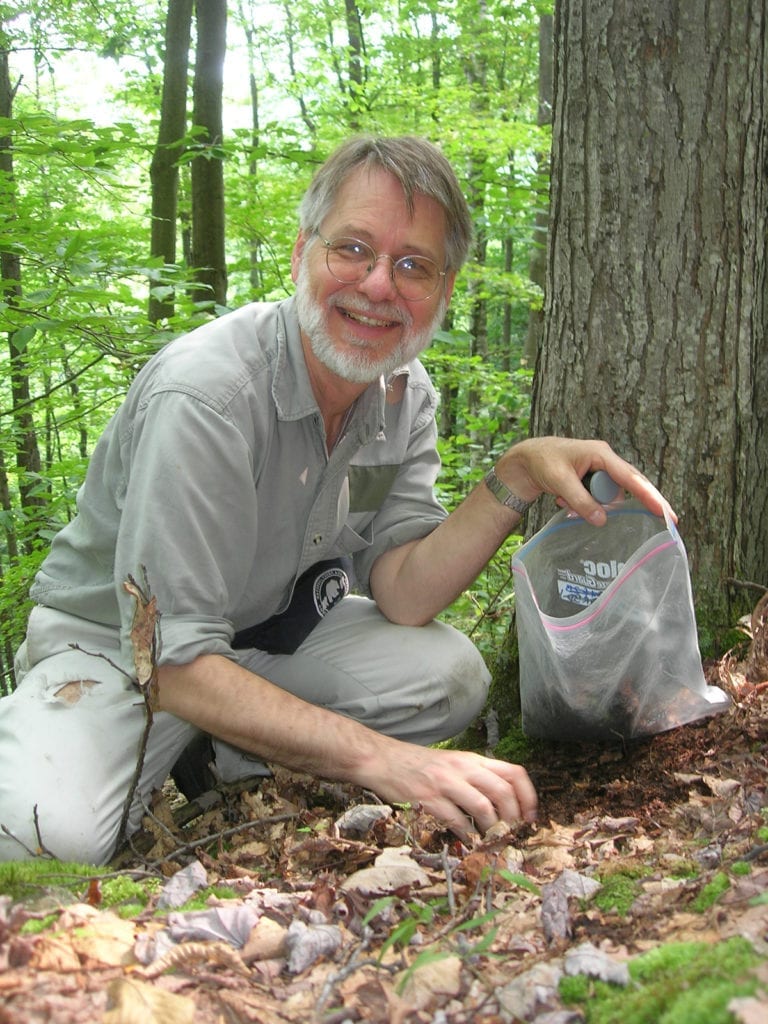
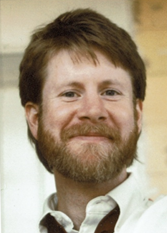
Kenneth P. Hotopp in 1990
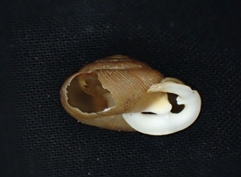
Triodopsis juxtidens robinae Hotopp, 2015, holotype, named for Ken’s wife.

The late Kenneth P. Hotopp (1960 –2019) passed away at age 58 on 7 June 2019.

Ken’s work focused on land snails of the Appalachian area. He was a superb naturalist, with extensive knowledge about a wide variety of plants and animals. He was a research associate in the Section of Mollusks at Carnegie Museum of Natural History, Pittsburgh, from 2002-2019. He published 8 articles on snails, including naming a new subspecies of land snail (Triodopsis juxtidens robinae) after his wife, and authored 13 unpublished reports on snails.

He had nearly finished this web resource on land snails of the northeastern USA when he passed away. This project grew from two previous versions of land snail web resources, one about Pennsylvania, later modified to include Virginia.

Another of Ken’s projects, still in the works, is a field guide to land snails of New York. Preliminary versions of that book have been useful to students and workers. A team continues working to complete that field guide.

Ken worked as a biologist for the Maryland Natural Heritage Program from 1990-1997. Later, he started Appalachian Conservation Biology, a consulting business specializing in ecology, conservation, and rare species inventory primarily of land snails but also including butterflies, salamanders, plants, and natural communities in the Appalachian Mountains.

Ken received a BS in forest biology in 1982 from SUNY ESF (Environmental Science and Forestry) in Syracuse, NY. He earned his MS degree in Ecology and Animal Behavior from SUNY, Albany in 1987 with a thesis on the foraging behavior of deer mice.

With his partner, Robin Gorrell, a small animal veterinarian Ken, Robin, and daughters Marian and Alice canoed, hiked, and cross-country skied wild places from West Virginia to Ontario, Canada. The family moved to Bethel, Maine in 2005. Ken’s father, Kenneth R. Hotopp (note middle initial R) frequently joined Ken on snail survey work and is listed as a collector on many specimens in museum collections.

Ken was a fierce defender of wilderness and the climate and worked locally to protect natural places and to participate in actions against climate change.

Publications by K.P. Hotopp

Hotopp, K.P. & Smith, D.A. 1995. Notes on land snails near Big Reed Pond in Piscataquis County, Maine. Maine Naturalist 3(2):103-106.

Hotopp, K.P. 2002. Land snails and soil calcium in Central Appalachian Mountain forest. Southeastern Naturalist 1(1):27-44

Hotopp, K.P. 2006. Patera panselenus (Hubricht, 1976) on the lower Cheat River, West Virginia (Gastropoda: Pulmonata: Polygyridae). Banisteria 27:40-43.

Hotopp, K.P., Pearce, T.A. & Dourson, D.C. 2008. Land Snails of the Cheat River Canyon, West Virginia (Gastropoda: Pulmonata). Banisteria 31:40-46.

Hotopp, K.P., Pearce, T.A., Nekola, J.C., & Schmidt, K. 2010. New land snail (Gastropoda: Pulmonata) distribution records for New York State. Proceedings of the Academy of Natural Sciences of Philadelphia 159:25-30.

Pearce, T.A. & Hotopp, K.P. 2011. Federally endangered land snail Polygyriscus virginianus (Burch, 1947) still alive in Pulaski County, Virginia, USA (Gastropoda: Helicodiscidae).Tentacle, Mollusk Conservation Newsletter (19):27-28.

Beier, C.M., Woods, A.M., Hotopp, K.P., Gibbs, J.P., Mitchell, M.J., Dovčiak, M., Leopold, D.J., Lawrence, G.B. & Page, D.B. 2012. Variability in gastropod and amphibian communities along a soil calcium gradient in Adirondack northern hardwood forests. Canadian Journal of Forest Research 42:1141-1152.

Hotopp, K.P. 2015. A new Triodopsis juxtidens subspecies (Gastropoda: Pulmonata) from West Virginia, U.S.A. Zootaxa 3914(4):490-494.

Web Resources by K.P. Hotopp:

Hotopp, K.P. & Pearce, T.A. 2006. Land Snails of Pennsylvania. Carnegie Museum of Natural History, Pittsburgh, PA, USA.

Hotopp, K.P., Pearce, T.A., Nekola, J.C., Slapcinsky, J., Dourson, D.C., Winslow, M., Kimber, G. & Watson, B. 2013. Land Snails and Slugs of the Mid-Atlantic and Northeastern United States. Carnegie Museum of Natural History, Pittsburgh, PA, USA. Online at http://www.carnegiemnh.org/science/mollusks/

Unpublished Snail-Related Reports by K.P. Hotopp:

Hotopp, K.P. 2000. Cheat Threetooth (Triodopsis platysayoides Brooks) Inventory 2000. Report to the US Fish & Wildlife Service, West Virginia Field Office, and West Virginia Division of Natural Resources, Elkins, WV. 38pp.

Hotopp, K.P. 2000. Land snails at four Nature Conservancy preserves in West Virginia. Report to the West Virginia Chapter of The Nature Conservancy, Charleston, WV. 34pp. +attachments.

Hotopp, K.P., Pearce, T.A. & Grimm, F.W. 2003. Land snails of selected Pennsylvania Natural Areas. Report to Pennsylvania Dept. of Conservation & Natural Resources, Harrisburg, PA. 44pp.

Hotopp, K.P. 2003. Uncommon Pennsylvania land snails: supporting citations for state ranking. Unpublished report to the Pennsylvania Dept. of Conservation & Natural Resources, Harrisburg, PA. 40pp.

Hotopp, K.P. 2005. Land and freshwater snails of Great Falls and Turkey Run National Parks. Report to the National Park Service, McLean, VA. 26pp. +attachments.

Hotopp, K.P. 2006. Expert report: Opinion for conservation of the Cheat Threetooth (Triodopsis platysayoides Brooks). Report for legal proceedings to DiTrapano, Barrett & DiPiero, PPLC, Charleston, WV. 16pp.

Hotopp, K.P. 2006. Inventory for two butterflies and two land snails in West Virginia. Report to the West Virginia Division of Natural Resources, Elkins, WV. 24pp.

Hotopp, K.P. and Pearce, T.A. 2007. Land snails in New York: statewide distributions and talus site faunas. Report to the New York State Biodiversity Research Institute, Albany, NY. 91pp.

Hotopp, K.P. and Pearce, T.A. 2008. Land snail distributions in West Virginia. Report to the Wildlife Resources Section, West Virginia Division of Natural Resources. 126pp.

Hotopp, K.P. 2012. Freshwater snail inventory of the Fish River lakes. Unpublished report to the Maine Outdoor Heritage Fund, Pittston, ME. 47pp. +attachments.

Hotopp, K.P. and Roe, J.L. 2014. Discovering Maine’s Own Freshwater Snail. Crowdfunded project through experiment.  Online at: https://experiment.com/projects/discovering-maine-s-own-freshwater-snail-part-1.

Hotopp, K.P., Watson, B.T., Pearce, T.A., Nekola, J.C. & Perez, K.E. 2014. Shaggy Coil Conservation Plan, September 2014. Report to Bureau of Wildlife Resources, Virginia Department of Game and Inland Fisheries, Richmond, VA. 23 pp.

Hotopp, K.P., Watson, B.T., Pearce, T.A., Nekola, J.C. & Perez, K.E. 2015. Rubble Coil Conservation Plan, March 2015. Report to Bureau of Wildlife Resources, Virginia Department of Game and Inland Fisheries, Richmond, VA. 30 pp.

Tim Pearce
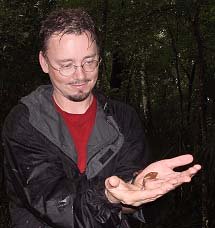
Tim sampling fallen leaves

Tim Pearce is Assistant Curator and Head of the Section of Mollusks at Carnegie Museum of Natural History. He conducts malacological research on land snails and cares for and promotes use of the huge research collection of snails and clams (1.8 million specimens). While he has been studying mollusks for more than 40 years, for the past couple of decades, his land snail field research is primarily in northeastern USA, but his snail survey localities also include Madagascar, Kuril Islands (far eastern Asia), Colombia (South America), Turkey, as well as western North America and land snails in the vicinity of the Great Lakes. He has published dozens of papers on mollusks and has named 70 land snail species.

Learn more about Tim Pearce
Jeffrey C. Nekola

Jeffrey C. Nekola is an Associate Professor in the Department of Botany and Zoology, Faculty of Sciences, Masaryk University, Brno, Czech Republic where his recent studies on land snails have used molecular techniques in combination with morphology to focus on resolving relationships to among large groups of small species including Vertiginidae, Euconulidae, and Haplotrematidae.

Admirably, his research often addresses larger (continental-scale) questions related to molluscan diversity and he specializes in documenting the mechanisms that trigger biodiversity. He has described more than 20 taxa of mollusks, and has published more than 90 peer-reviewed scientific papers.

John Slapcinsky

John Slapcinsky is the Malacology Collections Manager at the Florida Museum of Natural History. He is an avid researcher on land snails around the world, primarily in SE Asia and in SE United States. His projects document diversity of terrestrial snails in under-sampled geographic areas and microhabitats. His multi-year effort to sample terrestrial snails of the Papuan Peninsula and nearby islands off eastern New Guinea suggests the area is much more diverse than previously known. His surveys in southeastern North America focus particularly on small species restricted to specialized habitats including seeps and springs. His dozens of publications on Mollusca include the naming of more than 90 new species.

Brian Watson

Brian Watson is the Aquatic Resources Biologist and State Malacologist for Virginia, at the Virginia Department of Wildlife Resources. His responsibility is conservation of freshwater mussels and clams, crayfishes, aquatic and terrestrial snails, and nongame fishes. His efforts have been crucial for elevating the awareness land snails in need of conservation, including helping to secure funding for terrestrial snail research in Virginia. He continues to be a strong advocate for conservation of mollusks.

December 22, 2023 by

Land Snails Resources – Citing this Resource

  • Land Snails Home
  • Land Snails by State
  • Land Snails Ecology
  • Land Snails Resources

Terminology

References

Citing this Resource

About the Authors

Sources of Specimen Records

How to Cite this Web Resource

Hotopp, K.P., T.A. Pearce, J.C. Nekola, J. Slapcinsky, and B. Watson. 2023. Land Snails and Slugs of the Mid-Atlantic and Northeastern United States. Carnegie Museum of Natural History, Pittsburgh, PA, USA. Online Resource: https://carnegiemnh.org/mollusks/land-snails-slugs/

December 15, 2023 by

Lissachatina fulica

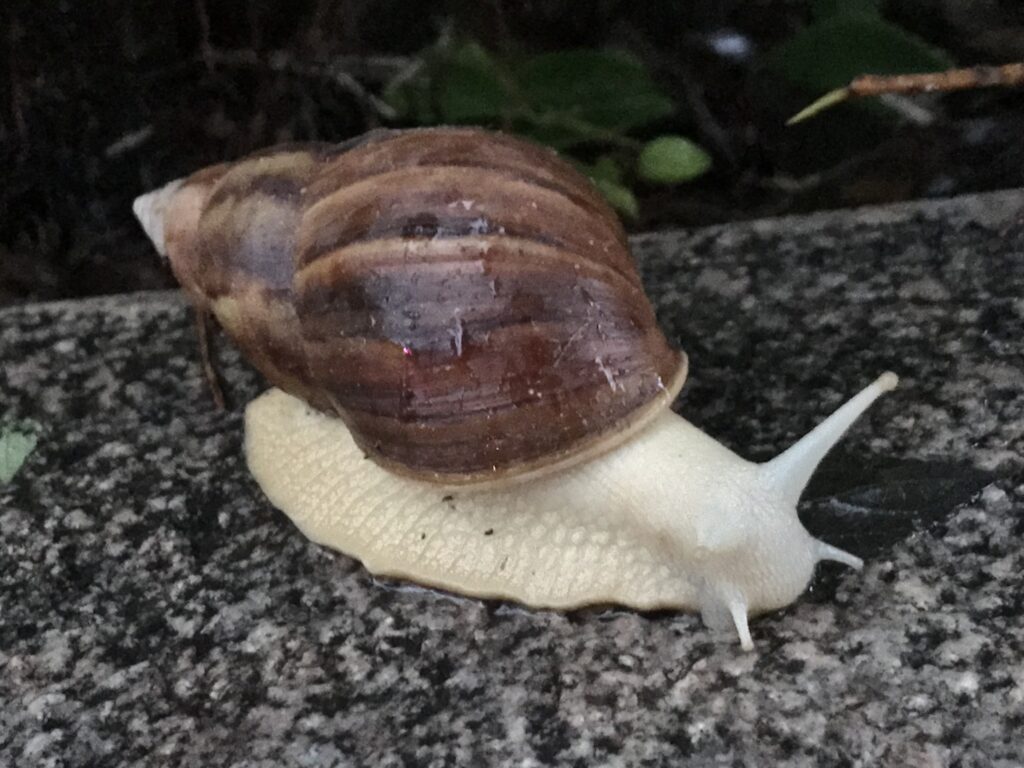
Profile of Giant African Land Snail, a large pale snail with a contrasting , slightly oblong shell
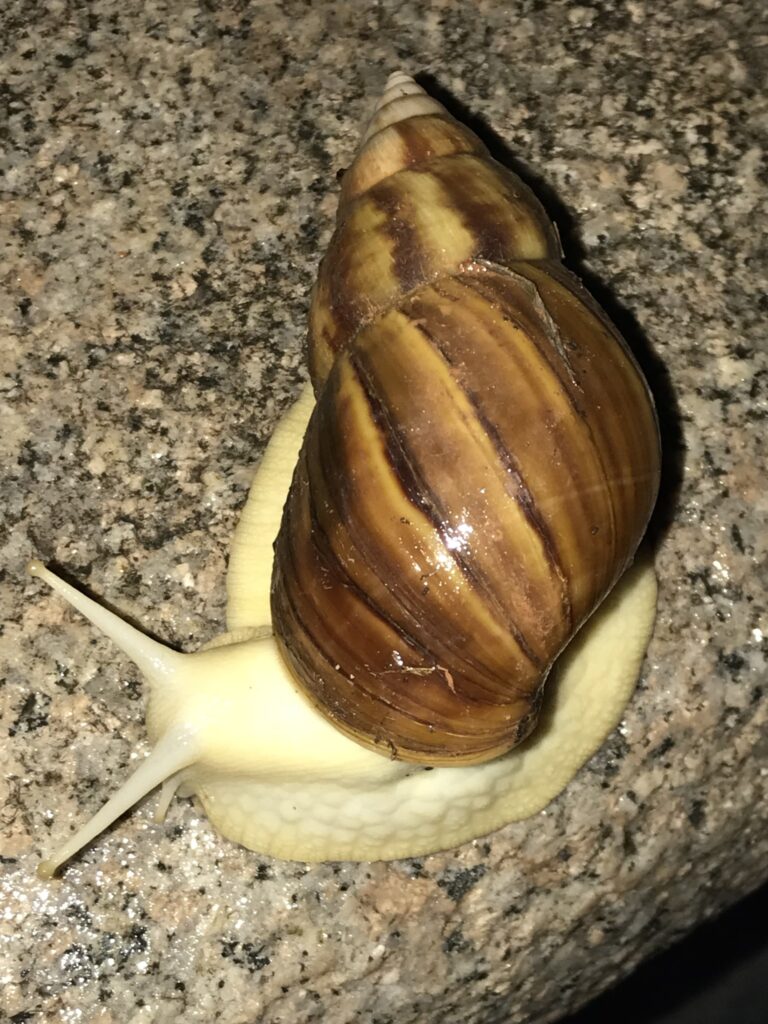
Superior view of Giant African Land Snail, foot of snail smushed on ground, looking like overflowing under pressure of shell

Image Usage Information

  •  Yan Cai
  • CC BY-NC 4.0 DEED
  • Additional information about this specimen

Family: Achatinidae

Common name: Giant African Land Snail

Discovery: Bowdich, 1822

Introduced species

Identification

Width: ~120 mm
Height: 50-200 mm
Whorls: 7-10

This tropical snail’s shell is cone-shaped, often marked with alternating radial bands of brown and tan (White-McLean, 2011). The aperture is simple, thickened along the columella, and the umbilicus is closed. The live animal may vary in color from tan to dark brownish. This species is conspicuously larger than other land snails in the Northeast.

Ecology

Lissachatina fulica is one of the planet’s best-known land snails. It is large, prolific, widely introduced, and easily kept in captivity. The species is cultivated for food, the pet trade, and mucus production for skin treatments. It is frequently used as a model animal for anatomical, physiological, and medical research (e.g. Mukherjee et al., 2017).

This land snail is primarily an herbivore, feeding upon a wide variety of plants including bananas, cotton, bread fruit, hemp, coffee, cocoa, rubber tree, various legumes, and many others (in Godan, 1979). However, it can be cannibalistic, and has been observed preying upon other gastropods as well (Meyer et al., 2009).

Lissachatina fulica has been introduced to many tropical islands, often with disastrous effects. In Hawaii and elsewhere, the predatory land snail Euglandina rosea introduced to control L. fulica has caused mass extinction of native snails through predation (e.g.  Civeyrel and Simberloff, 1996).

The invasiveness potential of L. fulica in the U.S. is ranked relatively highly (Cowie et al., 2009). Modelling of potential L. fulica invasion areas in India identified 2 million km2 at moderate risk to very high risk of invasion (Rekha Sarma et al., 2015). In South America, widespread introductions are reported and large areas of the coasts, highlands, and Amazon River basin have invasion potential (Borrero et al., 2009). Higher relative humidity is an important predictive factor in the model.

Lissachatina fulica is an intermediate host for the rat lungworm Angiostrongylus cantonensis, which can be transmitted to people, causing a form of meningitis (Stockdale Walden et al., 2015). Work in Florida shows this parasite is also carried by some other species of land snails, both native and introduced (Stockdale Walden et al., 2017).

Taxonomy

A synonym is Achatina fulica. There are several subspecies and congeners.

Distribution

Lissachatina fulica is native to East Africa, but has been spread around Earth’s tropical zone. In the United States there are populations in Hawaii and Florida. In Pittsburgh, Pennsylvania, an immature individual was found outside in a public park, in summer 2003 (Tim Pearce, pers. observation).

Conservation

NatureServe Rank: G5, Secure.

Importation of this non-native species is regulated by the U.S. Dept. of Agriculture (Anonymous, 2017). The State of Florida has an ongoing eradication program.

Author: Ken Hotopp
Publication date: 12/2017

December 15, 2023 by

Vertigo perryi

Image Usage Information

  • Jeff Nekola
  • All rights reserved

Family: Vertiginidae

Common name: none

Described by: Sterki, 1905

Identification

Height: 1.5-1.9 mm
Width: 1.0-1.1 mm
Whorls: 5

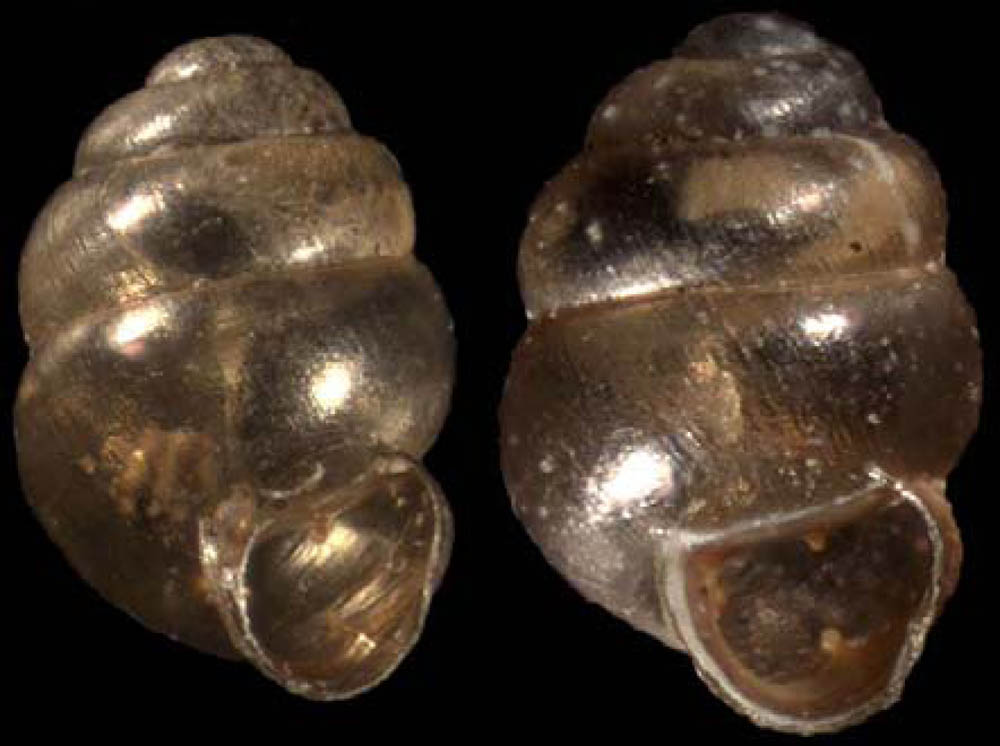
Within the subgenus Alaea, Vertigo perryi shares with boreal North American V. ventricosa and northeast Asian V. kurilensis a small shell with irregular, weak striae and ovate-conical shape. It consistently differs from V. ventricosa shells in its more ovate shape, grayer olive-yellow color, silky luster from the presence of weak malleation and fine spiral lines on the shell surface, weaker lamellae development and a dark coloration of the apertural margin. These features remain constant across its range.

Ecology

Vertigo perryi is limited to moderately to highly acidic forested to open wetlands (Coles and Nekola, 2004; Nekola, 2008; Nekola and Coles, 2010). It can be abundant in dead leaf accumulations adjacent to sedge tussocks and may also ascend into living vegetation. Type Locality: Warwick, Rhode Island, U.S.A.

Taxonomy

This species has no synonyms.

Distribution

While ranging in North America from northern Wisconsin to Newfoundland, V. perryi is most commonly encountered from areas bordering the Gulf of Maine and Cape Cod wetlands (Coles and Nekola, 2004; Nekola and Coles, 2010). While not yet reported from the southern Canadian Maritime provinces, it is to be expected from New Brunswick and southern Nova Scotia.

Conservation

NatureServe Global Rank: G3/G4, Vulnerable to Apparently Secure.

December 15, 2023 by

Vertigo morsei

Family: Vertiginidae

Common name: none

Described by: Sterki, 1894

Identification

Height:2.7-3.0 mm
Width: 1.3-1.5 mm
Whorls:  6-6.5

This is our largest species of Vertigo. It is similar to V. ovata in apertural teeth but V. morsei has more whorls and a relatively smaller aperture (Pilsbry 1948).

Ecology

Vertigo morsei occurs in well-decomposed leaf litter often overlying calcareous bedrock and in calcareous wetlands (Nekola and Coles, 2010), and along margins of ponds and marshes (Hubricht 1985). Type Locality: Woodland, Aroostook County, Maine, U.S.A.

Taxonomy

There are no synonyms.

Distribution

The known range of V. morsei is primarily in northern US states from northern Maine west through New York and Michigan, to Minnesota (Nekola and Coles, 2010).

Conservation

NatureServe Global Rank: G3. Vulnerable.

  • Page 1
  • Page 2
  • Page 3
  • Interim pages omitted …
  • Page 53
  • Go to Next Page »

sidebar

About

  • Mission & Commitments
  • Directors Team
  • Museum History

Get Involved

  • Volunteer
  • Membership
  • Carnegie Discoverers
  • Donate
  • Employment
  • Events

Bring a Group

  • Groups of 10 or More
  • Birthday Parties at the Museum
  • Field Trips

Powdermill

  • Powdermill Nature Reserve
  • Powdermill Field Trips
  • Powdermill Staff
  • Research at Powdermill

More Information

  • Image Permission Requests
  • Science Stories
  • Accessibility
  • Shopping Cart
  • Contact
  • Visitor Policies
One of the Four Carnegie Museums | © Carnegie Institute | Privacy Policy | Terms of Use | Accessibility
Rad works here logo