by Sara Klingensmith
Mushrooms are becoming popular! Visitors to Powdermill Nature Reserve often bring photos of colorful mushrooms in hopes of learning the identity of each. On nature hikes, the appearance of eccentric mushrooms such as viscid violet cort (Cortinarius iodes), stinky squid (Pseudocolus fusiformis), and some of the color-changing boletes (family Boletaceae) expand perspectives of what exists in nature. People are beginning to pay more attention to these understudied organisms and discovering that fungi do more than decompose. Fungi assist in many ecological processes such as symbiotic partnerships, carbon storage, primary colonization, and parasitism.
How Do We Know When and Where to Find Mushrooms?
Across this vast Kingdom of organisms, only some fungi deploy the charismatic spore-bearing structures we casually call mushrooms when certain environmental conditions are met. Scientifically speaking, these recognizable structures are termed macrofungi (visible sporocarps or fruitbodies). Among the various groupings of fungi, two produce macrofungi we are likely to notice during nature walks: Basidiomycota (external spore production or “club fungi”) and Ascomycota (internal spore production or “sac fungi”).
A mushroom is only the reproductive structure of a fungus. For many species, spores produced within hymenophores (reproductive structures such as gills or pores) are released through an active process called ballistospory. Wind, rain, and animals may help further spore dispersal. The bulk of a fungus lies in the root-like mycelial network within a nourishing substrate (its food). Leaf litter, soil, plants, scat, and even other fungi are all different types of substrates for fungi.
Determining when we will see the most mushrooms erupting from their substrates is challenging because there are multitudes of factors influencing fungal communities. Like many organisms, certain species will thrive better in certain habitats and elevations. Some fungi are tied to their host’s health, phenology, and life stage, which may also be influenced by forest management practices and climate change. Because fungi are fundamentally interwoven with their environment, these organisms undergo succession along with whole forest communities, and even on a single growth substrate.
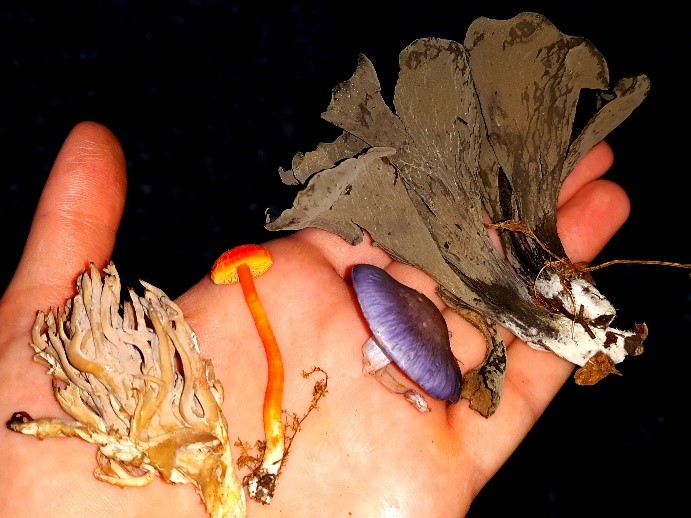
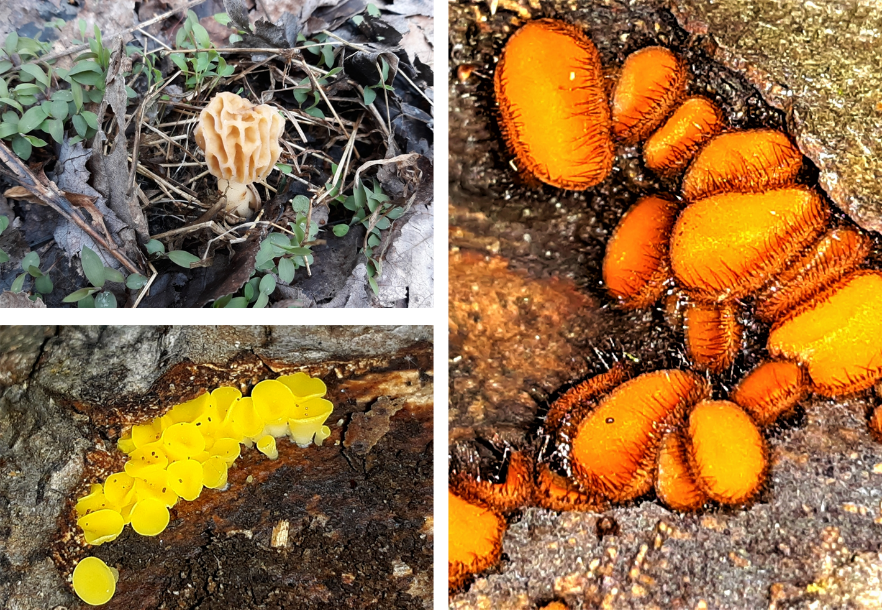
Through general observations, we have determined certain species have seasonal fruiting periods. Experienced foragers learn from experience when to search for morels, and we’ve likewise learned when to expect the fruiting of many other fungi species. Some fruitbodies are ephemeral, whereas others produce mushrooms that may persist on trees for years. While the presence of mycelium is generally linked to the appearance of mushrooms, some studies have observed an uncoupling of factors equating abundant mycelium with high sporocarp production. These findings apply particularly to fungi that form symbiotic relationships with plants—the ectomycorrhizal fungi (symbiotic macrofungi)! This fungal phenomenon has been observed in a few ectomycorrhizal species. For example, research that examined the relationship between mycelial and sporocarp abundance of Boletus edulis, also known as the king bolete, found no correlation between sporocarp production and distribution and the abundance of below-ground mycelium. This means some species of mycorrhizal fungi can appear abundant above ground, but lack a robust underground network expected to support such a high sporocarp population. Therefore, aboveground species richness may not reflect mycelial productivity for some species.
Current research suggests that soil moisture and temperature highly influence the appearance of mushrooms. For example, a dry spell may reduce sporocarp production by 50% in pine forests, yet the mycelial networks presumably continue their cryptic business below the soil surface. Research in the Mediterranean region suggests that precipitation is a limiting factor for sporocarp production for both mycorrhizal and saprotrophic fungi; however, more research is needed to examine these factors in different regions and habitats.
While fungi lack the mechanisms to use photosynthesis, light plays a role in growing mushrooms. Many fungi species show phototropic responses by growing towards light sources, with certain species failing to produce mushrooms in the absence of light.
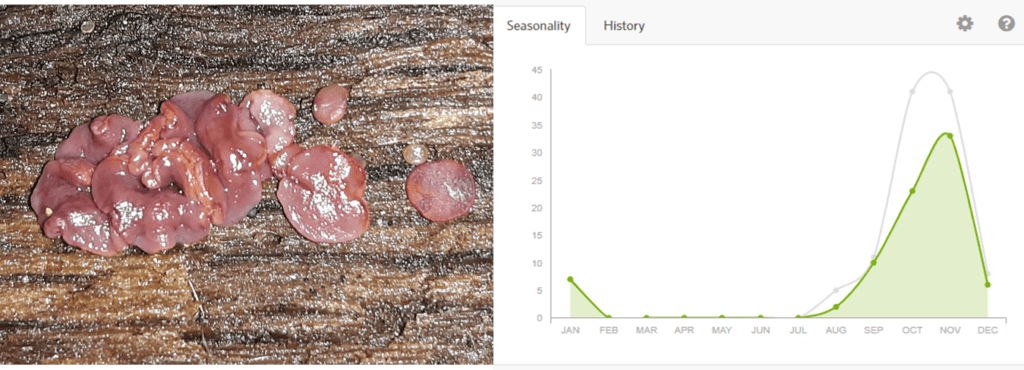
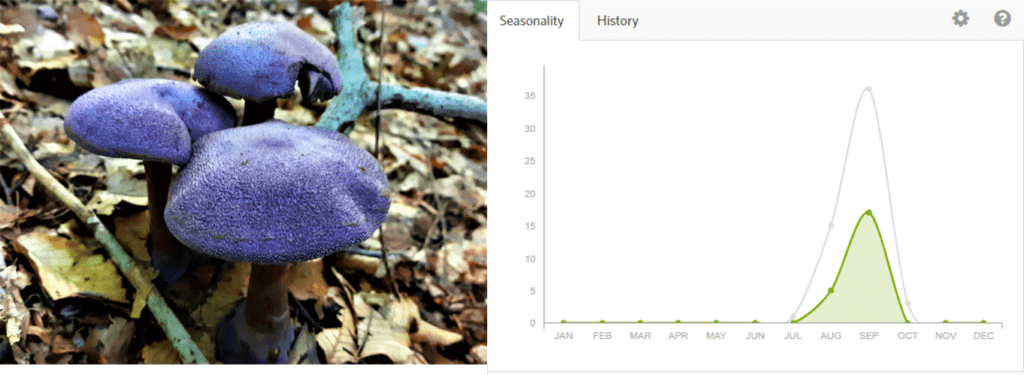
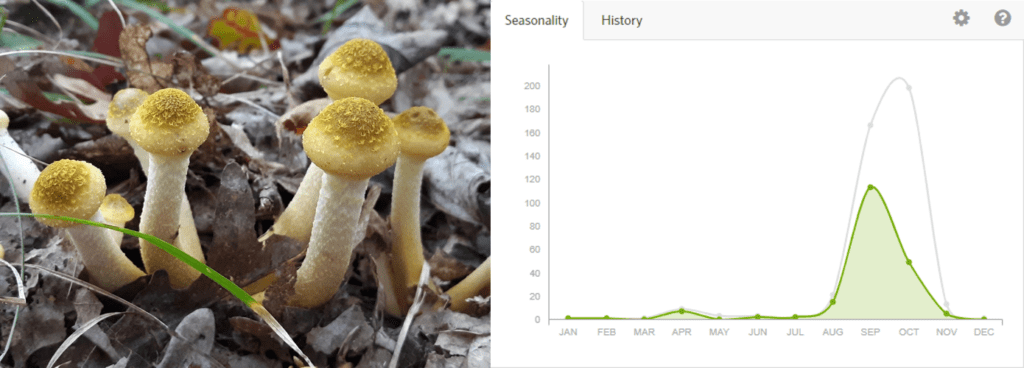
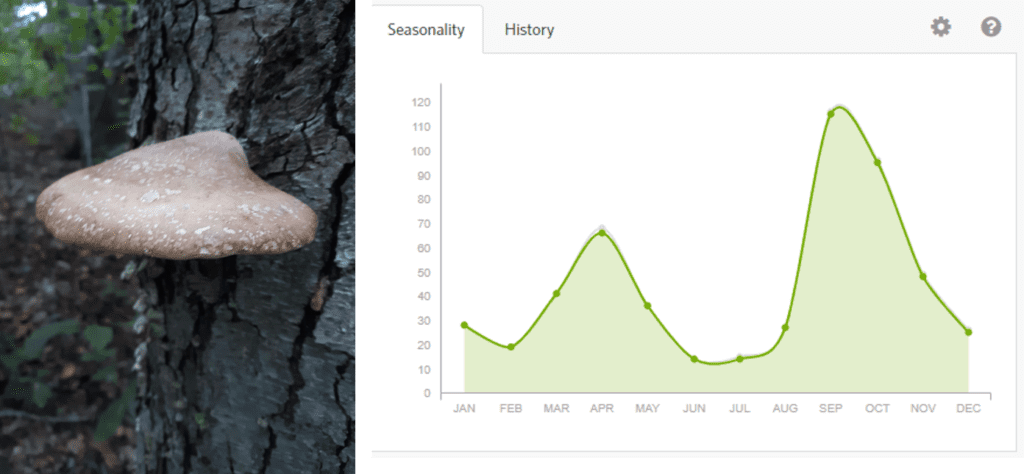
While the appearance of mushrooms can be seasonal and highly variable, searching after a good rainy period might improve your chances of finding some fantastic fungi! Listed below are a handful of species found at Powdermill, along with simple charts of their seasonal observation trends obtained from iNaturalist, a free online site and app promoting community science. Thanks to participating community members, these graphs reflect observation frequencies across seasons in the state of Pennsylvania. The green line represents research grade observations, meaning more than two-thirds of the identifiers agree on the identification. The gray line represents verifiable observations that have yet to attain research grade status. Because observations are on-going, these graphs may change as more data accumulates.
Sara Klingensmith is an Environmental Educator and Naturalist at Powdermill Nature Reserve. Museum employees are encouraged to blog about their unique experiences and knowledge gained from working at the museum.
Sources
Alday, J., Martínez de Aragón, J., de-Miguel, S. et al. Mushroom biomass and diversity are driven by different spatio-temporal scales along Mediterranean elevation gradients. Sci Rep 7, 45824 (2017). https://doi.org/10.1038/srep45824
Binion, E. Denise, et al. Macrofungi Associated With Oaks of Eastern North America, West Virginia University Press, 2008.
Ekblad, A. et al. The production and turnover of extrametrical mycelium of ectomycorrhizal fungi in forest soils: role in carbon cycling. Plant Soil (2013) 366: 1-27.
De la Varga, Herminia & Águeda, Beatriz & Martínez-Peña, Fernando & Parladé, Javier & Pera, Joan. Quantification of extraradical soil mycelium and ectomycorrhizas of Boletus edulis in a Scots pine forest with variable sporocarp productivity. Mycorrhiza. 22. 59-68. (2011) 10.1007/s00572-011-0382-2.
De la Varga, H., Águeda, B., Martínez-Peña, F. et al. Quantification of extraradical soil mycelium and ectomycorrhizas of Boletus edulis in a Scots pine forest with variable sporocarp productivity. Mycorrhiza 22, 59–68 (2012). https://doi.org/10.1007/s00572-011-0382-2
De la Varga, H., Águeda, B., Ágreda, T. et al. Seasonal dynamics of Boletus edulis and Lactarius deliciosus extraradical mycelium in pine forests of central Spain. Mycorrhiza 23, 391–402 (2013). https://doi.org/10.1007/s00572-013-0481-3
Štursová M, Kohout P, Human ZR, Baldrian P. Production of Fungal Mycelia in a Temperate Coniferous Forest Shows Distinct Seasonal Patterns. Journal of Fungi. 2020; 6(4):190. https://doi.org/10.3390/jof6040190
Lodge, D. J. et al. Terrestrial and Lignicolous Macrofungi. 2004. 10.1016/B978-012509551-8/50011-8.
Related Content
Fungi Make Minerals and Clean Polluted Water Along the Way
What Does Climate Change Mean for Western PA Farmers?
Carnegie Museum of Natural History Blog Citation Information
Blog author: Klingensmith, SaraPublication date: January 21, 2022
