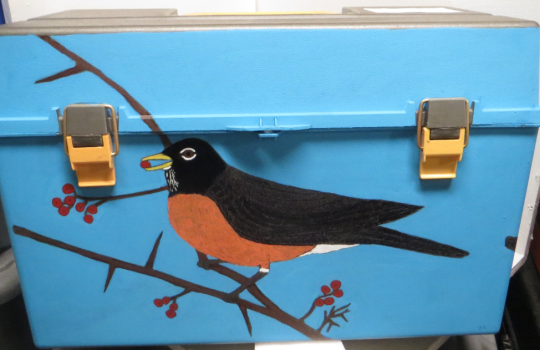
(above) The American Robin Box in the CMNH Educator Loan Program, with art work by John Franc. The loaning of educational materials has been suspended during the Covid-19 pandemic.
As a bird watcher, I’m out of the house early at this time of the year, listening for the calls of newly arrived migrating birds. New days begin in a still dark neighborhood with a steadily growing feathered chorus. Although the calls of a few Northern cardinals and Carolina wrens are close enough for me to guess the location of each singers’ perch, they are far outnumbered by American robins whose blended notes reach my ears from every compass point.
On recent mornings I’ve come to value the abundant presence of robins as a tonic to human nerves frazzled by the life-disrupting spread of Covid-19. The species’ horizon-wide dawn concert is a prelude to an active visible presence in the same territory all day. With minimal effort, little prior planning, and without violating protocol for social distance spacing, you can observe robins flying to and from cover, hopping over grassy feeding areas in search of worms, fighting rivals for mates and territory, and even gathering dried grass and mud for nest construction.
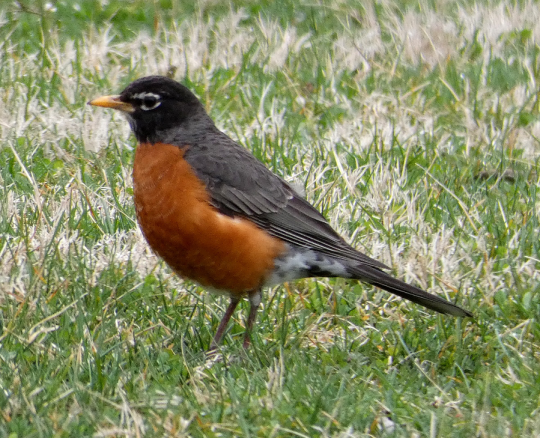
Photo by Amy Henrici.
Through such simple observations it’s possible to reach what naturalist Margaret Renkl, writing recently in The New York Times, termed “the alternate world we need right now, one that exists far beyond the impulse to scroll and scroll.”
A pre-pandemic, but still contemporary call for all of us to become better robin watchers can be found in A Season On The Wind, ornithologist Ken Kaufman’s 2019 account of spring bird migration near his home along the Lake Erie shore in western Ohio.
“Their songs are loud and rich and their colors are bold, from the deep yellow of the beak to the bright rufous orange of the chest. If the American robin were a rare bird, we would climb mountains or walk through fire to catch a glimpse of it. Why should we appreciate it any less just because it’s around us every day?” (A SEASON ON THE WIND, Inside the World of Spring Migration, Houghton Mifflin Harcourt, 2019.)
A far older robin endorsement can be found in the writings of John James Audubon. In early June of 1833, when the renowned bird artist arrived on the barren coast of Labrador, he encountered a robin singing from a snow-free patch of grass.
“That song brought with it a thousand pleasing associations referring to the beloved land of my youth, and soon inspired me with resolution to persevere in my hazardous enterprise.”
Audubon’s praise for the species continues for several paragraphs, and his deep appreciation for the wide-ranging bird includes an aspect unfamiliar to modern robin watchers. After describing how wintering robins in the American south feed on “the fruits of our woods,” he reminds readers that under these circumstances “they are fat and juicy and afford excellent eating.”
For more information about robins including song recordings:
https://www.allaboutbirds.org/guide/American_Robin/id
For read a fuller account of Audubon’s praise for robins:
https://www.audubon.org/birds-of-america/american-robin
For Margaret Renkl’s full essay about the value of nature observation:
https://www.nytimes.com/2020/03/23/opinion/coronavirus-nature-outdoors.html
Patrick McShea works in the Education and Visitor Experience department of Carnegie Museum of Natural History. Museum employees are encouraged to blog about their unique experiences and knowledge gained from working at the museum.
