• Skip to primary navigation
  • Skip to main content
  • Skip to primary sidebar

Carnegie Museum of Natural History

One of the Four Carnegie Museums of Pittsburgh

  • Visit
    • Buy Tickets
    • Visitor Information
    • Exhibitions
    • Events
    • Dining at the Museum
    • Celebrate at the Museum
    • Powdermill Nature Reserve
    • Event Venue Rental
  • Learn
    • Field Trips
    • Educator Information
    • Programs at the Museum
    • Bring the Museum to You
    • Guided Programs FAQ
    • Programs Online
    • Climate and Rural Systems Partnership
  • Research
    • Scientific Sections
    • Science Stories
    • Science Videos
    • Senior Science & Research Staff
    • Museum Library
    • Science Seminars
    • Scientific Publications
    • Specimen and Artifact Identification
  • About
    • Mission & Commitments
    • Directors Team
    • Museum History
  • Tickets
  • Give
  • Shop

African Wildlife

December 3, 2018 by wpengine

Tribute to Otto Epping

By Suzanne McLaren and Stephen Rogers

We recently received word about the passing of former Carnegie Museum of Natural History Taxidermist Otto Epping at the age of 90 in Winchester, Virginia.  In 1964, Otto Epping came to work in the Museum’s Exhibit department as a preparator and within a year his title had become ‘taxidermist.’
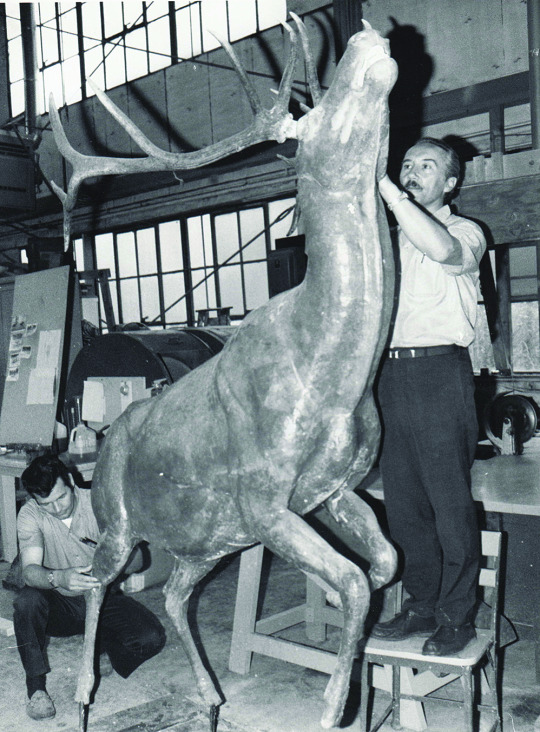
Otto Epping working on mammal taxidermy

Over the next 17 years, he completed many projects and with his passing, Otto leaves behind a legacy of well-crafted taxidermy that has now been enjoyed by several generations of visitors to Carnegie Museum of Natural History.

Not long after he arrived at the museum, a series of small dioramas were created, featuring some of Epping’s taxidermy, his wife Christine’s work on the plants in the foreground, and background paintings by Ottmar von Fuehrer or C. E. Smith.  Among these dioramas is a snow leopard currently on view in the Museum Store.  Individual mounts by Epping were used in the taxidermy areas of the “M is for Museum” exhibit as well as other displays that augment traveling, temporary shows that come to the Museum.

Some of Otto Epping’s craftsmanship can also be found in permanent displays on the second floor.   His first large project was the elk diorama, which occupies the entire east end of the Hall of North American Wildlife.
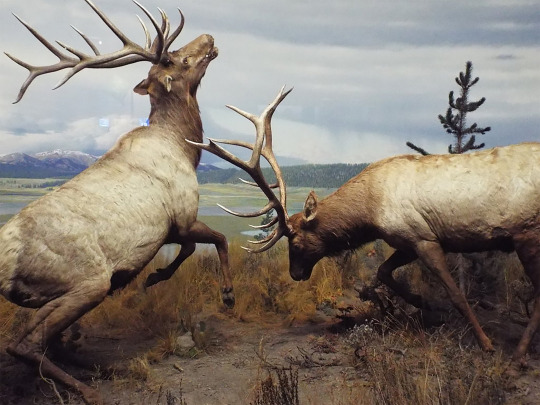
elk diorama

This exhibit draws the visitor in with two male elk sparring for mates in the foreground and the Hayden Valley of Yellowstone National Park behind them.  If you have ever been to Yellowstone, you might recognize this exact location as a place where you can stop for an expansive view of the Valley.

Epping collaborated with fellow taxidermist Ed McGuire on a display that depicts a male and female white-tailed deer on an October morning at the Museum’s Powdermill Nature Reserve.
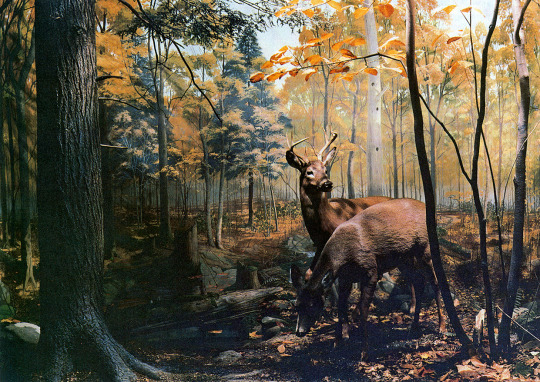
deer diorama

In this diorama, the male is alert to the presence of another male somewhere just out of view.  Well-done taxidermy captures an aspect of behavior that a viewer would expect to see in nature.  Take a close look the next time you are in the Hall of North American Wildlife.  Does this exhibit capture a vision that you have seen in Penn’s Woods?

Perhaps the most well-known of Epping’s taxidermy mounts is the adult male Lowland Gorilla found in the tropical forest section of the Hall of African Wildlife.
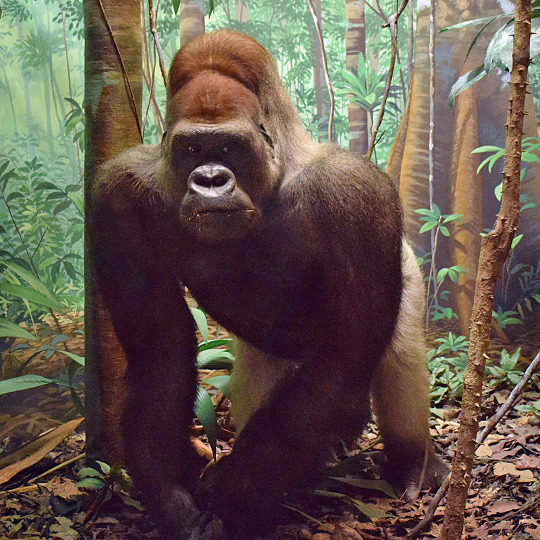
gorilla diorama

This silver-back had been a popular attraction at the Pittsburgh Zoo for nearly 15 years.  When he died in 1981, “George” was offered to the Museum and we quickly agreed to make him part of our planned changes in African Hall.  Epping collaborated with Danny Oplinger, using a method developed by renowned Field Museum taxidermist Leon Walters, to realistically portray the bare flesh and sparsely dispersed hairs on the face and feet of this primate. The final result is a world class rendering of a species that has always been a challenge for taxidermists.

Suzanne McLaren is the collection manager for the Section of Mammals and Stephen Rogers is the collection manager for the Section of Amphibians & Reptiles Carnegie Museum of Natural History. Museum employees are encouraged to blog about their unique experiences and knowledge gained from working at the museum.
Filed Under: Blog Tagged With: African Wildlife, mammals, taxidermy

February 1, 2018 by wpengine

Elephants and Ivory

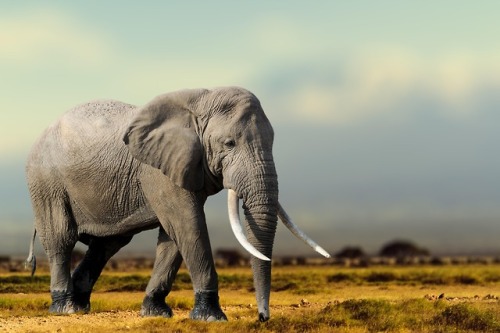
Elephant in the wild

Elephants and Ivory: Coordinating Natural History Museum Action to Address Wildlife Crime

Exquisite wildlife species like elephants, hunted and killed for ivory are endangered – and institutions like Carnegie Museum of Natural History are stepping up.

Eric J. Dorfman, the Daniel G. and Carole L. Kamin Director of Carnegie Museum of Natural History, wrote an article entitled:  “Elephants and Ivory: Coordinating Natural History Museum Action to Address Wildlife Crime” for a special elephant-conservation-themed issue of Curator The Museum Journal.

The article discusses wildlife crime, estimated to be worth as much as $23 billion annually on the black market. Elephants are frequent victims of poaching for their ivory tusks, and thieves desperate to obtain the material
try to steal elephant ivory from natural-history museums.

“Illicit trafficking of wildlife is arguably one of the most serious ethical and operational issues currently facing natural-history museums,” Dorfman writes. “As species like elephants become increasingly rare and efforts to protect them are stepped up, the black market is turning with increasing regularity to museum collections. Ongoing thefts from museums of elephant ivory and rhinoceros horn are being added to more traditional targets of crime such as gemstones, gold and cultural artifacts.”

More than 25 scholars and museum professionals contributed articles examining the ivory issue to the journal. John Fraser, Curator editor, says the issue shows the many ways museums can join a productive dialogue that can ensure the survival of elephants. “Essentially, this issue on ivory is a call to action for the entire museum sector,” Fraser says.

Filed Under: Blog Tagged With: African Wildlife

August 18, 2017 by wpengine

Burning Ivory

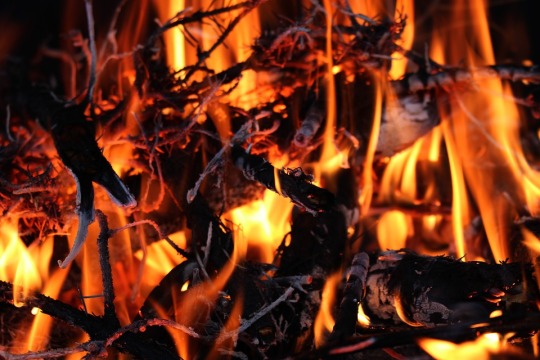
closeup of a fire

Dr. Eric Dorfman, the Daniel G. and Carole L. Kamin Director of Carnegie Museum of Natural History, recently wrote about the complicated practice of burning ivory on his blog. Check out an excerpt from his blog below:

“I just read an interesting blog post from National Geographic—“Does Destroying Ivory Save Elephants? Experts Weigh In.” Of course, a big public display of destroying artworks made from illegally hunted elephants makes an impact. National Geographic garnered the opinions of thinkers from all over the world, and their perspectives are equally varied.

For me, those people who are predisposed to thinking poorly of the ivory trade won’t be any more swayed by its destruction. They will continue to do what they can to protect elephants which, in most cases, is very little.

On the other hand, those people who value ivory artworks for their rarity (noting that China is the biggest market for this) might, in many ways, appreciate the burning of confiscated stashes, in that there is now less ivory in which other people can invest.”

Continue reading the full post.  

Filed Under: Blog Tagged With: African Wildlife

June 3, 2016 by wpengine

Play in the Savannah

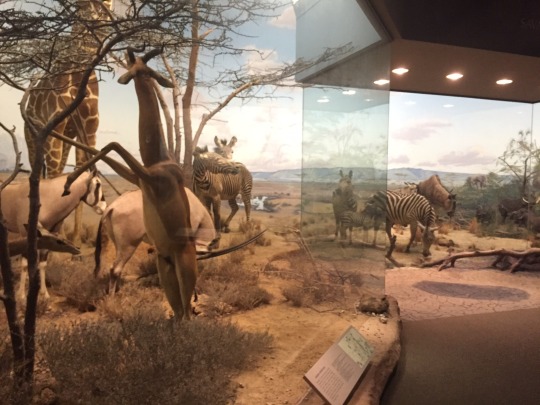
Hall of African Wildlife at Carnegie Museum of Natural History

by Patrick McShea

Amid the life sized, realistic diorama’s in Carnegie Museum of Natural History’s Hall of African Wildlife, there is a low table with adjacent seating that is reserved for play on a smaller scale.

Sturdy scale models of Africa’s emblematic species provide all that’s necessary for visitors to make associations, create scenes, simulate and imagine action, and engage in conversation.

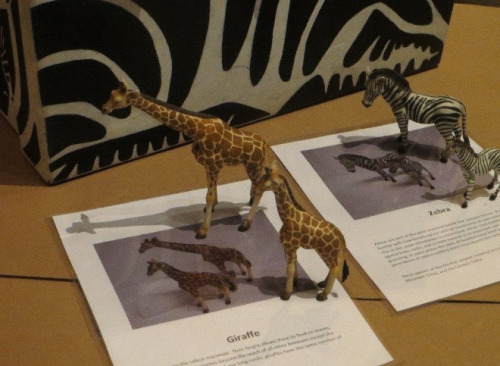
The plastic menagerie is housed in a zebra-striped toolbox, which also contains brief information sheets about featured creatures. Based upon the arrangements I’ve found while checking the table’s animal inventory, a popular pastime involves matching models with respective information sheets.

Giraffe and zebra miniature models

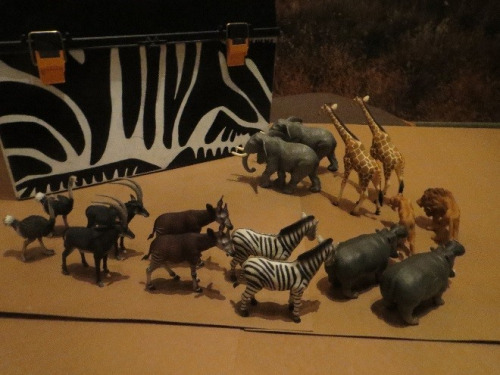
Novel uses include using the toolbox as a prop. Below the box stands-in for Noah’s Ark with the paired animal models in an orderly boarding line.

Savannah animals arranged in pairs

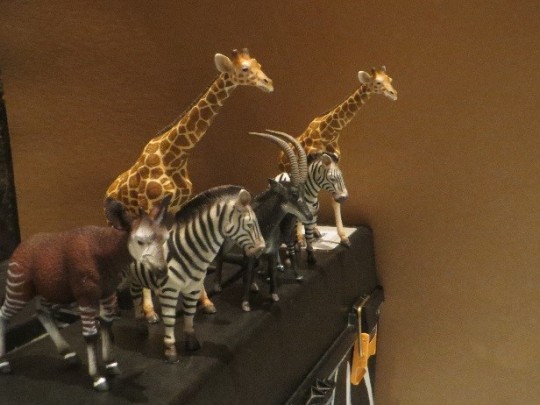
The creator of another scene appeared to imagine toolbox as a mesa with a line of grazers and browsers looking out to scout for predators or perhaps greener feeding grounds.

Savannah animal models

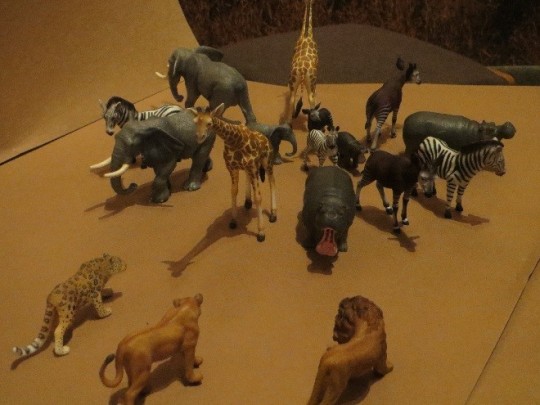
If the replicas’ proximity to dioramas containing life-sized taxidermy mounts invites discussion of scale, the plastic menagerie’s mix of carnivores and herbivores certainly leads to talk of predator and prey relationships. Below a dramatic visitor-constructed scene features a circle of full grown plant-eaters protecting their young from approaching meat-eaters.

Savannah animal models

Patrick McShea works in the Education and Visitor Experience department of Carnegie Museum of Natural History. Museum employees are encouraged to blog about their unique experiences and knowledge gained from working at the museum.
Filed Under: Blog Tagged With: African Wildlife, Education, Hall of African Wildlife, museums, Patrick McShea, Pittsburgh

sidebar

About

  • Mission & Commitments
  • Directors Team
  • Museum History

Get Involved

  • Volunteer
  • Membership
  • Carnegie Discoverers
  • Donate
  • Employment
  • Events

Bring a Group

  • Groups of 10 or More
  • Birthday Parties at the Museum
  • Field Trips

Powdermill

  • Powdermill Nature Reserve
  • Powdermill Field Trips
  • Powdermill Staff
  • Research at Powdermill

More Information

  • Image Permission Requests
  • Science Stories
  • Accessibility
  • Shopping Cart
  • Contact
  • Visitor Policies
One of the Four Carnegie Museums | © Carnegie Institute | Privacy Policy | Terms of Use | Accessibility
Rad works here logo