• Skip to primary navigation
  • Skip to main content
  • Skip to primary sidebar

Carnegie Museum of Natural History

One of the Four Carnegie Museums of Pittsburgh

  • Visit
    • Buy Tickets
    • Visitor Information
    • Exhibitions
    • Events
    • Dining at the Museum
    • Celebrate at the Museum
    • Powdermill Nature Reserve
    • Event Venue Rental
  • Learn
    • Field Trips
    • Educator Information
    • Programs at the Museum
    • Bring the Museum to You
    • Guided Programs FAQ
    • Programs Online
    • Climate and Rural Systems Partnership
  • Research
    • Scientific Sections
    • Science Stories
    • Science Videos
    • Senior Science & Research Staff
    • Museum Library
    • Science Seminars
    • Scientific Publications
    • Specimen and Artifact Identification
  • About
    • Mission & Commitments
    • Directors Team
    • Museum History
  • Tickets
  • Give
  • Shop

Albert Kollar

May 1, 2020 by wpengine

The Giant Eurypterid Trackway: A Great Fossil Discovery on Display in the Carnegie Museum of Natural History

Figure 1.

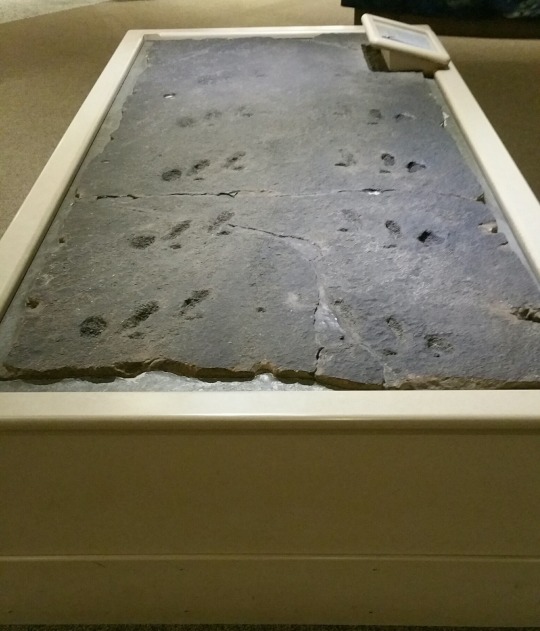
When museum patrons enter Carnegie Museum of Natural History’s Benedum Hall of Geology, they encounter a one-ton block of coarse sandstone with a series of bilateral footprints encased on the rock’s surface. Most visitors don’t know what type of creature made these footprints (Fig. 1) or realize that this fossil trackway represents one of the great fossil discoveries in the history of western Pennsylvania paleontology.
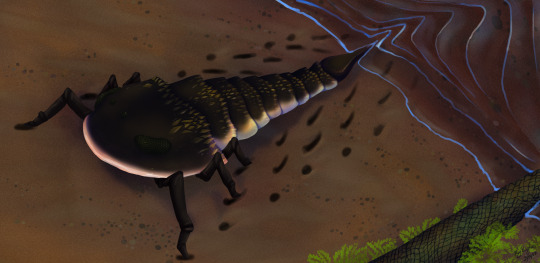
Figure 2. Illustration by Kay Hughes.

Last month, the cover of Pennsylvania Geology (Fig. 2) helped address both deficiencies. The magazine bears a colorful illustration by Kay Hughes of a 315 million-year-old scene: a large six-legged arthropod emerging from the water and dragging its tail onto a sand bar among fallen Lepidodendron logs. The intruder is a Giant Eurypterid, a creature known to science as Palmichnium kosinskiorum, and a member of an extinct family of arthropods informally called “sea scorpions” that are distant biological cousins.

Within the journal is a fuller explanation for the artistic interpretation of the creature behind the Benedum Hall trackway, an article I co-wrote with Kay Hughes and John Harper titled, Reflections on Palmichnium kosinskiorum-The Footprints of Pennsylvania’s Elusive Elk County Monster.

Fortuitous Discovery
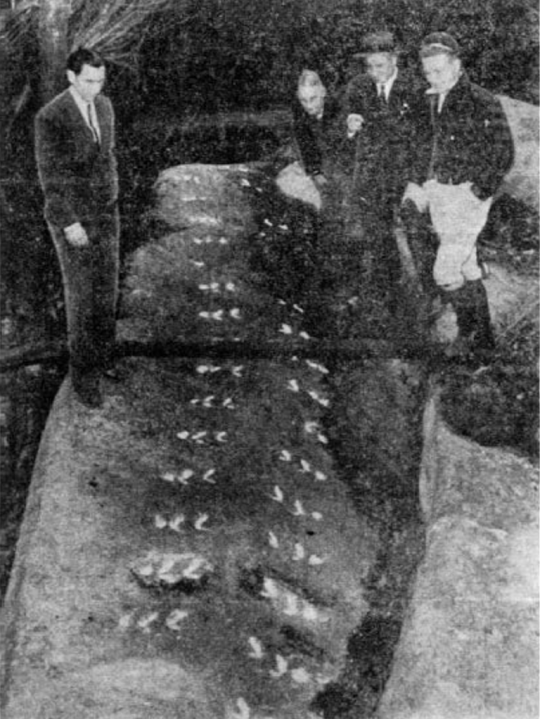
Figure 3. Photograph of Elk County in situ trackway looking southward (Brezinski and Kollar 2016).
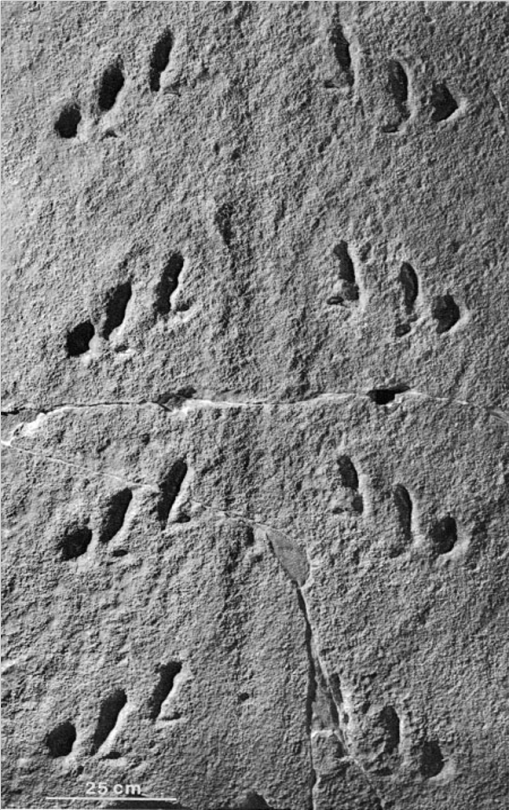
Figure 4. Trackway closeup showing tail drag on display in Benedum Hall of Geology (Brezinski and Kollar 2016)

Seventy-two years ago, in an Elk County section of the Allegheny National Forest, James Kosinski, a preparator in the Education Department of Carnegie Museum of Natural History, and his brother Michael were hunting deer in heavily wooded terrain. When Michael stumbled upon a large sandstone boulder bearing a pattern of unusual impressions, he informed James, who (Fig. 3) immediately recognized the impressions as the fossil tracks of an unknown animal (Fig. 4).

Later, when James described the discovery to Carnegie Museum’s Dr. E. Rudy Eller, Curator of the Section of Invertebrate Paleontology, and Dr. J. Leroy Kay, Curator of Vertebrate Paleontology, plans were made to remove a section of the boulder containing the best-preserved section of the trackway and transport the heavy block to the museum.

Exhibit History
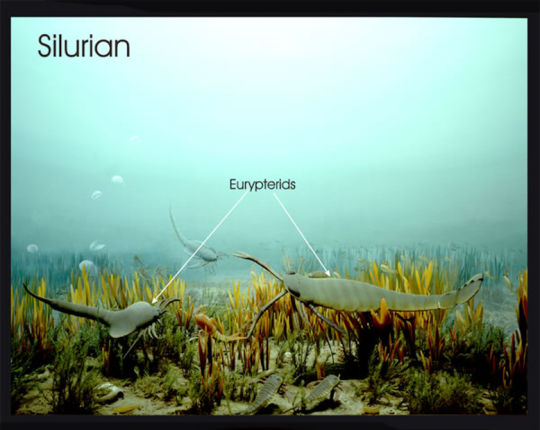
Figure 5. Former Paleozoic Hall Silurian Period Marine Diorama with Eurypterids.

Upon arrival at the museum in 1948, the sandstone block was prepared for exhibition and placed near the museum’s Coal Forest exhibit in 1949. In 1965, the trackway was incorporated as a floor centerpiece in the newly open Paleozoic Hall which featured dioramas of characteristic life forms of that Era’s time periods (Cambrian, Ordovician, Silurian, Devonian, Pennsylvanian, and Permian) along with representative fossils from the museum collection. (Fig. 5) In 1998, when Paleozoic Hall was dismantled, the trackway was placed temporarily in the Invertebrate Paleontology lab. The trackway returned to public view in 2007 as part of Bizarre Beasts, a temporary exhibition in the R. P. Simmons Family Gallery about unusual life forms. When Bizarre Beasts closed, I worked with James Senior, Chair of the museum’s Exhibit Department, to place the trackway in the Benedum Hall of Geology entrance as an introduction to great fossil discoveries from western Pennsylvania.

The Research – Locality Data Supports Recent Theory

The fossil trackway was initially identified by Dr. Kay as a hopping reptile inhabiting a Pennsylvanian coal forest 300 million years ago. Although Dr. Eller, citing his own research, suggested the track was formed by a crawling eurypterid, it would take 35 more years for the fossil trackway to be studied by expert arthropod paleontologists from Europe.

The eventual designation of Palmichnium kosinskiorum as a holotype specimen (CM 34388), a category of first order scientific importance, dates to the fossil’s description as a eurypterid trackway in a 1983 research paper by Dr. Derek E. G., Briggs and Dr. W. D. J. Rolfe, titled, A giant arthropod trackway from the Lower Mississippian of Pennsylvania (Journal of Paleontology, 57, 377 – 390). In paleontology, when a non-scientist such as Michael Kosinski discovers a fossil of importance, paleontologists, in this case Derek Briggs and Ian Rolfe, name the new fossil species after the founder, hence P. kosinskiorum.

For years, paleontologists in the Section of Invertebrate Paleontology assumed the scientific conclusions of Briggs and Rolfe (1983) about the eurypterid trackway were beyond dispute. This situation changed in 2009, when Yale University Professor Adolph Seilacher, a world-renowned expert on fossil trackways visited the museum. While Briggs and Rolfe concluded the trackway formed in a marine sandstone, Seilacher explained to me that the trackway was likely formed in an eolian or wind-blown sand environment. He also recommended that someone investigate the rocks at the fossil location in Elk County to substantiate his hypothesis.
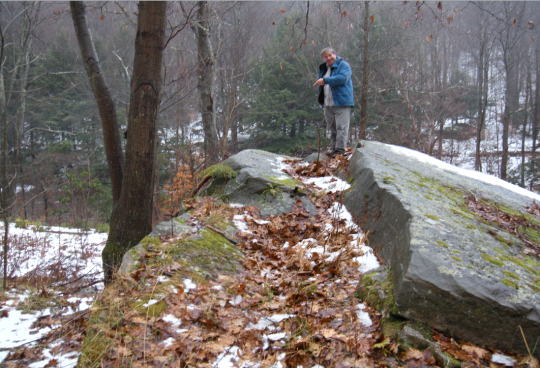
Figure 6. D.K. Brezinski at trackway. 

Later that year, when I accompanied David K. Brezinski, Associate Curator Adjunct, Section of Invertebrate Paleontology, to re-locate and re-examine the sandstone boulder with the remaining tracks, we discovered the original geologic and deposition conclusion by Briggs and Rolfe (1983) was incorrect (Fig. 6). In 2011, we reported these new findings at the Northeastern Sectional Meeting of the Geological Society of America in Pittsburgh.  After the meeting, we continued our research and eventually published our conclusion that the geologic age of the trackway was Early Pennsylvanian age and the embedded footprints represented a fluvial sand bar environment of deposition.(Reevaluation of the Age and Provenance of the Giant Palmichnium Kosinskiorum Eurypterid Trackway, from Elk County, Pennsylvania, Brezinski and Kollar (2016),  Annals of Carnegie Museum 84, 39 – 45,)

School Groups and Museum Interpreters

Based upon repeated anecdotal reports from the Interpreters who guide tour groups through the museum’s exhibit halls, the eurypterid trackway is one of the most celebrated education stops for elementary school students. According to Interpreter Patty Dineen, the appealing factors of the trackway include the size and possible scariness of the creature who made the tracks, the fact the track-maker lived long before the dinosaurs, the fossil’s local origin, and the sheer amount for information that can be gathered from the ancient preserved tracks.
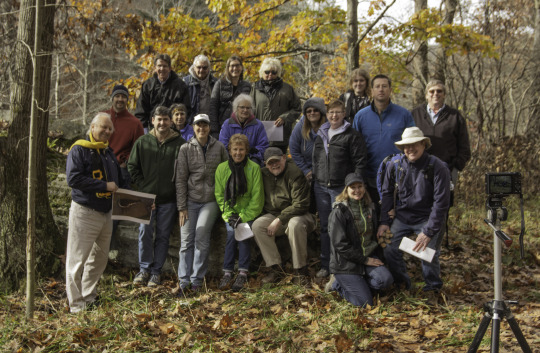
Figure 7. Interpreter field trip.

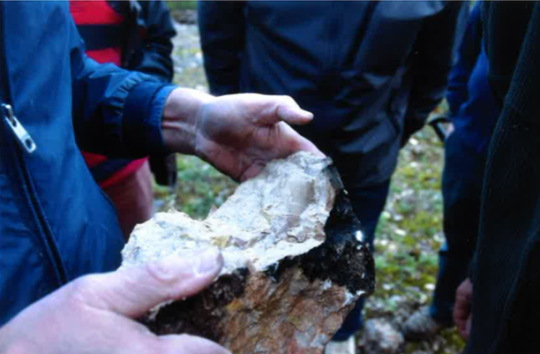
As part of an effort to better inform school groups about the eurypterid trackway, in 2017 Patty Dineen and Joann Wilson, co-coordinators and instructors for the museum’s Natural History Interpreters, arranged for six Interpreters to participate in a PAlS geology fall field trip to the fossil site in Elk County. (Fig. 7) An important by-product of field excursion was the creation of an instructional video that explains how museum scientists conduct research.

“Treasures of the Carnegie” Planning for a better Trackway Experience

Now that an illustration exists (Fig. 1) of the eurypterid that shaped the trackway walking out of the 315 million-year-old Olean River onto a sand bar, it might be time to consider how to best devise an improved visual and virtual tour experience for the Carnegie patrons and school groups.

Albert D. Kollar is Collections Manager for the Section of Invertebrate Paleontology at Carnegie Museum of Natural History. Museum staff, volunteers, and interns are encouraged to blog about their unique experiences and knowledge gained from working at the museum.
Filed Under: Blog Tagged With: Albert Kollar, Benedum Hall of Geology, invertebrate paleontology, Museum from Home, Science News

March 9, 2020 by wpengine

The Connemara Marble: A Cross-Atlantic Connection Between Ireland and Pittsburgh

Irish Dippy the dinosaur statue

Fig. 1: Irish Dippy

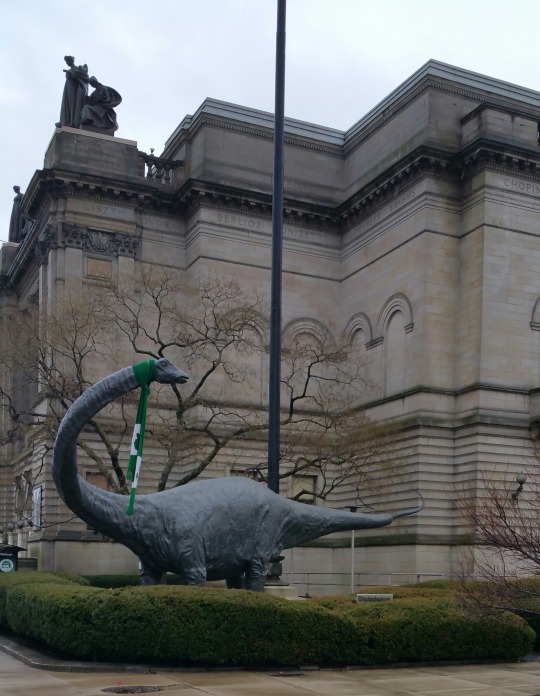
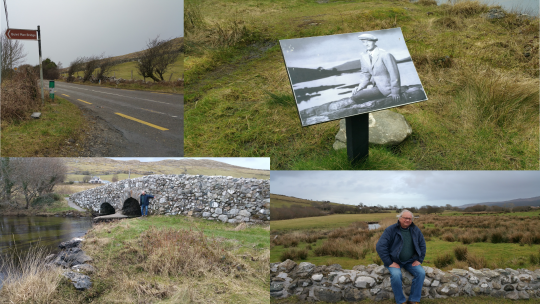
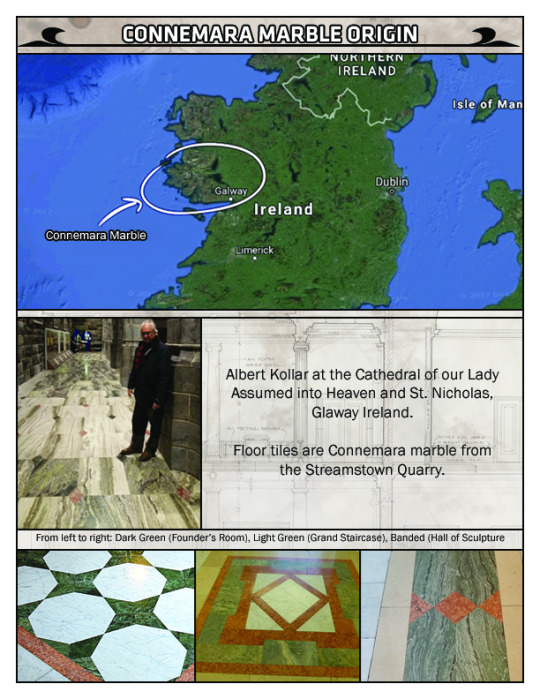
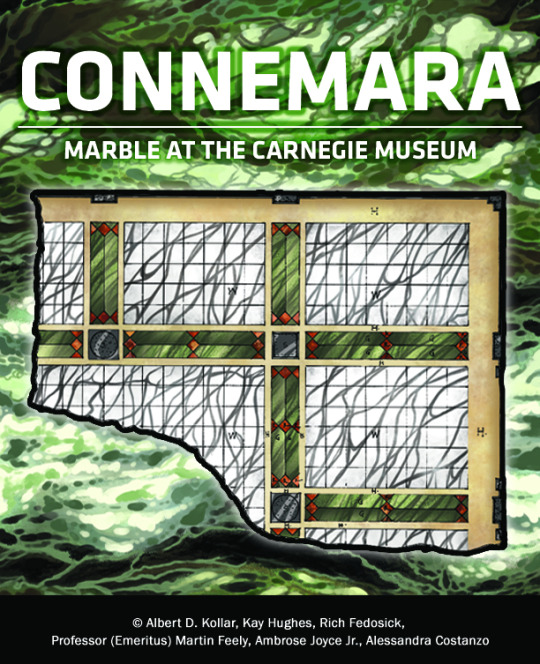
Each March in celebration of St. Patrick’s Day, the full-size dinosaur replica of Dippy (Diplodocus carnegii) that stands guard outside the Carnegie Complex along Forbes Avenue in Oakland, is draped in an iconic Irish scarf (Fig. 1). Inside the classic halls of the Carnegie Complex is a green marble from County Galway, western Ireland. It is called Connemara Marble and is ubiquitous in the museum’s architectural floor designs. Before visiting Ireland for the first time in 2015, my only reference to the green Isle was watching a classic John Wayne and Maureen O’Hara movie, titled, The Quiet Man circa 1952. Much of the movie was filmed amongst the Connemara landscapes and many of the films iconic locations survive to this very day, such as the famous Quiet Man Bridge (Fig. 2).  Moreover, researchers from the Carnegie Museum, National University of Ireland Galway, Connemara Marble Industries Ltd., Moycullen and Mount Holyoke College in Massachusetts, are investigating the significance of this Irish green marble in the architectural design of the Carnegie Institute Extension built by Alden & Harlow in 1907 (Fig. 3), Kollar et al., 2017; Feely et al., 2019, and Kollar et al., in review.

Fig. 2: Quiet Man bridge

Fig. 3: Connemara Map

The Streamstown Quarry in Western Ireland

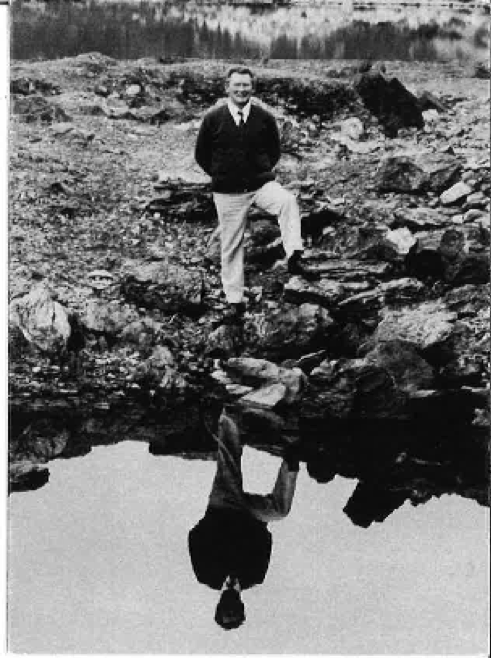
A cross-Atlantic research connection between Ireland and Pittsburgh was initiated in the winter of 2015, when I visited Martin Feely at the National University of Ireland, Galway, an expert on the geology of the Connemara Marble, and Ambrose Joyce, owner of the Streamstown quarry. The objective was to determine the provenance and geology of the Carnegie’s Connemara Marble quarry and to compare the varieties of colored marbles used in the Carnegie’s floor tiles against other buildings with Connemara Marble from the Streamstown quarry (Fig. 4).  The Connemara Marble can be found in the twelve public spaces, corridors, and private rooms, including the Hall of Sculptures, Grand Staircase, Green Room, President’s Office, and entrance corridors to the Carnegie Library of Pittsburgh. A unique use of Connemara Marble is as inlays in the design of the Thistle, the Scottish National flower in the Music Hall Foyer walls.

Fig. 4: Connemara Marble at the Carnegie Museum 

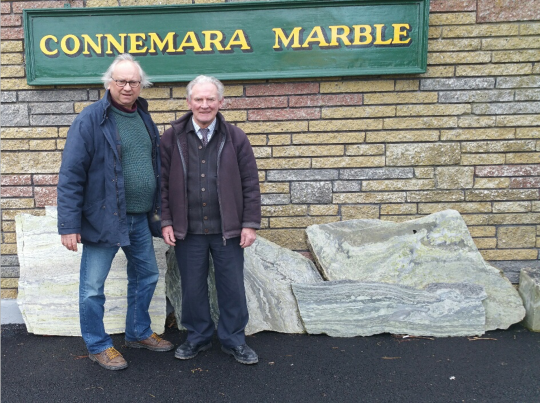
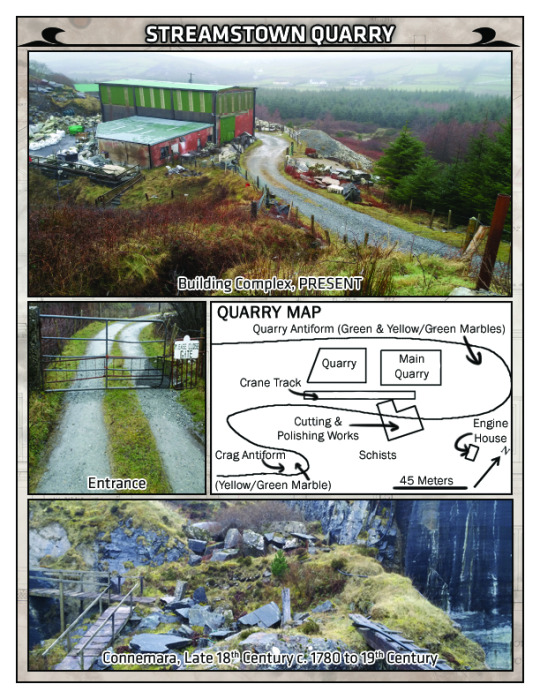
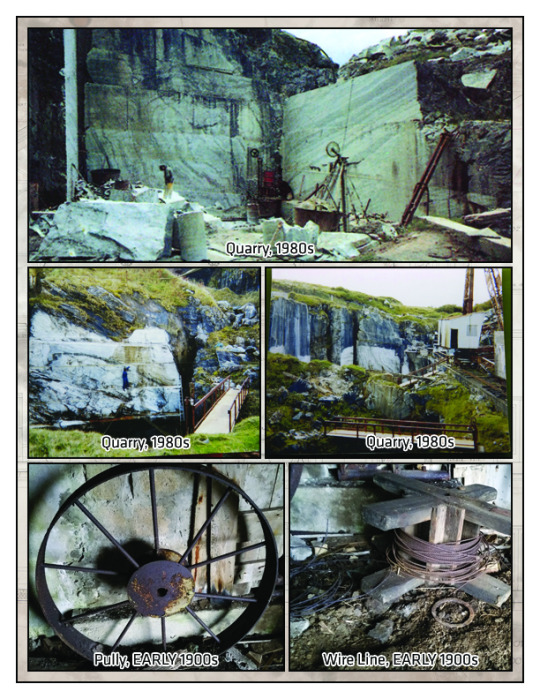
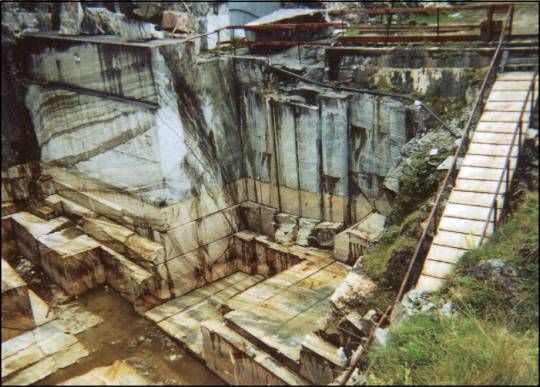
The best way to get to the Streamstown Quarry is by car. The 50-mile drive, along the N59 from Galway to Clifden takes about an hour and 15 minutes through quaint villages and along scenic winding roadways. Understandably, it rained that day as it commonly does in County Galway, circa 45 inches per year. In comparison, Pittsburgh receives about 36 inches of rain per year. Like Pittsburgh, Galway has lush green landscapes because of the annual rainfall.  Visible from the road are mountainous outcrops and lakes e.g. the Twelve Bens quartzite mountains formed over millions of years ago. Their present topography resulted from ice-sculpting during the last glacial maximum. The peat bogs in the low-lying regions formed 5,000 years ago. The history of the Streamstown quarry (Fig. 5) was always best recounted by the patriarch of the family Ambrose Joyce Sr., who sadly passed away in 2015 (Fig. 6 a, b). The entrance to the quarry is hidden from the main road and access is through a gate and then along a minor road shared by other land owners – access to the quarry is strictly by permission only, from Ambrose Joyce. The quarry and its buildings are surrounded by stockpiles of large marble blocks (Fig. 7). I walked around the quarry with Ambrose Joyce Jr. to see the old equipment and hear about the marble quarrying operations dating back to its late 19th century active period (Fig. 8). Then we viewed the modern quarry (Fig. 9) as Martin Feely explained the geology of the 650 Ma. pre-Cambrian limestone that would become green marble during the Ordovician Period some 470 million years ago.

Fig. 5: Streamstown Quarry

Fig. 6 a: Ambrose Joyce, Sr. 

Fig. 6 b: Ambrose Joyce, Sr. and Albert Kollar

Fig. 7: Streamstown Quarry setting

Fig. 8: Streamstown Quarry history

Fig. 9: Albert Kollar, Martin Feely, Ambrose Joyce Jr.

We returned to Galway via the Connemara Marble Industries Ltd., Moycullen, County Galway to meet with the Joyce family (Fig. 10). At the Connemara Marble Industries Ltd., Moycullen marble souvenirs and jewelry are produced for the tourist trade using the marble extracted from Streamstown quarry (Fig. 11, 12, 13).  Today, the ongoing global demand for Connemara Marble, for use in interior decoration projects, is supplied by the Italian company Antonlini. They source the marble from another Connemara marble quarry located several miles to the east of the Streamstown quarry.

Fig. 11: Christmas ornaments

Fig. 12: Coaster and Cube Shamrock

Fig. 13: Kennedy, Joyce, and rosary shamrock

Global Heritage Stone Resource

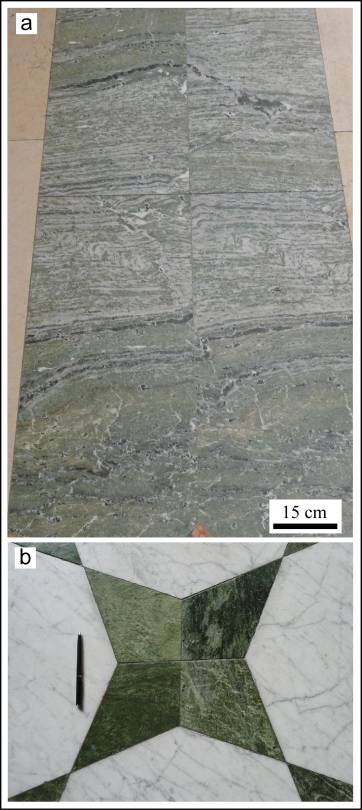
In 2019, the Connemara Marble was proposed as a Global Heritage Stone Resource with a citation to the Connemara Marble used in the Carnegie Museum (Wyle Jackson et al. 2020)  This Irish Heritage Stone was a much sought-after green marble for use in architecture, buildings and sculptures in Ireland, England, and the United States from the mid-19th century to the early 20th century including the Carnegie’s Hall of Sculpture (Fig. 14 a) and the Founder’s Room (Fig. 14 b) floor designs.

Figs. 14 a and b: Floor tiles

Have a Happy St. Patrick’s Day.

Albert D. Kollar is the Collection Manager in the Section of Invertebrate Paleontology at Carnegie Museum of Natural History. Museum employees are encouraged to blog about their unique experiences and knowledge gained from working at the museum.
Filed Under: Blog Tagged With: Albert Kollar, invertebrate paleontology, Science News

February 10, 2020 by wpengine

A Journey to France to Uncover the Mysteries of the Carnegie’s Grand Staircase

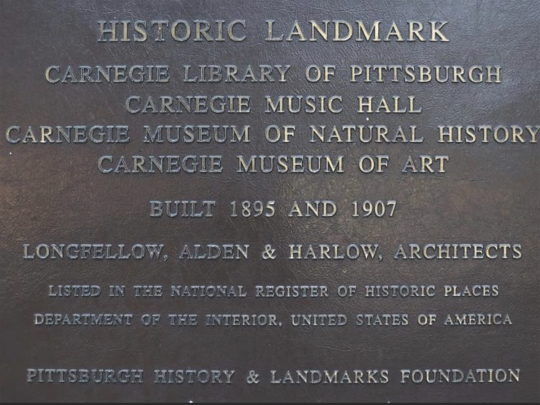
The Carnegie Institute has been in existence for 125 years and is one of the greatest architectural buildings ever designed in Pittsburgh. In 1985, Carnegie Institute President Robert Wilburn invited Dr. Cynthia R. Field, the Smithsonian’s Architecture Historian, to assess the artistic value of the museum. He asked, “what do you think is the most valuable specimen or painting in the museum?” She said, “The Building Itself is the Greatest Object of the entire Museum Collection” (Fig. 1).

image

Fig. 1: Carnegie plaque

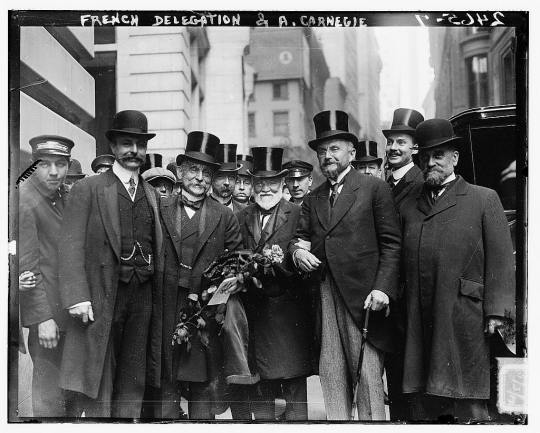
The internationally-famous architect, I.M. Pei, who designed the Louvre’s glass pyramid that sits in the Louvre’s central courtyard in Paris, France, opined, “Architecture is the very mirror of life. You only have to cast your eyes on buildings to feel the presence of the past, the spirit of a place; they are the reflection of society.” In 2018, Architecture Digest ranked the Carnegie’s Grand Staircase the 8th best museum staircase in the world. The Grand Staircase was built by the Pittsburgh architectural firm of Alden and Harlow at the apex of America’s Gilded-Age building boom. During my research, I discovered that the architects employed multicolored classic marbles and fossil limestones in the interior design from Algeria, Croatia, Greece, France, Ireland, Italy, and the United States. The commission to build the Grand Staircase in 1907 incorporated two classical French fossil limestones in the columns and pillars, floor tiles, steps, walls, balconies, and water fountains. This monumental Beaux-Arts style staircase is modeled after the L‘Opéra Garnier ‛a Paris, Grand Staircase in France, c. 1875, and was visited by a French Delegation with Andrew Carnegie (Fig. 2). The architecture described as Beaux-Arts was taught at the École des Beaux-Arts in Paris, from the mid-19th century until 1900. It drew upon the principles of French neoclassicism and used modern building materials, i.e., iron and glass. And as such, it became a preferred architectural style in the United States from 1895 until 1910 in cities such as, Boston, Chicago, New York City, Pittsburgh, and Washington D.C.

image

Fig. 2: French delegation and Andrew Carnegie

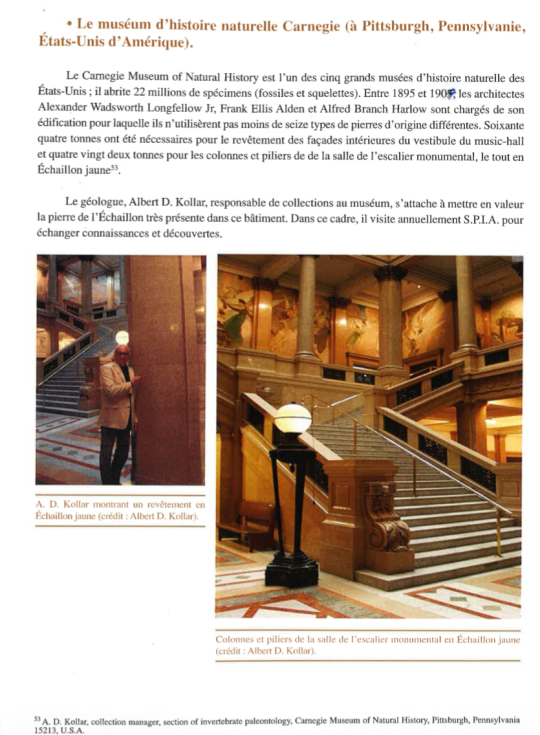
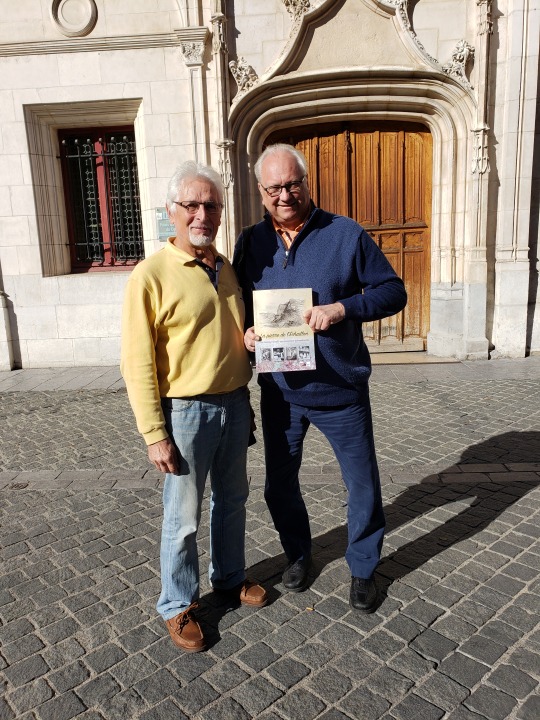
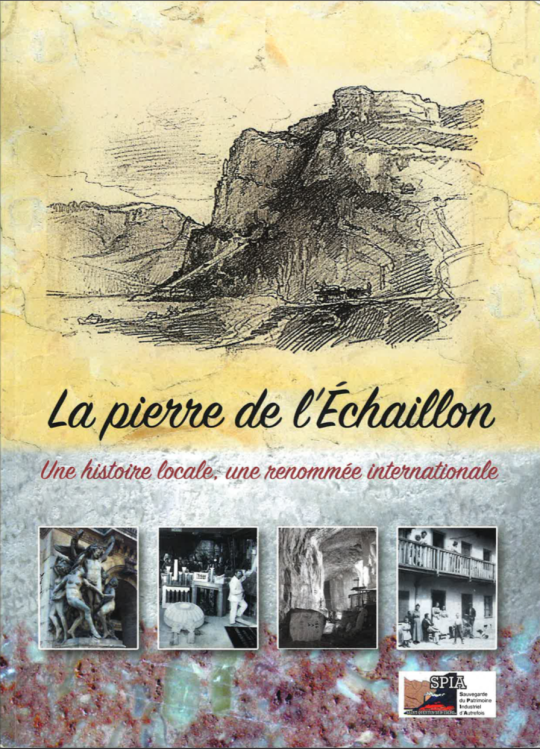
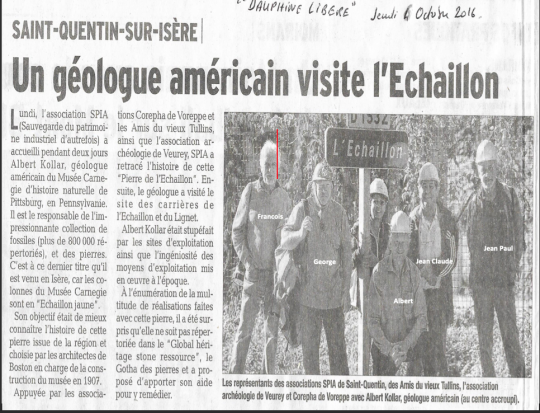
In 2019, The Carnegie’s Grand Staircase and Music Hall Foyer were recognized in the book La pierre de l’Échaillon Une histoire locale, une renommée international for the use of Échaillon jaune (yellow) ornamental stone in the museum’s columns, pillars, and walls (Fig. 3). This book was published by S.P.I.A. (Sauvegarde du Partrimoine Industriel d’Autrefois, a historical society founded by Jean Paul Rey, president) (Fig. 4).  In the book, they describe how a small French village of l’Échaillon, pronounced Esh-ee-own, received recognition for its white marble (a limestone) used by famous French architects in 64 classic buildings and sculptures from 1875 to the early 20th century (Fig. 5).  I first met Jean Paul in October of 2016, when I was invited to give a presentation at an S.P.I.A. meeting on my research on the Carnegie’s l’Échaillon.  The meeting was held in an old schoolhouse in the village of Saint-Quentin-sur-Isère, Département de Isère, in southeast France.

image

Fig. 3: The Grand Staircase

image

Fig. 4: Jean Paul Rey and Albert D. Kollar

image

Fig. 5: Book cover

The French Limestones in the Carnegie’s Architecture

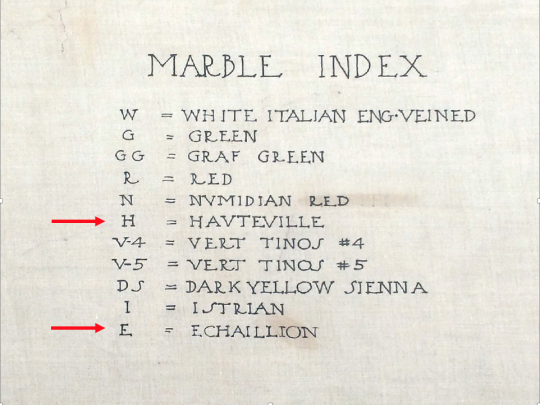
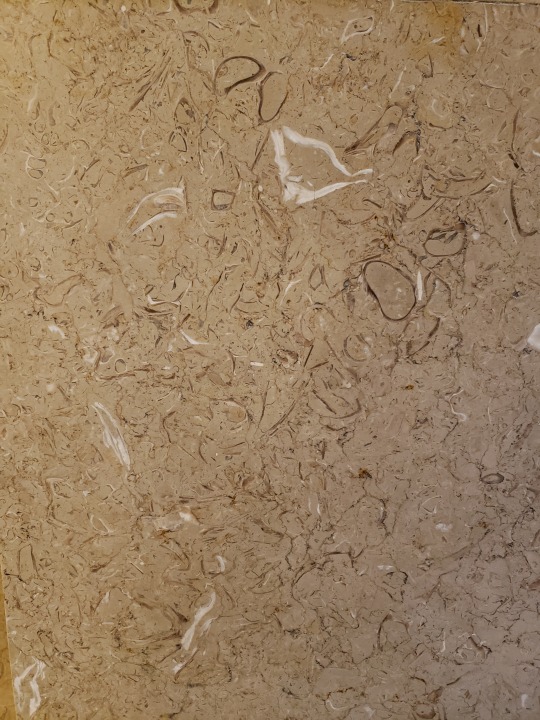
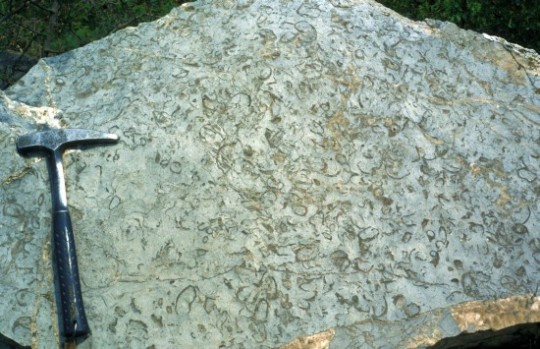
The Carnegie building stones research project progressed significantly, once we obtained the digital images of the architect’s blueprints from the Carnegie Museum of Art’s Architecture Department. With the assistance of my co-authors, Rich Fedosick and Kay Hughes of the Section of Invertebrate Paleontology, we examined the blueprints to understand the architects Marble Index terminology (Fig. 6). Eventually, we were able to interpret and recognize the location of the two French limestones based on the Marble Index letters, E for Échaillon and H for Hauteville. From a nonscientific perspective, the architects considered the Carnegie’s interior stones to be marbles. However, the geological definition of a marble is when a rock defined as a limestone or dolomite is subjected to high heat and pressure from geologic forces forms a metamorphic rock.  The six stones listed in the Marble Index as marbles, are limestones, a sedimentary rock enriched with fossil seashells. The characteristic rudist fossils and yellow color that distinguish the Échaillon stone are found in the 18 pillars and the 22 columns that rise 3.8 meters or 12.5 feet about the Grand Staircase, and in the walls of the Music Hall Foyer (Fig. 7).

image

Fig. 6: Marble index E and H letters

image

Fig. 7: Échaillon fossils

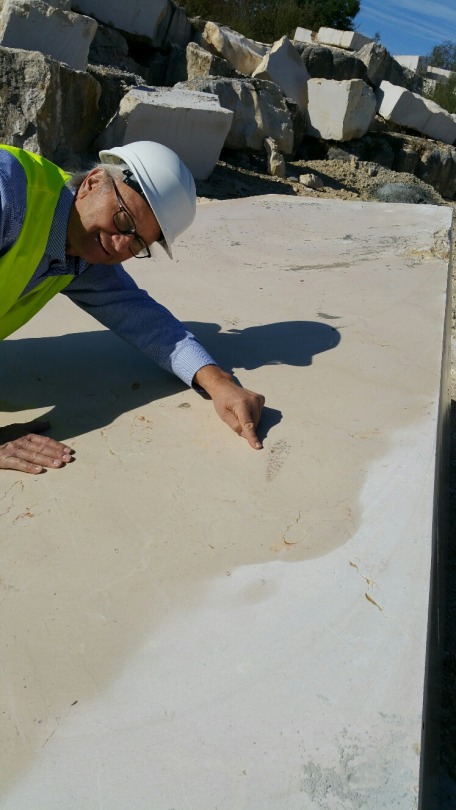
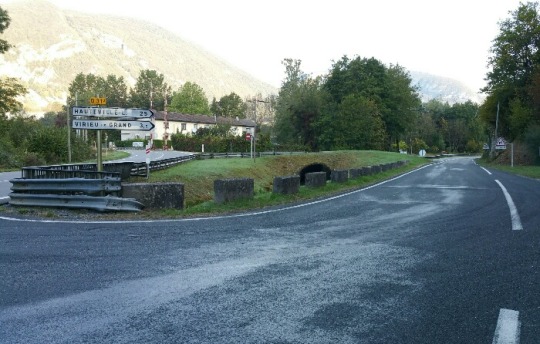
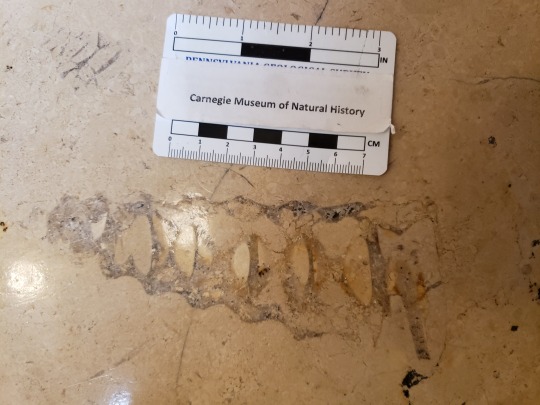
The other French limestone used in the Carnegie is Hauteville. This limestone was quarried from the Plateau d’Hauteville in the Ain Department, in eastern France. I visited this quarry in 2016 to investigate the geology of the quarry operation, to uncover evidence of the common fossil snail Nerinea in the quarry rock (Fig. 8), and to learn more about the cultural history of the region (Fig. 9).  The Hauteville limestone was used in the Grand Staircase walls, balcony features, water fountains, vestibule steps, and as floor tiles. Other locations include, the Hall of Sculpture and Hall of Architecture floors, the walls along the grand hallway, the Music Hall vestibule floor, the Founder’s Room vestibule floor, the floor and steps in the Smoking Room (now offices), the Forbes Avenue vestibule entrances to the music hall, carriage drive, and museum and fine arts. Moreover, the Hauteville floor tiles are distributed throughout the Carnegie Library of Pittsburgh main entrance corridors. The Hauteville stone is beige in color and contains many visible fossils, none more distinctive than the robust Nerinea, a 12.7 cm/5-inch-long snail that serves as the index fossil for the limestone identification (Fig. 10).

image

Fig. 8: Hauteville Quarry fossil snail

image

Fig. 9: Hauteville directional signs

image

Fig. 10: Nerinea snail in Carnegie floor

Introduction to the l’Échaillon Carrières

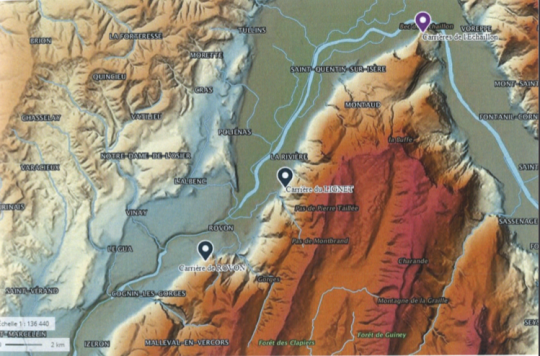
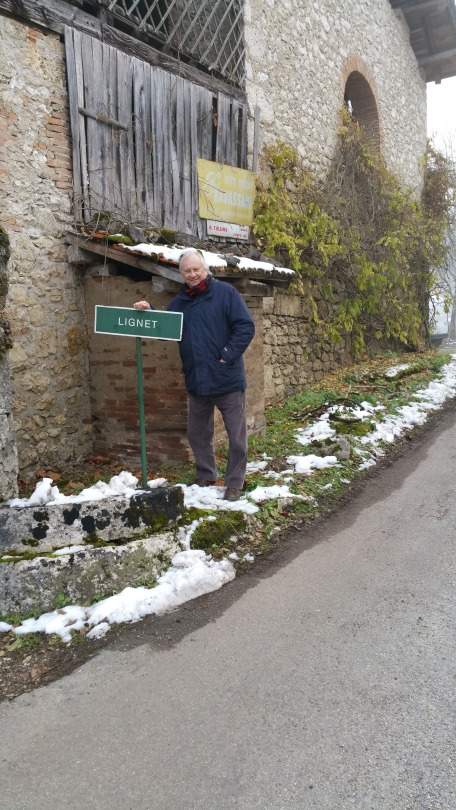
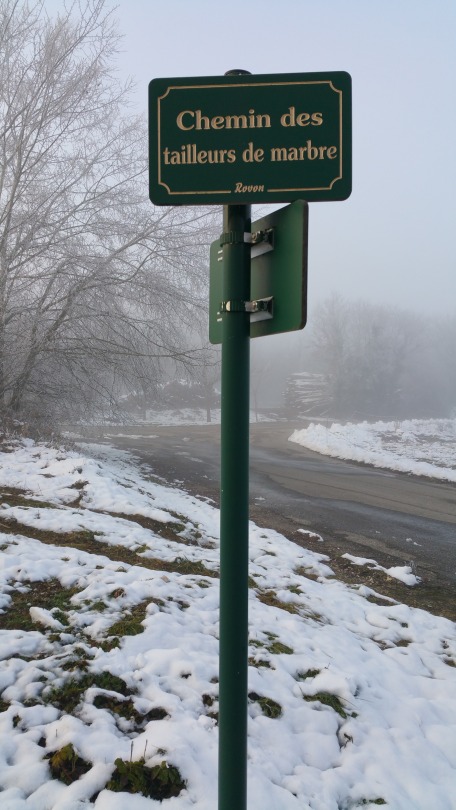
There are three carrières or quarries in the Vercors cliffs located in the Isère River Valley that were excavated for White Echaillon or “Echaillon blanc,” Yellow Echaillon or “Echaillon jaune,” and Pink Echaillon or “Echaillon rose” during the 19th and early 20th century (Fig. 11).  These unique color combinations became popular for various interior and exterior architecture features in 194 buildings in western Europe, North Africa, and the United States. In 2016, Jean Paul Rey and members of S.P.I.A. led me on a field trip to the abandoned classic l’Échaillon white quarries (Fig. 12). We explored what is thought to be a 2,000-year-old Roman quarry and walked through a maze of underground caverns and narrow tunnels that contained abandoned mining equipment.  The other two Echaillon carrières are located several kilometers south in the small villages of Lignet, where the Pink Echaillon was quarried (Fig. 13) and Rovon, where the Yellow Echaillon was excavated (Fig. 14).

image

Fig. 11: Echaillon quarries locations, S.P.I.A.

image

Fig. 12: Visit to Echaillon

image

Fig. 13: Lignet Quarry Marker

image

Fig. 14: Rovon quarry

Cularo, Grenoble, and the white l’Echaillon stone

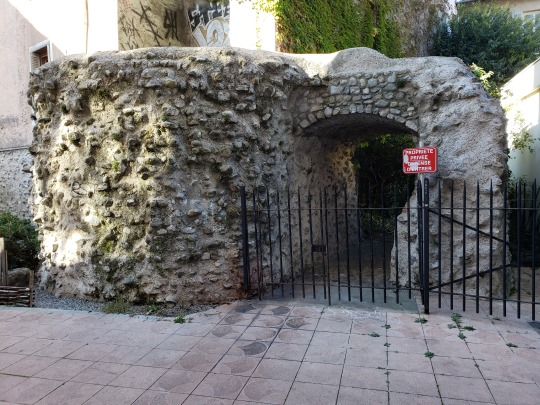
A fortuitous discovery was made by S.P.I.A. for their book while searching for evidence of the white l’Echaillon in the Gallo-Romans era 4th century Cularo or Grenoble, France today. In the Saint Laurent crypt that is preserved many meters below the modern-day street level tramway, a white capitol on top of a white limestone column was identified as l’Echaillon. This white capitol stone is presumably from the Roman quarry adjacent to the white l’Echaillon underground caverns. When Emperor Gratian ruled the Roman Empire from 367 to 383 A.D., he renamed Cularo after himself. Cularo thus became Gratianopolis, which through a later phonetic shift became Graignovol and then Grenoble. Although hard to find among the narrow streets and passageways of Grenoble, is a section of a Roman wall that once encircled Cularo, a portion of which is protected by a fence. This historic wall can be seen at Passage Sainte-Claire on the corner of Rue Lafayette, in the central city of Grenoble (Fig. 15). I suspect some of the white cobbles embedded in the wall may have their origin from the white l’Echaillon Roman quarry. Undoubtedly, more research will be necessary to make an affirmative conclusion.

image

Fig. 15: Roman wall

“Geology of the l’Échaillon Carrières”

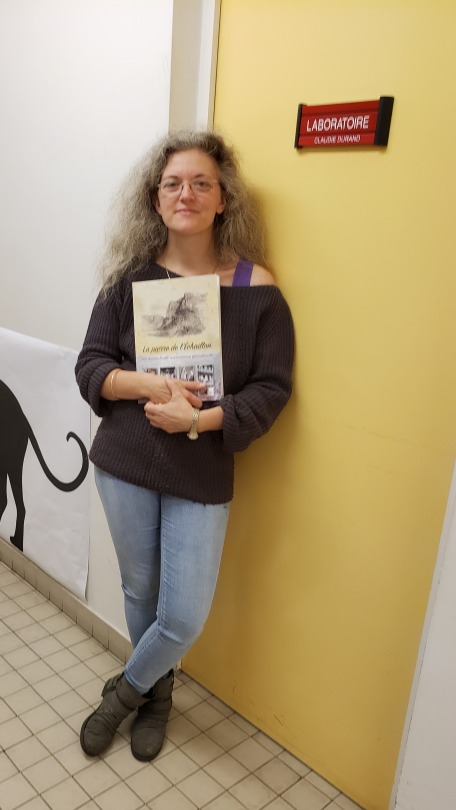
The drawing of a new geologic map on the l’Echaillon carrières by Professor Thierry Dumont of the Université Grenoble-Alpes, confirms stratigraphically, the ages of the three limestone quarries. Among the three, the white Echaillon limestone is late Jurassic in age, whereas the pink Lignet and yellow Rovon limestones are early Cretaceous in age. The formal geologic name for the rose and yellow limestones is the Urgonian Formation. Fossils are abundant in the three limestones. Dr. Claudie Durand of Le musèum d’Histoire naturelle de Grenoble (Fig. 16) curated a diverse collection of 163 species of invertebrate fossils from l’Echaillon first published in 1919. Geologically, the three limestones were deposited in the tropical Tethys Seaway a circum-equatorial ocean of the Mesozoic Era. The strata form the Vercors carbonate platform, a buildup of late Mesozoic rudist (bivalve mollusk) reefs spanning 25 million years of evolution from (late Jurassic 140 million years ago to early Cretaceous 165 million years ago) (Fig. 17).  

image

Fig. 16: Dr. Claudie Durand

image

Fig. 17: Rudist (bivalve) reef fossils

The Rovon carrière provenance and fossils

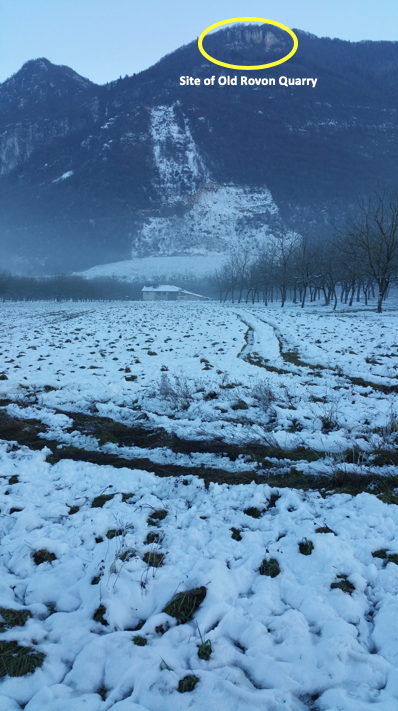
The primary goal of this research is to define the geology and authenticate the specific provenance of all marbles, fossil limestones, sandstones, and the singular igneous granite rock used in the Carnegie building. The search for the provenance of the Carnegie’s yellow Echaillon was initiated in December of 2017 by Jean Paul Rey, when we were introduced to the Forman of the modern-day Rovon quarry. After a long discussion about our objectives, he granted permission to visit the old quarry. As darkness fell, we met with a local farmer who directed us to the quarry location in the Vercors cliffs that rise some 538 meters above his snow-covered field (Fig. 18).  

image

Fig. 18: Verors cliffs and old Rovon quarry

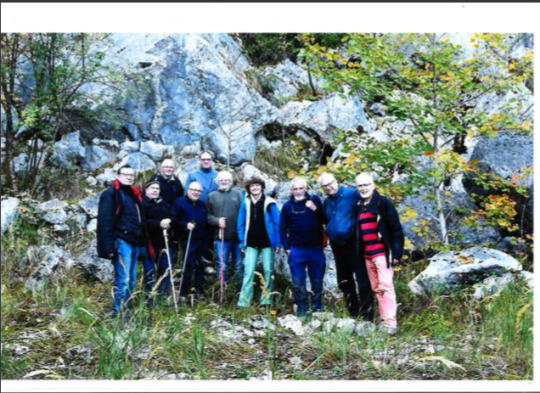
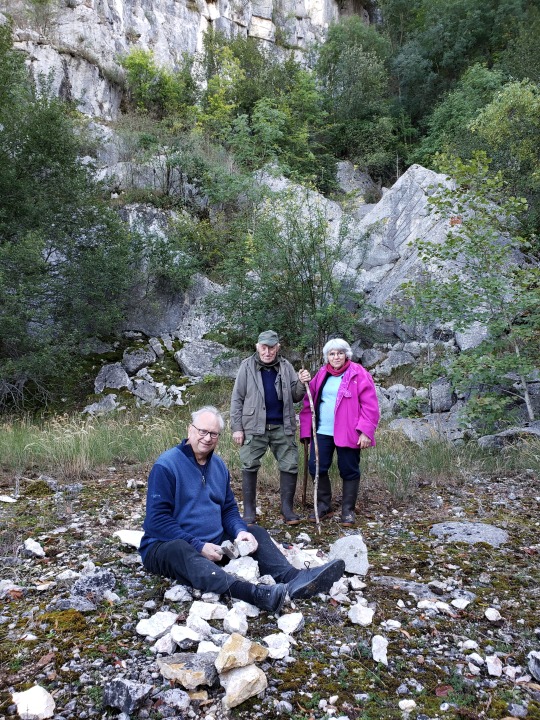
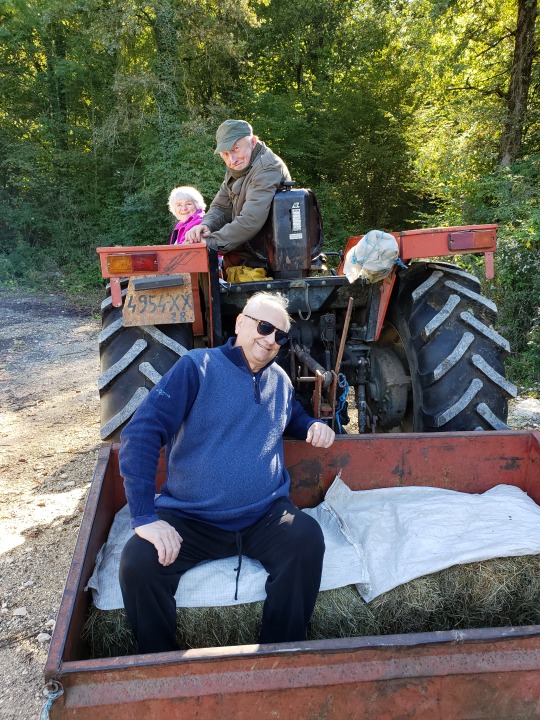
In October of 2018, the S.P.I.A. team pre-arranged to have several 4-wheel trucks transport ten people including Professor Fabienne Giraud-Guillot of the Université Grenoble-Alpes to the Rovon quarry. We ascended the long steep road that ended some 500 m from the main quarry. Surprisingly, the quarry was filled with massive limestone boulders that were cut by mechanical wire saws from the cliff rock (Fig. 19). Such large boulders make it virtually impossible to break with small hammers. For actual fossil collecting purposes, it is better to search for smaller size rocks to break apart (Fig. 20). This past October, transport to the Rovon quarry riding in a 55-year-old Russian built farm tractor was a treat (Fig. 21). And the fossil collecting was a success with 21 complete specimens collected for the museum of the diagnostic Caprina rudist bivalve clam (Fig. 22). The shape of these fossils closely resembles the fossils preserved in the Echaillon limestone in the Grand Staircase and Music Hall Foyer. Additional geologic data is being reviewed by colleagues from the Geology Department at the University of Zagreb in Croatia and the University of Ireland at Galway.  

image

Fig. 19: S.P.I.A. team

image

Fig. 20: Collecting fossils

image

Fig. 21: Russian tractor

image

Fig. 22: Caprina rudist clam

“Carnegie’s Grand Staircase in the 21st Century”

A study published this month by the BMJ, formerly The British Medical Journal, suggested that “when people of all ages participate in the arts and visit museums once a month or even every few months, they are likely to be more engaged in the world and may actually live longer.” Years ago, the Oscar winner actor Russell Crowe was in Pittsburgh, and he was asked what he did on his days off. In reply, he said, “I ride my bicycle to look at buildings and the architecture of the city.” I. M. Pei states, “Architecture brings people together.” I agree.

Maybe it’s time to reconsider how the Carnegie’s Grand Staircase is promoted to the public at large. For instance, the current arrangement of the free-standing dioramas situated on the first floor, awkwardly impede the flow of patrons walking among the pillars, columns, and the taking of photographs of the Grand Staircase.  Moreover, the placement of these dioramas detracts from the visual enjoyment of the famous John White Alexander multicolor murals. An artistic feature of the murals is their connection to the stone colors to enhance the first and second floors architectural features. The best vantage points to see this fabulous spectrum of color is from the third-floor balcony looking down to the first and second floors.

The Carnegie Museum of Art (Museum of Fine Arts) will be celebrating its 125th Anniversary in the fall of 2020. The Grand Staircase was designed as the showcase entrance to the Museum of Fine Arts for Pittsburghers of the early 20th Century. One hundred and twenty-five years later, perhaps, this world-class space can once again establish a new generation of museum patrons and become the destination as a place to be for its cultural and intellectual heritage.  And don’t forget, this staircase can be an Instagram-worthy site for a family portrait to encourage our younger audiences to visit too.

Albert D. Kollar is the Collection Manager in the Section of Invertebrate Paleontology at Carnegie Museum of Natural History. Museum employees are encouraged to blog about their unique experiences and knowledge gained from working at the museum.
Filed Under: Blog Tagged With: Albert Kollar, Invertebrate Zoology, Science News

October 15, 2019 by wpengine

Carnegie Geologists Win National Award

John Harper and Albert D. Kollar.

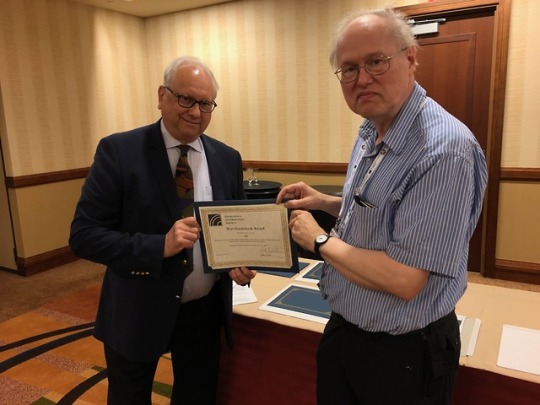
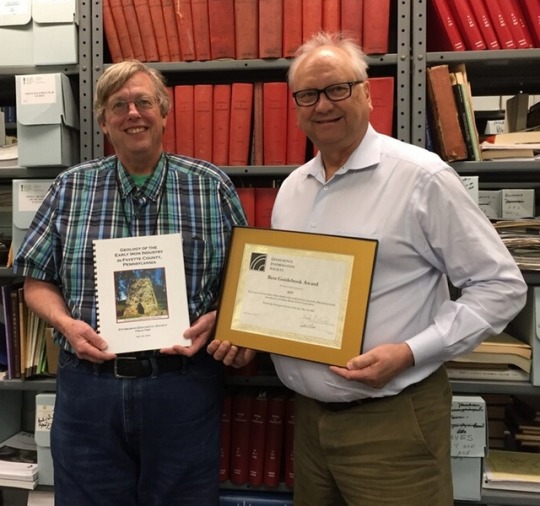
In the fall of 2018, Albert D. Kollar and John A. Harper (volunteer and research associate) of the Section of Invertebrate Paleontology in collaboration with the Pittsburgh Geological Society conducted a geology field trip titled: Geology of the Early Iron Industry in Fayette County, Pennsylvania. Back then, we had no idea this field guide would be recognized by the Geoscience Information Society with their GSIS Award 2019 for Best Guidebook (professional) at the Annual Meeting of the Geological Society of America (GSA). On September 23, 2019, Albert attended the Awards Luncheon in Phoenix, Arizona, to receive the GSIS Award.

Albert D. Kollar and Michael Noga representing Geoscience Information Society.

As stated by the GSIS committee chair, “The Geology of the Early Iron Industry in Fayette County, Pennsylvania is well-written and well-illustrated, with both professional and popular sections. I can see local geology teachers taking students on these trips to show a chapter in the development of an important early ore industry in the United States. With the aid of detailed road logs guidebook users can see and learn about the geology, industrial development, history, and fossils in Fayette County. Field Trip leaders can use the guidebook to expand on several topics, depending on the interests of their trip attendees. An additional benefit of the guidebook is its free availability online, so any traveler with an interest in the area can explore on their own. The Pittsburgh Geological Society has performed a great model for other local societies that are interested in spreading the benefits of their field trips to wider audiences.”

In receiving the award, Kollar opined that the guidebook has been recognized for the diverse geology of the region and the many historical sites that can be seen and visited respectively throughout southwestern Pennsylvania. These include, the geology of Chestnut Ridge, a Mississippian-age limestone quarry with abundant fossils and Laurel Caverns, the history of oil and gas exploration, the historic Wharton Charcoal Blast Furnace, the geology of natural gas storage, the country’s First Puddling Iron Furnace, and the birth place of both coke magnate Henry Clay Frick and Old Overholt Straight Rye Whiskey, West Overton, Westmoreland County, Pennsylvania.

Another feature of the guidebook is its dedication to Dr. Norman L. Samways, retired metallurgist, geology enthusiast, and good friend who spent many years as a volunteer with the Invertebrate Paleontology Section of the Carnegie Museum of Natural History.  Sam, as we called him, passed away in February 2018.  His contribution came about when he was instrumental in the research and writing of the Geology and History of Ironmaking in Western Pennsylvania, with his co-authors John A. Harper, Albert D. Kollar, and David J. Vater, published as PAlS Publication 16, 2014. Moreover, Sam was solely responsible for a new historical marker, AMERICA’S FIRST PUDDLING FURANCE along PA 51, dedicated on September 10, 2017 by the Pennsylvania Historical & Museum Commission and the Fayette County Historical Society. David Vater contributed to the guidebook’s content by drawing a schematic diagram of a typical puddling iron furnace, which is greatly appreciated. Key fossils and iron ores of the section’s collection are referenced as well. The cataloged fossils cited in peer review journals authored by section staff and research associates includes those on the trilobites by Brezinski (1984, 2008, and 2009), Bensen (1934) and Carter, Kollar and Brezinski (2008) for brachiopods, and Rollins and Brezinski (1988) for crinoid-platyceratid (snail) co-evolution.

In recent years, the section has run highly successful regional field trips about various geology and paleontology topics based on the museum collections, collaborations with the Pittsburgh Geology Society, the Geological Society of America, Osher Institute of the University of Pittsburgh, Nine-Mile Run Watershed, Allegheny County Parks, Pittsburgh Parks Conservancy, Montour Trail, Carnegie Discovers, and the section’s own PAlS geology and fossil program. A future field trip is being planned to assess the dimension stones that built the Carnegie Museum and noted architectural building stones of Oakland.

Albert D. Kollar is the Collection Manager in the Section of Invertebrate Paleontology at Carnegie Museum of Natural History. Museum employees are encouraged to blog about their unique experiences and knowledge gained from working at the museum.
Filed Under: Blog Tagged With: Albert Kollar, Anthropocene, fossils, geology, invertebrate paleontology, western pennsylvania

July 10, 2019 by wpengine

Citizen Science, The Last Ice Age in Western Pennsylvania and Carnegie Museum of Natural History Exhibits

Recent education initiatives in the Section of Invertebrate Paleontology encourage citizen science collaborations among professional geological societies to elevate the value of fossil collections, research and museum exhibits of the Carnegie Museum of Natural History. For example, this April, 20 members of the North Alleghenies Geological Society were introduced to exceptional Pennsylvanian age fossils on display in Benedum Hall of Geology, i.e., the giant Eurypterid trackway (discovered in Elk County, PA) and the amphibian fossil skull Fedexia (discovered in Moon Twp., near the Pittsburgh International Airport), and the Jurassic age Lyme Regis of England, Holzmaden and Solnhofen fossils of Germany in Dinosaurs in Their Time. And yes, we did view the Carnegie dinosaurs from the Morrison Formation of Sheep Creek, Wyoming and Dinosaur National Monument, Jensen, Utah. The group was amazed with the behind-the-scenes in fossil invertebrates. This month, another citizen science field trip event took place to Slippery Rock Gorge and Moraine State Park in Butler and Lawrence Counties for 40 members of the Pennsylvania Council of Professional Geologists (PCPG). The title of the field trip: The Last Ice Age in Western Pennsylvania: A Changing Climate as Seen in the Glacial Landscape co-led by Albert D. Kollar of the Carnegie Museum of Natural History and Dan A. Billman (Billman Geologic Consultants, Inc). Dan and his wife Pam (both geologists) are longtime supporters of the section and museum. They are members of the section’s PAlS (Patrons and lauradanae Supporters). Dan co-authored the 2011 PAlS Publication 11, Geology of the Marcellus Shale and has provided drill cuttings of the 390 million-year-old Marcellus Shale for the section’s Geology and Energy workshops. Dan served as president of PCPG in 2017 and 2018 and asked if I would be interested to co-lead a glacial geology field trip for PCPG in June of 2019.
The 23,000 year old Jacksville Esker in Butler County, PA. The esker is the ridge between the shrubs and base of the tree line.

So why propose a field trip to the region known with the best-preserved landscapes of the Last Ice Age in western Pennsylvania? In Dan’s opinion, many of the PCPG members are certainly aware of the current discussion on human induced climate change but may be less familiar with the climate change and landscapes that occurred and formed respectively just 23,000 years ago. For instance, a summary of the professional affiliations of the 40 participants on the field trip confirms a division of sorts in disciplines. The dominant groups in attendance are made up of sixteen environmental geologists, followed by nine oil and gas geologists, four with PA DEP, four earth resource scientists, four geologic consultants, two academic professors, and one part-time school teacher – who asked to volunteer in the section – a new citizen scientist for the section.

To plan the field trip, we reviewed past geologic field trip guides and publications on the subject and visited the sites several times over the last six months. We also looked at key exhibits in the Carnegie Museum that mimic many of the glacial and climate change features that we would see on the field trip. These include the bedrock geology of western Pennsylvania i.e., coal, sandstone, limestone and shale that represent depositional cycles associated with the Milankovitch cyclothems and Earth’s precession. These are related to some 120 glaciation events in the rock record that occurred over Permo-Carboniferous time (Pennsylvanian Period) 319 MA to Early Permian 270 MA. In the museum dioramas: A replica coal forest and coeval marine seaway can be seen in Benedum Hall of Geology. In Botany Hall, the Northern Pennsylvania Bog is an example of a glacial tundra bog like the West Liberty Bog – a paleoclimate indicator. And the Muskox exhibit of the Arctic tundra biome is representative of the Alpine permafrost periglacial environment in the Appalachian ridges, which formed “rock city”. The Last Glacial Maximum, a +/-23,000-year-old Kent glacial terminal moraine, Jacksville Esker, and the scenic gorge at Cleland Rock were the highlights of the trip.

Blog post by Albert D. Kollar, collection manager in the Section of Invertebrate Paleontology at Carnegie Museum of Natural History, and Dan A. Billman of Billman Geologic Consultants, Inc.

Filed Under: Blog Tagged With: Albert Kollar, Benedum Hall of Geology, geology, invertebrate paleontology, western pennsylvania

April 26, 2019 by wpengine

One of the Best Kept Secrets:  The Collaboration of the Carnegie Museum and Shady Side Academy Middle School 2014 – 2019

Each spring, when the Robin first appear on the landscape, 70 students from Shady Side Academy Middle School in Fox Chapel, descend upon the Carnegie Museum for their yearly four-hour tour. Led by National Earth Science Teacher of the Year Award Winner, Matt Brunner, the seventy students are divided into four groups that partake in arranged educational activities that last 45 minutes each. One of the most important activities is lunch, without which, the entire school visit would collapse – seriously!  Each group is toured by museum educators and staff i.e., interpreters for the natural history exhibits and CMOA art staff for that class. A unique, behind the scenes fossil and geology workshop in invertebrate paleontology is the highlight of the visit. After Mr. Brunner started teaching at Shady Side Academy in 2004, we developed a behind the scenes Earth Science learning/activities class. Years later, the class has become very popular with the students, chaperones and school administrators. Continuing with this collaboration, Matt developed an energy debate class for his sixth graders, which focuses on fossil fuels and other sources of energy in the student’s daily lives. To help address the student’s questions on energy, Matt invited Ray Follador and me, and other scientists to come to Shady Side Academy to talk about the use of fossil fuels, nuclear, and renewables in energy production. Each January, 70 bleary eyed sixth graders wait in anticipation for our 8 AM to 8:45 class in the school auditorium. The class is divided into two ten-minute PowerPoint presentations, a Question and Answer session, and the use of a 200-foot long rope, that fully engage the entire class to help visualize the depth of the Marcellus Shale Gas Deposit below the school parking lot.
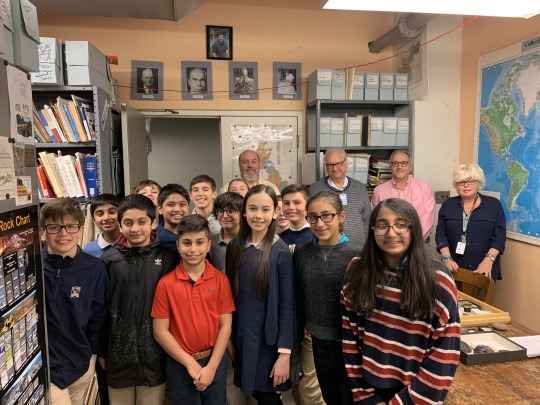
Shady Side Academy Middle School visit to the Section of Invertebrate Paleontology, April 03, 2019. Back row. left to right, Matt Brunner, Albert Kollar, Ray Follador, Tara Pallas-Sheetz

Behind the Scenes in Invertebrate Paleontology:  As each class of 18 students enter the Invertebrate Paleontology office, they are asked to sit down on the carpeted floor for a brief introduction to the section’s staff, and to sign their names to a gallon-size zip-lock plastic bag and a copy of the section’s Geology and Fossils Coloring Book.  The class is then divided into three equal groups that rotate among the three scheduled activities that last approximately ten – twelve minutes each.  The fossil activities include, 1. Breaking fossil rocks on the one-hundred-year-old rock breaker coordinated by Tara Pallas-Sheetz. 2. Building a fossil and rock kit from duplicate (non-accessioned) fossils with geologist Ray Follador. 3.  Learning about the evolution of trilobites, the state fossil of Pennsylvania, Phacops rana (a trilobite) and fossil arthropods such as, eurypterid, horseshoe crab, and cockroach with Albert Kollar. In activity 3, some of the fossils shown on the table are naturally preserved in various colors of yellow, red, gray and black. Keeping in mind the fossil colors, each student is asked to use colored pencils to color in the black and white illustrations of arthropods on page 35 in the coloring book. For many students, this activity showcases their artistic talents. All students are encouraged to handle fossils and ask questions. Each group keeps their fossil kits and each student keeps the fossils collected from the rock trimmer activity (the reason for the plastic bag). The invertebrate paleontology learning activity class is later reviewed by Mr. Brunner in his Earth Science classes at Shady Side Academy.

Albert D. Kollar and Tara Pallas-Sheetz, Section of Invertebrate Paleontology

Ray Follador, Pittsburgh Geological Society

Matt Brunner, Shady Side Academy Middle School

Filed Under: Blog Tagged With: Albert Kollar, invertebrate paleontology, Ray Follador

  • « Go to Previous Page
  • Page 1
  • Page 2
  • Page 3
  • Page 4
  • Page 5
  • Page 6
  • Page 7
  • Go to Next Page »

sidebar

About

  • Mission & Commitments
  • Directors Team
  • Museum History

Get Involved

  • Volunteer
  • Membership
  • Carnegie Discoverers
  • Donate
  • Employment
  • Events

Bring a Group

  • Groups of 10 or More
  • Birthday Parties at the Museum
  • Field Trips

Powdermill

  • Powdermill Nature Reserve
  • Powdermill Field Trips
  • Powdermill Staff
  • Research at Powdermill

More Information

  • Image Permission Requests
  • Science Stories
  • Accessibility
  • Shopping Cart
  • Contact
  • Visitor Policies
One of the Four Carnegie Museums | © Carnegie Institute | Privacy Policy | Terms of Use | Accessibility
Rad works here logo