• Skip to primary navigation
  • Skip to main content
  • Skip to primary sidebar

Carnegie Museum of Natural History

One of the Four Carnegie Museums of Pittsburgh

  • Visit
    • Buy Tickets
    • Visitor Information
    • Exhibitions
    • Events
    • Dining at the Museum
    • Celebrate at the Museum
    • Powdermill Nature Reserve
    • Event Venue Rental
  • Learn
    • Field Trips
    • Educator Information
    • Programs at the Museum
    • Bring the Museum to You
    • Guided Programs FAQ
    • Programs Online
    • Climate and Rural Systems Partnership
  • Research
    • Scientific Sections
    • Science Stories
    • Science Videos
    • Senior Science & Research Staff
    • Museum Library
    • Science Seminars
    • Scientific Publications
    • Specimen and Artifact Identification
  • About
    • Mission & Commitments
    • Directors Team
    • Museum History
  • Tickets
  • Give
  • Shop

amphibians

January 30, 2019 by wpengine

The Search for the Near Threatened Green Salamander, Aneides aeneus

By Kaylin Martin

green salamander
Photo credit: Aaron Semasko

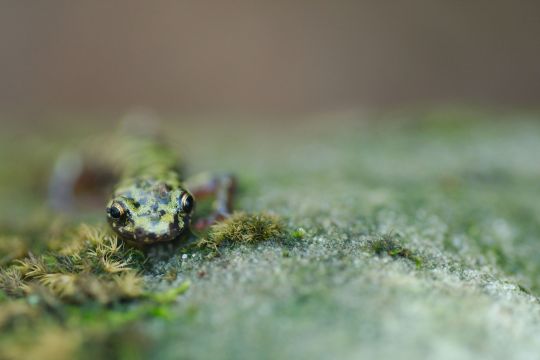
Fueled by caffeine and the promise of a sighting of the elusive and threatened green salamander, I made my way to the assigned meeting point in Fayette County, Pennsylvania. I was told we would be meeting a contact that could lead us to his secret location wherein there was prime habitat for green salamanders. Slowly, a muddy truck approached us and motioned for us to follow him. Thirty minutes of unpaved, unmarked, pothole riddled roads later I was standing in front of a hillside with rough terrain.

I knew I was in for an intense hike. Green salamanders are found in rock crevices in outcroppings or on the sides of cliffs. Unlike most salamanders that can be found abundantly under damp logs or rocks, green salamanders are extreme habitat specialists. Because of their habitat requirements, these salamanders are considered Near Threatened by the IUCN Red List of Threatened Species. The green salamander is listed as Endangered in Indiana, Ohio, Maryland, and Mississippi, as Threatened in Pennsylvania, and as Protected in Georgia. Some herpetologists argue that they should be nationally classified as Endangered, given that population sizes are decreasing due to habitat loss, drought and road development.

Armed with flashlights, our group of enthusiastic herpetologists made our way toward outcrops of rock along the hillside. We pointed our flashlights into every small crevice big enough to fit a salamander, hoping to see two large round eyes staring back at us. Within the first hour, we found a handful of common slimy salamanders, Plethodon glutinosus. Distinguished by their black color with silver or gold spots running along their backs, slimy salamanders are most known for the sticky substance they exude when threatened. Mostly found under logs or stones, the slimy salamander is also known to utilize its climbing abilities to crawl into crevices of shale banks, the same habitat that green salamanders favor.
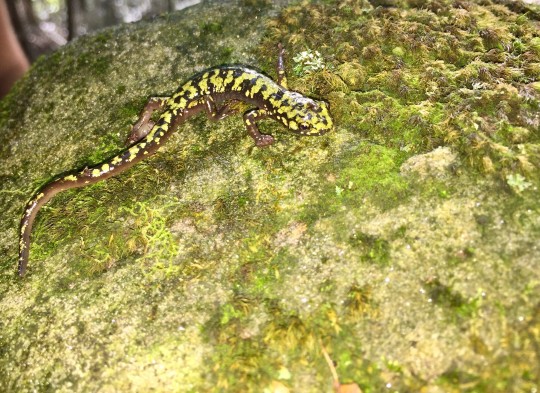
green salamander

As I was photographing an eastern red-backed salamander, Plethodon cinereus, I heard a yelp of excitement, “A green! A GREEN!” A few agonizing minutes of scrambling through brambles and rocky terrain to get to my colleague ensued. As I approached, I was filled with excitement. Being the Curatorial Assistant of Amphibians and Reptiles allows me to catalogue specimens from all over the world, collected by renowned scientists in my field. This position gives me a platform to tell the public about why amphibians and reptiles are so important to our ecosystem. The thrill of seeing a Near Threatened salamander in its natural habitat reaffirmed my love for my career and the honor I feel in being an ambassador for amphibians and reptiles. Nothing beats the opportunity to photograph the species camouflaged into the moss around it, or the few minutes where you promise yourself and the species in front of you that your life’s goal is to promote environmental awareness of Pennsylvania herpetofauna (reptiles and amphibians), and the hope that maybe the green salamander will thrive in Pennsylvania in the age of the Anthropocene.

What can you do? Check out the Pennsylvania Amphibians and Reptiles Survey at https://paherpsurvey.org/.If you find an amphibian or reptile, take a photo and send it to the PA Herp Survey to help document the biodiversity and status of Pennsylvania herpetofauna.

Kaylin Martin, M.Sc, is the curatorial assistant in the Section of Amphibians and Reptiles. Museum employees are encouraged to blog about their unique experiences and knowledge gained from working at the museum.
Filed Under: Blog Tagged With: amphibians, amphibians and reptiles, Anthropocene, herpetology, Kaylin Martin, pennsylvania, reptiles

November 28, 2018 by wpengine

Field Time in Borneo

By Jennifer Sheridan

Jennifer Sheridan and students in Borneo

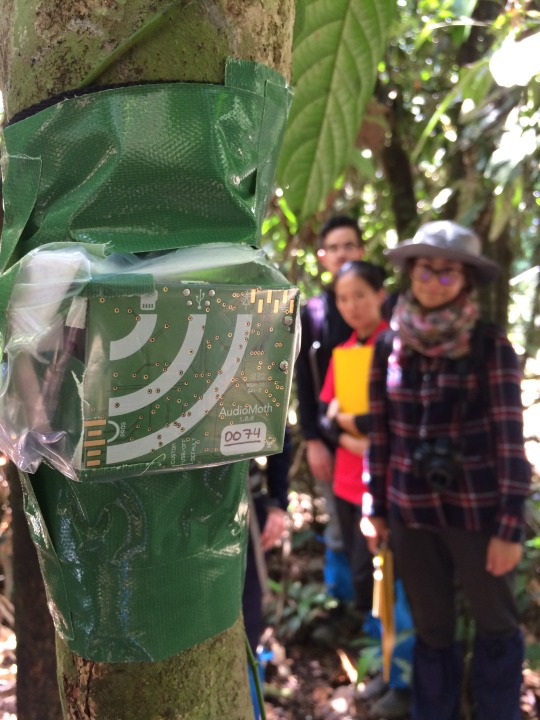
As some of you know, my main field research takes place in Malaysian Borneo, in the state of Sabah. I travel there frequently for work (ecological fieldwork), and I was lucky enough to be asked to serve as an instructor for a graduate field course held at one of my main field sites in October of this year. This particular site, Danum Valley Conservation Area, is one of the largest expanses of lowland primary forest remaining in Borneo, and because I have been going there regularly since 2010, it holds special meaning for me. Thus, I was very eager to share my enthusiasm for and knowledge of this place and its herpetological inhabitants with students.

AudioMoth on a tree and students in the background

This particular field course is run by the Tropical Biology Association, based out of Cambridge (UK). TBA courses are wonderful for many reasons, but one of my favorite features is that they are an even mix of students from Europe and, in the case of the Danum course, Southeast Asia. Because students in SE Asia don’t always have the same opportunities for continued graduate education as do students in Europe and the US, this course provides much-needed capacity building in a region that suffers from the highest rate of deforestation (and thus biodiversity loss) in the world. This year’s course featured students from 12 countries, and was nearly 2/3 female—another important capacity-building measure, given that women remain underrepresented in the sciences.

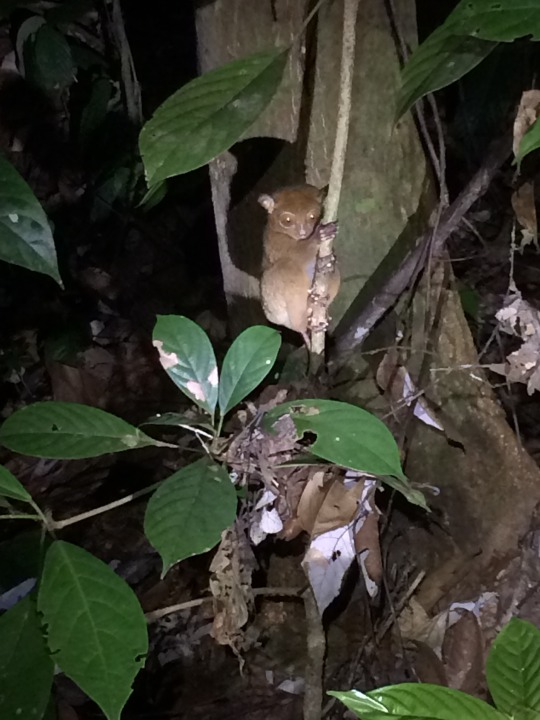
tarsier in a tree at night

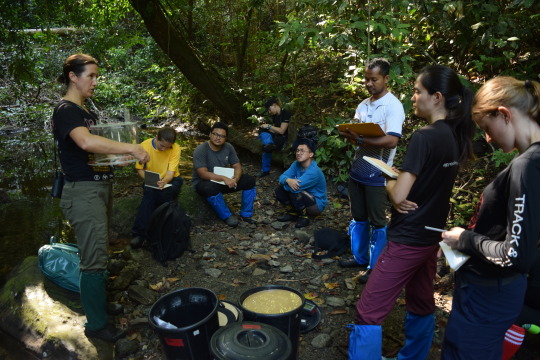
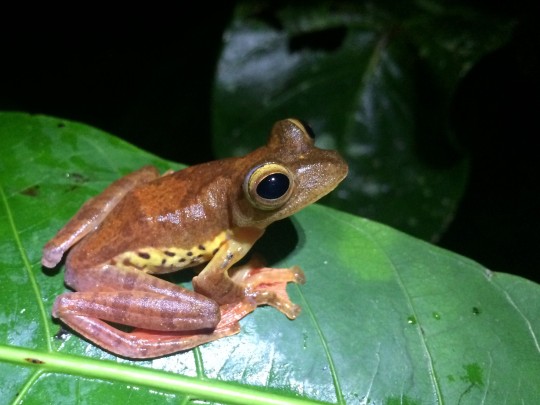
The structure of the course is also one that I think works well: two weeks of detailed field instruction and exercises, introducing students to methods of surveying and studying multiple taxonomic groups, followed by two weeks of students working in small groups to design, execute, and present original research projects. For me, as a scientist working at the site long-term, this structure also allows me to test new methods or gather pilot data for potential future projects. This year I supervised two groups who chose to work on frogs: one group who radiotracked a species of frog that had never been tracked before, and one group who measured the biomass of frogs on three different streams. The former project was intended to serve as pilot data for future radiotracking studies in primary and disturbed forest areas, to determine whether movement patterns and dispersal of amphibians are impacted by fragmentation. The latter project was partly because I had never measured this before and was curious what the biomass of frogs on these streams was, and partly because knowing biomass, in addition to abundance and diversity, can help ecologists like me better understand how loss of species or communities (multiple species of frogs, for example) impacts ecosystem function. Both of these projects, though small, will be written up by myself and the students who conducted them, and submitted to regional peer-reviewed journals for publication. In science, publications such as this are important both for me as curator, as well as for students just beginning their careers.

frog on a leaf at night

In addition to the wonderful educational and research opportunities this course afforded all of us, I happen to just love being in the field. I wake up to the sound of gibbons or birds calling. I get to hike through the jungle to get to my pristine streams (most frogs in Borneo are stream-breeders), which are so beautiful. I can talk shop with other researchers, like the fellow instructor I met who studies carbon stocks of Sabah forests, and who will now collaborate with me on my long-term research project. I look for frogs along streams at night, and in doing so I get to see loads of other wildlife, like snakes, sleeping lizards and birds, fluorescent caterpillars, glow-in-the-dark fungi, mouse deer, civets, slow loris, tarsier, and clouded leopard, just to name a few. The dual nature of my job—sitting at my desk analyzing data, managing the section of amphibians & reptiles, and writing papers, then going out and living and working in the jungle—is one of the greatest things about being a scientist, and one of the reasons I love being a curator. This was one of the greatest field months of my life thanks to the amazing students, my fellow instructors, and the luck of seeing so much great wildlife, and now I get the pleasure of sharing the results of that trip with the public as well as the scientific community, while exploring other projects with our expansive museum collections. I really can’t imagine doing anything else.

Jennifer A. Sheridan is the Assistant Curator in the Section of Herpetology at the Carnegie Museum of Natural History. Museum employees are encouraged to blog about their unique experiences and knowledge gained from working at the museum.
Filed Under: Blog Tagged With: amphibians, Borneo, conservation, herpetology, Jennifer Sheridan, reptiles

September 13, 2018 by wpengine

A Herp Collection Mystery

by Jennifer Sheridan

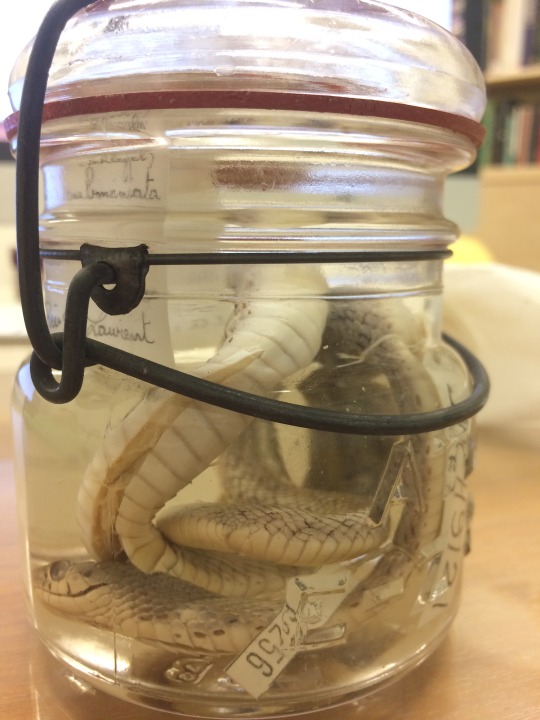
snake specimen

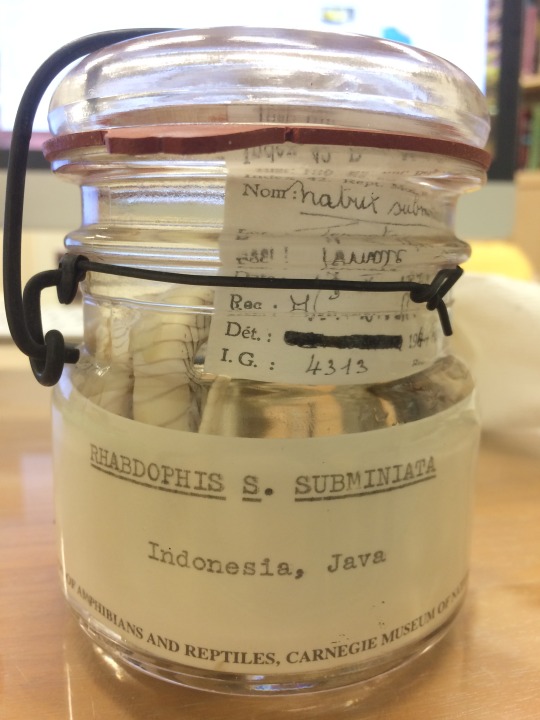
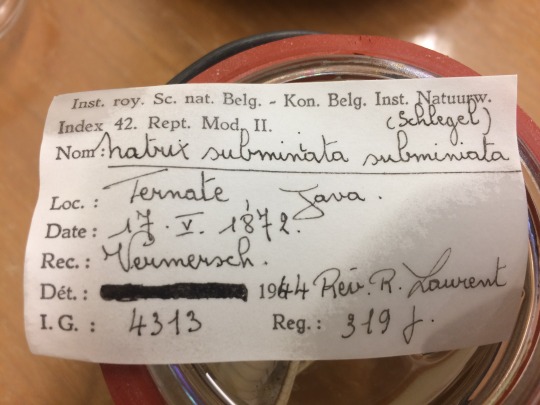
Part of the fun of being a new curator is getting to know the collections. In preparing for an upcoming talk (Scientists Live on Facebook on September 19th), I was sorting through our collections database to see what specimens we have from Southeast Asia, where I do most of my research. I came across a record that intrigued me: a fairly common snake (Rhabdophis subminiatus) from a potentially uncommon locality. The jar label says “Indonesia, Java”—Java being one of the islands in the Indonesian archipelago, which also happens to be the world’s most populous island. But the exact location detail is what caught my eye: Ternate.

snake specimen from Indonesia

If you happen to be from Southeast Asia or you’re a biogeography buff, you may know that Ternate is not in fact on Java, but is itself a tiny island in eastern Indonesia, off the coast of Halmahera, which is part of the Maluku group. Biogeographically this area is interesting because it lies just east of Wallace’s Line, an imaginary dividing line that separates the flora and fauna of Sundaland (mainland Southeast Asia) from that of Austronesia (Australia, New Guinea, and associated islands). This area played a key role in our understanding of biogeography because it was while he was traveling across Indonesia that Alfred Russel Wallace noticed that there was a very distinct change in the species of plants and animals found in Borneo and Bali (west of the line), compared to those on Sulawesi and Lombok (east of the line), despite the fact that those islands are not separated by a large distance. He noted this in his journals and scientists later named this dividing line after him, once they learned that the plants and animals west of the line originated in mainland SE Asia, while those east of the line originated in Australia.

But Ternate is interesting not simply because of its geographic location, but because of Wallace’s relationship to it. Ternate is where Wallace was when he wrote his famous letter to Charles Darwin in 1858, while laid up in bed with fever, explaining to Darwin his idea of evolution by natural selection. Amazingly these two people had arrived at the same idea totally independently of one another, half a world apart. They had shared correspondence prior to 1858, and it was this letter from Wallace that prompted Darwin to jointly publish his own work alongside Wallace’s, thus introducing to the world for the first time the idea of evolution by natural selection, which has allowed us to understand the natural world.

notes about the snake specimen from Indonesia

Coming back to the specimen, I had been hoping that perhaps it was collected by Wallace or one of his team, but the record is from 1872, ten years after Wallace had returned to England. The listed collector, Vermersch, is not a collector known to me or other herpetologists I’ve checked with who work in SE Asia, and we have no additional details on the specimen. Given that I cannot find a record of a city called Ternate on the island of Java, and the fact that all of Indonesia may have been known as the Java Sultanate at the time, my guess is that this specimen is actually from Ternate, and not Java proper. This specimen also has the distinction of being one of our oldest, so for me, and anyone else studying biogeography of SE Asia, this specimen becomes doubly interesting and valuable, and will definitely be one of the highlights of any upcoming tours of the Alcohol House! I’m looking forward to finding more secret treasures as I get to know our collection.

Jennifer A. Sheridan is the Assistant Curator in the Section of Herpetology at the Carnegie Museum of Natural History. Museum employees are encouraged to blog about their unique experiences and knowledge gained from working at the museum.
Filed Under: Blog Tagged With: Alfred Russel Wallace, amphibians, amphibians and reptiles, herpetology, Mason Heberling, reptiles, snakes

July 26, 2018 by wpengine

New Member of the Section of Herpetology

By Jennifer Sheridan

The Section of Herpetology has welcomed a new curator—me! I’m happy to be writing this blog post as a way of introducing myself and to be joining the Carnegie Museums family.

I moved here from Singapore, where I was Assistant Professor of Environmental Studies for the past four years at Yale-NUS College, a small liberal-arts college entering its sixth year of operation. It was fantastic, but I’m very much looking forward to my new role as curator. People often ask me what exactly a curator does, and in my case, it won’t be too different from my job as a professor: my time will be divided between research & curation, outreach & education, and service to the museum (providing input for exhibits, for example). At Yale-NUS, about two-thirds of my time was teaching (education) and service, and about one-third was research, so I’m looking forward to being able to devote a larger portion of my time (closer to 50%) to research now that I’m here.

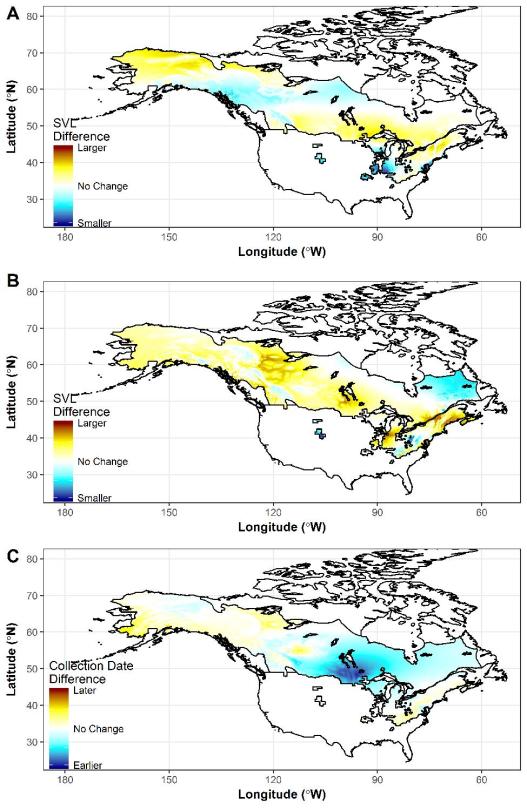
Additionally, it’s exciting to have such a great collection on hand with which to answer questions about ecological responses to climate change, one of the main foci of my research. In fact, a recent paper of mine relied heavily on specimens from the Carnegie Museum of Natural History. My co-authors and I used more than 350 specimens from this museum, plus more than 900 specimens from 15 other museums, collected between 1901–2000, to examine how wood frog body size and breeding have shifted in response to climate change.

maps showing body size changes
Image credit: Nick Caruso

We found that breeding and size shifted as predicted at broad spatial scales, but when we examined the data at finer spatial scales, local changes in climate did not accurately predict local body size changes. This suggests that climate itself is not the driving factor of observed body size changes, but rather that there is another mechanism driving such changes, that also correlates with climate. Moving forward, I’ll be combining examinations of the collections with field work to uncover other ways that amphibians have responded to climate change, whether through shifts in body size, breeding date, or geographic range, and what impacts that might have on ecosystem function. I’m excited to be here with such great resources for answering these interesting questions!

Jennifer Sheridan is the Assistant Curator in the Section of Herpetology at the Carnegie Museum of Natural History. Museum employees are encouraged to blog about their unique experiences and knowledge gained from working at the museum.
Filed Under: Blog Tagged With: amphibians, Anthropocene, climate change, herpetology, Jennifer Sheridan, reptiles

April 2, 2018 by wpengine

Hellbenders aren’t so scary!

three hellbender specimens in a tray

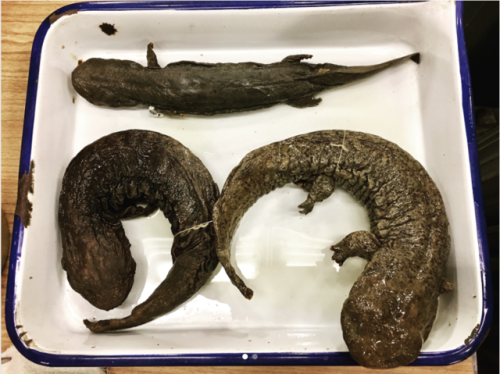
Hellbenders aren’t so scary! Cryptobrachus alleganiensis are in the running to become the Pennsylvanian State Amphibian. Due to their permeable skin, hellbenders are extremely susceptible to pollution, making them great bioindicators. A bioindicator is an organism who is representative of the status of an ecosystem’s health. Hellbenders are the largest North American salamander.


This post was originally posted on our curatorial assistant’s Instagram, which features specimens in the museum’s historic Alcohol House. 

Filed Under: Blog Tagged With: amphibians, pennsylvania

January 8, 2018 by wpengine

Frogsicles?! 

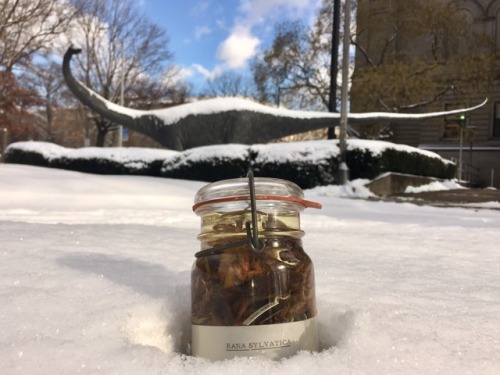
jar of frog specimens in the snow in front of the Dippy statue

Rana sylvatica (also formally known as Lithobates sylvaticus) freeze 2/3 of their bodies in the winter during hibernation! They stop breathing and their hearts stop beating.

How do they do this? Cryoprotectants. Their body produces an excess of urea and glucose in order to avoid cell shrinkage and ice formation. When spring arrives, the frog simply thaws and returns to a normal life.


Kaylin Martin is a Curatorial Assistant in the Section of Herpetology. She blogs about the collection in Carnegie Museum of Natural History’s historic Alcohol House, which is home to thousands of fluid-preserved specimens.

Filed Under: Blog Tagged With: amphibians, Kaylin Martin

  • Page 1
  • Page 2
  • Go to Next Page »

sidebar

About

  • Mission & Commitments
  • Directors Team
  • Museum History

Get Involved

  • Volunteer
  • Membership
  • Carnegie Discoverers
  • Donate
  • Employment
  • Events

Bring a Group

  • Groups of 10 or More
  • Birthday Parties at the Museum
  • Field Trips

Powdermill

  • Powdermill Nature Reserve
  • Powdermill Field Trips
  • Powdermill Staff
  • Research at Powdermill

More Information

  • Image Permission Requests
  • Science Stories
  • Accessibility
  • Shopping Cart
  • Contact
  • Visitor Policies
One of the Four Carnegie Museums | © Carnegie Institute | Privacy Policy | Terms of Use | Accessibility
Rad works here logo