• Skip to primary navigation
  • Skip to main content
  • Skip to primary sidebar

Carnegie Museum of Natural History

One of the Four Carnegie Museums of Pittsburgh

  • Visit
    • Buy Tickets
    • Visitor Information
    • Exhibitions
    • Events
    • Dining at the Museum
    • Celebrate at the Museum
    • Powdermill Nature Reserve
    • Event Venue Rental
  • Learn
    • Field Trips
    • Educator Information
    • Programs at the Museum
    • Bring the Museum to You
    • Guided Programs FAQ
    • Programs Online
    • Climate and Rural Systems Partnership
  • Research
    • Scientific Sections
    • Science Stories
    • Science Videos
    • Senior Science & Research Staff
    • Museum Library
    • Science Seminars
    • Scientific Publications
    • Specimen and Artifact Identification
  • About
    • Mission & Commitments
    • Directors Team
    • Museum History
  • Tickets
  • Give
  • Shop

amphibians and reptiles

March 1, 2019 by wpengine

The Enduring Appeal of Snakes

by Jennifer A. Sheridan

As a herpetologist, I’m often asked whether I see a lot of snakes. To be clear, seeing snakes is always an exciting treat for me. But I’ve come to learn that when people ask this question, they’re usually not asking because they want to hear about all the gorgeous ones I’ve seen, but because they want to gauge how “dangerous” it is to be out and about in the forests where I work. I always explain that snakes are fairly skittish and most will quickly move away from humans, but that yes, I do have the good fortune of seeing some excellent individuals. I especially love Danum Valley, one of my field sites in Borneo, for this reason. Depending on the year, I may be lucky enough to see several species within a short time, and last October I had some great sightings.

Because I focus on amphibians, most of my work is at night, and mostly along streams. Often, we see snakes on branches as we come into the stream, like this lovely triangle keelback (Xenochrophis triangularis):
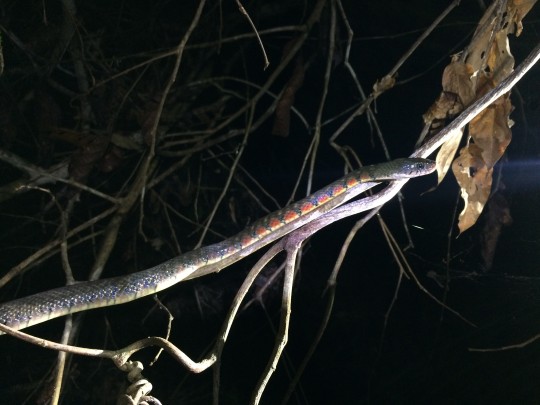
snake on a branch at night

Or in the middle of our search for frogs along the stream transect, like this blunt-headed snail-eating snake (Aplopeltura boa):
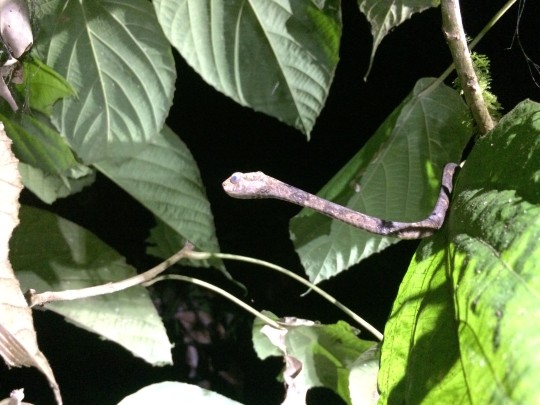
snake in a tree at night

This species is one of my favorites because it has a big fat head that it uses to hunt for snails. It unhinges its jaw and inserts the lower jaw into the shell to pull out the meat. Sorry, Tim Pearce! 😉

Other times we see snakes swimming in the water as we’re walking upstream, like this baby Python reticulatus:
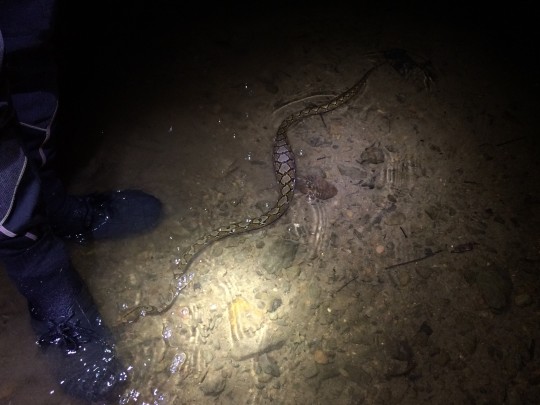
snake in the water

This was one of the highlights of the trip because a) baby pythons are so cute and b) it had clearly just eaten, so it had a large belly bulge (I feel you, python). When it tried to dive under water, its belly kept floating at the surface and it didn’t really have much luck in hiding away from us. Adorable. (It eventually made its way over to the bank and up into the forest.)

One of the most striking sights, however, had to be this mangrove snake (Boiga dendrophila) swimming downstream towards us, head held up above the water, jet black body lithely undulating behind it. Because of its bright yellow chin and underside, it is extremely striking at night.
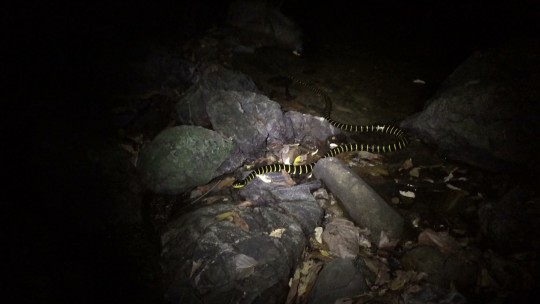
snake on rocky ground at night

One time, years ago, I was in the middle of a transect and the batteries in my headlamp had started to die. I stopped, turned off my light, and changed them out while my teammates continued the survey upstream. When I got my headlamp back on my head and switched it on, a Boigadendrophilawas between my feet. While I am fairly calm in the field, I have to admit that this gave me quite a start! But he went on his way and I went on mine, neither of us all that bothered by the other. So while many people fear snakes, for the vast majority of species if you don’t bother them, they really won’t bother you.

Jennifer A. Sheridan is the Assistant Curator in the Section of Herpetology at the Carnegie Museum of Natural History. Museum employees are encouraged to blog about their unique experiences and knowledge gained from working at the museum.

Related Content

Do Snakes Believe in the Tooth Fairy?

Is This What They Call Overkill? Toxin and Venom in the Herp World

Ask a Scientist: What is an Alcohol House?

Carnegie Museum of Natural History Blog Citation Information

Blog author: Sheridan, Jennifer A.
Publication date: March 1, 2019
Share this post!

  • Share on Twitter Share on Twitter
  • Share on Facebook Share on Facebook
  • Share on Pinterest Share on Pinterest
  • Share on LinkedIn Share on LinkedIn
  • Share on Reddit Share on Reddit
  • Share via Email Share via Email

Filed Under: Blog Tagged With: amphibians and reptiles, Borneo, herpetology, Jennifer Sheridan, reptiles, snakes

January 30, 2019 by wpengine

The Search for the Near Threatened Green Salamander, Aneides aeneus

By Kaylin Martin

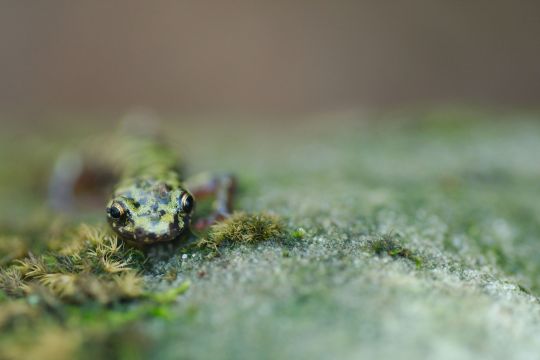
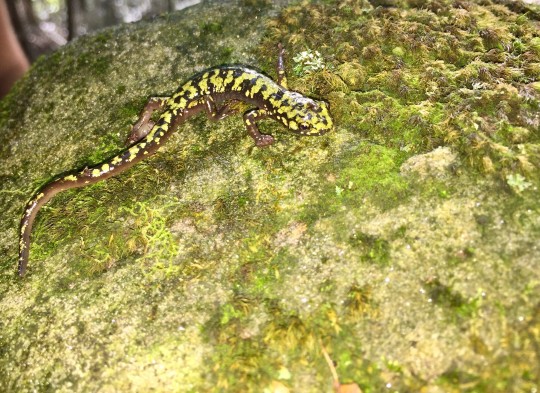
green salamander
Photo credit: Aaron Semasko

Fueled by caffeine and the promise of a sighting of the elusive and threatened green salamander, I made my way to the assigned meeting point in Fayette County, Pennsylvania. I was told we would be meeting a contact that could lead us to his secret location wherein there was prime habitat for green salamanders. Slowly, a muddy truck approached us and motioned for us to follow him. Thirty minutes of unpaved, unmarked, pothole riddled roads later I was standing in front of a hillside with rough terrain.

I knew I was in for an intense hike. Green salamanders are found in rock crevices in outcroppings or on the sides of cliffs. Unlike most salamanders that can be found abundantly under damp logs or rocks, green salamanders are extreme habitat specialists. Because of their habitat requirements, these salamanders are considered Near Threatened by the IUCN Red List of Threatened Species. The green salamander is listed as Endangered in Indiana, Ohio, Maryland, and Mississippi, as Threatened in Pennsylvania, and as Protected in Georgia. Some herpetologists argue that they should be nationally classified as Endangered, given that population sizes are decreasing due to habitat loss, drought and road development.

Armed with flashlights, our group of enthusiastic herpetologists made our way toward outcrops of rock along the hillside. We pointed our flashlights into every small crevice big enough to fit a salamander, hoping to see two large round eyes staring back at us. Within the first hour, we found a handful of common slimy salamanders, Plethodon glutinosus. Distinguished by their black color with silver or gold spots running along their backs, slimy salamanders are most known for the sticky substance they exude when threatened. Mostly found under logs or stones, the slimy salamander is also known to utilize its climbing abilities to crawl into crevices of shale banks, the same habitat that green salamanders favor.

green salamander

As I was photographing an eastern red-backed salamander, Plethodon cinereus, I heard a yelp of excitement, “A green! A GREEN!” A few agonizing minutes of scrambling through brambles and rocky terrain to get to my colleague ensued. As I approached, I was filled with excitement. Being the Curatorial Assistant of Amphibians and Reptiles allows me to catalogue specimens from all over the world, collected by renowned scientists in my field. This position gives me a platform to tell the public about why amphibians and reptiles are so important to our ecosystem. The thrill of seeing a Near Threatened salamander in its natural habitat reaffirmed my love for my career and the honor I feel in being an ambassador for amphibians and reptiles. Nothing beats the opportunity to photograph the species camouflaged into the moss around it, or the few minutes where you promise yourself and the species in front of you that your life’s goal is to promote environmental awareness of Pennsylvania herpetofauna (reptiles and amphibians), and the hope that maybe the green salamander will thrive in Pennsylvania in the age of the Anthropocene.

What can you do? Check out the Pennsylvania Amphibians and Reptiles Survey at https://paherpsurvey.org/.If you find an amphibian or reptile, take a photo and send it to the PA Herp Survey to help document the biodiversity and status of Pennsylvania herpetofauna.

Kaylin Martin, M.Sc, is the curatorial assistant in the Section of Amphibians and Reptiles. Museum employees are encouraged to blog about their unique experiences and knowledge gained from working at the museum.

Filed Under: Blog Tagged With: amphibians, amphibians and reptiles, Anthropocene, herpetology, Kaylin Martin, pennsylvania, reptiles

January 4, 2019 by wpengine

Sounds of Science

By Patrick McShea

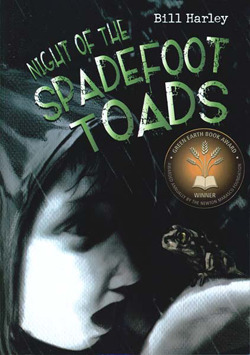
Night of the Spadefoot Toads book cover

In early October, when a pre-school teacher requested frog and toad materials from the museum’s Educator Loan Collection, she mentioned plans to share the items with a fifth-grade teacher.

Jean Nipaver, an early childhood teacher at Pittsburgh’s Beechwood PreK-5, has long borrowed museum materials to create stimulating learning environments for children 3 – 5 years old. In her email request, she credited a former student for the plan to share resources:

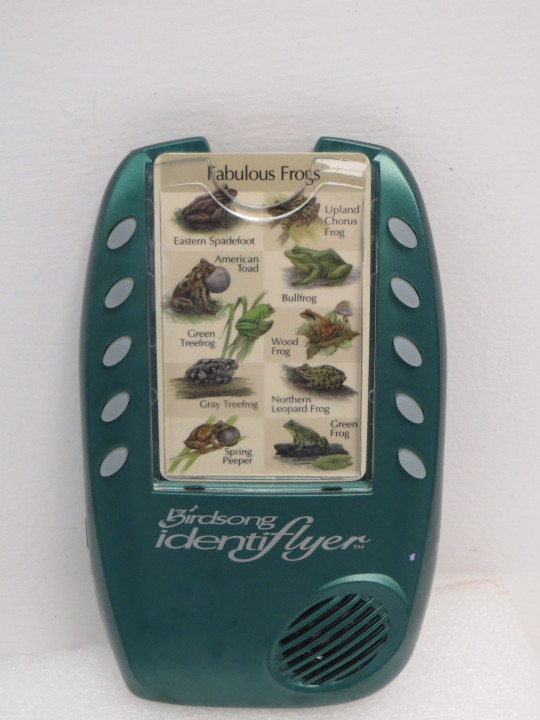
“Yesterday, a fifth-grade teacher stopped me in the hall. Her class is reading Night of the Spadefoot Toads, and a girl in the class told her about all the science she remembered from pre-k, especially about the frogs & toads we’d borrowed from you and the very cool frog song player that you lent us.”

Battery-powered song player


Night of the Spadefoot Toads, which all fifth grade students in Pittsburgh Public Schools read as part a core literacy program, is an award-winning book from 2012 by long-established children’s book author Bill Harley.

It tells the story of a fifth grade boy’s adjustment to a move from Arizona to Massachusetts, and his eventual attachment to new varieties of wildlife and the habitat that supports them. As the author summarizes on his website, the book is “about nature and wildlife, friends, school, bullies, and finding a home in the world. The story reminds us that the place around the corner has its own secrets and treasures.”

At Beechview PreK-5, borrowed museum materials let pre-school students and fifth graders in on the same secret – the deep groan-like croak of the spadefoot toad. For the older students the spooky noise added a bit of a soundtrack to the engaging, relevant, age-appropriate story they were reading. For the younger students in Jean Nipaver’s class, the toad call was part of a school-year-long soundtrack, one focused on learning about science.

Learn more about spadefoot toads and play their call courtesy of the University of Georgia’s Savannah River Ecology Laboratory.

For information about the popular book, visit Bill Harley’s website.

Learn more about the CMNH Educator Loan Program.

Patrick McShea works in the Education and Visitor Experience department of Carnegie Museum of Natural History. Museum employees are encouraged to blog about their unique experiences and knowledge gained from working at the museum.

Filed Under: Blog Tagged With: amphibians and reptiles, Educator Loan Program, Patrick McShea

December 27, 2018 by wpengine

Eorubeta: A Mysterious Ancient Frog Revealed

By Amy Henrici

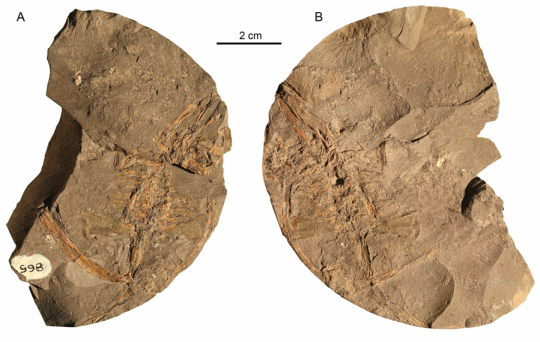
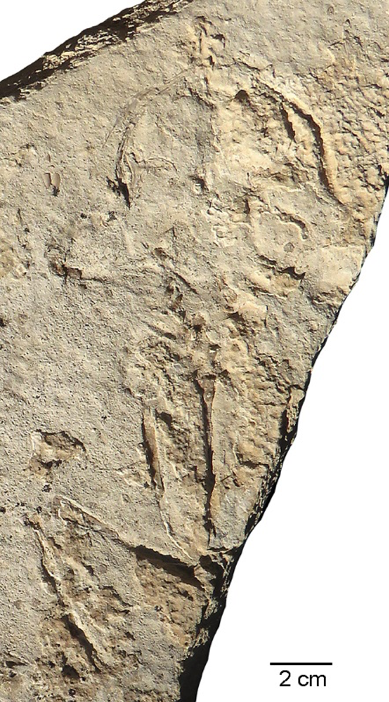
I recently completed a project on fossil frogs from east central Nevada that my collaborators and I identified as the enigmatic Eorubeta nevadensis Hecht, a species that was originally based on a single, poorly preserved specimen that had been discovered in a well core.

The new collection of Eorubeta came from the Sheep Pass Canyon area about 12.5 miles northeast of the well core site. Peter Druschke discovered fossil frogs here in 2005 while working on his PhD dissertation on a rock unit known as the Sheep Pass Formation. Peter and fellow University of Nevada Las Vegas graduate students Josh Bonde and Aubrey Shirk and colleagues Dick Hilton and Tina Campbell (of Sierra College in Rocklin, California) collected additional fossil frogs in subsequent years. I was very fortunate to be invited to join the team, and we collected over 60 specimens for Carnegie Museum of Natural History in 2012, 2013, and 2016.

ancient frog fossils
Part (A) and counterpart (B) of the first-known specimen of the fossil frog Eorubeta nevadensis. This specimen resides in the Vertebrate Paleontology collection of the American Museum of Natural History in New York.

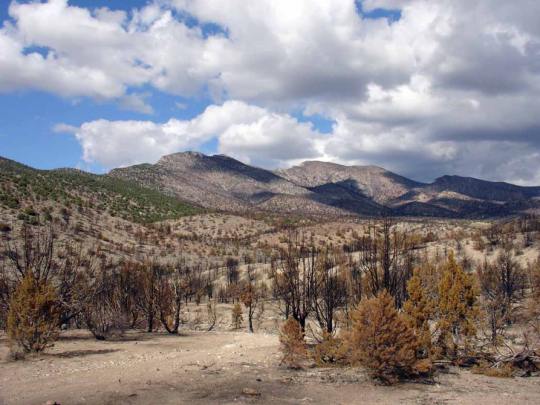
The field site lies in the South Egan Range Wilderness Area of east central Nevada. Being a wilderness area, we could only drive on existing roads, and had to hike nearly a mile to the fossil-producing slopes. The climate in Nevada is challenging to work and camp in, with temperatures reaching over 100 degrees Fahrenheit during the July 2013 field season and nighttime temperatures dipping into the high 20s during the November 2016 season.

White Pine County, Nevada.
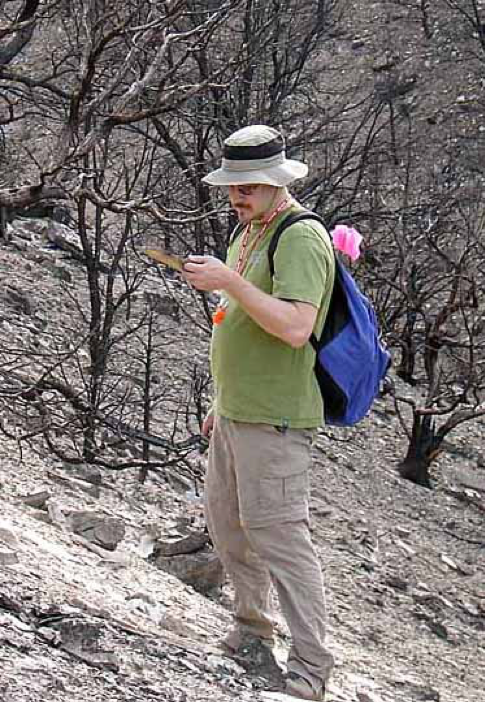
Road into the South Egan Range Wilderness area, White Pine County, Nevada. The area burned three months prior to the 2012 field season. The fire cleared vegetation from the fossil-producing slopes, making it easier to find fossils, though burnt tree branches left us streaked with charcoal.

When Eorubeta was originally named, the rock unit from which this frog came (Member B of the Sheep Pass Formation) was thought to date to a time interval known as the Early Eocene (56–47.8 million years ago). More recently, however, Peter has determined that this unit was probably latest Cretaceous–Paleocene (72.1–56 million years ago) in age instead. It is thus possible that Eorubeta spanned the Cretaceous–Paleogene boundary (66 million years ago) and survived the infamous asteroid impact that caused the extinction of non-avian dinosaurs and many other animal and plant species.

ancient frog fossil
ancient frog fossil
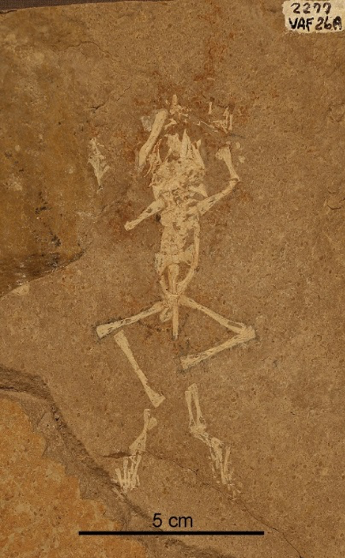
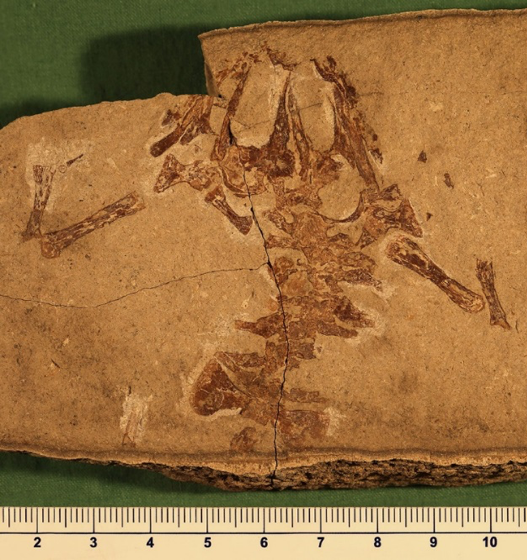
Two of the recently-collected specimens of Eorubeta nevadensis.

Peter determined that the beds in which the fossil frogs were preserved were part of a very high-elevation lake system (1.4–2.2 miles in elevation), similar in this way to today’s Lake Titicaca located in the Andes Mountains on the border of Bolivia and Peru. To date, Eorubeta is the only fossil frog known to have inhabited such a high-elevation environment. Most fossil frogs from this time come from prehistoric river and lake systems situated on coastal plains. The discovery of Eorubeta suggests that ancient frogs probably inhabited a greater variety of environments than the current fossil frog record indicates.

The first specimen discovered by Peter in 2005 indicates that Eorubeta may have reached a considerable size, though the fossil’s extremely weathered condition makes its identification uncertain. An analysis of the relationships of Eorubeta to other frogs reveals that it is more archaic than spadefoot toads, Neobatrachia (a group known as modern frogs), and their relatives.

ancient frog specimen
The largest known specimen of Eorubeta.
Peter Druschke, the team geologist who discovered the specimen.

To learn more about Eorubeta, please follow this link to our paper recently published online in the Journal of Vertebrate Paleontology: https://www.tandfonline.com/doi/full/10.1080/02724634.2018.1510413.

Amy Henrici is the collection manager for the Section of Vertebrate Paleontology at Carnegie Museum of Natural History. Museum employees are encouraged to blog about their unique experiences and knowledge gained from working at the museum.

Filed Under: Blog Tagged With: amphibians and reptiles, Amy Henrici, Ancient Frog, paleontology, Vertebrate Paleontology

September 13, 2018 by wpengine

A Herp Collection Mystery

by Jennifer Sheridan

snake specimen

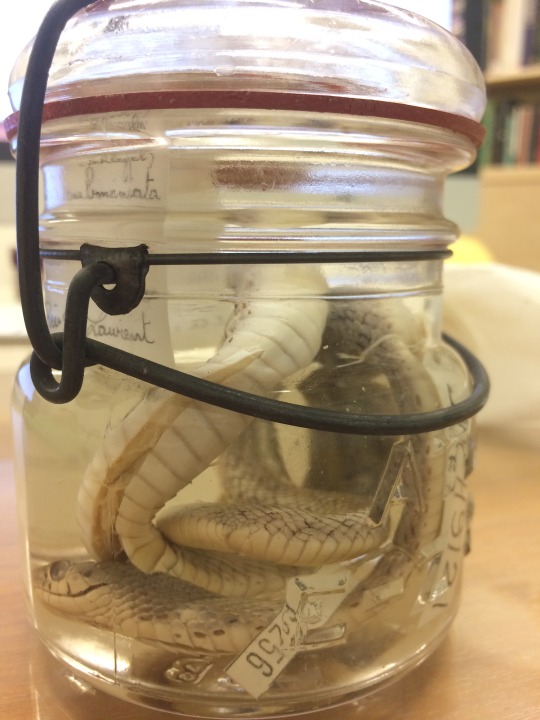
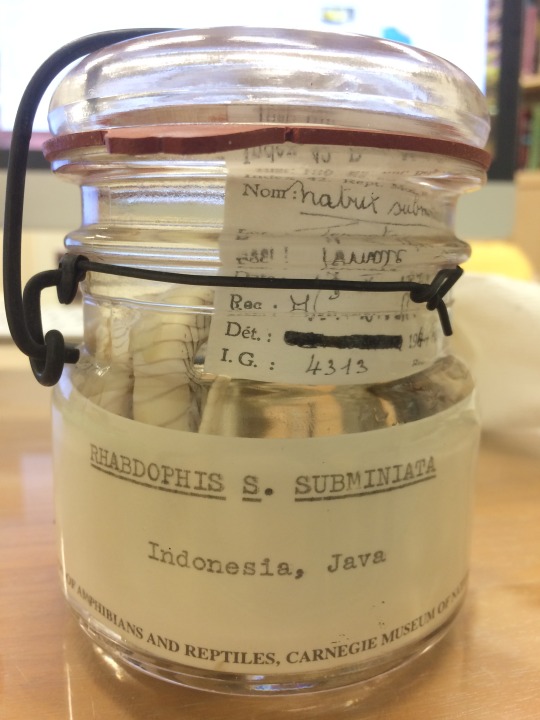
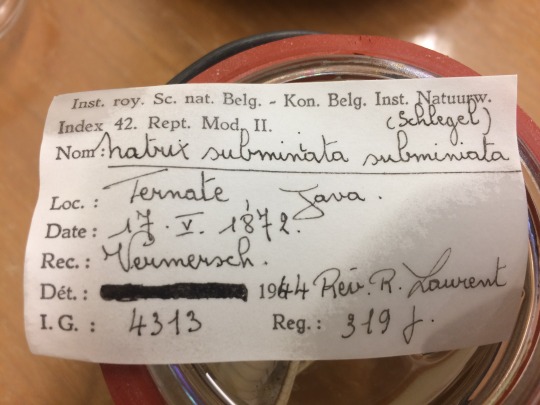
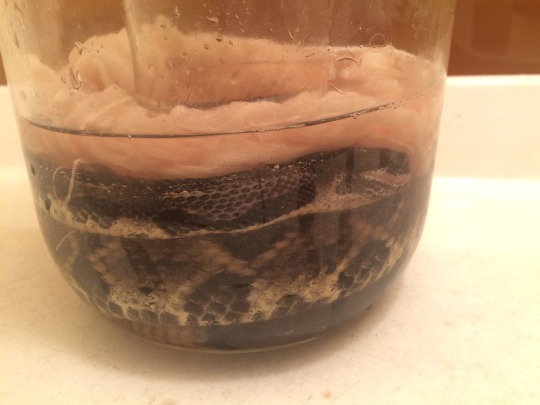
Part of the fun of being a new curator is getting to know the collections. In preparing for an upcoming talk (Scientists Live on Facebook on September 19th), I was sorting through our collections database to see what specimens we have from Southeast Asia, where I do most of my research. I came across a record that intrigued me: a fairly common snake (Rhabdophis subminiatus) from a potentially uncommon locality. The jar label says “Indonesia, Java”—Java being one of the islands in the Indonesian archipelago, which also happens to be the world’s most populous island. But the exact location detail is what caught my eye: Ternate.

snake specimen from Indonesia

If you happen to be from Southeast Asia or you’re a biogeography buff, you may know that Ternate is not in fact on Java, but is itself a tiny island in eastern Indonesia, off the coast of Halmahera, which is part of the Maluku group. Biogeographically this area is interesting because it lies just east of Wallace’s Line, an imaginary dividing line that separates the flora and fauna of Sundaland (mainland Southeast Asia) from that of Austronesia (Australia, New Guinea, and associated islands). This area played a key role in our understanding of biogeography because it was while he was traveling across Indonesia that Alfred Russel Wallace noticed that there was a very distinct change in the species of plants and animals found in Borneo and Bali (west of the line), compared to those on Sulawesi and Lombok (east of the line), despite the fact that those islands are not separated by a large distance. He noted this in his journals and scientists later named this dividing line after him, once they learned that the plants and animals west of the line originated in mainland SE Asia, while those east of the line originated in Australia.

But Ternate is interesting not simply because of its geographic location, but because of Wallace’s relationship to it. Ternate is where Wallace was when he wrote his famous letter to Charles Darwin in 1858, while laid up in bed with fever, explaining to Darwin his idea of evolution by natural selection. Amazingly these two people had arrived at the same idea totally independently of one another, half a world apart. They had shared correspondence prior to 1858, and it was this letter from Wallace that prompted Darwin to jointly publish his own work alongside Wallace’s, thus introducing to the world for the first time the idea of evolution by natural selection, which has allowed us to understand the natural world.

notes about the snake specimen from Indonesia

Coming back to the specimen, I had been hoping that perhaps it was collected by Wallace or one of his team, but the record is from 1872, ten years after Wallace had returned to England. The listed collector, Vermersch, is not a collector known to me or other herpetologists I’ve checked with who work in SE Asia, and we have no additional details on the specimen. Given that I cannot find a record of a city called Ternate on the island of Java, and the fact that all of Indonesia may have been known as the Java Sultanate at the time, my guess is that this specimen is actually from Ternate, and not Java proper. This specimen also has the distinction of being one of our oldest, so for me, and anyone else studying biogeography of SE Asia, this specimen becomes doubly interesting and valuable, and will definitely be one of the highlights of any upcoming tours of the Alcohol House! I’m looking forward to finding more secret treasures as I get to know our collection.

Jennifer A. Sheridan is the Assistant Curator in the Section of Herpetology at the Carnegie Museum of Natural History. Museum employees are encouraged to blog about their unique experiences and knowledge gained from working at the museum.

Filed Under: Blog Tagged With: Alfred Russel Wallace, amphibians, amphibians and reptiles, herpetology, Mason Heberling, reptiles, snakes

August 9, 2018 by wpengine

New Rattlesnake Specimen

By Jennifer A. Sheridan

rattlesnake specimen

Last week the amphibian and reptile unit acquired a valuable specimen—a timber rattlesnake (Crotalus horridus). This species is federally protected, and females can take up to 10 years to reach sexual maturity. This long time to maturity means that they are particularly vulnerable to population declines, so for this and other reasons we would never harvest a live one. Fresh roadkills, however, while sad, are valuable to our collection and the collective database on rattlesnakes. This was found dead in the road at Powdermill Nature Reserve, so I brought it back to the museum to fix in formalin.

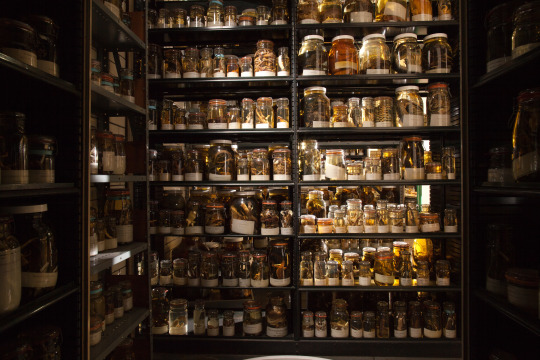
The formalin helps to harden the tissues so that they maintain a shape in long-term storage that is conducive to future morphological study. After about two weeks, the curatorial assistant, Kaylin Martin, will soak the specimen in water to remove as much formalin as possible (leaving it in formalin too long can make the specimen difficult to handle for future studies), and then transfer it to gradually stronger ethanol for long-term storage. Amphibian and reptile specimens are stored in ethanol (hence the name of our home, the Alcohol House) to prevent them from decaying over time.

Alcohol House shelves

This particular specimen brings our total number of C. horridus at Carnegie Museum of Natural History to 597. Our earliest specimen dates back to 1872 (nearly 150 years ago!), and we have specimens representing every decade from 1890–1990, collected from 18 different states.

Prior to this roadkill, our last specimen was collected in 1991—so this is a good specimen to have considering the long time gap in our collection.

Researchers interested in studying long-term trends of rattlesnakes can search online databases such as VertNet to find which museums have specimens, and then examine specimens from several different museums to understand long-term changes in distribution, size, or breeding phenology, and how those may be associated with changes in land use due to increased human population sizes, or changes in climate. We’re sad to have found this beautiful specimen killed on the road, but I’m pleased to know that as part of our collection, it may provide a key element of understanding broader ecological patterns.

Jennifer A. Sheridan is the Assistant Curator in the Section of Herpetology at the Carnegie Museum of Natural History. Museum employees are encouraged to blog about their unique experiences and knowledge gained from working at the museum.

Filed Under: Blog Tagged With: amphibians and reptiles, conservation, herpetology, Jennifer Sheridan

  • « Go to Previous Page
  • Page 1
  • Interim pages omitted …
  • Page 3
  • Page 4
  • Page 5
  • Page 6
  • Go to Next Page »

sidebar

About

  • Mission & Commitments
  • Directors Team
  • Museum History

Get Involved

  • Volunteer
  • Membership
  • Carnegie Discoverers
  • Donate
  • Employment
  • Events

Bring a Group

  • Groups of 10 or More
  • Birthday Parties at the Museum
  • Field Trips

Powdermill

  • Powdermill Nature Reserve
  • Powdermill Field Trips
  • Powdermill Staff
  • Research at Powdermill

More Information

  • Image Permission Requests
  • Science Stories
  • Accessibility
  • Shopping Cart
  • Contact
  • Visitor Policies
One of the Four Carnegie Museums | © Carnegie Institute | Privacy Policy | Terms of Use | Accessibility
Rad works here logo