• Skip to primary navigation
  • Skip to main content
  • Skip to primary sidebar

Carnegie Museum of Natural History

One of the Four Carnegie Museums of Pittsburgh

  • Visit
    • Buy Tickets
    • Visitor Information
    • Exhibitions
    • Events
    • Dining at the Museum
    • Celebrate at the Museum
    • Powdermill Nature Reserve
    • Event Venue Rental
  • Learn
    • Field Trips
    • Educator Information
    • Programs at the Museum
    • Bring the Museum to You
    • Guided Programs FAQ
    • Programs Online
    • Climate and Rural Systems Partnership
  • Research
    • Scientific Sections
    • Science Stories
    • Science Videos
    • Senior Science & Research Staff
    • Museum Library
    • Science Seminars
    • Scientific Publications
    • Specimen and Artifact Identification
  • About
    • Mission & Commitments
    • Directors Team
    • Museum History
  • Tickets
  • Give
  • Shop

bugs

April 20, 2023 by

So Many Bugs!

  • Third Floor

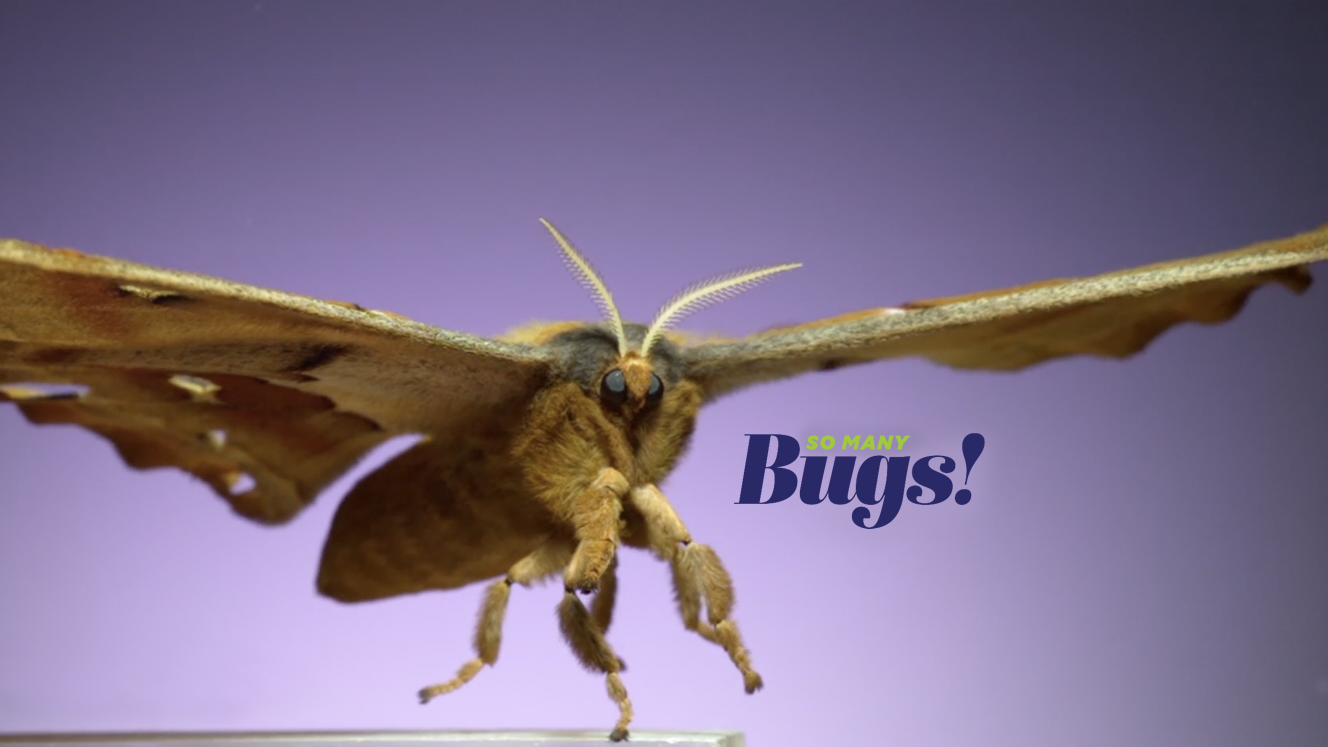
Explore Bug Hall to learn about the creatures that make up more than 80% of all life on Earth: arthropods. Compare the varied colors of butterflies, moths, and beetles. See enlarged dioramas of where bugs live. Watch a slow-motion video to understand how bugs move.

Behind the scenes, the museum’s invertebrate zoology collection houses 14 million pinned bug specimens in 30,000 drawers. Museum scientists use them in their research to better understand the world around us.

The brand new Bug Hall

Meet our Invertebrate Zoologists

Ainsley Seago

Ainsley E. Seago, Ph.D.

Associate Curator, Invertebrate Zoology

Learn More

Fetzner, Jim

James W. Fetzner, Jr., Ph.D.

Assistant Curator

Learn More

Kevin Keegan

Kevin Keegan, Ph.D.

Collection Manager

Learn More
Bob Androw

Robert Androw, B.S.

Collection Manager

Learn More

Learn about the Invertebrate Zoology Collection at the Museum

Learn about the Section of Invertebrate Zoology

Blogs about Bugs

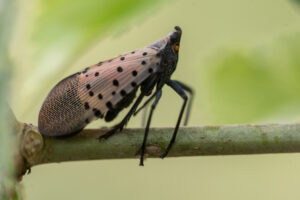
  • Do No Harm: Dealing with Spotted Lanternflies

    Do No Harm: Dealing with Spotted Lanternflies

    by Jonathan Rice Spotted lanternflies are a “true bug,” cousins of the cicada and stink bug. Unlike our native bug species, these …
  • Can’t Choose Just One: Asking an Entomologist to Name Their Favorite Native Species

    Can’t Choose Just One: Asking an Entomologist to Name Their Favorite Native Species

    by Bob Androw I was recently asked what my favorite native species of beetle is. A seemingly simple question, but one with …
  • Beyond the Simple Ecosystem Graphic: Teaching About Biodiversity and Pollination

    Beyond the Simple Ecosystem Graphic: Teaching About Biodiversity and Pollination

    by Pat McShea You probably remember some version of this graphic: simple line drawings linked by arrows to chart energy flow through …
  • Two Perspectives on Attending a Course on Moths and Butterflies in the Southwest

    Two Perspectives on Attending a Course on Moths and Butterflies in the Southwest

    by Kevin Keegan and Vanessa Verdecia Kevin Keegan, Collection Manager of Invertebrate Zoology (IZ), and Vanessa Verdecia, Scientific Preparator for IZ, recently …
Filed Under: Uncategorized Tagged With: bugs, insects, Invertebrate Zoology

April 29, 2020 by wpengine

Bugging Out…and Coming Back

From the first blooms of spring through the end of summer, insects (and many other things we often call bugs), are plentiful. They make their presence known at all hours by buzzing along during the day and chirping throughout the night. But where were they all winter? There is no one answer and that is what makes it so fascinating! Let’s take a closer look at where the insects we are seeing now have been hiding.

Flying South for the Winter

When we think of migration, we usually attribute it to birds. However, insects are known to migrate as well. Generations of monarch butterflies from the United States and Canada fly south to Mexico and roost in mountain forests. Different species of dragonflies also migrate. In the US and Canada, adults of migrating species leave for Mexico in the early fall and return in the early spring. What’s really amazing is that the young larvae stick around in our winter creeks and rivers, and hatch into adults in the spring.  

The Next Generation

The end of fall can mean the end of a life cycle for many insects. To keep their species going, they lay eggs in the fall that either survive the cold as larvae or hatch in the spring. This is known as overwintering. Young woolly bear caterpillars find shelter in the cover of decaying leaves and logs or under rocks. Those praying mantises you see in the spring and summer? They hatched from eggs that survived the winter. Mayfly nymphs live in the water, even under ice, and are known to feed and grow all winter.

Yawn…See Ya in the Spring

That’s right, some insects even hibernate. Honey bees will group together in their hive and keep each other warm by slowly flapping their wings to generate heat. Certain arthropods like isopods can even produce a kind of antifreeze known as glycerol that keeps them from freezing. Now that spring is here, it’s the perfect opportunity to observe flowers in a garden, park or street and see what insects visit. You can also note these in the iNaturalist app during the City Nature Challenge.

A Buggy Challenge

How many photos of insects can you take and share on the free iNaturalist app during the 2020 City Nature Challenge, April 24-27.

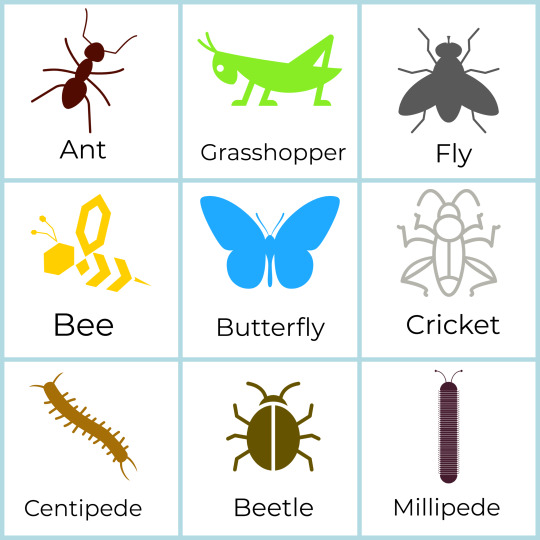
Let’s Play Bug Bingo!

Get three in a row and you win! Head outside and cross off each insect (or other type of arthropod) that you see, in the order in which you spot it. Give yourself a bonus point each time you snap a picture and upload it to the iNaturalist app (with your parents’ permission!) during the City Nature Challenge that takes place April 24-27! Have socially distant fun with family and friends to see who can get bingo and then collect the most bonus points.

Filed Under: Blog Tagged With: bugs, City Nature Challenge, Museum from Home, Nature 360, Nature Lab

August 21, 2019 by wpengine

Lasius will Amaze-i-Us

Lasius workers tending a flock of aphids underground. Photo by Alex Wild.

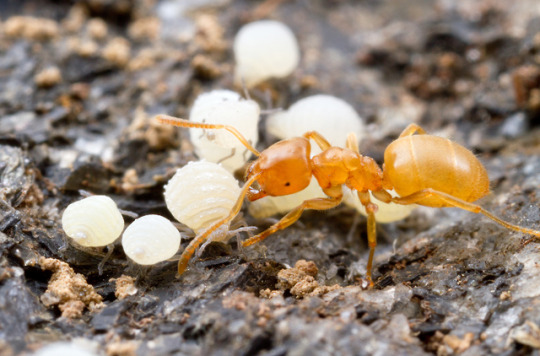
Common Lasius ants tend aphids that live underground feeding on plant roots. They protect the herd of aphids from other ants, and move them to more productive roots if the plant dies back. Sometimes the future queen will pick up an aphid in her mandibles and carry it along on the mating flight, and place it on a good root in the wall of the first nest chamber to start a new herd of aphids.

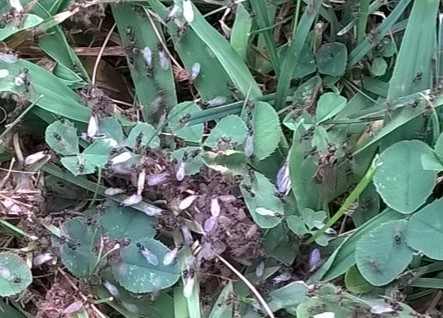
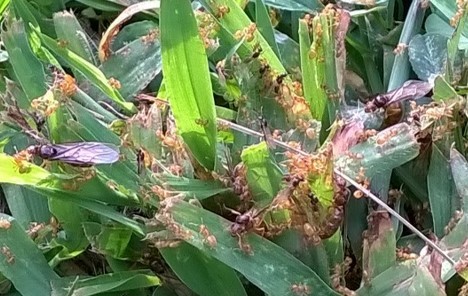
At this time of year, Lasius have their mating flights. A warm day with some rain in the afternoon to soften the soil, and then a clear sky near sundown would be perfect. The ants will be in the top of the nest, awaiting the exact right moment. Somewhere between about 4:00 pm and 7:00 pm, when the atmosphere is just right, workers dig several passages to the surface, and usually the small and slender male ants emerge first, taking flight quickly. Future queens, much larger than the workers or males, and bearing large wings, emerge next and take flight. All the colonies in the landscape where the weather is appropriate may emerge in a time span as short as five or ten minutes.  We found dozens of colonies of two species (below) emerging in an area of our lawn about 20 feet by 40 feet.

Silver wings of many male Lasius neoniger are obvious as they prepare to take flight. Photo by Donna Wenzel.

The many gossamer wings may give the impression of smoke rising from the soil. Swallows, swifts, and other birds will fly in circles snapping up the winged ants. The queens will mate with one or a few males, who die promptly, and then the queens will dig into the moist soil and create a chamber for her new nest, maybe with an aphid she carried along the way to start her new colony.

But the life of Lasius ants is not all pastoral peace and harmony. Two different methods of parasitic attack have evolved where a queen of one species of Lasius will invade the nest of a different species of Lasius to take it over. In one of these methods, the parasitic queen releases citronella, a lemon-like odor that is pleasant to humans but communicates alarm to ants. The workers avoid the invading queen who works her way into the chamber where the host queen is. Quickly, the parasitic queen accumulates the odor of the host colony, and the workers will not recognize her as an alien usurper.

Here we see several large, winged Lasius claviger queens among many small workers, preparing to fly. These queens will parasitize mature colonies of other species, such as L. neoniger above. A few small, dark males are visible top, center. Photo by Donna Wenzel.

A different method used by some species is that the queen is very hairy or armored, and simply fights her way into the host nest. There, the invader may kill the host queen. By either method, the parasitic queen takes over the host nest, and the workers of the original colony, not knowing any better, spend their lives raising the offspring of the parasitic queen. As the original workers die out, the workers of the parasitic queen replace them until the colony is entirely of the parasitic species.

If you keep a sharp eye out at this time of year, you have a good chance of observing a mating flight of Lasius or another ant species, but you have to be in the right place at exactly the right time!

John Wenzel is the Director at Powdermill Nature Reserve, Carnegie Museum of Natural History’s environmental research center. Museum employees are encouraged to blog about their unique experiences and knowledge gained from working at the museum.

Filed Under: Blog Tagged With: bugs, insects, Invertebrate Zoology, John Wenzel, Powdermill Nature Reserve

May 22, 2019 by wpengine

O-Do-nates or O-Don’t-nates—Dragonflies and Damselflies in the Section of IZ

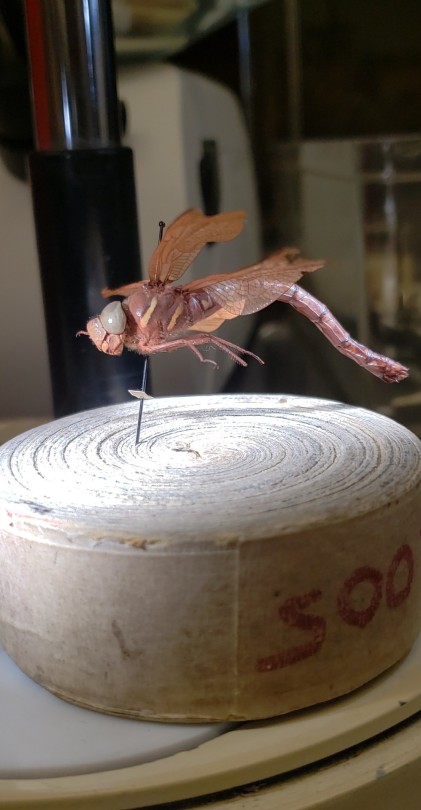
Here, in the section of Invertebrate Zoology, we have a large collection of moths (order Lepidoptera: particularly in the families Sphingidae and Noctuidae), beetles (order Coleoptera: particularly in the family Carabidae), and fleas (order Siphonaptera: from all over the world). However, one of the most interesting groups we have in our collection is the order Odonata (pronounced oh-DOE-naw-ta), also known as dragonflies and damselflies (Figure 1). Aquatic in their juvenile stages, these masters of air and water are stunningly beautiful in overall design and coloration, and are phenomenal hunters. Truly, these delicate predators are impactful and under-appreciated among insect taxa.

Figure 1. A pinned dragonfly, undetermined. Photograph taken by Catherine Giles.

Odonates are insects that undergo incomplete metamorphosis, and have three primary life stages: egg, nymph, and adult (or imago). Incomplete metamorphosis (also called hemimetaboly) is a process where juveniles look like miniature versions of the adults, but get larger over time. Organisms undergoing complete metamorphosis (also called holometaboly) have a pupal stage, and juvenile and adult stages appear very different. For example, a caterpillar turns into a pupa, before emerging as an adult moth or butterfly. Odonates can spend months or years in their nymphal stages, depending on the taxon. Most people (myself included!) are more familiar with the adult phase of an odonate’s life cycle, and see them darting around freshwater ponds and rivers, hunting to satiate their carnivorous diet.

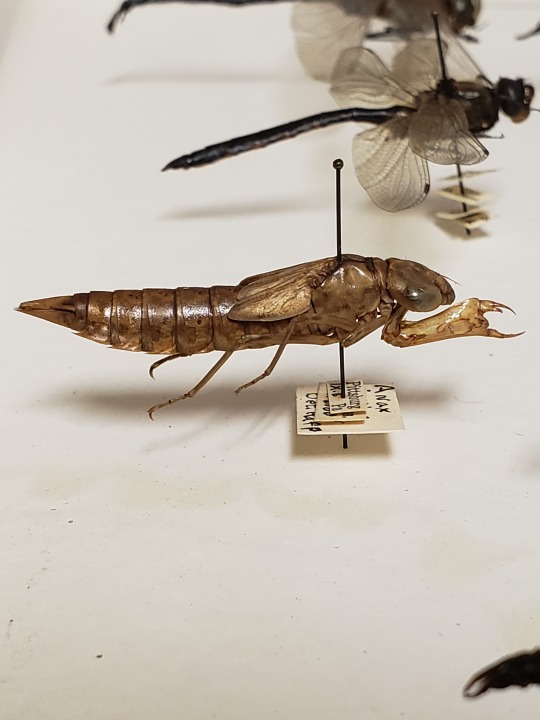
Recently, I transferred our pinned and papered odonate material from one kind of drawer (USNM) into other drawers (Old Holland and Ortmann) due to space limitations in our collection. (For a refresher on drawer types found around the section, see the “Ants in our Pants and Bugs in Our Drawers” blog post!) Among much of our pinned material were numerous nymphal exuviae, or skins cast off by young, immature, juvenile odonates as they grew towards adulthood.

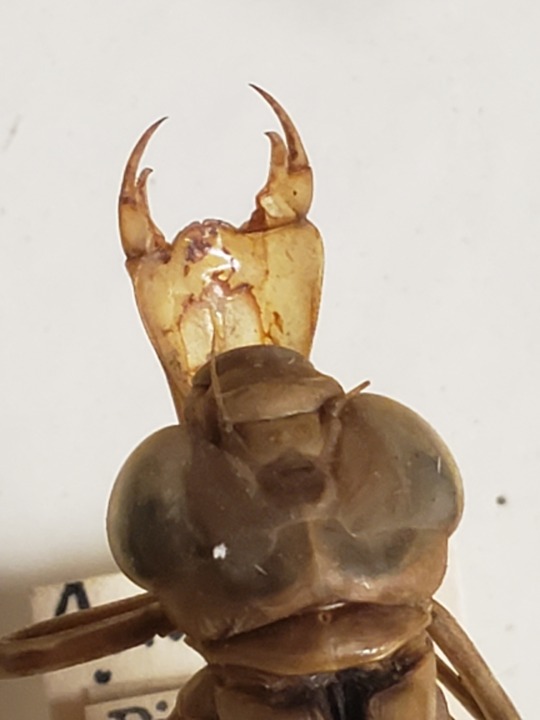
Pictured below is not a Hollywood monster, but rather a dragonfly nymph, Anax junius, in the family Aeshnidae, with the labium extended (Figure 2). While this image could be considered the stuff of nightmares, for an entomologist like me, it makes me excited! Nymphs use the labium to grab for prey in the water, and on the end of this particular specimen’s labium, you can clearly see additional pincers, used to grasp prey more securely. Pictured below is a close-up view of these pincers (Figure 3). Even as juveniles, dragonflies are top predators, making them masters of both water and air.

Figure 2. Nymphalexuviae of Anax junius. Photograph taken by Catherine Giles.


Figure 3. A close-up of pincers on Anax junius’s labium. Photograph taken by Catherine Giles.

At last count, we had approximately 40,000 pinned and papered odonate specimens in our collection. Having nymphal exuviae, like the ones pictured here, only enrich and enhance the diversity and magnificence of our insect collection here at the Carnegie.

Catherine Giles is the Curatorial Assistant of Invertebrate Zoology at the Carnegie Museum of Natural History. Museum employees are encouraged to blog about their unique experiences working at the museum.

Filed Under: Blog Tagged With: bugs, Catherine Giles, insects, Invertebrate Zoology

April 10, 2019 by wpengine

Another Reason to Love Ladybugs

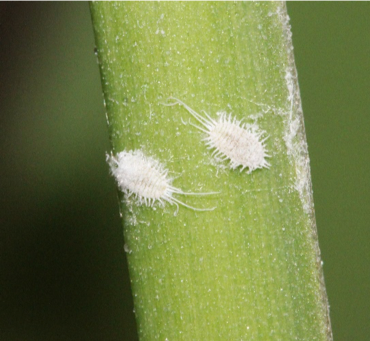
mealy bugs on plant

The Marsh Machine at Powdermill is great for recycling the nature center’s wastewater. It’s also great for building up huge populations of pests, such as aphids, scales, and mealy bugs (Picture 1). These plant-feeding insects thrive in the warm greenhouse environment, free from the natural predators they would encounter in an outdoor setting.

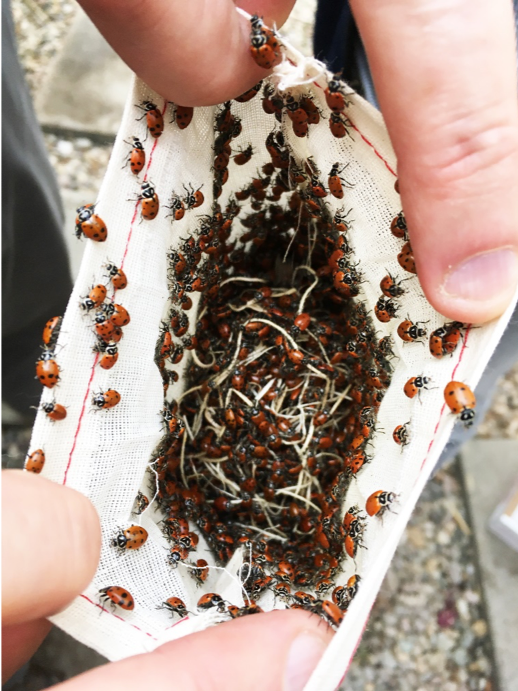
lady bugs crawling out of a canvas bag

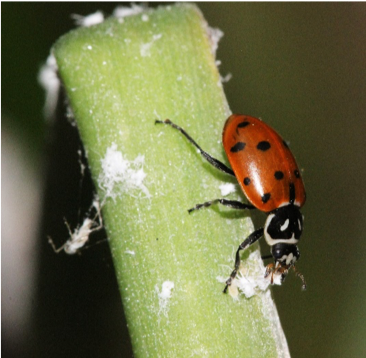
So what would be the logical solution to combatting these pests, which are highly destructive to the Marsh Machine plants that are working so hard to treat our wastewater? Bring the predators in, of course! The convergent ladybug (Hippodamia convergens), is a native predatory beetle that prefers just the types of insects that infest the Marsh Machine. We purchased 4,000 of these ladybugs (Picture 2) and have just released them into our greenhouse. The voracious predators immediately began their search and started feasting on a buffet of teeny bugs (Picture 3).

ladybug eating a mealy bug on a plant

According to our ladybug vendor, each adult ladybug can consume about 5,000 aphids in its lifetime! The adult females lay about 10-15 eggs a day, and the larvae that hatch out consume 50-60 aphids per day. At this rate, we anticipate our infestation will be under control in no time!

Note: While releasing ladybugs is an effective way to control greenhouse pests, releasing them outdoors generally results in the ladybugs flying away from the intended target, so keep this in mind when considering pest control options in your own backyard. Other options include eliminating the use of pesticides, which also kill the beneficial predators (and pollinators), and gardening with native plants, which are adapted to defend against native pests.

Andrea Kautz is a Research Entomologist at Carnegie Museum of Natural History’s Powdermill Nature Reserve. Museum employees are encouraged to blog about their unique experiences and knowledge gained from working at the museum.

Filed Under: Blog Tagged With: Andrea Kautz, Anthropocene, bugs, insects, Powdermill Nature Reserve

March 22, 2019 by wpengine

So, Just What is a Wheel Bug?

As March was approaching, I knew I was ‘on deck’ to produce a blog entry originating from our Section of Invertebrate Zoology. Looking at the calendar, I saw that the deadline would land around the 15th of the month, and something nagged at me about that date – what was the significance? Why, yes – the Ides of March was looming! Shakespeare’s Caesar failed to heed the warnings, and in the end… met his assassin…

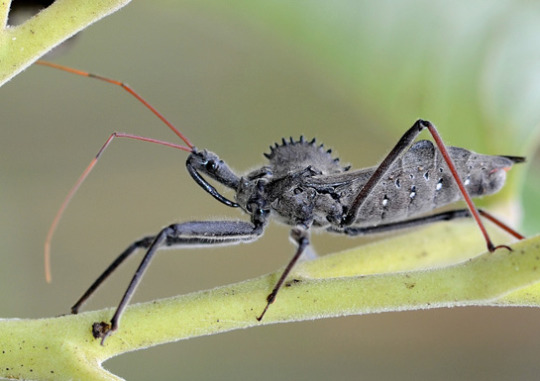
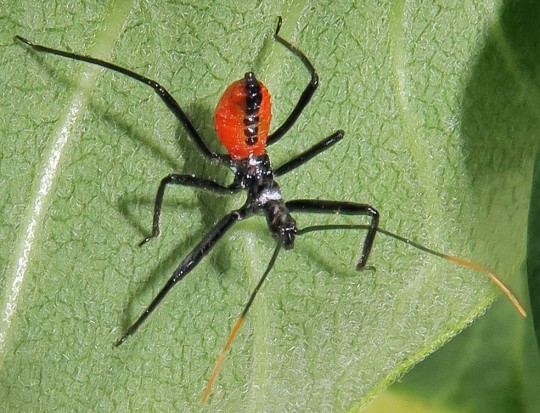
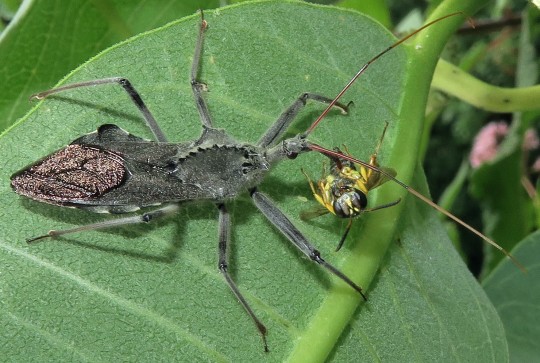
So, let’s take a look at an insect that carries the moniker of “assassin bug” – a species that possesses a bite of which everyone should truly beware. The insect is Arilus cristatus (Linnaeus), a species of ‘true bug’ in the order Heteroptera, in the family Reduviidae, collectively known as the assassin bugs. Arilus cristatus also carries the common name of ‘wheel bug’ due to the distinctive, serrated crest on its pronotum that in profile resembles a portion of a wheel or gear. No other insect in the United States possesses such a structure and the ‘wheel’ allows this species to be readily identified. In addition to the odd cog-like crest, the bug is large – nearly 1 ½ inches in length in mature adults and is dull gray in coloration. The immatures, or nymphs, look entirely different – they are small, bright red and lack the ‘wheel.’

Wheel bug, Arilus cristatus (Linnaeus) (Heteroptera: Reduviidae) (Image ©Rich Kelly, New Hyde Park, NY. Used with permission)

The wheel bug occurs throughout the southern half of the United States, ranging northward to the upper Midwest and southern New England. While Southwest Pennsylvania is within its natural distributional range, it appears to have become more common in our area over the last decade. People began bringing specimens into the museum for identification at an increasing rate starting around 10 or so years ago. While the evidence is anecdotal, the apparent increase in their abundance in our area could be a result of our changing climate – as our region becomes warmer on average, the environment becomes more suitable for the wheel bug, allowing it to thrive. Another potential factor for its increased numbers in our area is the introduction of an invasive species, the brown marmorated stinkbug, Halyomorpha halys Stål — a true bug species native to eastern Asia. With an increase in easily captured prey, the wheel bug may be exploiting this new food source. On a number of occasions, I have witnessed wheel bugs feeding on the introduced stinkbugs in the field.

Immature of the wheel bug, Arilus cristatus (Image ©Seth Ausubel, Washington Crossing, PA. Used with permission)

All of the reduviids are predatory on other invertebrates, using their beak-like mouthparts to pierce their prey and inject a powerful mix of enzymes that kills and begins digesting their prey from the inside, similar to the feeding habits of spiders. I can attest, from personal experience, to the extreme pain this insect can inflict by its bite. Wheel bugs, like many Insects, can be attracted to lights at night, and while collecting around some bright gas station lights some years ago, I foolishly decided to pick one up by the wheel with my bare fingers, assuming it could not reach me with its relatively short beak – and oh, how wrong I was! The initial bite was not terribly bad, but unusual, feeling like a tiny electrical shock. In less than a minute, however, a sharp, burning sensation began spreading the length of my thumb. The pain reached a crescendo in about 5 minutes and stayed at that level for several hours. The next day, the burning had subsided, but was replaced by a dull, throbbing ache that felt as if I’d smashed my thumb with a hammer. That discomfort persisted for a couple more days, yet oddly, there was no swelling and no obvious redness or sore at the site of the bite.

Arilus cristatus feeding on a hymenopteran (Image ©Seth Ausubel, Washington Crossing, PA. Used with permission)

While the bite of the wheel bug can certainly be a painful experience, and potentially worse in individuals that have a sensitivity or allergic reaction to the bite, they are rightfully considered a beneficial insect. Their predatory behavior helps rid gardens and forests of a wide variety of pest insects, from leaf-feeding beetles to caterpillars — a process of natural pest elimination known as biocontrol. So, if you should encounter a wheel bug — mid- to late summer is their peak time of activity — enjoy observing this odd insect and appreciate it for the role it plays in the environment. But heed my warning — resist any temptation to pick it up for a closer look!

Bob Androw is a Scientific Preparator in Invertebrate Zoology. Museum employees are encouraged to blog about their unique experiences and knowledge gained from working at the museum.

Filed Under: Blog Tagged With: Bob Androw, bugs, insects, Invertebrate Zoology

  • Page 1
  • Page 2
  • Page 3
  • Go to Next Page »

sidebar

About

  • Mission & Commitments
  • Directors Team
  • Museum History

Get Involved

  • Volunteer
  • Membership
  • Carnegie Discoverers
  • Donate
  • Employment
  • Events

Bring a Group

  • Groups of 10 or More
  • Birthday Parties at the Museum
  • Field Trips

Powdermill

  • Powdermill Nature Reserve
  • Powdermill Field Trips
  • Powdermill Staff
  • Research at Powdermill

More Information

  • Image Permission Requests
  • Science Stories
  • Accessibility
  • Shopping Cart
  • Contact
  • Visitor Policies
One of the Four Carnegie Museums | © Carnegie Institute | Privacy Policy | Terms of Use | Accessibility
Rad works here logo