• Skip to primary navigation
  • Skip to main content
  • Skip to primary sidebar

Carnegie Museum of Natural History

One of the Four Carnegie Museums of Pittsburgh

  • Visit
    • Buy Tickets
    • Visitor Information
    • Exhibitions
    • Events
    • Dining at the Museum
    • Celebrate at the Museum
    • Powdermill Nature Reserve
    • Event Venue Rental
  • Learn
    • Field Trips
    • Educator Information
    • Programs at the Museum
    • Bring the Museum to You
    • Guided Programs FAQ
    • Programs Online
    • Climate and Rural Systems Partnership
  • Research
    • Scientific Sections
    • Science Stories
    • Science Videos
    • Senior Science & Research Staff
    • Museum Library
    • Science Seminars
    • Scientific Publications
    • Specimen and Artifact Identification
  • About
    • Mission & Commitments
    • Directors Team
    • Museum History
  • Tickets
  • Give
  • Shop

Catherine Giles

August 17, 2020 by wpengine

Traub Flea Data Books

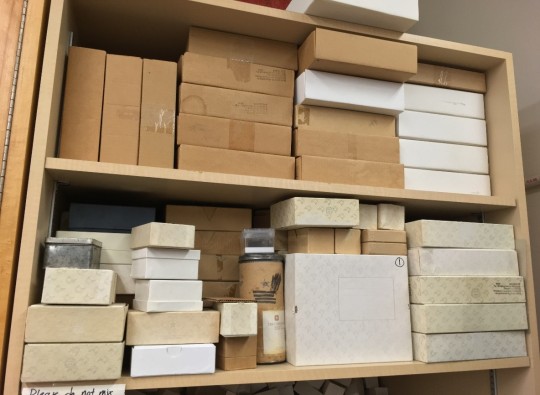
With work-from-home restrictions in place, I’ve been transcribing the handwritten field notes (Figures 1-2) of world-renowned flea expert Robert Traub into a digital database. Between 1995 and 1997, Traub donated most of his collection to CMNH. Materials housed in the Traub collection span the globe, from the middle east to central America to islands in the pacific and beyond. The notebook I’m currently transcribing dates back to the mid-1900s, with records from particular field expeditions to Pakistan and Mexico.
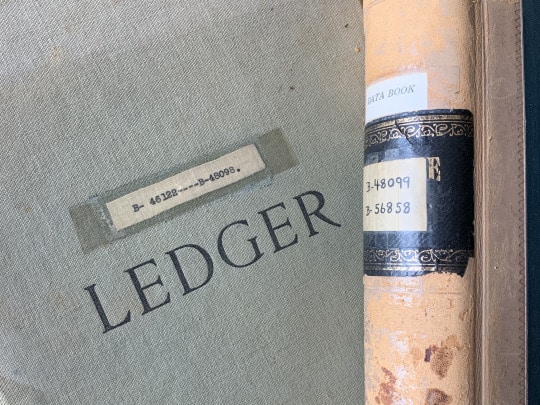
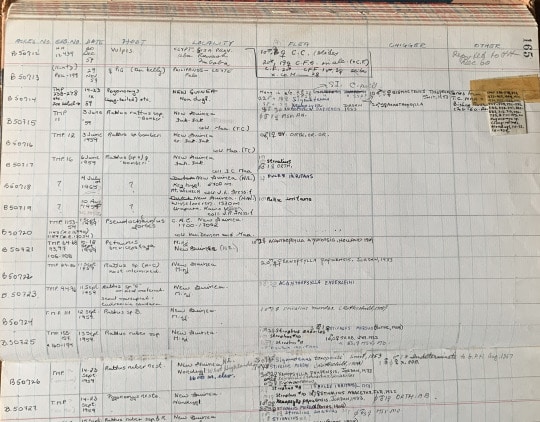
Figure 1. Some of the notebooks written by Robert Traub containing information on his flea specimens.
Figure 2. One of the pages from a Traub notebook illustrating the specimen data it contains. Eventually, all of this data will be transcribed into electronic format so it can be searched and shared.

This type of retroactive data capture allows us to put standard locality information on specimens formerly associated with just an identification or data code number. This process also allows us to verify and update taxonomic names as necessary. While it’s not nearly as fun as field work, data capture and transcribing are still an important part of collections work.

The Traub collection is estimated to contain nearly 75,000 specimens mounted on glass slides (Figure 3), with 5,000 associated genitalic dissections. The enormous collection is housed in antique cabinetry as well as modern Eberbach cabinets. Almost 7,000 of these specimens only have a data code; thus, my digitization efforts and subsequent labeling continue!
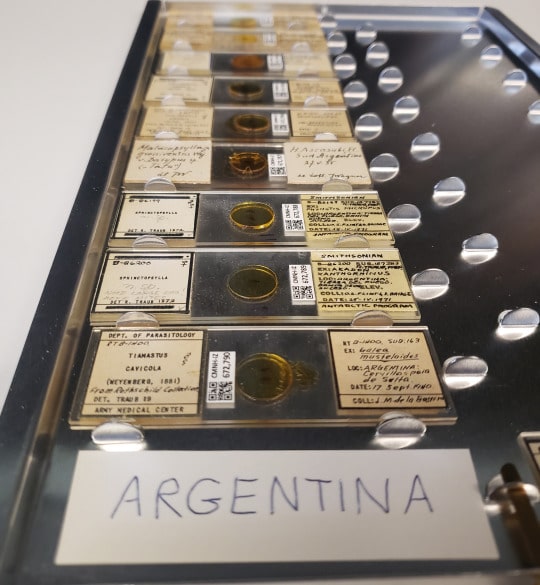
Figure 3. Several slides from the Traub Flea collection.

Since I started working in IZ nearly three years ago, I have had the distinct privilege of working with different taxa every few months. From Lepidoptera, to Odonata, to Coleoptera, to Arachnida, and now Siphonaptera, these tasks serve as beautiful reminders of the diversity of life here on planet Earth.

Catherine Giles is Curatorial Assistant in the Section of Invertebrate Zoology at Carnegie Museum of Natural History. Museum employees are encouraged to blog about their unique experiences and knowledge gained from working at the museum.
Related Content

Moth Meme Science

Working with the Type Collection

A Bumble’s Blog and Bumble “Weee” Catapult Craft

Filed Under: Blog Tagged With: Catherine Giles, Invertebrate Zoology, Museum from Home, Science News, Section of Invertebrate Zoology

April 9, 2020 by wpengine

Building Webs and Making Connections: Working with the Arachnid Collection

At one point in the long history of Invertebrate Zoology, we went by the name “Section of Insects & Spiders.” It may be surprising to some readers, but spiders aren’t actually insects. Insects and Arachnids (spiders and their kin) are two very distinct groups of animals that make up part of the mega-diverse lineage of organisms known as the Arthropods (phylum Arthropoda; which also includes the crustaceans (crabs, shrimps, and lobsters, etc.) and myriapods (centipedes and millipedes).

Arthropods are characterized by having segmented bodies, the presence of an exoskeleton, bilateral symmetry, and paired jointed appendages. Within this phylum, the classes Insecta and Arachnida vary in several key ways. Arachnids have a fused head and thorax (called a cephalothorax) with a separate abdomen, while insects have three distinct regions: a head, thorax, and abdomen, typically unfused. Additionally, insects have 6 legs, while spiders have 8.

Within arachnids, there are several orders, including Araneae (spiders), Acari (mites & ticks), Opiliones (Harvestmen/“Daddy Long Legs”), Scorpionida (scorpions), Solifugae (camel or sun spiders), and others. Spiders comprise the majority of the order Araneae and includes the tarantulas.

Historically, spiders have been treated differently from most of the insects housed here in IZ. As largely a section of entomology, the main focus has been on class Insecta, while still building on donated arachnid materials where applicable.

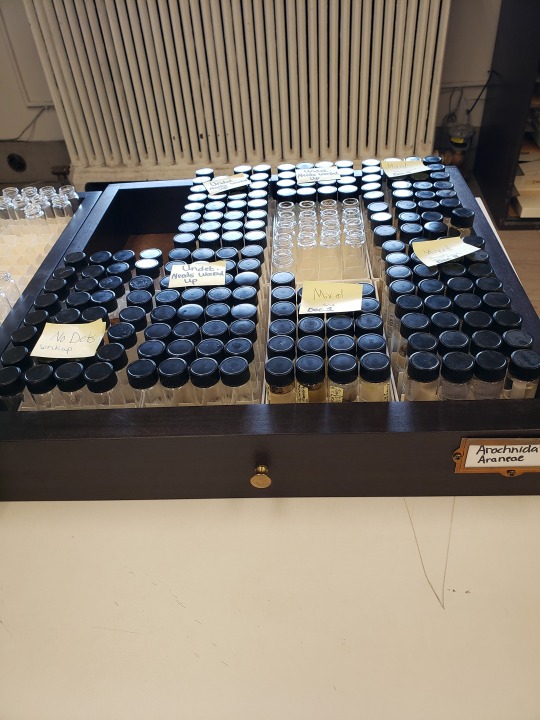
In early 2019, I was tasked with bringing the arachnid holdings together and began databasing its contents. This was part of a larger digitization initiative pioneered in IZ as well as many museum collections world-wide. As with many soft-bodied organisms, we store our spider specimens in alcohol (80% ethanol), as shown in Figure 1.

Figure 1. A standard alcohol drawer, containing arachnid specimens in 6 dram vials.

I began by bringing determined material together taxonomically. Determined materials are those that an expert has identified to the genus and/or species level. I can then catalogue that information into a database so that the holdings here can be shared electronically to other arachnologists around the globe.

Currently, we have over 900 spiders databased of the estimated 2700+ arachnids in our collection. Most of our spiders are from field expeditions to the Dominican Republic, from a large donated collection from Brazil, and from a former curator’s backyard in Gibsonia, PA.

We plan to move on to other arachnid groups in the future, and ultimately hope to have our specimens completely digitized and available for loans to the scientific community.

I’d like to give a special thank you to two of our wonderful volunteers, J. Murphy and A. Bianco. Their dedication and hard work have allowed this project to really blossom and our “web” of arachnid lovers to grow ever larger.

Catherine Giles is the Curatorial Assistant of Invertebrate Zoology at the Carnegie Museum of Natural History. Museum employees are encouraged to blog about their unique experiences working at the museum.
Filed Under: Blog Tagged With: Catherine Giles, Invertebrate Zoology, Museum from Home, Science News

May 22, 2019 by wpengine

O-Do-nates or O-Don’t-nates—Dragonflies and Damselflies in the Section of IZ

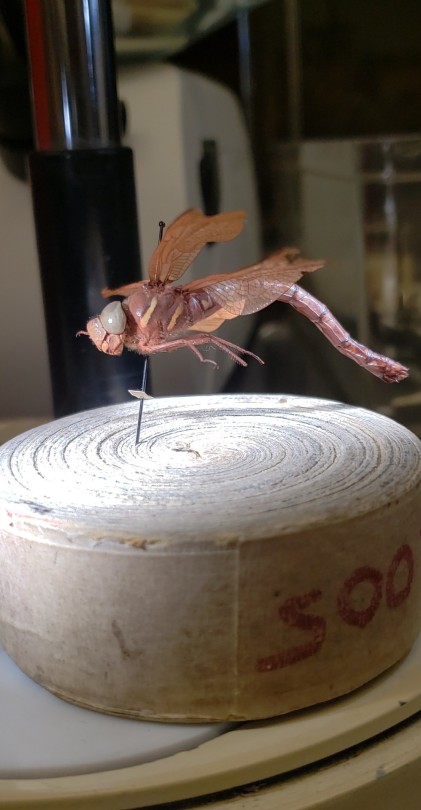
Here, in the section of Invertebrate Zoology, we have a large collection of moths (order Lepidoptera: particularly in the families Sphingidae and Noctuidae), beetles (order Coleoptera: particularly in the family Carabidae), and fleas (order Siphonaptera: from all over the world). However, one of the most interesting groups we have in our collection is the order Odonata (pronounced oh-DOE-naw-ta), also known as dragonflies and damselflies (Figure 1). Aquatic in their juvenile stages, these masters of air and water are stunningly beautiful in overall design and coloration, and are phenomenal hunters. Truly, these delicate predators are impactful and under-appreciated among insect taxa.

Figure 1. A pinned dragonfly, undetermined. Photograph taken by Catherine Giles.

Odonates are insects that undergo incomplete metamorphosis, and have three primary life stages: egg, nymph, and adult (or imago). Incomplete metamorphosis (also called hemimetaboly) is a process where juveniles look like miniature versions of the adults, but get larger over time. Organisms undergoing complete metamorphosis (also called holometaboly) have a pupal stage, and juvenile and adult stages appear very different. For example, a caterpillar turns into a pupa, before emerging as an adult moth or butterfly. Odonates can spend months or years in their nymphal stages, depending on the taxon. Most people (myself included!) are more familiar with the adult phase of an odonate’s life cycle, and see them darting around freshwater ponds and rivers, hunting to satiate their carnivorous diet.

Recently, I transferred our pinned and papered odonate material from one kind of drawer (USNM) into other drawers (Old Holland and Ortmann) due to space limitations in our collection. (For a refresher on drawer types found around the section, see the “Ants in our Pants and Bugs in Our Drawers” blog post!) Among much of our pinned material were numerous nymphal exuviae, or skins cast off by young, immature, juvenile odonates as they grew towards adulthood.

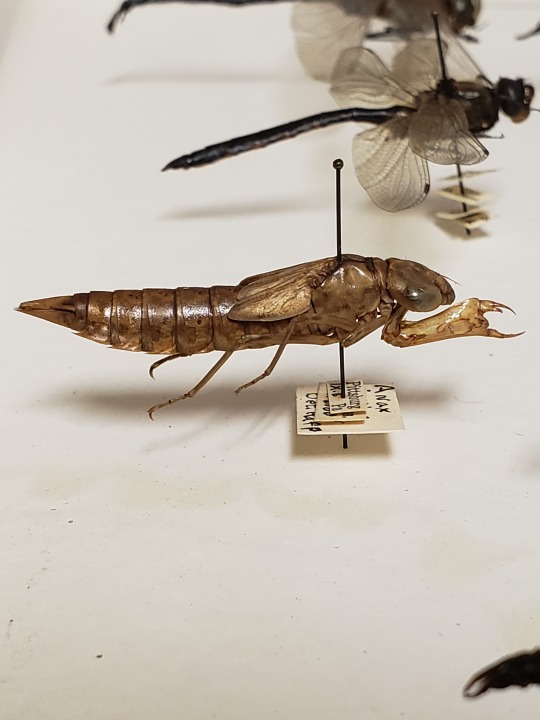
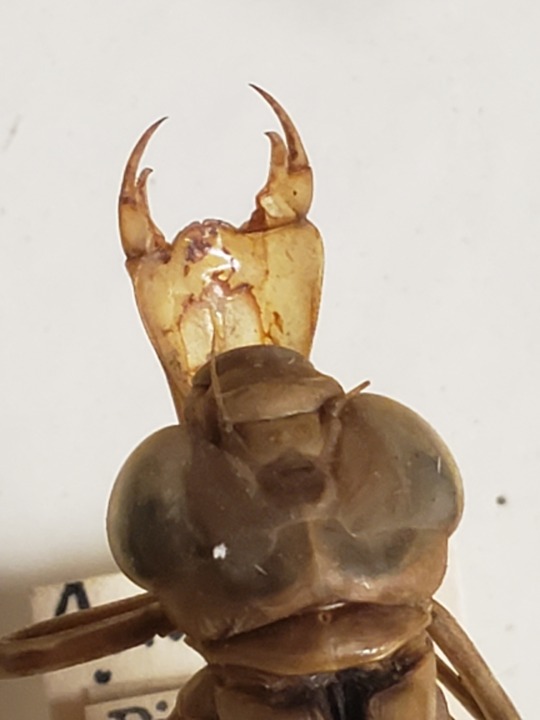
Pictured below is not a Hollywood monster, but rather a dragonfly nymph, Anax junius, in the family Aeshnidae, with the labium extended (Figure 2). While this image could be considered the stuff of nightmares, for an entomologist like me, it makes me excited! Nymphs use the labium to grab for prey in the water, and on the end of this particular specimen’s labium, you can clearly see additional pincers, used to grasp prey more securely. Pictured below is a close-up view of these pincers (Figure 3). Even as juveniles, dragonflies are top predators, making them masters of both water and air.

Figure 2. Nymphalexuviae of Anax junius. Photograph taken by Catherine Giles.


Figure 3. A close-up of pincers on Anax junius’s labium. Photograph taken by Catherine Giles.

At last count, we had approximately 40,000 pinned and papered odonate specimens in our collection. Having nymphal exuviae, like the ones pictured here, only enrich and enhance the diversity and magnificence of our insect collection here at the Carnegie.

Catherine Giles is the Curatorial Assistant of Invertebrate Zoology at the Carnegie Museum of Natural History. Museum employees are encouraged to blog about their unique experiences working at the museum.
Filed Under: Blog Tagged With: bugs, Catherine Giles, insects, Invertebrate Zoology

November 26, 2018 by wpengine

Ants in our Pants and Bugs in our Drawers: A Field Guide to Dry Specimen Storage in the Section of Invertebrate Zoology

By Catherine Giles

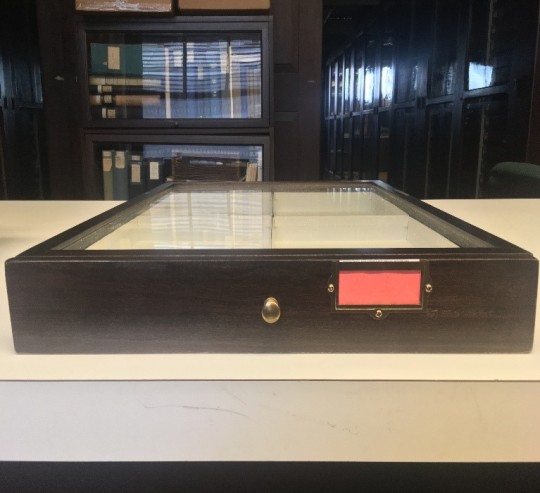
Welcome to the Field Guide to Dry Specimen Storage for the Section of Invertebrate Zoology (IZ)! Contained in this guide is a detailed listing of all storage containers used by IZ to store insects dry (i.e., those not placed into alcohol) for future study. This easy-to-use guide will specifically cover insect drawer storage, drawer identification, and their location within IZ. Using this guide will allow the reader to identify seven different storage containers we have utilized historically in IZ from the time the museum was founded. These drawers can be identified using their dimensions, coloration, and knob style.

Don’t Drop Your Drawers: A History of Drawer Usage In Invertebrate Zoology

There are many factors that limit where and how we store our insect drawers, but they are primarily dictated by physical space allocations, mainly because we have roughly 30,000 drawers to contend with. Our specimen storage containers range in size from a few square inches to roughly three square feet, and they all require specialized cabinetry for long-term protective storage. This cabinetry is currently divided among four large rooms. The IZ staff have done our best to incorporate technological advances to help with our ever-increasing collection, all while simultaneously maintaining the historical integrity of our museum workspace.  We have worked hard to provide our nearly 14.5 million specimens with safe, secure storage.

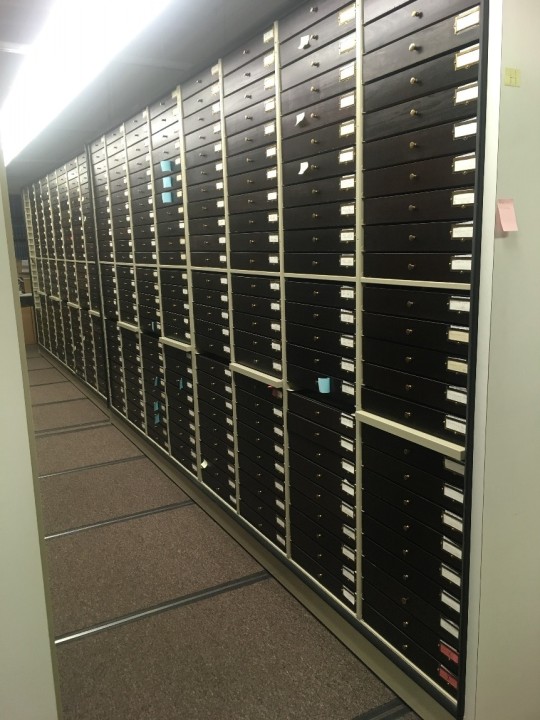
In the early 1980s, IZ received an NSF grant to construct a compactor in the Ulke Room. In the early 1990s, we received yet another NSF grant to install another compactor in the Avinoff Room. This enormous, movable, compact housing for storing our drawers freed up large volumes of space for us to acquire more drawers (and thus more bugs!). One range contains eight columns of 25 drawers, and can be rolled backwards or forwards to access either side of each range. A stationary range sits single-sided in the middle of each compactor, dividing it roughly in half, so that someone in the back of the compactor can work simultaneously with someone in the front. These compactors were built to store USNM drawers and Schmitt boxes.

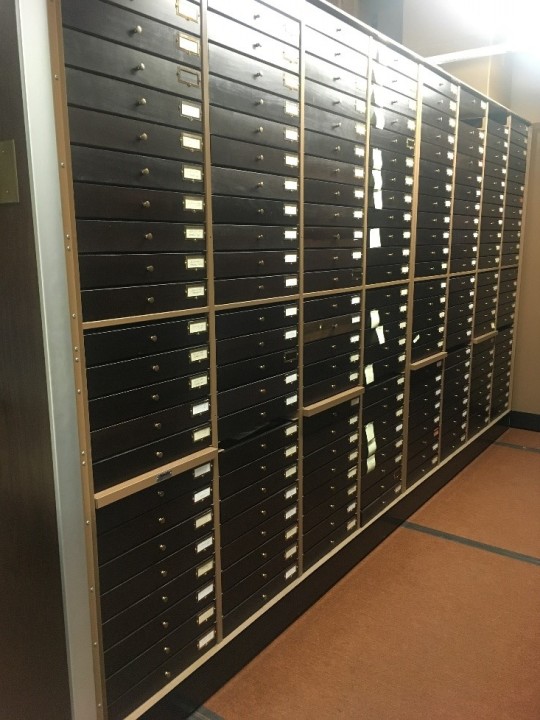
In the mid-2000s, IZ was awarded a grant to retrofit some antique wooden cabinetry in the Holland room. We retrofitted each wooden cabinet with steel inserts, making the entire room available for USNM and similarly-styled drawers. Previously, the Holland Room had quirky cabinets, fitted with slats of wood that only permitted Old Holland drawers to fit in at the mercy of humidity and warping. Now, with the new metal inserts, we can fit any combination of Old and New Holland Drawers, USNM, and Schmitt Boxes in the Holland Room.

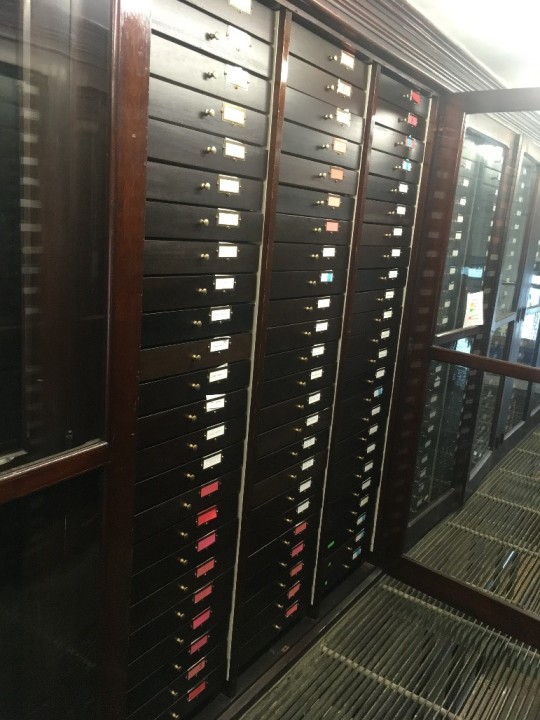
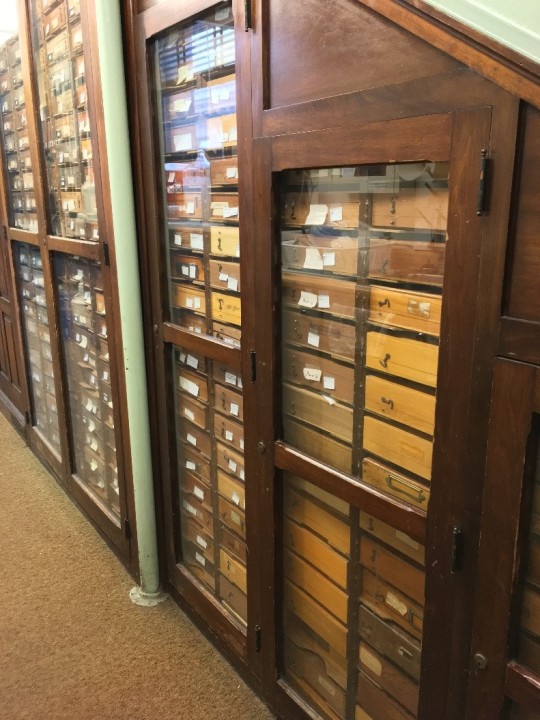
At one point in IZ’s history, mollusks (snails, slugs, and kin) were included in our section before it split off as the Section of Malacology. In the room formerly occupied by the Section of Mollusks, which now partly houses the Section of Education, you can find antique wooden cabinetry similar to that found in the Holland Room. These cabinets have not been retrofitted with steel inserts and thus can only hold Old Holland and Ortmann drawers. This space is colloquially known as the Sweadner Deck (pictured in part below), after a former Entomology staff member.

Detailed below are each individual storage method and their known habitats around the section. Measurements are given in approximate inches, and photographs are used when applicable. Rarity is used to indicate frequency of specimen storage and frequency of sightings around the section.

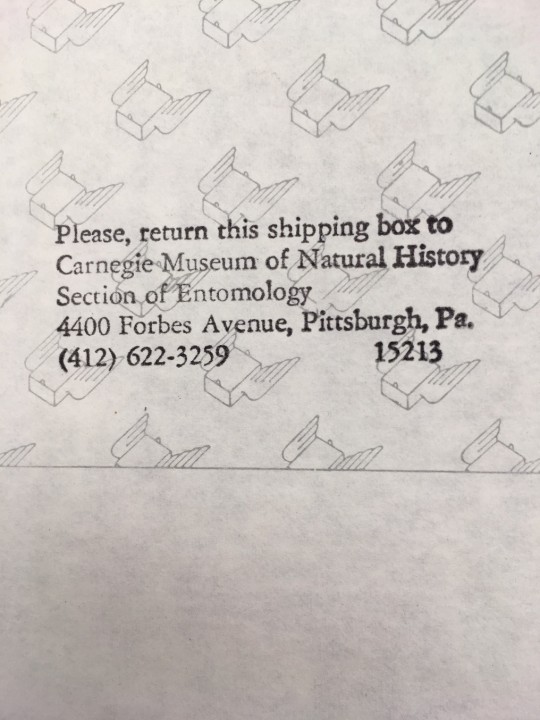
Text on a box that says: Please return this shipping box to Carnegie Museum of Natural History, Section of Entomology, 4400 Forbes Avenue, Pittsburgh, Pa. 15213, (412) 622-3259
drawers

USNM (United States National Museum) Drawer

Rarity: Most Common

Length: 18in, Width: 18in, Depth: 3in

Coloration: Dark Brown to almost Black

Locality and Habitat: Avinoff, Ulke, and sometimes the Holland Room

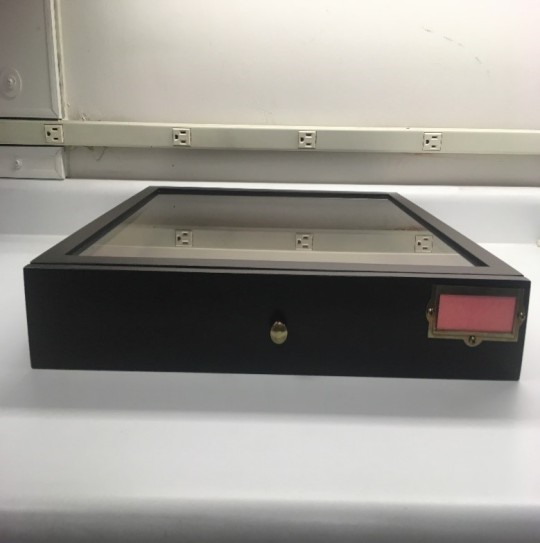
empty drawer
line of drawers
drawers

Top photo: An empty USNM Drawer awaits usage; Middle photo: USNM drawers in their Avinoff Compactor Habitat; Bottom photo: USNM Drawers in their Ulke Compactor Habitat; Not Pictured: Holland Room Locality.

New Holland Drawers

Rarity: Common

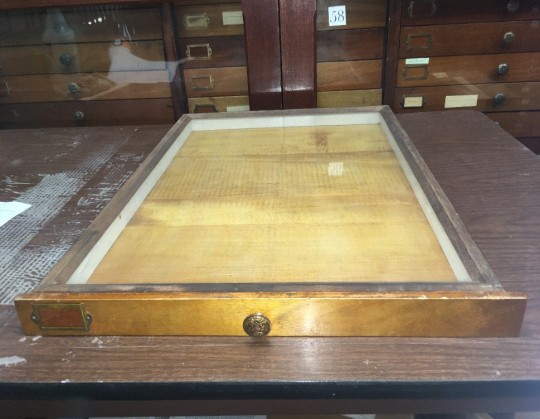
Length: 23.75in, Width: 18in, Depth: 3in

Coloration: Dark Brown to almost Black

Locality: Holland Room

drawers
drawer

Top photo: New Holland Drawers await final curation in their cabinetry in the Holland Room; Top photo: At about six inches longer than a USNM drawer, the New Holland Drawer’s lengthier frame allows it to be seated only in the cabinetry of the Holland Room.

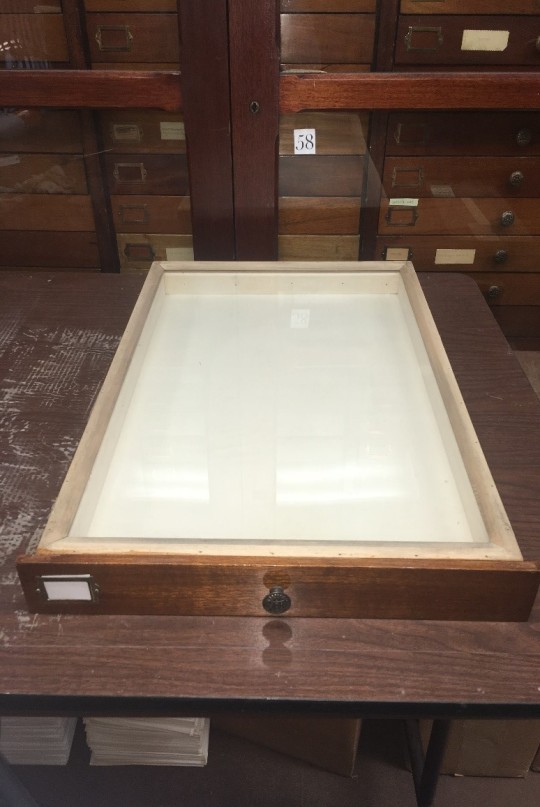
Old Holland Drawers

Rarity: Common

Length: 23in, Width: 18.15in, Depth: 2.25in

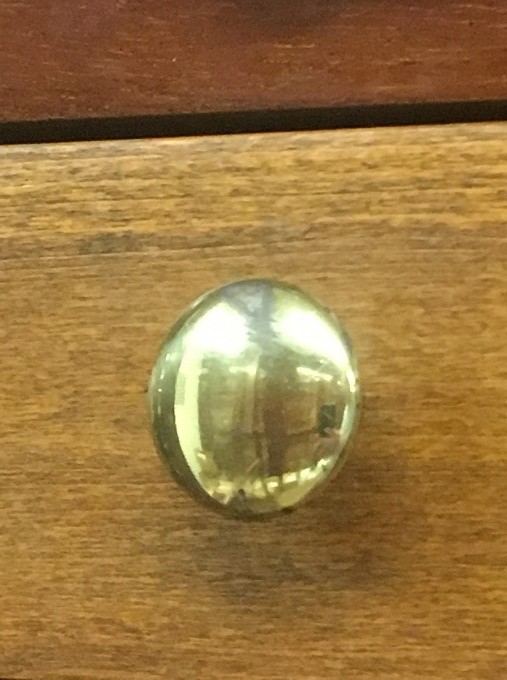
Coloration: Variable light tan, with 3 different style knobs and a pinning bottom

Locality: Holland Room, Sweadner Deck

drawer
detail of drawer handle

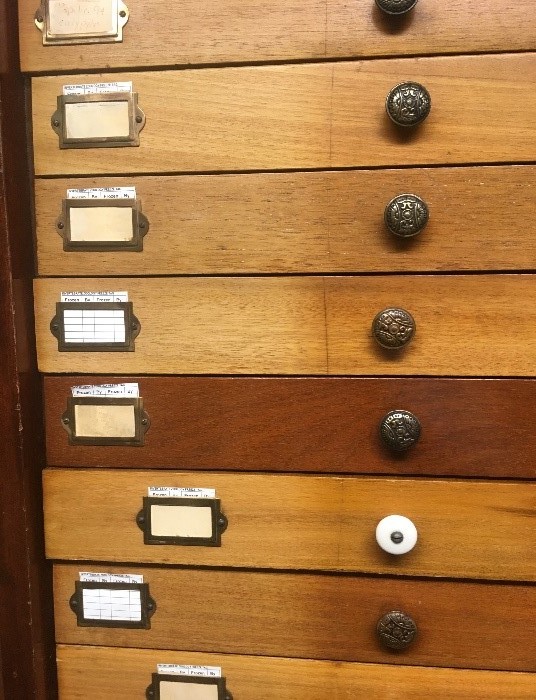
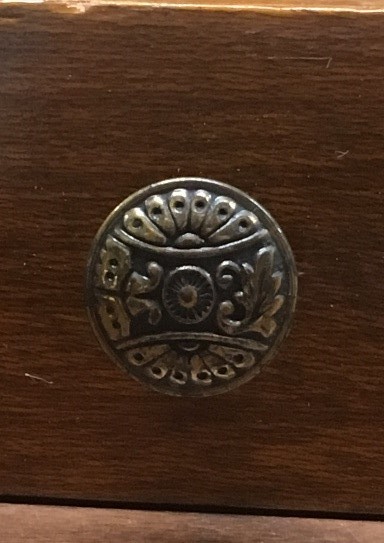
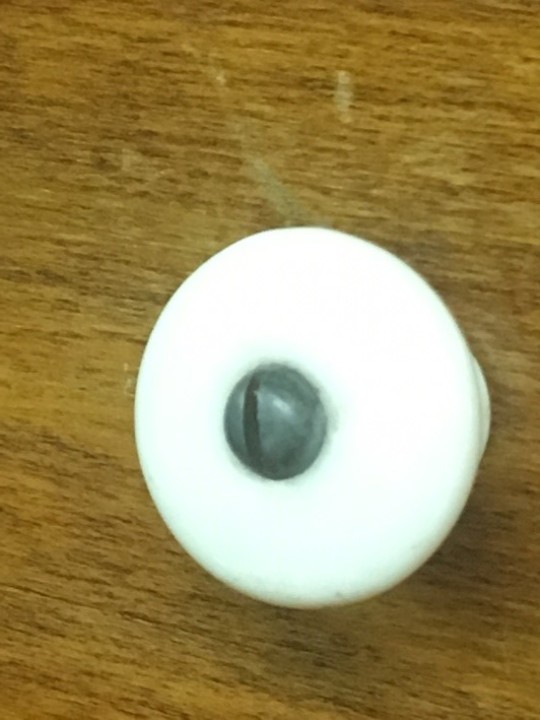
Pictured from top to bottom: An empty Old Holland Drawer, characterized by the wooden side slats and either a cork or foam pinning bottom, sits in the Sweadner Deck, one of only two places it can be housed. Ornate knobs like the one pictured in the middle were used up until World War II, when there was a strict recall on metal to be used in the war efforts. Knobs were then switched to the porcelain style, pictured at the far right. Sometime after the conclusion of World War II, knobs could once again be constructed of metal, this time smooth, as depicted at right.

Ortmann Drawers[FJ1]

Rarity: Extirpated

Length: 24.5in, Width: 18+in, Depth: 2.25in or 4in

Coloration: Variable Tan, with no pinning bottom

Locality: Stragglers may be found on the Sweadner Deck, but this style of drawer is no longer used

[FJ1]Note that the Ortmann drawers were not used by IZ, but were the drawers used by Malacology. We have used them more recently for wasp nests and papered materials.

drawer

A shallow Ortmann Drawer, characterized by a distinct lack of a pinning bottom and an additional half an inch or more in length, when compared to the nearly identical Old Holland Drawers.

drawers

Originally used exclusively in Malacology, Ortmann drawers have been repurposed to house some of our larger items, such as wasps nests and papered materials. A Deep Ortmann Drawer is pictured at right.

Cornell Drawers

Rarity: Uncommon

Length: 16.5in, Width: 19in, Depth: 3in

Coloration: Tan/yellow

Locality: Migratory (basement)

drawer

Cornell Drawers like the one pictured above are too long to fit into our standard cabinetry, but they are frequently used elsewhere in the entomological world. They are uncommonly used throughout our section but can be seen from time to time, especially in our basement storage unit. We often receive many Cornell drawers via donation and interaction with collections and collectors. They are generally too wide, much like the Mineral drawers, to fit into our storage units.

Schmitt Boxes

Rarity: Uncommon

Length: 9in, Width: 13in, Depth: 2.5in

Coloration: Variable light tan

Locality: Holland Room

drawers
drawer

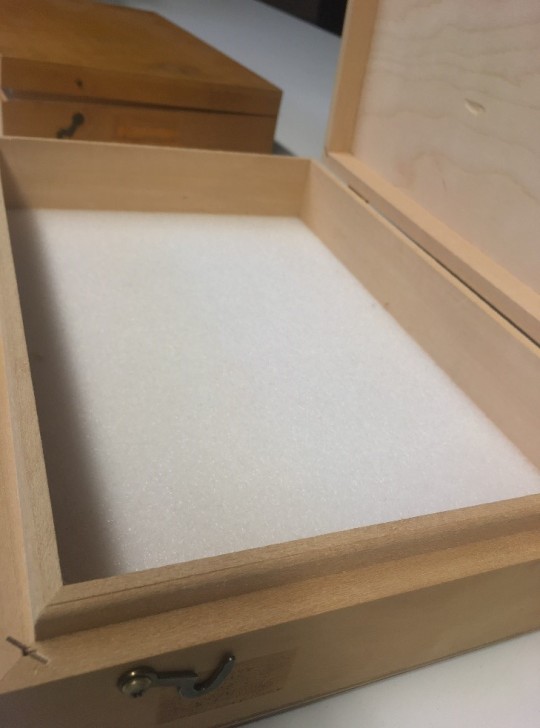
Schmitt Boxes were created by Jerome Schmitt. They are incredibly useful when conducting field work. In our section, they hold mostly loan returns and papered materials, and are located in the Holland Room, in intricate cabinets under the stairs. The Schmitt box pictured at the right has a foam pinning bottom, but many also contain cork.

Shippers

Rarity: Rare

Length: 9in, Width: 13in, Depth: 2.5in

Coloration: White or Brown

Locality: Preparatory Lab

open boxes

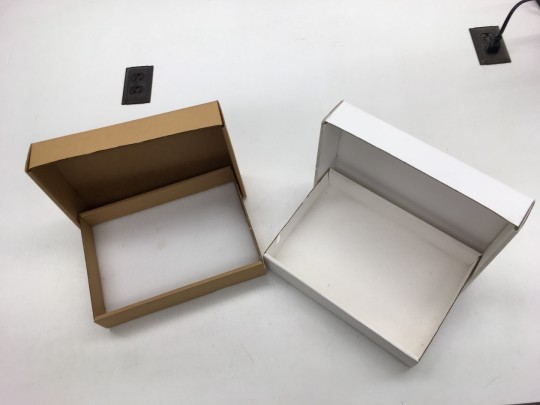
Our final storage method is our shipping containers. We typically do not store specimens here in the long-term, but while we are preparing to send a loan or have received one, specimens may be found here. Pictured above: Shippers, of similar dimensions to Schmitt Boxes. Pictured below: Shippers of a variety of sizes and shapes, in their home in the Preparatory Lab.

stacked boxes

Catherine Giles is the Curatorial Assistant of Invertebrate Zoology at the Carnegie Museum of Natural History. Museum employees are encouraged to blog about their unique experiences working at the museum.
Filed Under: Blog Tagged With: Catherine Giles, Invertebrate Zoology

October 29, 2018 by wpengine

What is a caterpillar database?

What is a caterpillar database? Curatorial Assistant in Invertebrate Zoology Catherine Giles introduces the larval collection and how it is organized. Learn how the section of Invertebrate Zoology collects and pickles specimens, then how they are stored and matched to a digital database of images and written notes.

Ask a Scientist is a video series where we ask our research staff questions about the millions of amazing objects and specimens stored in our museum collection. Tune in on YouTube, and submit your own questions via Twitter @CarnegieMNH!

Filed Under: Blog Tagged With: Ask a Scientist, caterpillars, Catherine Giles, Invertebrate Zoology

sidebar

About

  • Mission & Commitments
  • Directors Team
  • Museum History

Get Involved

  • Volunteer
  • Membership
  • Carnegie Discoverers
  • Donate
  • Employment
  • Events

Bring a Group

  • Groups of 10 or More
  • Birthday Parties at the Museum
  • Field Trips

Powdermill

  • Powdermill Nature Reserve
  • Powdermill Field Trips
  • Powdermill Staff
  • Research at Powdermill

More Information

  • Image Permission Requests
  • Science Stories
  • Accessibility
  • Shopping Cart
  • Contact
  • Visitor Policies
One of the Four Carnegie Museums | © Carnegie Institute | Privacy Policy | Terms of Use | Accessibility
Rad works here logo