• Skip to primary navigation
  • Skip to main content
  • Skip to primary sidebar

Carnegie Museum of Natural History

One of the Four Carnegie Museums of Pittsburgh

  • Visit
    • Buy Tickets
    • Visitor Information
    • Exhibitions
    • Events
    • Dining at the Museum
    • Celebrate at the Museum
    • Powdermill Nature Reserve
    • Event Venue Rental
  • Learn
    • Field Trips
    • Educator Information
    • Programs at the Museum
    • Bring the Museum to You
    • Guided Programs FAQ
    • Programs Online
    • Climate and Rural Systems Partnership
  • Research
    • Scientific Sections
    • Science Stories
    • Science Videos
    • Senior Science & Research Staff
    • Museum Library
    • Science Seminars
    • Scientific Publications
    • Specimen and Artifact Identification
  • About
    • Mission & Commitments
    • Directors Team
    • Museum History
  • Tickets
  • Give
  • Shop

discovery basecamp

March 28, 2022 by Erin Southerland

Learning From Misinterpretations

by Patrick McShea

Every job has its awkward moments, even work aiding museum visitors in their interpretation of exhibits. One memorable situation in that realm involved a father explaining skeletal bear remains to his three grade-school-aged children.

The setting was Discovery Basecamp during a busy December weekend in 2012. The exhibition had been established just two months earlier as an experiment in providing museum visitors with opportunities to examine authentic objects from the Educator Loan Collection, the enormous cross-discipline teaching collection that is managed to serve the needs of classroom teachers and other educators. In a section of well-lighted, first floor rear exhibit space, three free-standing racks of wire shelves held two dozen colorful toolboxes containing a wide range of natural history materials for visitors to examine, and the tops of five adjacent tables displayed large sturdy objects for close, hands-on inspection.

I was spending the day welcoming visitors to the space, and training a work-study student from the University of Pittsburgh and another from Carnegie Mellon University to do the same. We aimed to assist visitors in retrieving and returning toolboxes, and whenever asked, to answer questions. Listening to visitor conversations during that time was an important way to evaluate the success of the ongoing experiment. 

“Hey, let’s look at this,” I heard the father say as he gathered his children around a display table and picked-up one end of a yard-long, rope-linked strand of more than 20 large resin-coated vertebrae. “The tag says ‘bear,’ so let’s see if we can figure this out.” He stretched out the column on the tabletop, and moved both hands to its far end where an irregularly shaped shoebox-sized bone structure anchored the string. The structure, which was not identified on the simple paper tag, was the fused combination of the creature’s sacrum and hip bones, and the father’s unfamiliarity with mammal skeletal anatomy was immediately apparent. He mistook the bear’s butt-end for its skull, explaining to his children how the hip sockets were holes for the eyes, and that it was a shame the animal’s teeth were missing.
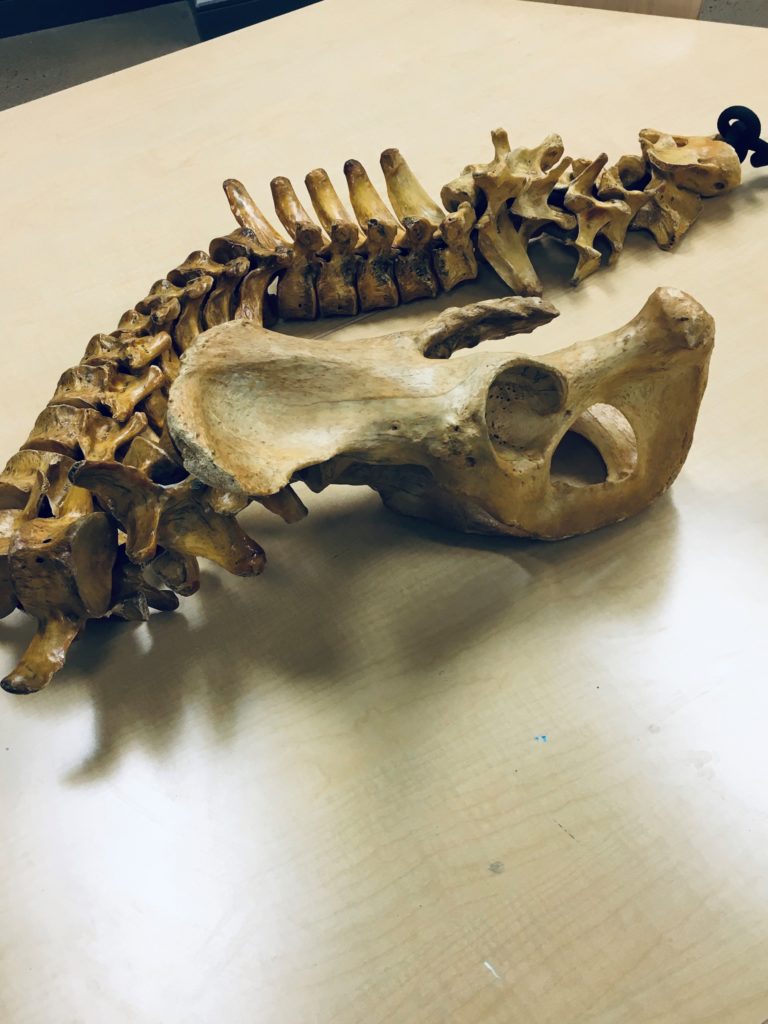
Bear vertebrae, sacrum, and hip bones on a table.
For anyone unfamiliar with mammal skeletal anatomy, hip sockets that once secured rounded femur heads might be confused with eye openings.

I didn’t correct him. Instead I explained to the work-study students that I’d be down in the loan program’s basement storage area for a few minutes. By the time I returned with a black bear skull, the attractions of the exhibition had pulled the family unit apart. All three children were engaged with toolboxes containing insect material, while their father was examining mineral samples on another table.
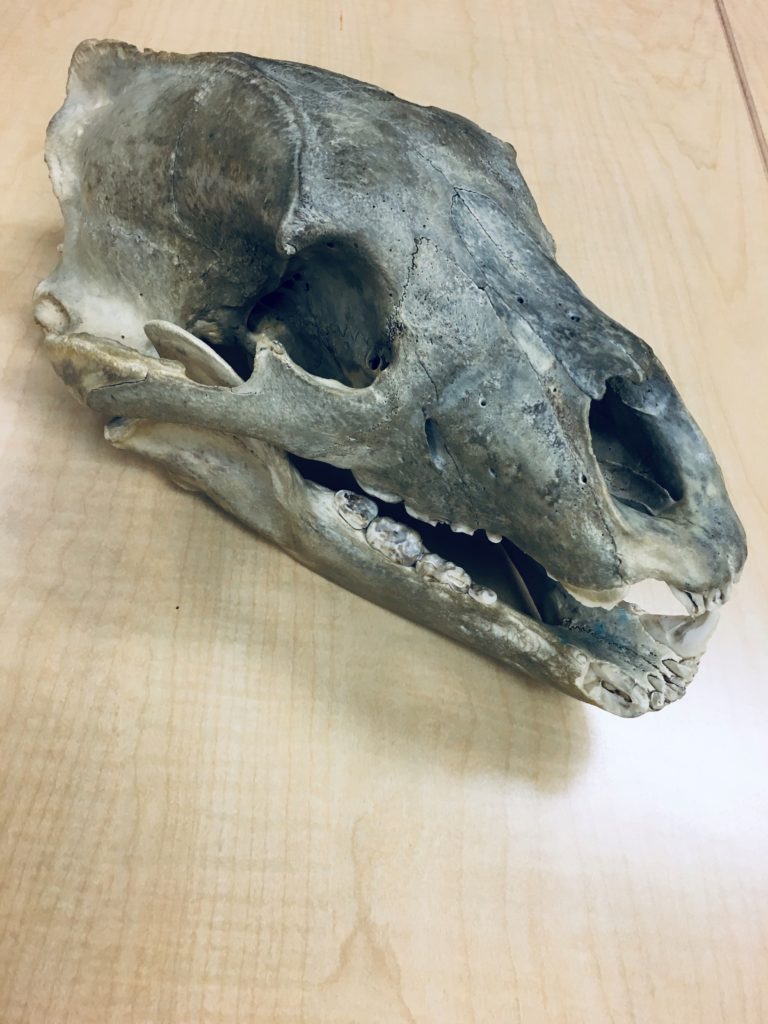
Bear skull on a table.
Discoloration and broken and missing teeth mark this American black bear jaw as a long-used teaching specimen.

I approached him holding out the bear skull and saying simply, “Our lack of labels might have caused some confusion a little earlier.” He looked at the skull, glanced back at the table with the vertebrae column, and then, to my great relief, laughed and accepted the skull from me. He called his children back to the original table, and with the skull as a visual aid, offered them a two-minute remedial lesson. I stood as far away from the table as possible.

Patrick McShea works in the Education and Visitor Experience department of Carnegie Museum of Natural History. Museum employees are encouraged to blog about their unique experiences and knowledge gained from working at the museum.

Related Content

Pitt Outreach Efforts Enriched with Museum Materials

March Mammal Madness and Middle School Science Class

African Artifacts: Back Story and Current Use

Carnegie Museum of Natural History Blog Citation Information

Blog author: McShea, Patrick
Publication date: March 28, 2022

Share this post!

  • Share on Twitter Share on Twitter
  • Share on Facebook Share on Facebook
  • Share on Pinterest Share on Pinterest
  • Share on LinkedIn Share on LinkedIn
  • Share on Reddit Share on Reddit
  • Share via Email Share via Email

Filed Under: Blog Tagged With: discovery basecamp, Education, Educator Loan Program, Pat McShea

August 6, 2018 by wpengine

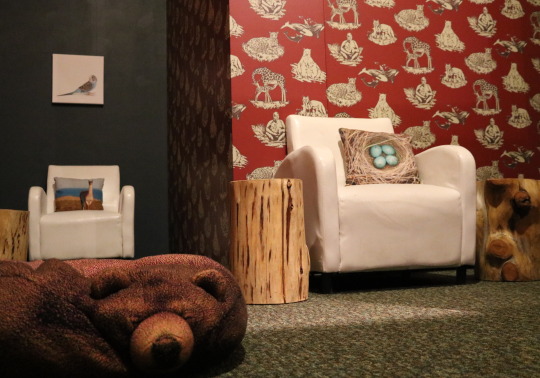
2018 Breastfeeding Friendly Place Award

breastfeeding area

We are proud to be a winner of the 2018 Breastfeeding Friendly Place Award! Cozy chairs and pillows in a private area near Discovery Basecamp provide a welcoming, convenient place for mothers to breastfeed. The space has been recently updated with wallpaper designed by Pittsburgh artist Ashley Cecile.

Filed Under: Blog Tagged With: discovery basecamp

October 9, 2017 by wpengine

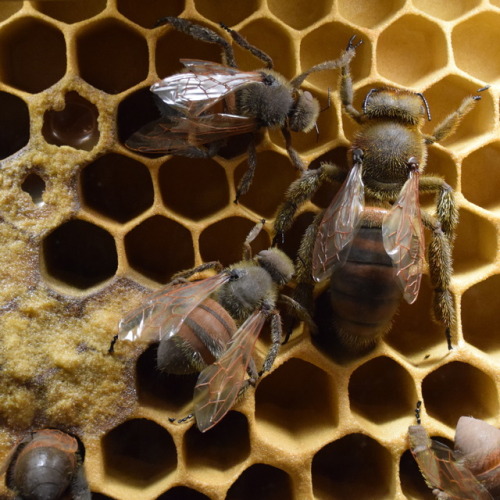
The Honey Bee (Apis mellifera)

honey bee diorama in Discovery Basecamp

The honey bee (Apis mellifera) has been domesticated by humans since ancient times. Drone bees have composite eyes that consist of about 14,000 individual eyes, which you can see in this super-sized display in Discovery Basecamp!

Filed Under: Blog Tagged With: discovery basecamp

July 21, 2017 by wpengine

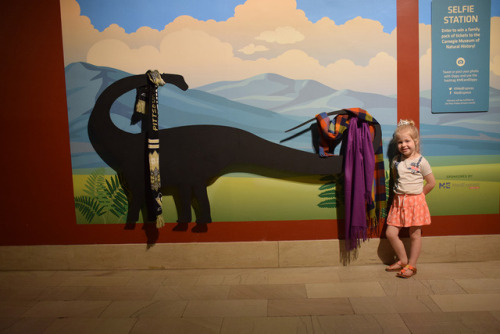
Check out our new selfie station featuring Dippy

child posing with a dinosaur dressed up in scarves
Check out our new selfie station featuring Dippy and all of his scarves!

The set-up is located in Discovery Basecamp at Carnegie Museum of Natural History and is sponsored by MedExpress Urgent Care.

Tweet or post your photo with Dippy on Facebook using #MEandDippy for the chance to win a family pack of tickets to the museum. MedExpress will select a winner once a month.

Filed Under: Blog Tagged With: discovery basecamp

July 17, 2016 by wpengine

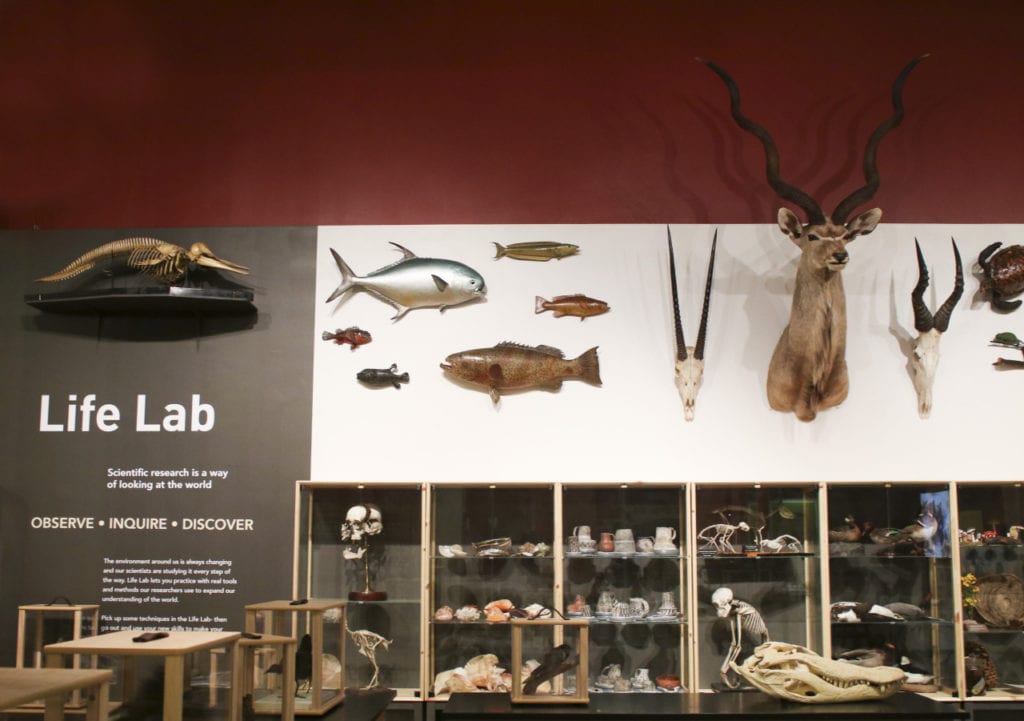
Life Lab at Discovery Basecamp

Wall of specimens in the Life Lab at Discovery Basecamp
(Photo by Hayley Pontia)

Life Lab at Discovery Basecamp, our new interactive permanent gallery, teaches the importance of scientific research and introduces a way of thinking to many young aspiring scientists.

Filed Under: Blog Tagged With: discovery, discovery basecamp, Pittsburgh

June 26, 2016 by wpengine

You can pet the mane of this lion

Lion Head

You can pet the mane of this lion at Discovery Basecamp, our new permanent gallery where visitors can explore, touch, and examine specimens from nature up close.

Filed Under: Blog Tagged With: discovery, discovery basecamp, Pittsburgh

  • Page 1
  • Page 2
  • Go to Next Page »

sidebar

About

  • Mission & Commitments
  • Directors Team
  • Museum History

Get Involved

  • Volunteer
  • Membership
  • Carnegie Discoverers
  • Donate
  • Employment
  • Events

Bring a Group

  • Groups of 10 or More
  • Birthday Parties at the Museum
  • Field Trips

Powdermill

  • Powdermill Nature Reserve
  • Powdermill Field Trips
  • Powdermill Staff
  • Research at Powdermill

More Information

  • Image Permission Requests
  • Science Stories
  • Accessibility
  • Shopping Cart
  • Contact
  • Visitor Policies
One of the Four Carnegie Museums | © Carnegie Institute | Privacy Policy | Terms of Use | Accessibility
Rad works here logo