• Skip to primary navigation
  • Skip to main content
  • Skip to primary sidebar

Carnegie Museum of Natural History

One of the Four Carnegie Museums of Pittsburgh

  • Visit
    • Buy Tickets
    • Visitor Information
    • Exhibitions
    • Events
    • Dining at the Museum
    • Celebrate at the Museum
    • Powdermill Nature Reserve
    • Event Venue Rental
  • Learn
    • Field Trips
    • Educator Information
    • Programs at the Museum
    • Bring the Museum to You
    • Guided Programs FAQ
    • Programs Online
    • Climate and Rural Systems Partnership
  • Research
    • Scientific Sections
    • Science Stories
    • Science Videos
    • Senior Science & Research Staff
    • Museum Library
    • Science Seminars
    • Scientific Publications
    • Specimen and Artifact Identification
  • About
    • Mission & Commitments
    • Directors Team
    • Museum History
  • Tickets
  • Give
  • Shop

ecology

April 17, 2019 by wpengine

Defeating Thanos and his Malthusian Mission of Population Control

Thomas Robert Malthus penned an essay on population growth in 1798 that mathematically demonstrated the relationship between food and human population. Malthus argued that whenever food supply increases, population rapidly grows to eliminate the abundance resulting in perpetual human suffering unless we control human population. From bacteria growing in a petri dish to lynx feeding on hares, Malthus’ essays on the principle of population are essential tools to ecologists forecasting population changes relative to resources. Malthus’ ideas also greatly influenced the early architects of the theory of evolution and sparked a great deal of debate on the improvement of society, birth rates, and forced sterilization. In fact, Malthus’ work is usually taught with care in today’s classrooms and museums because of its role in the development of eugenics and policies that violate human rights.

Malthus died almost 200 years ago, but his legacy continues to appear in debates on sustainability and to inspire apocalyptic plots in science and popular culture. One of the best-known Malthusians was Charles Dickens’ character Ebenezer Scrooge, a miserable old man who suggested that the poor ought to perish sooner rather than later to “decrease the surplus population.” Another example is Aldous Huxley’s novel Brave New World, which was based on a society where people were mass produced using in vitro technology to precisely control the population and people wear their contraception on so called “Malthusian belts.” And, today, Malthus’ latest incarnation comes as the supervillain Thanos in Avengers: Endgame, the next film from the Marvel Cinematic Universe. Over the course of many films, we follow Thanos on a Malthusian mission to wipe out half of all living things to achieve a “perfect balance” in the universe and to eliminate suffering caused by limited resources, a hard choice requiring Thanos’ strong will.

Thanos action figure
Credit: Krikkiat / Shutterstock.com

Despite the fact that wildlife populations repeatedly demonstrate Malthus’ principles of resources and population growth followed by population crashes, nearly all predictions of human suffering forecasted by Malthusians have been proven wrong. The world has generally gotten better with less human suffering as quality of life rises every year since Malthus’ first predictions. For decades apocalyptic predictions by biologists who studied butterflies and bacteria have not been realized because there was no way to account for the innovative abilities of human beings. We humans have radically altered our population and quality of life with inventions like vaccines and chemical fertilizers. Of course, population size and growth underlie nearly every measure of environmental impact in existence, but our ingenuity as a species has tended to prevent human suffering at the apocalyptic scales predicted by Malthusians.

When it comes to innovation for solving big problems caused by human population size and growth, like climate change and extinction, diversity matters. Unlike the world Malthus knew 200 years ago, the source pool for innovative solutions consists of over 7 billion people and includes women, people of color, and others who have been historically suppressed. Diversity leads to more creative and more novel solutions to problems; this has been proven in ecosystems with high amounts of biodiversity, companies with diverse workforces, and, maybe, diverse teams of superheroes defeating Thanos. In the upcoming battle for balance in the Marvel Cinematic Universe, diversity in numbers may be their greatest strength. Is diversity in numbers our greatest strength for solving our biggest problems, like climate change and extinctions?

female Avengers action figures
Credit: Krikkiat / Shutterstock.com

As far as decent ways to balance birth and death on our finite planet, the best strategy seems to be liberating girls and women around the world. In fact, family size shrinks, and quality of life almost always improves when girls are allowed to go to school, when women are allowed to earn money, and when contraceptives are available. Equity for women worldwide sounds like something we can all support regardless of our current planetary boundaries.

Chase Mendenhall is Assistant Curator of Birds, Ecology, and Conservation at Carnegie Museum of Natural History. Museum employees are encouraged to blog about their unique experiences and knowledge gained from working at the museum.
Filed Under: Blog Tagged With: Anthropocene, Chase Mendenhall, ecology, Thomas Robert Malthus

August 29, 2018 by wpengine

Oh MAN(tis)!

by Catherine Giles

Picture it: A crisp, early evening in late spring. The virtually cloudless sky cascades in a brilliant azure backdrop against your humble abode.

You’ve just arrived home from a long, exhausting day of work, yet your mind is still racing:

I need to remember that meeting on Tuesday, answer those important emails, what even is Windows 10?, did I put gas in the car?, what was that notification from my mother in law?

You are definitely ready to unwind and relax for the day!

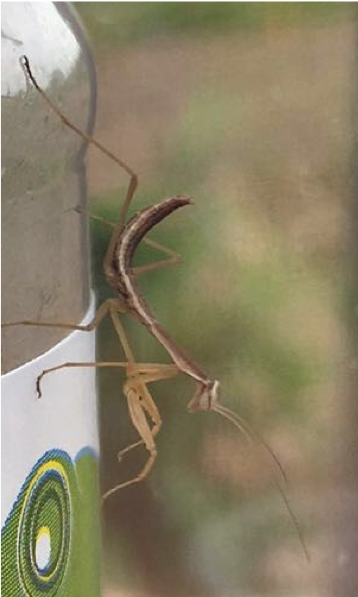
You sling your bags over a shoulder and balance your keys in one hand. You sigh wearily as you slide the key into the lock and, glancing over at the front window, notice a tiny, greenish-brown praying mantis staring back at you inquisitively, like the one pictured below.

praying mantis
A young praying mantis stalks her prey.

Huh. That’s funny.

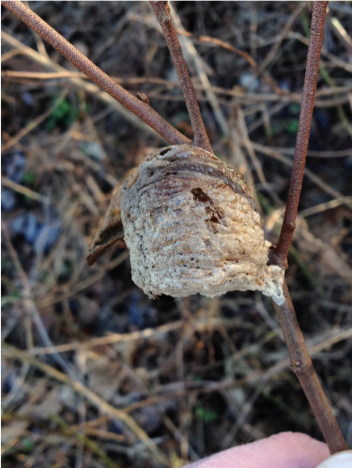
You, entomologist that you are, had found an ootheca, the foamy pouch in which mantises lay their eggs, last week, and decided to try and rear them on your own, giving them a better chance of survival for eventual release into the wild. Early this morning, you’d taken the ootheca out of a humid jar, and arranged it carefully into a brand new aerated container, mimicking seasonal outdoor changes.

ootheca
An ootheca, found outdoors. Photo credit: Jim Fetzner.

How weird that you should see a singular mantis on your window, let alone one this tiny. It probably got in through an open screen or something. You make a mental note to send your landlord a work order.

You unlock and open the door to find another tiny praying mantis on your end table. Whoa! Definitely need to check the screens.

But there’s another mantis on your ceiling. And another on the couch. Two by the sink. Three all over the Taco Bell wrappers in the trash.

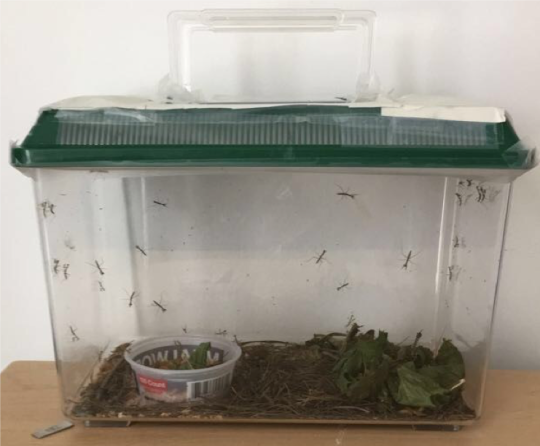
Slowly, with growing horror (and excitement!) you realize the mesh on your brand new aerated container is too large to contain minute mantises, and they’ve escaped to the refuge of your apartment.

You spend the next hour and 45 minutes frantically running around, grabbing handfuls of jumping mantises, throwing them into a (sealed) container, using a broom to pick the ones off the ceiling and praying to the old gods and the new, you can catch them all.

It’s a full-on Pokehunt, and you’re all out of potions and revives.

Nearly 200 thumb-nail sized, jumping, running, scuttling, adorable baby mantises play havoc on your heart strings (and your apartment) and you just have to take care of them. Knowing that mantises like to eat live food, and knowing they’ve gone a full day without it, you decide it’s time to get them some grub.

With all rambunctious insects fully secured, you race to Petco to grab their last container of crickets before closing, pulling Indie 500 stunts (you didn’t get gas earlier, by the way) along Route 8 to make sure your precious mantises have enough food for the day.

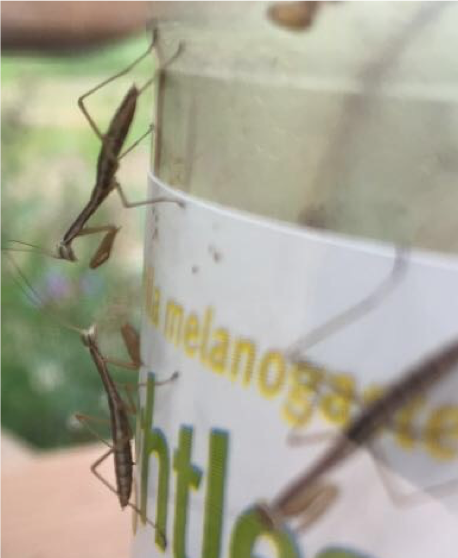
two praying mantises
Two praying mantises practice The Titanic for their peers.


You bought about 30 Acheta domesticus, a common house cricket, in a small container. They’re nearly three times the size of your mantises! What a hearty snack these will be. Trying to be a good mantis Momma, you empty the crickets into the enclosure.

But you’re new at this. Caterpillars you can rear easily, with the right host plant. You’ve had a dog before for goodness sake, this should be easy.

A. domesticus, though, will eat meat. Meat the approximate size and shape of a baby praying mantis.

Oh no.

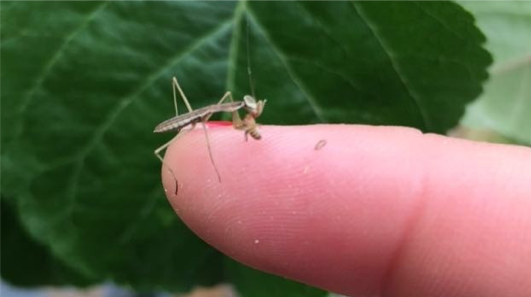
You wrangle the crickets away from their mantis midnight snack and call it a day. The next day, you’ll get some flightless fruit flies and rear the mantises with less tragic incidents for several more weeks.

A praying mantis enjoying a refreshing flightless fruitfly.

Eventually, the spring chill warms to light summer breezes, and you’re able to release the mantises into the wilds of your home garden. All in all, you’ve learned a tremendous lesson, and earned a great campfire story, when it comes to rearing and caring for praying mantises.

mantises in their enclosure

Catherine Giles is the Curatorial Assistant of Invertebrate Zoology at the Carnegie Museum of Natural History. Museum employees are encouraged to blog about their unique experiences working at the museum. 

Filed Under: Blog Tagged With: biodiversity, bugs, ecology, entomology, Invertebrate Zoology

sidebar

About

  • Mission & Commitments
  • Directors Team
  • Museum History

Get Involved

  • Volunteer
  • Membership
  • Carnegie Discoverers
  • Donate
  • Employment
  • Events

Bring a Group

  • Groups of 10 or More
  • Birthday Parties at the Museum
  • Field Trips

Powdermill

  • Powdermill Nature Reserve
  • Powdermill Field Trips
  • Powdermill Staff
  • Research at Powdermill

More Information

  • Image Permission Requests
  • Science Stories
  • Accessibility
  • Shopping Cart
  • Contact
  • Visitor Policies
One of the Four Carnegie Museums | © Carnegie Institute | Privacy Policy | Terms of Use | Accessibility
Rad works here logo