• Skip to primary navigation
  • Skip to main content
  • Skip to primary sidebar

Carnegie Museum of Natural History

One of the Four Carnegie Museums of Pittsburgh

  • Visit
    • Buy Tickets
    • Visitor Information
    • Exhibitions
    • Events
    • Dining at the Museum
    • Celebrate at the Museum
    • Powdermill Nature Reserve
    • Event Venue Rental
  • Learn
    • Field Trips
    • Educator Information
    • Programs at the Museum
    • Bring the Museum to You
    • Guided Programs FAQ
    • Programs Online
    • Climate and Rural Systems Partnership
  • Research
    • Scientific Sections
    • Science Stories
    • Science Videos
    • Senior Science & Research Staff
    • Museum Library
    • Science Seminars
    • Scientific Publications
    • Specimen and Artifact Identification
  • About
    • Mission & Commitments
    • Directors Team
    • Museum History
  • Tickets
  • Give
  • Shop

GIS lab

December 31, 2018 by wpengine

From Metes and Bounds to GPS: Part 2

By James Whitacre

In my last post I talked about how surveyors and cartographers used chains and compasses to survey the land. They also used the system of metes and bounds to describe the data they collected, typically for land ownership purposes. At the GIS Lab at Powdermill Nature Reserve, we no longer use these techniques of old when mapping research data in the field. But with today’s advances in technology, we use much different methods and tools to collect research data.

The primary tool used today for collecting data in the field is a GPS receiver, as you might have guessed. At Powdermill, we use these devices to quickly and efficiently record latitude, longitude, and altitude. We can also couple GPS receivers with mobile apps to help us collect other non-spatial data.

To learn more about projects that use mobile apps and GPS, I recommend checking out the BirdSafe Pittsburgh program and our effort to map plastic waste.

However, you may be wondering, what exactly is GPS…and what does it actually stand for? The Global Positioning System (GPS) is operated by the US Air Force and has been around since 1978. It is a world-wide constellation of over 30 satellites that are constantly in orbit around the earth. With just four satellites in view, the location of the GPS device can be determined by using a process called trilateration, which measures the distances between multiple satellites and the device on the ground (I’m not going to get into the technical math…). GPS is also just one of a few other global navigation satellite systems (GNSS), as Russia, China, and the European Union all have operational systems as well. Many GPS devices utilize all GNSS systems.

There are many different types of GPS devices and they are generally categorized into three accuracy levels: recreational grade (accurate from 3 to within 10 meters), mapping grade (0.5 to 3 meters), or survey grade (1 millimeter to 0.5 meters). If your smartphone has GPS on it, as most do, that is considered a recreational grade GPS device. Other recreational GPS devices, such as Garmin devices, are fairly affordable and can be found at sporting goods stores. More sophisticated GPS devices for mapping and surveying are not typically found in stores and must be ordered from specialty vendors.
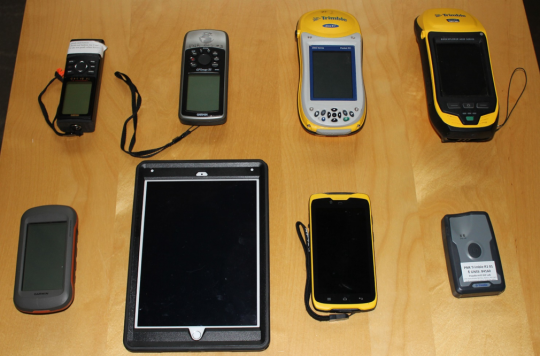
GIS lab mapping tools including GPS

The above image shows the different devices the GIS Lab has used over the years. At Powdermill, we use mapping grade GPS devices most often, as represented by the four devices on the right in the image above, but we also use recreational GPS devices and GPS-enabled mobile devices, which are the four devices on the left. We no longer use the top row of devices as the devices on the bottom row are newer technology that vastly outperform the older devices. The need for survey grade GPS devices is not typically needed for research at Powdermill, as one to three meters of accuracy is usually good enough for most ecological and field biology research.

By collecting research data with geographic information collected from GPS, we can analyze ecological phenomena in space, which allows us to discover much more about plant and animal communities. For example, we have used GPS to collect where trees are in addition to the species and size of the trunk. When we analyzed the distribution of our trees, we learned that red maples tend to grow on south facing slopes, while sugar maples tend to grow on north facing slopes. This information could impact future decisions for our forest management. Therefore, it is essential that we think spatially about our research!

James Whitacre is the GIS Research Scientist for Carnegie Museum of Natural History, where he primarily manages the GIS Lab at Powdermill Nature Reserve, the Museum’s environmental research center. Museum employees are encouraged to blog about their unique experiences and knowledge gained from working at the museum.
Filed Under: Blog Tagged With: GIS lab, GIS Research, James Whitacre, Powdermill Nature Reserve, research

August 16, 2018 by wpengine

Mapping Pittsburgh’s Plastic Waste

By James Whitacre

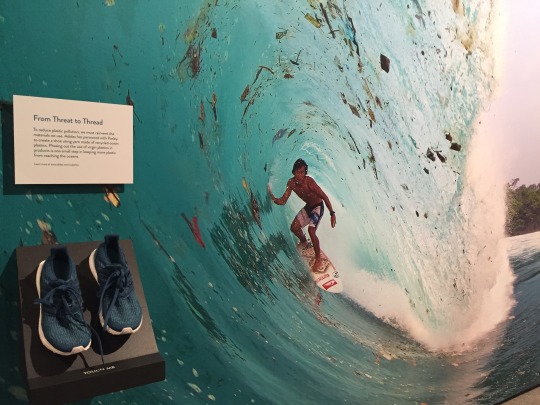
If you have visited the museum recently, you have probably seen the We Are Nature: Living in the Anthropocene exhibition (if not, you have less than a month to check it out!!). When I walked through the exhibition the first time, I was struck by the image of the surfer gliding across a wave with plastic and other debris floating all around him. It is a bleak image of how the beauty and ecology of our oceans, rivers, and lakes is being tarnished and even destroyed by the accumulation of so much plastic waste.

surfer in wave with plastic

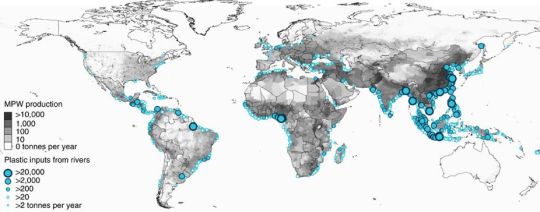
Recently, I also came across an interesting 2017 article, ‘River plastic emissions to the world’s oceans,‘ in which the authors have developed a global model using spatial and temporal data on waste management, population density, and hydrology to measure the amount of plastic in rivers that makes its way into oceans. They found that the top 20 polluting rivers account for 67% of the global total of plastic waste, which is between 1.15 and 2.41 million tonnes of plastic a year. While most of the top 20 rivers are in Asia, and none are in the U.S., their findings have great implications for how plastic waste should be managed and mitigated at global and local scales.

Diagram of mass of river plastic flowing into oceans in tonnes per year.
Mass of river plastic flowing into oceans in tonnes per year. This work is licensed under a Creative Commons Attribution 4.0 International License. Source: https://www.nature.com/articles/ncomms15611/figures/1


This article got me thinking…How can we, as humans living in the Anthropocene, do something to decrease and even eliminate the accumulation of plastic in our waterways? Many people are thinking about this, but what about our beloved three rivers of Pittsburgh? How much do we as a community contribute to the global plastic waste epidemic? Well, to start answering these questions, we need data to know where the plastic waste is…

How often have you walked through your neighborhood, a local or state park, or even been driving around, and noticed plastic waste (and likely other trash)? With this in mind, we’d like to invite you into an experiment…to help us map Pittsburgh’s plastic waste. The GIS Lab, located at Powdermill Nature Reserve, has developed a simple mapping survey to help track plastic waste in our area. To participate, all you have to do is fill out the form using your GPS-enabled smartphone or mobile device when you encounter plastic waste:

Plastic Waste Survey


What will we do with this data?

Well, right now this is just an experiment…But we are thinking of some cool ways to map and analyze this data. We will definitely share a map that shows the data, so stay tuned. We would also like to help our community understand what happens to the plastic if left in the environment. So, here are some example research questions we hope to shed some light on in the near future:

  • If you find some plastic near your house, what stream will it end up in, and what is the shortest path to the ocean from there?
  • How much rain or wind would it take to move that plastic to a stream or river?
  • Where is the nearest recycling center that I can take a few bags or a large heap of plastic (and other) waste?

Data can be very powerful, and sometimes more powerful than we can imagine on our own. So if you have any other ideas for how we could use this data, please email the GIS Lab!

What is Survey123?

The GIS Lab used Survey123 to build this survey, which is part of the ArcGIS platform. Survey123 for ArcGIS is a simple and intuitive form-centric data gathering solution that makes creating, sharing, and analyzing surveys easy using GIS software. Download the free Survey123 app to use the form we created.

James Whitacre is the GIS Research Scientist for Carnegie Museum of Natural History, where he primarily manages the GIS Lab at Powdermill Nature Reserve, the museum’s environmental research center. Museum employees are encouraged to blog about their unique experiences and knowledge gained from working at the museum.

Filed Under: Blog Tagged With: Anthropocene, GIS lab, Pittsburgh, Powdermill Nature Reserve, We Are Nature: Living in the Anthropocene

sidebar

About

  • Mission & Commitments
  • Directors Team
  • Museum History

Get Involved

  • Volunteer
  • Membership
  • Carnegie Discoverers
  • Donate
  • Employment
  • Events

Bring a Group

  • Groups of 10 or More
  • Birthday Parties at the Museum
  • Field Trips

Powdermill

  • Powdermill Nature Reserve
  • Powdermill Field Trips
  • Powdermill Staff
  • Research at Powdermill

More Information

  • Image Permission Requests
  • Science Stories
  • Accessibility
  • Shopping Cart
  • Contact
  • Visitor Policies
One of the Four Carnegie Museums | © Carnegie Institute | Privacy Policy | Terms of Use | Accessibility
Rad works here logo