• Skip to primary navigation
  • Skip to main content
  • Skip to primary sidebar

Carnegie Museum of Natural History

One of the Four Carnegie Museums of Pittsburgh

  • Visit
    • Buy Tickets
    • Visitor Information
    • Exhibitions
    • Events
    • Dining at the Museum
    • Celebrate at the Museum
    • Powdermill Nature Reserve
    • Event Venue Rental
  • Learn
    • Field Trips
    • Educator Information
    • Programs at the Museum
    • Bring the Museum to You
    • Guided Programs FAQ
    • Programs Online
    • Climate and Rural Systems Partnership
  • Research
    • Scientific Sections
    • Science Stories
    • Science Videos
    • Senior Science & Research Staff
    • Museum Library
    • Science Seminars
    • Scientific Publications
    • Specimen and Artifact Identification
  • About
    • Mission & Commitments
    • Directors Team
    • Museum History
  • Tickets
  • Give
  • Shop

ice age mammals

August 5, 2020 by wpengine

Meowfest: Sabertooth Tiger

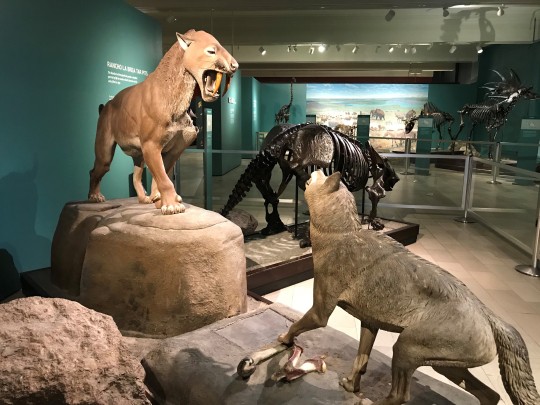
sabertooth tiger and dire wolf museum exhibit

If you ever think you’ve found yourself in a sticky situation, it doesn’t compare to what this sabertooth tiger found itself in. This specimen of Smilodon, otherwise known as a sabertooth tiger, the Dire Wolf, and Harlan’s Ground Sloth at the museum were recovered from excavations at the La Brea Tar Pits.

Smilodon itself is the general name for three separate related species: Smilodon populator, Smilodon fatalis, and Smilodon gracilis. Despite their name, they’re not closely related to tigers or other big cats in the genus Panthera, which also includes lions, leopards, and jaguars. The three species mostly differ in size—while Smilodon gracilis typically weighed in at around 55-100 kg (100-220 lbs), Smilidon fatalis tipped the scales at 160-280 kg (350-600 lbs); approximately the same weight as a Siberian tiger.

All three species of Smilodon have elongated canine teeth. Some specimens have teeth measuring up to 11 centimeters (4.33 in.). However, these teeth are incredibly fragile. If the Smilodon were to hunt the same way as modern cats, they would have broken their canine teeth. Instead, it’s thought Smilodons would use their upper body strength to tackle the intended prey and then use their canines to puncture and tear away meat. Due to the distribution of fossils found, it is believed that they were most likely pack hunters.

Carnegie Museum of Natural History is proud to feature a Smilodon fatalis specimen, which had a roundabout journey 2,000 miles and approximately 11,000 years in the making.
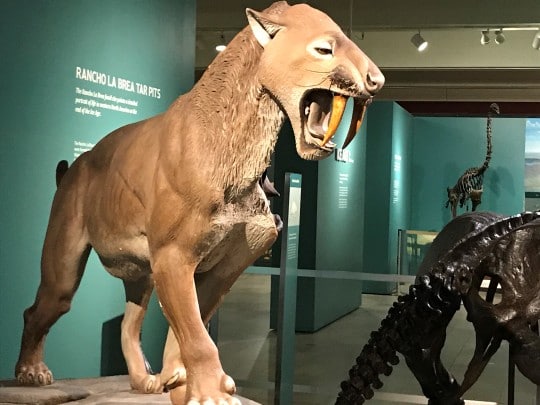
close up of sabertooth tiger model

It all began at the La Brea Tar Pits—a series of naturally occurring asphalt pits where petroleum oozes from the ground. What makes the pits at La Brea unique is the fact they have been continuously active for 50,000 years. As history has progressed, modern-day Los Angeles has grown around them. The pits are now one of the only paleontological sites located inside of a major city in the world.

The Rancho La Brea Tar Pits are a virtual treasure-trove for fossils from the Ice Age. Over 100 excavations since the early 1900s have resulted in the recovery of over 3.5 million fossils from all manner of species, including over 2,000 individual sabre tooth tigers. This is due to the unique fossilizations process created by the pits themselves. As the tar oozes, pools, and warms on the ground, it becomes sticky; prey mammals can easily become stuck in as little as four centimeters (1.57 in.) and unable to move. A strong and healthy animal might be able to escape, but for the majority trapped in the tar, it was only a matter of time until they succumbed. Sometimes, a passing predator would hear a stuck animal and try to seize them first (such as Smilodon). This would often result in the predator becoming stuck as well, and both predator and prey would be found well-preserved thousands of years later.

Even today, the Rancho La Brea site is still actively producing fossils. A variety of flora and fauna have been preserved here, allowing us to have an unparalleled look at species from the end of the last major Ice Age. By studying these fossils from the past, scientists in turn can learn how things like climate change may affect us in the future.

Andrew Huntley is a Gallery Presenter in CMNH’s Lifelong Learning Department, as well as part of the Animal Husbandry staff for the Living Collection. Museum staff, volunteers, and interns are encouraged to blog about their unique experiences and knowledge gained from working at the museum.
Related Content

Big Cats, Big Personalities

Meowfest: DIY Cat Toy

Cats: The Archeological Site!

Filed Under: Blog Tagged With: Educator Resources, ice age mammals, Museum from Home, Super Science Days, Super Science Meowfest

October 15, 2018 by wpengine

Meet The Newest Addition To The Fossil Vertebrate Collection

by Amy Henrici

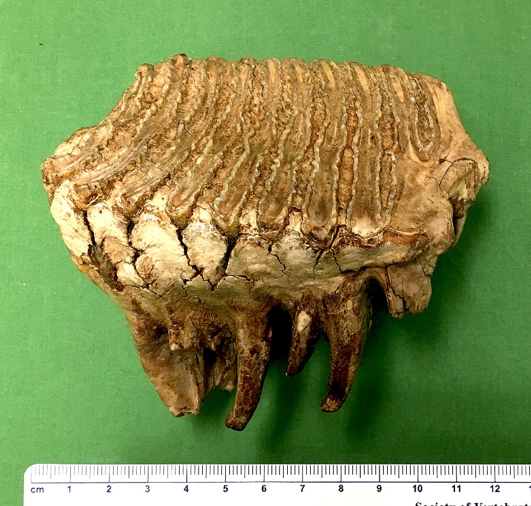
mammoth tooth from the side
The new mammoth tooth as viewed from the side. The crown, or exposed part, of the tooth is at the top, and the root is at the bottom.

The Section of Vertebrate Paleontology at Carnegie Museum of Natural History acquires fossils in a variety of ways, most commonly through field work by Section staff, exchanges with other museums, donations, or (very rarely) purchases. The most recent addition to the collection came by way of a donation.

Gary Kirsch discovered the tooth shown above in a sand-gravel bar of a central Ohio stream in 1988 while collecting sediment samples. He had set his sampling equipment on the sand-gravel bar and was moving between the bar and the stream collecting samples. During one of his many forays, Gary noticed an edge of the tooth sticking out of the bar and pulled it out. It was covered in mud, which he quickly cleaned off in the stream to reveal the beautifully preserved tooth, which he identified as that of a mammoth.

Gary recently emailed photographs of the tooth to Assistant Curator of Vertebrate Paleontology Matt Lamanna because he wanted to donate it to the museum. Acceptance of his generous offer required some research: mammoth and Asian elephant teeth are very similar, and because none of the Section staff are experts in fossils of Pleistocene (Ice Age) mammals, we reached out to Pleistocene expert Blaine Schubert at East Tennessee State University, who often uses our collection, to verify Gary’s identification. Blaine was certain that it was a mammoth tooth because an Asian elephant tooth could only have come from a zoo or circus animal, which was highly unlikely. Blaine was curious about how teeth of the two species are distinguished, so he forwarded the photographs to an elephant expert at his university, Chris Widga.

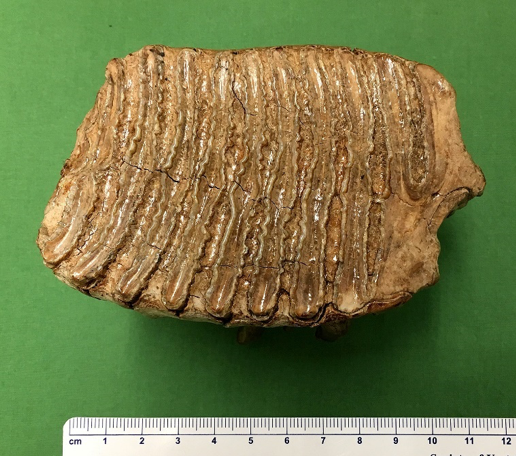
mammoth tooth from the top
The grinding (i.e., lower, occlusal) surface of the tooth, showing the fairly crenulated tooth enamel.

Chris determined that the tooth is the first (forward-most) molar from the left upper jaw, and because it has fairly crenulated enamel, that it is from a woolly mammoth (Mammuthus primigenius). Through comparison with tooth eruption and wear schedules (sequences) of modern elephants, Chris concluded that the animal was in its late teens to early 20s when it died. In the wild, modern elephants generally live to about their mid-50s, so this single specimen offers a window into mammoth mid-life.

The Section is grateful to Gary for his thoughtful donation. The specimen will be put on temporary display soon in the PaleoLab window on the first floor of the museum for public viewing.

Amy Henrici is the collection manager for the Section of Vertebrate Paleontology at Carnegie Museum of Natural History. Museum employees are encouraged to blog about their unique experiences and knowledge gained from working at the museum.
Filed Under: Blog Tagged With: Amy Henrici, fossils, ice age mammals, paleontology, Vertebrate Paleontology

February 26, 2018 by wpengine

Renovating Age of Mammals: The Cenozoic Era

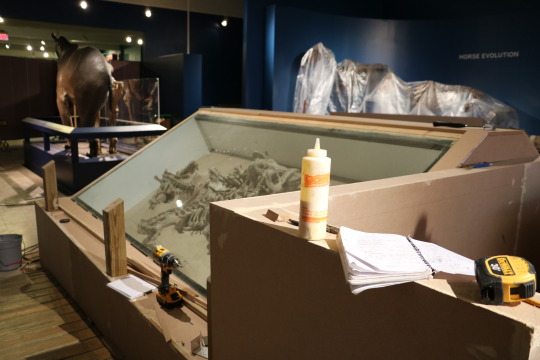
exhibition under construction

Carnegie Museum of Natural History’s exhibition team has been working on renovating parts of Age of Mammals: The Cenozoic Era which features fascinating fossils of some animal relatives you may be familiar with–like the 55-million-year old ancestors of horses and giant ground sloths!

The renovated parts of this exhibition should be back on display by March 10th. To learn more about it in the meantime, check out our relevant blogs.

Filed Under: Blog Tagged With: Age of Mammals: The Cenozoic Era, Cenozoic Hall, ice age mammals

sidebar

About

  • Mission & Commitments
  • Directors Team
  • Museum History

Get Involved

  • Volunteer
  • Membership
  • Carnegie Discoverers
  • Donate
  • Employment
  • Events

Bring a Group

  • Groups of 10 or More
  • Birthday Parties at the Museum
  • Field Trips

Powdermill

  • Powdermill Nature Reserve
  • Powdermill Field Trips
  • Powdermill Staff
  • Research at Powdermill

More Information

  • Image Permission Requests
  • Science Stories
  • Accessibility
  • Shopping Cart
  • Contact
  • Visitor Policies
One of the Four Carnegie Museums | © Carnegie Institute | Privacy Policy | Terms of Use | Accessibility
Rad works here logo
