• Skip to primary navigation
  • Skip to main content
  • Skip to primary sidebar

Carnegie Museum of Natural History

One of the Four Carnegie Museums of Pittsburgh

  • Visit
    • Buy Tickets
    • Visitor Information
    • Exhibitions
    • Events
    • Dining at the Museum
    • Celebrate at the Museum
    • Powdermill Nature Reserve
    • Event Venue Rental
  • Learn
    • Field Trips
    • Educator Information
    • Programs at the Museum
    • Bring the Museum to You
    • Guided Programs FAQ
    • Programs Online
    • Climate and Rural Systems Partnership
  • Research
    • Scientific Sections
    • Science Stories
    • Science Videos
    • Senior Science & Research Staff
    • Museum Library
    • Science Seminars
    • Scientific Publications
    • Specimen and Artifact Identification
  • About
    • Mission & Commitments
    • Directors Team
    • Museum History
  • Tickets
  • Give
  • Shop

Educator Resources

April 18, 2022 by Erin Southerland

Using iNaturalist in the City Nature Challenge and beyond

by Patrick McShea

Participation in this year’s City Nature Challenge (CNC), April 28–May 1, 2023, is a great way to familiarize yourself with iNaturalist, an innovative cell phone app that powers the annual biological survey of metropolitan areas across the globe. Mastery of the easy-to-use technology during this self-paced bioblitz-style event can create positive outcomes long after the Pittsburgh CNC concludes and in places far beyond the event’s six county territory.          
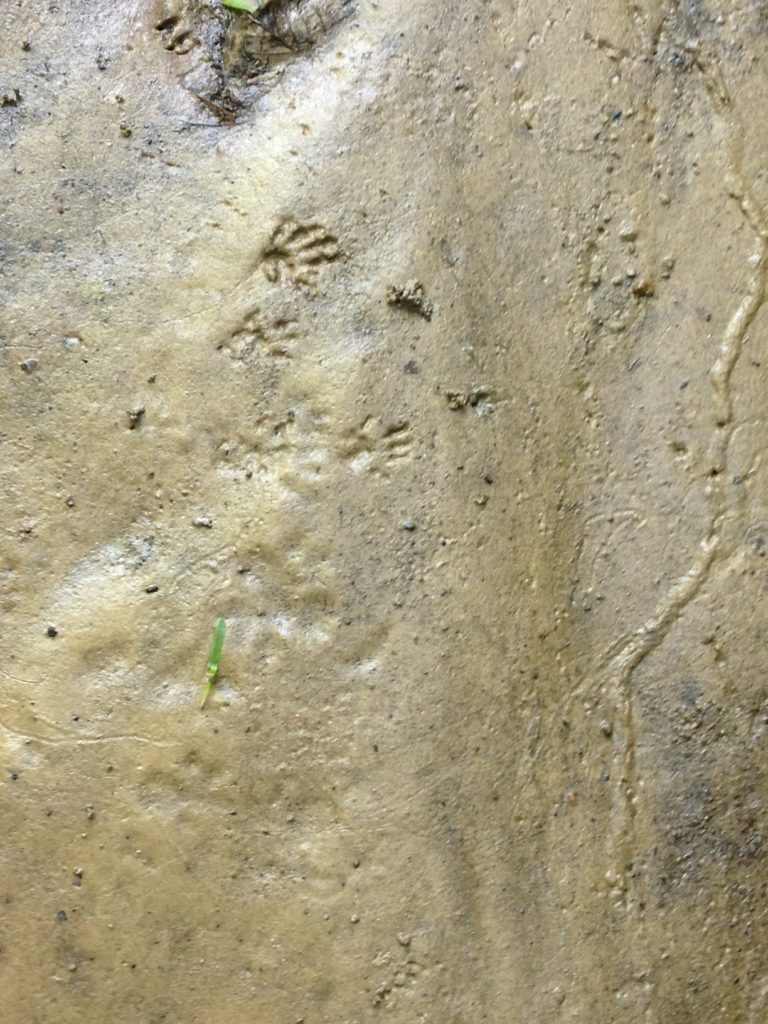
Raccoon tracks in the mud.
During the City Nature Challenge participants can identify observations, such as these raccoon tracks, or rely upon iNaturalist to identify them.

Although 2023 will be the sixth consecutive year for Carnegie Museum of Natural History to serve as a CNC city organizer agency, I didn’t become an active participant in the event until 2021. In 2021, I was among 446 participants who, in using our phone cameras to take and submit pictures, documented 7,045 observations of free-living plants, animals, and fungi in Allegheny, Armstrong, Beaver, Butler, Washington, and Westmoreland Counties. Our collective efforts verified and geo-referenced the presence of 1,219 different species at various locations in the surveyed territory.

My contributions, which came from four half-hour periods over as many days, amounted to only 29 observations, and for each of them I was able to include an accurate name of the observed subject in the submission form’s “What did you see?” line. iNaturalist, which is a joint initiative of the California Academy of Sciences and the National Geographic Society, functions amazingly well in identifying submitted images even when this question is ignored. The app provides users with impressive evidence of its image recognition capabilities by quickly supplying identification suggestions. This digital wizardry is only a starting point, however, because iNaturalist defines itself as “an online social network of people sharing biodiversity information to help each other learn about nature.” 

Whether an observation is tentatively identified by the observer or through the powerful software, higher levels of identification certainty occur hours, weeks, or even months later when other users, who are focused on identifying observations, verify, refine, or even challenge identifications. Consistent verification by such reviewers can raise observations to “research grade,” indicating possible use in future scientific investigations.

Because I didn’t pay close attention to the network aspects of iNaturalist during the CNC, appreciation for my phone’s transformation into far more than a multi-category field guide came months later and more than 500 miles to the northeast during an early fall vacation in the Adirondack Park.
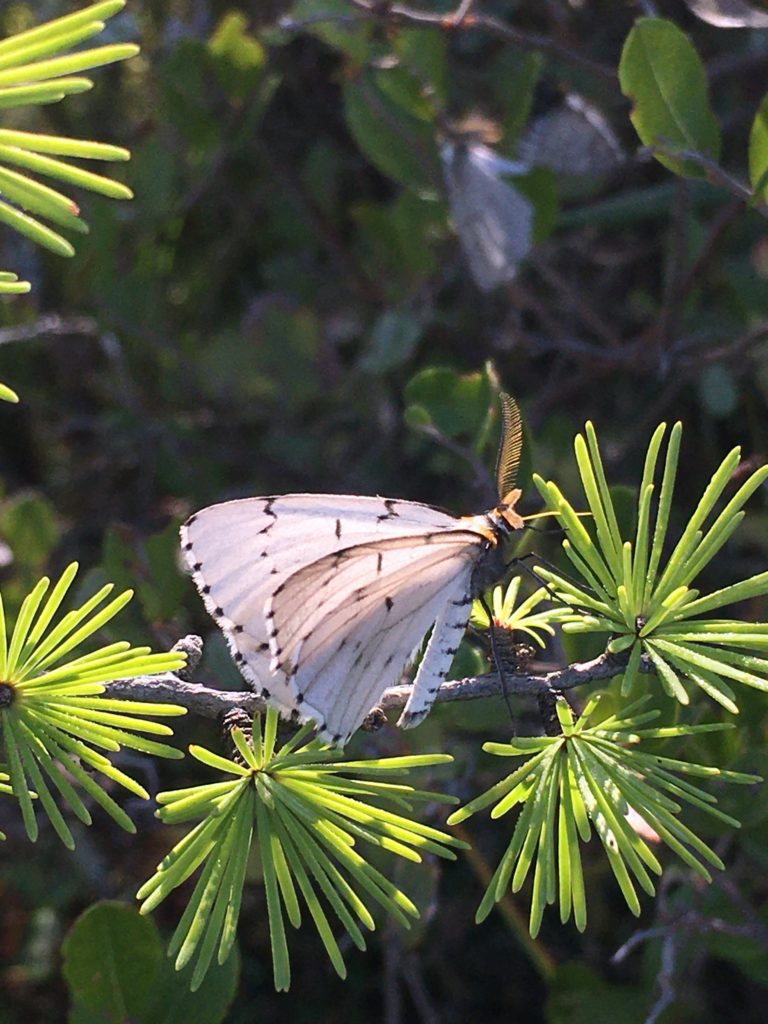
Moth on a branch.
The moth known commonly as the Chain-dotted Geometer on the Boreal Life Trail at the Paul Smith’s College Visitor Information Center.

On a sunny mid-September afternoon, while my wife and I watched for birds and pitcher plants along a bog-crossing boardwalk that is part of the unique 14,000-acre campus of Paul Smith’s College, we were frequently surrounded by white moths with delicate black markings. When one landed close by I took its picture, then immediately submitted it as an iNaturalist observation. “Genus Cingilia,” I saw on the phone screen within 30 seconds. 

Days later, when an email notification informed me that an observation reviewer had refined the identification to “Cingilia catenaria,” or the “Chain-dotted Geometer,” curiosity about the bog moths prompted a visit to BugGuide.net, a reliable site for information about insects and spiders in North America. Here a statement in the “Remarks” section of the species account raised an ecological question: “Locally abundant to the point of being a pest in some years, yet becoming increasingly rare over much of its former range in the Northeast.”

As I wondered whether the numerous bog moths had been a pest-level outbreak, I remembered someone who might be able to answer that question. The observation reviewer had identified herself on iNaturalist. Dr. Janet Mihuc is a professor at Paul Smith’s College who has been conducting a moth biodiversity survey on the college’s lands for the past six years. In an email exchange she was happy to discuss the bog moths and their role in the ecosystem.

I certainly consider C. catenaria common in our area. I am not aware of it being a pest but that may just be because our local bogs have no economic significance to humans so I doubt there is data on the amount of defoliation that the caterpillars can cause. Hopefully the caterpillars are an important food for migrant songbirds before they depart or for resident songbirds. Based on my data, adult moth species diversity peaks in July then drops steadily in August and September. I would expect caterpillar availability to show a similar trend.

Her generous sharing of information was completely inline with my experience as a CMNH educator asking museum scientists for clarification of concepts presented in current exhibits. The fact that the information exchange was brokered by a cell phone app did not diminish the learning that occurred.

Patrick McShea is an Educator at Carnegie Museum of Natural History. Museum employees blog about their unique experiences and knowledge gained from working at the museum.

Related Content

Evidence Counts For Absent Creatures: City Nature Challenge

Go For a Color Walk

Naturally Pittsburgh: Big Rivers and Steep Wooded Slopes

Carnegie Museum of Natural History Blog Citation Information

Blog author: McShea, Patrick
Publication date: April 18, 2022
Share this post!

  • Share on Twitter Share on Twitter
  • Share on Facebook Share on Facebook
  • Share on Pinterest Share on Pinterest
  • Share on LinkedIn Share on LinkedIn
  • Share on Reddit Share on Reddit
  • Share via Email Share via Email

Filed Under: Blog Tagged With: City Nature Challenge, Educator Resources, Pat McShea

January 27, 2022 by Erin Southerland

African Artifacts: Back Story and Current Use

by Patrick McShea

Teaching with African Artifacts at Pittsburgh Public Schools’ Gifted Center

At Pittsburgh Public Schools’ Gifted Center, Cheree Charmello Andrews has long used a set of handcrafted objects from the Educator Loan Collection of Carnegie Museum of Natural History to help her seventh and eighth grade students better understand the diverse Peoples of the African Continent. The K-8 school, which is in the city’s Elliot neighborhood, serves students throughout the school district whose Individual Education Plans (IEPs) identify them as gifted. Students visit the Center once a week to participate in innovative programs developed and presented by some two dozen faculty members.

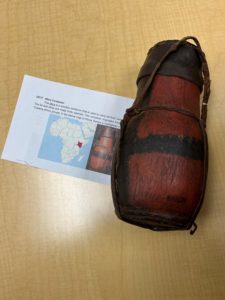
Wood and cowhide container on a table next to a piece of paper with information about it.
A wood and cowhide container represents the handwork of Kenya’s Samburu and Turkana ethnic groups.

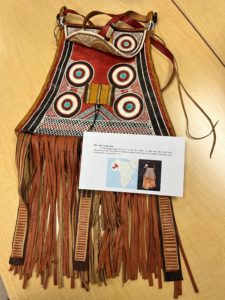
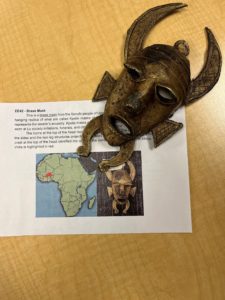
The set of materials Cheree borrows can be broadly described as contemporary African Artifacts that reflect deep cultural history. Among the 18-item set are carved wooden figures, hammered aluminum utensils, ornate leather pouches, miniature masks in cast brass, a colorful hand-stitched story cloth, a canteen fashioned from a dried gourd, and even a fully functional set of dance bells, a musical instrument traditionally worn as ankle adornment. All the objects are sturdy enough for handling, and in-hand their educational power is enhanced when the name of the cultural group each represents is supplied – Senufo, Samburu, Turkana, Akamba, and Masai.

ornate leather bag with beading and fringe on a table accompanied by an information sheet
An ornate leather bag from Mali.

Preparing African Artifacts for the Educator Loan Collection

Some of the Masai and Samburu materials were purchased for educational use in the 1980s by a CMNH mammal curator performing fieldwork in Kenya. The acquisition history of the other objects is unknown, but the story of the small collection’s organization for education use is clear, and worth wider sharing. During the summer of 1992, then Cornell University sophomore Marcus McFerren was a work-study student in the CMNH Division of Education. When he expressed interest in preparing the African cultural objects in a storage cabinet for classroom use, the project became his principal work assignment. Marcus established personal connections with the librarians who then managed the African American Collection at the University of Pittsburgh’s Hillman Library, and with their assistance, created simple background information sheets for each object.

Person wearing a suit and glasses
Dr. Marcus McFerren was a work-study student at CMNH in 1992.

For the past 25 years, Marcus has been Dr. McFerren. He is a Board-Certified Dermatologist with a practice in Connecticut, who completed a PhD in Plant Biology at Cornell before he entered medical school. As a skilled ethnobotanist, he has conducted his own fieldwork at several locations in Africa. Six years ago, when Marcus visited the museum with his wife and two sons, he asked to see the educational materials he prepared so many years earlier. He’s due for an update because of recent upgrades. 

Brass mask on a table next to a piece of paper with information about it.
A brass mask from the Senufo People of Burkina Faso.

2021 Updates and Current Use

In the fall of 2021 two small teams of Duquesne University students created new labels for the African objects as a volunteer project for a seminar class titled, Science at the Service of Society. Labels now pair object images with simple maps marking their county of origin. Perhaps of greater importance, Cheree recently shared the story behind her use of the well-worn authentic objects. It’s a brief account that nonetheless encompasses art, natural history, and most of all, what skilled teachers can accomplish:

Years ago, I designed a class called #BlackMindsMatter in response to a beloved Black student who expressed that she felt her culture was consistently left out of the academic setting in any positive or substantial way. I began to use the museum boxes in my classroom as a way of helping students access a beautiful legacy that is not always included in Eurocentric curriculum. As a white woman, it can be challenging to help students connect to the vast diaspora of Black culture. I paired the artistic genius of old and new African art and artifacts with modern Black art. We explored the parallels between the older forms of African art with the work of historical and contemporary art and concluded that many artists had to be influenced by Black art and artifacts. It was illuminating and uplifting.

Cheree Charmello Andrews

Patrick McShea works in the Education and Visitor Experience department of Carnegie Museum of Natural History. Museum employees blog about their unique experiences and knowledge gained from working at the museum.

Related Content

Rising Through the Educator Ranks

Expanding the Scope of Environmental Education

Center Court Culture Sharing

Carnegie Museum of Natural History Blog Citation Information

Blog author: McShea, Patrick
Publication date: January 27, 2022

Share this post!

  • Share on Twitter Share on Twitter
  • Share on Facebook Share on Facebook
  • Share on Pinterest Share on Pinterest
  • Share on LinkedIn Share on LinkedIn
  • Share on Reddit Share on Reddit
  • Share via Email Share via Email

Filed Under: Blog Tagged With: Educator Loan Program, Educator Resources, Pat McShea

September 7, 2021 by wpengine

Guiding a Local Focus On Climate Education

by Patrick McShea

During the last three days of July more than 330 educators from across the country gathered virtually to learn how to more effectively teach about a topic generating increasingly alarming headlines. The event, titled Summer Institute for Climate Change Education, operated with three principle hosts, Climate Generation, a St. Paul, Minnesota-based educational organization with a national reach, the Youth Climate Program of The Wilds Center in New York’s Adirondack State Park, and the Climate Office of NOAA, the National Oceanic and Atmospheric Administration.

On the middle day of the Institute, participants remotely joined one of a dozen sub-region programs for a more local focus on discussions, resource sharing, and reviews of potential classroom activities. Pittsburgh was the center of one such sub-region, and the host for our region’s day-long program was Katie Modic, Executive Director of a small and innovative organization known as Communitopia.

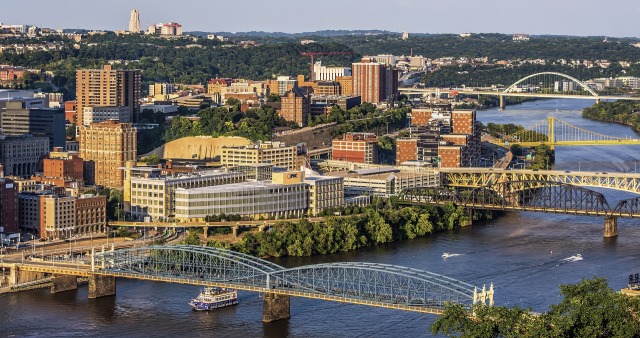
City of Pittsburgh from above showing buildings, bridges, a river, and many trees.
Image by Bruce Emmerling from Pixabay.

Communitopia is a 12-year-old organization, whose ongoing efforts to slow climate change and create healthier communities through new media and project-based campaigns have been distilled into a three-word mission statement, “Making Green Mainstream.” The 501©3 nonprofit operation is well served by the experience Katie brings to her leadership position. She is a University of Wisconsin-Madison alumni (M.S. in Education, B.A. in Spanish and Anthropology), whose work experience since graduation includes a two-year Teach for America middle school assignment along the US/Mexico border in Donna, Texas, public school teaching experience in Colorado and Florida, international teaching experience in Rotterdam, the Netherlands, and the sharing of many of her first hand learning experiences with undergraduate education students as a professor at Central College in Pella, Iowa.

In planning the day’s schedule, Katie worked with staff from both Phipps Conservatory and Botanical Gardens and Carnegie Museum of Natural History. In carrying out her role as a Zoom screen host for a territory that encompassed nearly all of Pennsylvania, she was able to direct attention to the revision of Pennsylvania’s academic standards for science as a current issue relevant in every corner of the state.

Katie’s position that the standards revision process creates an opportunity to strengthen how climate is addressed in both Science Standards and those for Environment and Ecology is outlined on Communitopia’s website. During the Summer Institute she was able to explain how her opportunity observations were largely based upon her experience in working with students at Woodland Hills High School in Pittsburgh’s eastern suburbs. When biology teacher Margeaux Everhart invited Katie to present Communitopia’ s classroom program about the local impacts of climate change, the session sparked a student-driven grassroots movement that eventually led to the Woodland Hills School District adopting a formal Climate Action Plan.

For many of the educators who participated in the Pittsburgh-based day of Summer Institute programs, watching and listening as some of those students made Zoom speaking appearances was an inspiring and empowering experience.

Patrick McShea works in the Education and Visitor Experience department of Carnegie Museum of Natural History. Museum employees are encouraged to blog about their unique experiences and knowledge gained from working at the museum.

Related Content

Expanding the Scope of Environmental Education

Getting Started: A High School Intern’s Experience in the Herp Section

Bird Architecture on Human Infrastructure

Carnegie Museum of Natural History Blog Citation Information

Blog author: McShea, Patrick
Publication date: September 7, 2021

Share this post!

  • Share on Twitter Share on Twitter
  • Share on Facebook Share on Facebook
  • Share on Pinterest Share on Pinterest
  • Share on LinkedIn Share on LinkedIn
  • Share on Reddit Share on Reddit
  • Share via Email Share via Email

Share this post!

  • Share on Twitter Share on Twitter
  • Share on Facebook Share on Facebook
  • Share on Pinterest Share on Pinterest
  • Share on LinkedIn Share on LinkedIn
  • Share on Reddit Share on Reddit
  • Share via Email Share via Email

Filed Under: Blog Tagged With: Educator Resources, Educators, Pat McShea, We Are Nature 2

August 4, 2021 by wpengine

Rising through the Educator Ranks

by Patrick McShea

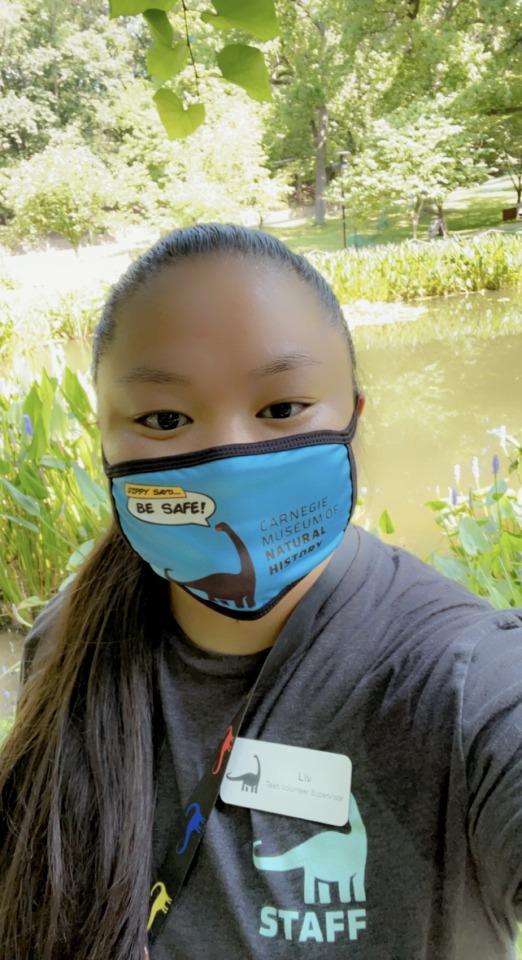
Woman wearing a mask and t-shirt with dinosaurs on them.
Olivia McNulty (Liv)

Every morning, as young participants in the museum’s summer camp and the adults accompanying them approach an outdoor sign-in table, Olivia McNulty is prepared to explain all that the coming day might hold. “I’m the first face they see, and I try to radiate positivity,” explains the recent Seton Hill University graduate, who goes by her first name’s second syllable, Liv. “I’m wearing a facemask, and checking temperatures with a handheld scanner, but I’ve also got some idea of the day’s schedule in every camp session, and I welcome questions.”

As tempting as it is to describe Liv’s comprehensive knowledge of camp operations as “second nature,” the term short-changes the unusually deep experience she brings to her current position of Senior Camp Educator. To use a baseball analogy, she is major league talent nurtured through years of development in a professional team’s multi-tiered farm system.

During the nine summers between age 5 and 13, Liv experienced camp as a camper. Due to her parents’ work schedules, an hour or two of pre-camp and post-camp care at the museum was also always part of her daily schedule. She remembers regularly experiencing “pure excitement and joy” at the museum during those long days, explaining further how she now reflects back upon her summer camp experience as an early, prolonged, and wholly positive learning intervention. “I struggled at school with a learning disability. I’m dyslexic, and at camp that was never a barrier to learning.”

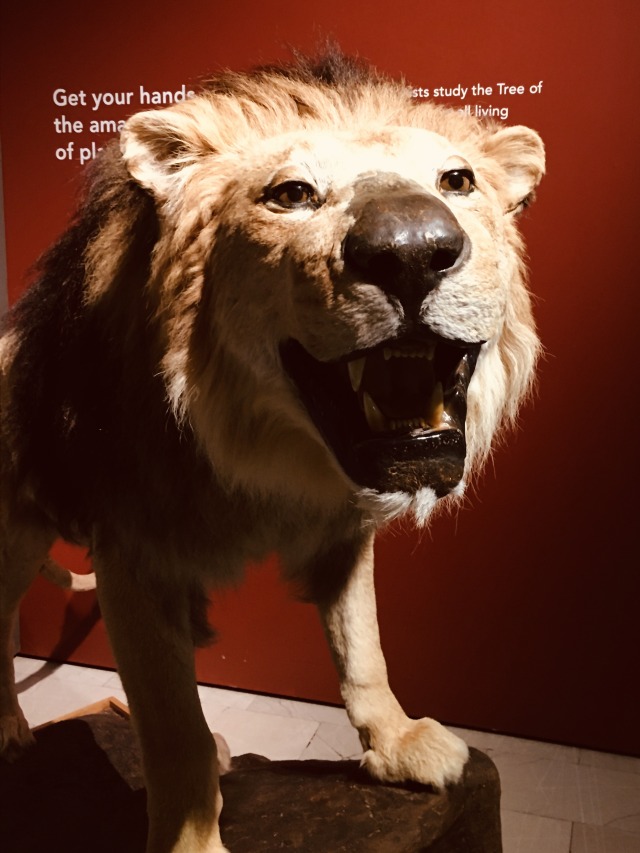
African Lion taxidermy mount
Liv cites the lion currently displayed in Discovery Basecamp as her constant visual anchor for 16 summers of camp experience.

When Liv aged-out of the camp participant demographic at age 14, she spent the next four summers as a teen volunteer with the program. “I knew how camp ran,” she explains, “and I wanted to emulate the camp counselors who had welcomed me for so many years. As a volunteer I started gravitating towards those children who had learning difficulties. I saw myself in some of their challenges and worked to support them.”

During the summer of 2018, Liv assumed broader camp responsibilities as a Museum Educator Assistant, a paid position that included some oversight of not just campers, but also teen volunteers. She summarizes the focus of each position as being complimentary, but drastically different. “For the teen volunteers the focus is fun – playing games, engaging the campers in those games. As an assistant educator your concerns involve safety and learning.”

This summer, Liv also holds the title of Teen Volunteer Supervisor. Her acknowledgement of greater responsibility is occasionally expressed in a motto, a saying now familiar to all the staff, volunteers, and campers she works with: “If we cannot be safe, we cannot have fun.” The statement of both warning and motivation seems particularly apt for these COVID times. It also contains evidence of all Liv learned as a psychology major at Seton Hill, and within an informal but highly effective summer training program at Carnegie Museum of Natural History.

Patrick McShea works in the Education and Visitor Experience department of Carnegie Museum of Natural History. Museum employees are encouraged to blog about their unique experiences and knowledge gained from working at the museum.

Related Content

Stage and Screen Sharing

Teacher Profile: Emmanuelle Wambach

Expanding the Scope of Environmental Education

Carnegie Museum of Natural History Blog Citation Information

Blog author: McShea, Patrick
Publication date: August 4, 2021

Share this post!

  • Share on Twitter Share on Twitter
  • Share on Facebook Share on Facebook
  • Share on Pinterest Share on Pinterest
  • Share on LinkedIn Share on LinkedIn
  • Share on Reddit Share on Reddit
  • Share via Email Share via Email

Share this post!

  • Share on Twitter Share on Twitter
  • Share on Facebook Share on Facebook
  • Share on Pinterest Share on Pinterest
  • Share on LinkedIn Share on LinkedIn
  • Share on Reddit Share on Reddit
  • Share via Email Share via Email

Filed Under: Blog Tagged With: Education, Educator Resources, Educators, Pat McShea

July 12, 2021 by wpengine

Interpreting Museum Exhibits Virtually

by Patrick McShea

Natural History Interpreters are a corps of educators charged with presenting the museum’s exhibits to audiences in a way that encourages the collective development of emotional and intellectual connections to the topics being discussed. During the past eight months, a small, but growing number of Interpreters have pursued this mission by guiding school groups on virtual tours of Dinosaur Armor.

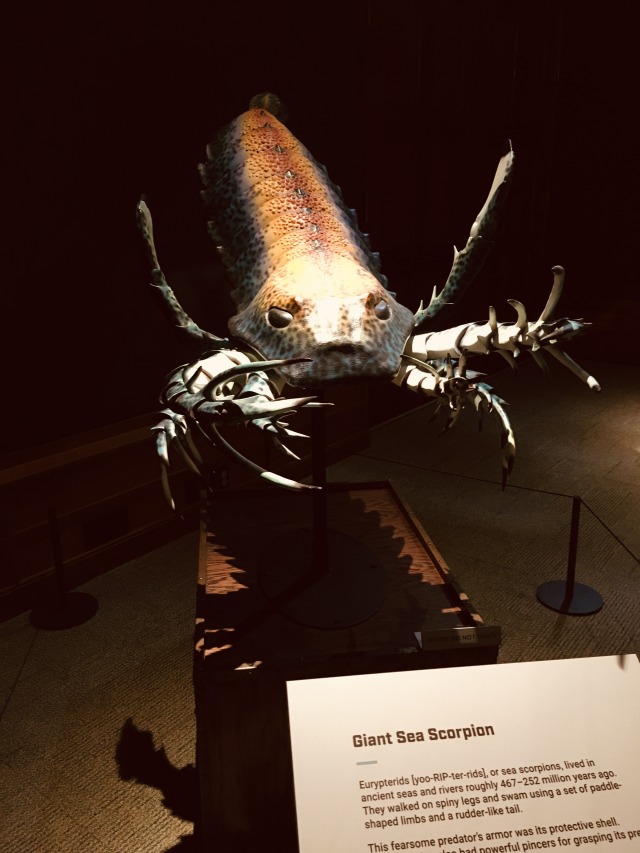
Replica giant sea scorpion museum display
Details such as the sharp claws of this sea scorpion were clearly visible to students who participated in virtual tours of Dinosaur Armor.

The visually striking objects in the world premiere exhibition retain much of their captivating power when presented over electronic screens, and cell phone cameras, when paired with hand-held stabilizer units, have proven to be fully capable of live streaming all the required video.

During the recently completed school year 54 virtual tours of Dinosaur Armor reached an estimated student audience of 3,450, with classes in first to fourth grades accounting for the greatest number of those individuals. The geographical reach of the program has been particularly impressive, with schools in 13 states participating.

The Interpreters developed a team-based strategy for delivering their presentations as cohesive interactive lessons. Standard team positions, which rotate as necessary, include a camera operator in the exhibit, an accompanying narrator who occasionally appears on camera, and a director who participates via a computer link to both provide occasional commentary and facilitate communication between the audience, camera operator, and narrator.

According to Interpreter Joann Wilson the development was an easier-said-than-done proposition. “When I started virtual tours, I thought that it would be like my old in-person tour role with a few minor adjustments.  How wrong I was!   What I have discovered after over 8 months is that although the goal is the same, how we get there is very different.”

On June 8, I had the opportunity to observe a virtual Dinosaur Armor tour for a combined pre-school and kindergarten class. My computer screen displayed the same images the children watched on a large monitor at the front of their classroom. When the colorful image of a frightening looking Eurypterid, or sea scorpion filled the screen, audience excitement was transmitted back to the Interpreter team via the “oohs” and “ahhs” of young voices. Just as the Interpreters would do for any in-person audience, they quickly transformed student curiosity into a learning experience through the careful use of questions.

Students were initially asked to describe what they observed, and their responses (“The claws are sharp.” “The eyes are big ovals.”) provided immediate feedback about the clarity of the transmission. In this case the routine compilation of student observations was remarkable because of the distance involved. The pre-school and kindergarten class was in Bali, Indonesia.

As Program Manager Mandi Lyon explains, “It was 9:30 a.m. for us in Pittsburgh, and 9:30 p.m. for them in Bali. They came back to their school in their pjs for a pajama party so they could participate in the tour together.”

In most cases, however, the same COVID-19 restrictions that led to the development of Virtual Tours also placed many students in viewing conditions far less comfortable than the classroom in Bali. Whenever a Virtual Tour served a class in a school operating under a remote learning mandate, the Interpreter team faced the challenge of engaging dozens of students watching separately from their homes.

By supplying teachers with relevant digital resources, including video clips, blog posts, and work sheets, weeks before their students participated in a Virtual Tour, the Interpreters hoped to initiate teaching partnerships that made each live 60-minute program both instructive and enjoyable. The success of such efforts is currently being accessed through the review of post-Virtual Tour evaluations, several of which included heartening testimony. One teacher noted how the virtual tour had expanded the range of possible teaching resources: “I am so excited we had the opportunity to visit through Zoom. After doing this, it seems we could reach so many places and let the students have such a varied experience in the classroom.” Another teacher was particularly pleased with a potential career thread woven into the tour: “The idea of anyone becoming a scientist was evident in your presentation.”

Outside of the formal evaluations, one wholly positive real-time measurement stands out. Several times teachers remarked that students who kept their cameras off though weeks of regular remote classes turned their cameras on to watch and participate in the Virtual Tour.

CMNH Interpreters have also provide Virtual Tours exploring Ecosystems, Ancient Egypt, and Gems and Minerals. Besides Indonesia, other particularly distant schools served by the program were in Qatar, and the U.S. Virgin Islands. Training is currently underway to expand the number of Interpreters who are able to participate on Virtual Tour teams.

The development and implementation of Virtual Tour Program was generously supported with funding from the Buncher Foundation and the Scaife Family Foundation.

Patrick McShea works in the Education and Visitor Experience department of Carnegie Museum of Natural History. Museum employees are encouraged to blog about their unique experiences and knowledge gained from working at the museum.

Related Content

Virtual Field Trips & Activities

Teacher Profile: Emmanuelle Wambach

Alaskan Brown Bears Spotlight (Video)

Carnegie Museum of Natural History Blog Citation Information

Blog author: McShea, Patrick
Publication date: July 12, 2021

Share this post!

  • Share on Twitter Share on Twitter
  • Share on Facebook Share on Facebook
  • Share on Pinterest Share on Pinterest
  • Share on LinkedIn Share on LinkedIn
  • Share on Reddit Share on Reddit
  • Share via Email Share via Email

Share this post!

  • Share on Twitter Share on Twitter
  • Share on Facebook Share on Facebook
  • Share on Pinterest Share on Pinterest
  • Share on LinkedIn Share on LinkedIn
  • Share on Reddit Share on Reddit
  • Share via Email Share via Email

Filed Under: Blog Tagged With: Education, Educator Resources, Educators, Pat McShea

June 7, 2021 by wpengine

Expanding the Scope of Environmental Education

by Patrick McShea

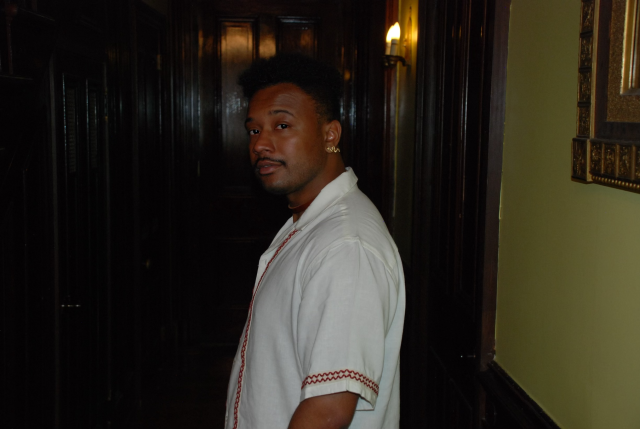
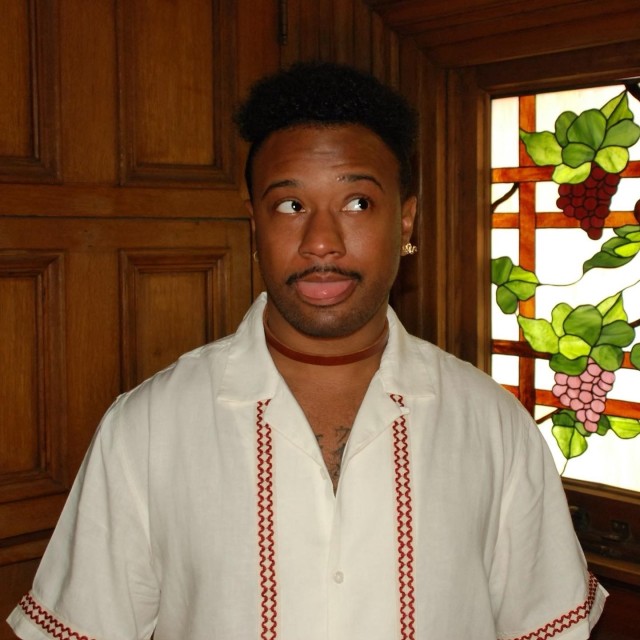
Black man in a white collared shirt standing in front of a wooden door indoors.

Seven years after he graduated from Allegheny College with a degree in Environmental Studies, Will Tolliver Jr. accepted responsibility for teaching some aspects of that discipline at the 206-year-old liberal arts institution. As an adjunct professor, he presented an overview of environmental education’s foundations and its intersection with anti-bias and anti-racist education for 22 juniors and seniors during a recent semester-long course. As a Pittsburgh native, Will brought a hometown focus to some course work at the Meadville college by leading his students in developing lesson plans for Hilltop Urban Farm, an eight-year-old initiative that is transforming 108 acres of the former St. Clair Village housing complex into a national model of community food production.

“I think the relatively short interval between being a student and being a teacher worked to my advantage.” Will explains. “The course was taught remotely because of the pandemic, and during this time of continued civic and social unrest. l was mindful of the students’ situations, concerned about elements effecting their mental health and well-being that were beyond the bounds of the course.”

Will’s out-of-school experience prepared him well for the challenge. His resume includes current work as a consultant to the Public Broadcasting Service, and various teaching, training, grant-writing, and administrative roles for the Pittsburgh Parks Conservancy, Pennsylvania Association for the Education of the Young Child, Grow Pittsburgh, and the Children’s Museum of Pittsburgh. During each phase of his career CMNH helped Will to use authentic objects in his public presentations by providing him with a toolbox of touchable objects including feathers, mammal skulls, preserved plants, and fossils.

If there’s a theme to date in Will’s career, it might be expanding the vocabulary of the people he engages. He explains his first professional challenge, as a Pittsburgh Parks Conservancy naturalist, as “closing the word gap” for three- to five-year-old children in the city’s Homewood neighborhood. In a grant-supported program called “Buzzword Pittsburgh,” he used storytelling, play, guided hikes, songs, and museum objects to explore the meanings of individual words and build vocabulary related to science, math, art, and even local plants and wildlife.

Expanding the working environmental education vocabulary of college students in 2021 involved a greater level of sharing. As Will summarizes, “I wanted to be that better teacher, who covered the core principles and ideas, but also honestly shared what it has been like for me as a Black man working in this field.” His students explored the undeniable connections between environmental health and social justice. Their understanding of the history and importance of such collaborative community initiatives as Hilltop Urban Farm, for example was tied to understanding potentially new terms like urban food deserts, and red-lined neighborhoods.

Patrick McShea works in the Education and Visitor Experience department of Carnegie Museum of Natural History. Museum employees are encouraged to blog about their unique experiences and knowledge gained from working at the museum.

Related Content

Stage and Screen Sharing

Pittsburgh’s Moths Reflect Environmental Impacts of Industry

Teaching About Local Wildlife with the City Nature Challenge

Carnegie Museum of Natural History Blog Citation Information

Blog author: McShea, Patrick
Publication date: June 7, 2021

Share this post!

  • Share on Twitter Share on Twitter
  • Share on Facebook Share on Facebook
  • Share on Pinterest Share on Pinterest
  • Share on LinkedIn Share on LinkedIn
  • Share on Reddit Share on Reddit
  • Share via Email Share via Email

Share this post!

  • Share on Twitter Share on Twitter
  • Share on Facebook Share on Facebook
  • Share on Pinterest Share on Pinterest
  • Share on LinkedIn Share on LinkedIn
  • Share on Reddit Share on Reddit
  • Share via Email Share via Email

Filed Under: Blog Tagged With: Education, Educator Loan Program, Educator Resources, Pat McShea, We Are Nature 2

  • Page 1
  • Page 2
  • Page 3
  • Interim pages omitted …
  • Page 5
  • Go to Next Page »

sidebar

About

  • Mission & Commitments
  • Directors Team
  • Museum History

Get Involved

  • Volunteer
  • Membership
  • Carnegie Discoverers
  • Donate
  • Employment
  • Events

Bring a Group

  • Groups of 10 or More
  • Birthday Parties at the Museum
  • Field Trips

Powdermill

  • Powdermill Nature Reserve
  • Powdermill Field Trips
  • Powdermill Staff
  • Research at Powdermill

More Information

  • Image Permission Requests
  • Science Stories
  • Accessibility
  • Shopping Cart
  • Contact
  • Visitor Policies
One of the Four Carnegie Museums | © Carnegie Institute | Privacy Policy | Terms of Use | Accessibility
Rad works here logo