• Skip to primary navigation
  • Skip to main content
  • Skip to primary sidebar

Carnegie Museum of Natural History

One of the Four Carnegie Museums of Pittsburgh

  • Visit
    • Buy Tickets
    • Visitor Information
    • Exhibitions
    • Events
    • Dining at the Museum
    • Celebrate at the Museum
    • Powdermill Nature Reserve
    • Event Venue Rental
  • Learn
    • Field Trips
    • Educator Information
    • Programs at the Museum
    • Bring the Museum to You
    • Guided Programs FAQ
    • Programs Online
    • Climate and Rural Systems Partnership
  • Research
    • Scientific Sections
    • Science Stories
    • Science Videos
    • Senior Science & Research Staff
    • Museum Library
    • Science Seminars
    • Scientific Publications
    • Specimen and Artifact Identification
  • About
    • Mission & Commitments
    • Directors Team
    • Museum History
  • Tickets
  • Give
  • Shop

John Wenzel

May 9, 2019 by wpengine

Honey Bees Hunt Bargains, Bumble Bees Go Gourmet

It is rewarding to receive questions and reports from people who turn to the staff at Powdermill Nature Reserve for information on nature in our area. Usually, we have a pretty good idea of what people are asking about, but once in a while visitors ask about something completely new to us. Last year, a visitor asked why he saw honey bees on his bird feeder in great numbers. The feeder was only stocked with bird seed. What were the bees doing?  We had no explanation. Recently, in the February 2019 issue of NY Conservationist, we read the answer. Mr. Gary Ennis provided a photo of the same phenomenon, and had the same question. According to beekeeper Bob Henke, during shipping and handling the seeds rub against each other and produce a fine powder similar to pollen, and the honey bees collect it as if it were pollen.
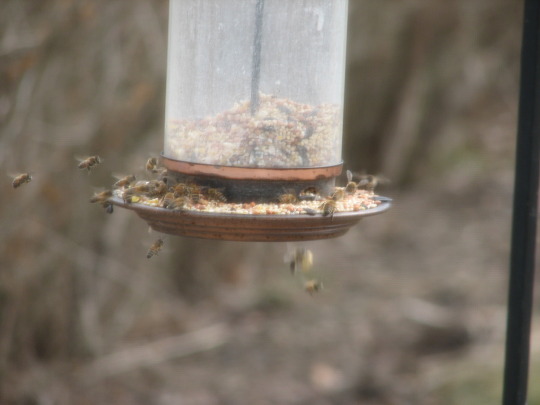
bees at a bird feeder
Photo credit: Gary Ennis.

But, why don’t we see other bees doing this?  Why are there no bumble bees on the feeder?  Bumble bees and other native bees sample the world one scout at a time, each bee making her own decisions. Researchers at Penn State showed that bumble bees monitor the nutritional value of the pollen they take, trying to keep an appropriate balance of protein versus lipids (fats, oils, and waxes.) If a certain plant produces pollen that has little lipid, then the bumble bee will favor pollen that is richer in lipids on future trips. This effort to balance their diet means that they specifically vary the pollen they harvest. It is as if they go to the grocery store and take a few items from the vegetable section, and a few from the dairy section, and a few from the bakery, creating a balanced plate on a daily basis.

On the other hand, honey bees are well-known for their ability to recruit to a good food source, and marshal large numbers of workers to harvest nectar or pollen. If an experienced scout finds a tree in bloom, she will recruit her sisters to that tree. They will go to that site directly without sampling other flowers on the way, and then return for another load, and another, and another.  This form of shopping is more like discovering that the grocery has potatoes on sale, and then buying 100 pounds of potatoes. Of course, a different scout will find a different resource, and she will recruit workers to harvest that in great numbers. As the weeks go by, the bees collect many different kinds of pollen, providing a broad selection for the nurse bees to feed the larvae. If we collect the separate loads of pollen from each returning bee: we see that each bee collected only one kind of pollen (all the same color), but different bees collected different pollen (many colors among the separate loads.)
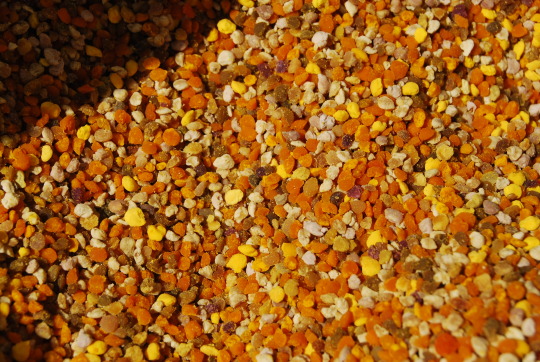
pollen
Photo Credit: Jodi Gertz

Aside from the importance of recruiting, the scout honey bees also make some effort to balance their diet, particularly regarding the important fatty acids, omega-3 and omega-6. Work by Hebrew University in Jerusalem has shown that if these nutrients are not eaten in an appropriate ratio, the bees learn poorly and do not remember what they learn. For example, bees with adequate omega-3 in their diets are much better at learning to associate an odor with a food reward compared to bees with no omega-3. Further, the bees with good nutrition remember what they learned the next day, whereas those with a poor diet forget. We are only just appreciating what this means for bee pollination of large monoculture crops. When the 1.2 million acres of almonds are in bloom in California, about 3 million commercial bee hives are there to pollinate them for several weeks. During this time, almond pollen is all the bees will get. Almond pollen has almost no omega-3 fatty acids. When these poor bees are moved to other sites, how long will it take them to learn what flowers are good, and will they remember?
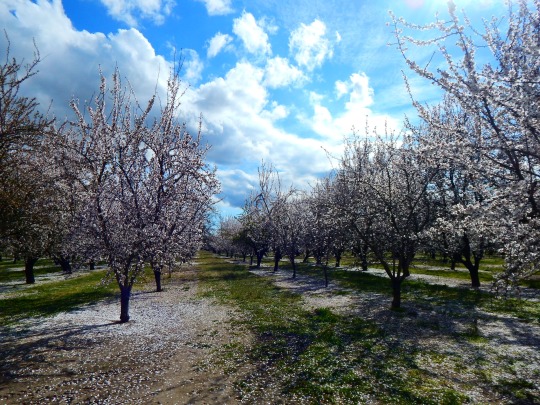
almond orchard in bloom

Thanks to NY Conservationist for allowing us to reprint the photo and retell the bird feeder story.

John Wenzel is the Director at Powdermill Nature Reserve, Carnegie Museum of Natural History’s environmental research center. Museum employees are encouraged to blog about their unique experiences and knowledge gained from working at the museum.
Filed Under: Blog Tagged With: Anthropocene, bees, John Wenzel, Powdermill Nature Reserve

January 22, 2019 by wpengine

Woodlands in White

By John Wenzel

As we enter 2019, I start my ninth year here, and Powdermill Nature Reserve grows cold and quiet. The summer woodland is easy to appreciate, full of sounds of birds in the day, and frogs and insects at night, but for me the forest is most elegant in winter.

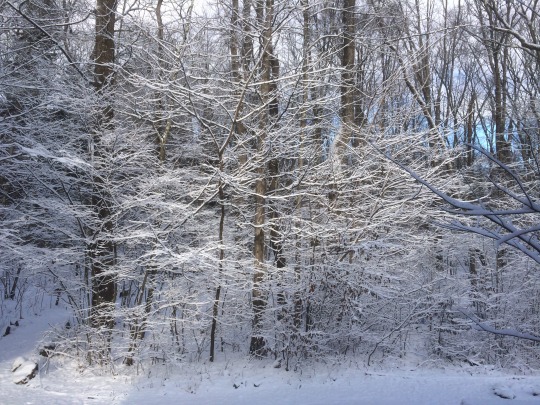
Powdermill woods covered in snow

I moved to Powdermill in January, and at first I lived alone at the reserve. My first season was one of snow and solitude, of beauty and discovery.  The woods are never as striking as when every dark twig is lined in white, creating a world of infinite fragile lace. The naked branches let the explorer see much farther than when the woods are heavy with leaves.  We see deep into the forest, and through it entirely across a hilltop or when we are above the wooded valley.  Animal tracks in the snow allow us to feel the presence of the unseen wildlife more than we do in summer. Wet seeps from mountain springs melt away spots of snow and provide the occasional soothing view of bright green moss, which is very welcome and more readily admired in the starkness of winter.

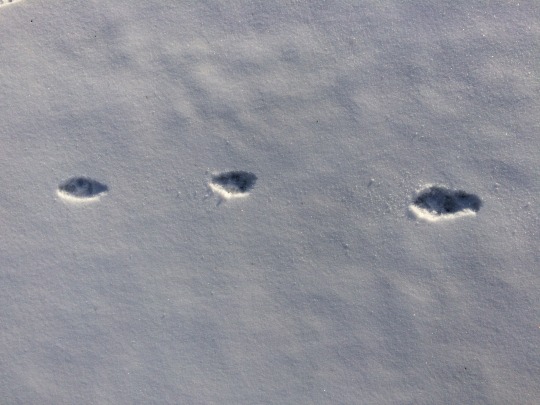
coyote tracks in snow
Coyote tracks at Powdermill Nature Reserve.

Noise of the outside world is nearly absent when a blanket of snow covers the landscape.  This makes the bubbling flow of Powdermill Run all more distinct, and more focal in the outdoor experience. In daylight, we see the million crystal reflections beneath a bright blue sky. At night, far from town, we marvel at the inestimable number of brilliant stars in the onyx above.  Perhaps because visitors to the Nature Center are few in winter, I feel that the reserve is more “mine” than at other times. My Powdermill is the quiet, winter Powdermill, dressed in white and hushed by the cold.

John Wenzel is the Director at Powdermill Nature Reserve, Carnegie Museum of Natural History’s environmental research center. Museum employees are encouraged to blog about their unique experiences and knowledge gained from working at the museum.
Filed Under: Blog Tagged With: John Wenzel, nature, Powdermill, Powdermill Nature Reserve, Winter

November 14, 2018 by wpengine

Snowflakes and Snow Fleas

by John Wenzel

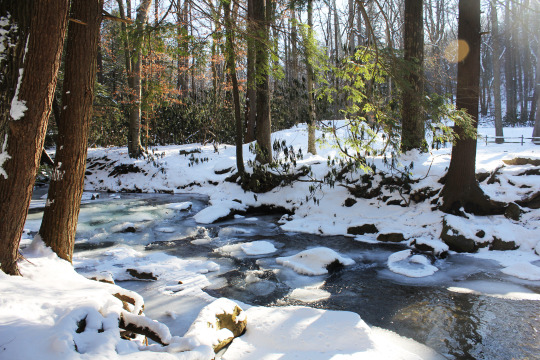
river and trees in the snow

When Shakespeare wrote “Now is the winter of our discontent,” he certainly was not referring to entomologists.  Botanists, mammalogists, ornithologists, and herpetologists spend most of the winter in the office waiting for spring. But many entomologists remain busy because insects that live under water go into high gear and treat the winter as their growing season. Hatching from eggs in spring or summer, these aquatic “macroinvertebrates” get their Thanksgiving dinner as the leaves fall into the stream. The insects are grazing and hunting underwater, growing to adulthood, preparing to fly away next spring when the air is warm again.

I was lucky to grow up with a 10 acre woodlot on one side of our house and a 12 acre pond on the other. As a kid, I loved to be out in my row boat or exploring the woods, hunting wildlife, catch and release. My parents encouraged my interests in nature, providing books and equipment that allowed me to increase my knowledge and experience as I grew.

I raised caterpillars through metamorphosis, marked turtles that I would find again years later, and nursed orphaned baby animals. Initially, I had no special preferences other than those that seem to come naturally to all humans. Mammals capture our affection, we all wish we could fly like birds, predators are particularly interesting, as is anything colorful or rare. By the time I was in college, I decided to study insects as a career for many reasons, and chief among them was a very pragmatic element for a striving academic: if you know about insects, you can find fascinating species in your backyard, wherever you live, anywhere in the world.

Since college, I have learned a great deal about many other groups, but when winter is approaching, I enjoy very much being an entomologist.  Even on the coldest day in January, I can go out to a stream and find abundant insects doing their thing, below the ice in the cold water. Some specifically emerge in winter when there are no predators around. At Powdermill Nature Reserve, we have plenty of wonderful winter insects, and it is great fun to hunt for these gems.

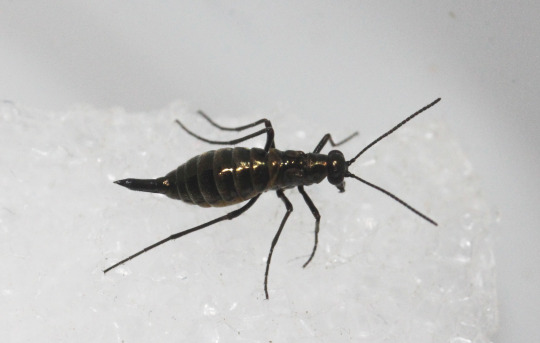
scorpionfly

Here you see a female Boreus scorpionfly who came up from a patch of moss to walk across the snow looking for a male in late December. Also called a snow flea, Boreus is so rare that few entomologists ever see them alive. There is a deep reward in learning to appreciate small things, and I have never regretted becoming an entomologist, especially as winter approaches.

Want to know more about winter bugs? Read about the first Powdermill Christmas Bug Count.

John Wenzel is the Director at Powdermill Nature Reserve, Carnegie Museum of Natural History’s environmental research center. Museum employees are encouraged to blog about their unique experiences and knowledge gained from working at the museum.
Filed Under: Blog Tagged With: entomology, insects, John Wenzel, Powdermill Nature Reserve, Winter

November 12, 2018 by wpengine

Pennsylvania Botany 2018

by Bonnie Isaac

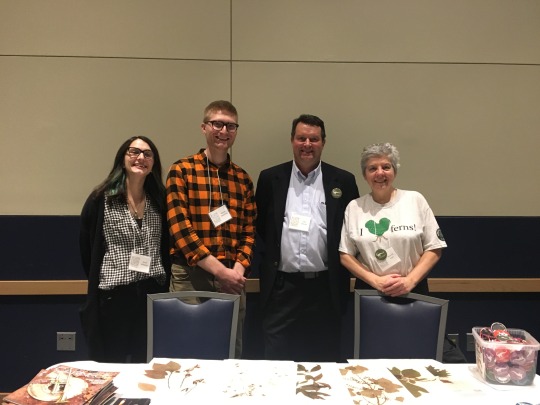
Carnegie Museum of Natural History (CMNH) was well represented at PA Botany 2018. The 4th Biennial Pennsylvania Botany Symposium took place on November 2nd and 3rd at the Penn Stater Hotel and Conference Center. CMNH staff were there in full force.  PNR Director John Wenzel, Post-Doctoral Fellow Mason Heberling, Botany Collection Manager Bonnie Isaac, and Botany Curatorial Assistant Sarah Williams attended in addition to over 200 other people. This event features a day of workshops followed by a day of presentations. CMNH Botany folks were involved in both the workshops and the symposium talks. Williams & Isaac assisted workshop leaders, Heberling was a student in one of the workshops, and Wenzel was a symposium speaker.  CMNH Botany volunteer Joe Isaac was the instructor for the workshop for Botanical Consultants.

Curatorial Assistant Sarah Williams, Post-Doctoral Fellow Mason Heberling, PNR Director John Wenzel and Botany Collection Manager Bonnie Isaac at CMNH Table in the Exhibitor hall at PA Botany 2018.

John Wenzel’s presentation highlighted some of the exciting things going on at Powdermill Nature Reserve and CMNH integrating botany and technology. John showed the crowd some of the cool techniques developed at PNR for forest study using drones and computer simulation of trees as well as introducing them to the new AR Perpetual Garden App available for free in app stores. This app helps people learn about the effects of the deer population on an environment. It shows how the forest should look compared to how the forest looks when deer are over abundant. The app features Woodland In Balance vs. Woodland Out of Balance Scenarios along with dialogue to explain the differences and why they differ.

CMNH Botany has been active in this event since its inception in 2012. We hope to see more people attend this conference on plants and how important they are.  You can find more information for this conference and other plant related items at PABotany.org.

Bonnie Isaac is the Collection Manager in the Section of Botany. Museum employees are encouraged to blog about their unique experiences and knowledge gained from working at the museum.
Filed Under: Blog Tagged With: Bonnie Isaac, Botany, John Wenzel, Mason Heberling, plants, Powdermill Nature Reserve, Sarah Williams

October 24, 2018 by wpengine

A Striking Success in Protecting Birds

by John Wenzel

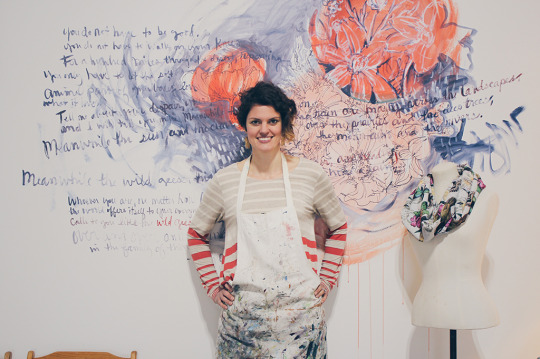
A particular point of pride of our bird research is the BirdSafe Pittsburgh program. A consortium of environmental groups and concerned citizens is working to create a more bird-friendly city, from restoring urban habitat to advising builders and architects on designing structures that will be less dangerous to birds. One of our prime collaborators has been Ashley Cecil, who was Artist in Residence at Carnegie Museum of Natural History. Ashley’s art is bird-themed, including one work that was reproduced on adhesive film that reflects UV light and is highly visible to birds. This film can be applied to windows so that birds will see Ashley’s pattern and avoid collision rather than see a reflection of a distant tree they would approach, striking the window. The film is available in color, making the window look like a stained glass, and in transparent form, resembling lace.

Ashley Cecil in front of her art work

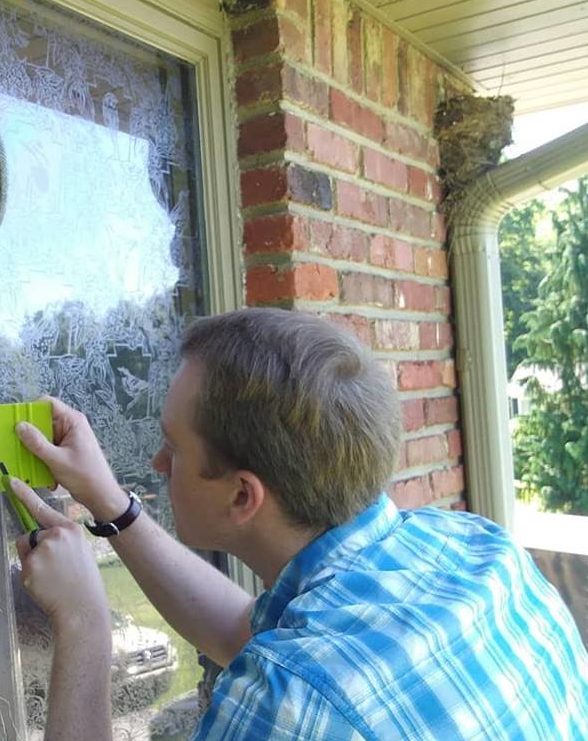
But does the film work? If you put the film on the window, does it reduce bird strikes? As the Director of Powdermill Nature Reserve, I thought I should lead by example and test the film on my own house. I have been monitoring bird strikes at my home since August of 2015. From about 6:00 am to 8:00 am, three or four days a week (at total of six to eight hours a week), I listened for strikes and recorded them. They are not random, nor evenly distributed. Certain windows seem to be a repeated problem, while others never seem to get hit. My house has 15 windows of various dimensions, plus a cathedral window that is 11 feet high and 21 feet wide. No bird has ever hit that window as far as I know. Most strikes occur when migrating birds are coming through, usually April and May, or September and October. When there is a flush of migration, it shows: I had seven strikes from August 27 to 31 in 2015, in only 10 hours of observation. Ignoring seasonal variation, and averaging across the entire data set, a rough estimate is that I observed about one strike for every 20 hours of observation. On June 14, 2018, our Urban Bird Conservation Coordinator, Jon Rice, installed the transparent film on the five most dangerous windows, leaving the others bare.

Jon rice applying birdsafe window

We have had zero bird strikes since the film was installed. To assess the effect of the film, consider that in the same period in 2017 we had seven strikes, in 2016 we had four, and in 2015 we had nine. Years have some random variation, but clearly, there is a reduction from these earlier three years’ average of 6.7 down to 0. More than that, my wife Donna and I became more vigilant since the installation of the film, and we logged about 10 or 12 hours of observation per week rather than six or eight we did for the baseline. If we use the baseline expected frequency of one bird per 20 hours of observation, then with the more thorough observations we would have expected a little more than one bird every two weeks, or about 10 birds in the 18 elapsed weeks, rather than 6.7. Using a simple “chi-square” statistic to estimate the difference between an expectation of 10 birds and an observation of zero, the probability is one in a thousand that we would get zero birds by random variation from an expectation of 10 birds. In other words, if our recent sample differs from our baseline probability purely by chance, we would have to measure 1,000 years to get one year as far from expectation as we got in 2018 following application of Ashley’s film. According to our scientific standards, we reject proposals that have a probability of less than one in 20. Our analysis is less than one in 1,000. We conclude that the film works very well to prevent birds from hitting windows.

You can contact Urban Bird Conservation Coordinator Jon Rice at RiceJ@CarnegieMNH.org.

John Wenzel is the Director at Powdermill Nature Reserve, Carnegie Museum of Natural History’s environmental research center. Museum employees are encouraged to blog about their unique experiences and knowledge gained from working at the museum.
Filed Under: Blog Tagged With: Anthropocene, Ashley Cecil, birdsafe pittsburgh, conservation, John Wenzel, Powdermill Nature Reserve

September 26, 2018 by wpengine

Boogie Woogie Aphids

by John Wenzel

aphids on a branch

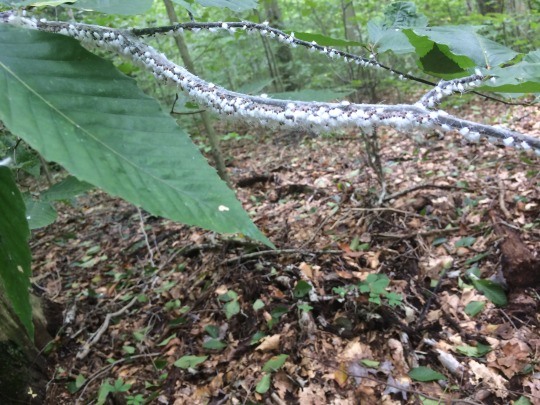
Aphids are usually small wingless insects that suck sap from plants, usually specializing on one kind of plant. Many species can reproduce rapidly by parthenogenesis, where females give live birth to daughters without mating. They can build up great numbers quickly, which is why aphids are often pests of crop plants. In late summer or early autumn, populations are about as large as they are going to get, and soon a generation of both male and females that has wings is produced. These will disperse and mate before winter comes. The winged females will lay eggs that last over winter to start the cycle again in the spring. In our area, one amusing species is the beech blight aphid (Grylloprociphilus imbricator) that feeds on beech trees. The aphid produces from its abdomen profuse wax fibers that give it a woolly appearance. In the photo shown here, the aphid itself is just a small brown dot at one end of the white fluffy wax mass. The wax is essentially a shield, and a predator that bites into the woolly floss will come away with nothing but wax. These aphids have a defensive behavior of waving their abdomens and the wax shield when they are disturbed, as you can see in this video of dancing aphids.

Because sap has far more sugar than nutrients, aphids need to get rid of the sugar by excreting it in the form of honeydew. Under a mass of aphids like that shown here, the honeydew will accumulate on the branches or the ground below the aphid colony and will attract flies, bees, wasps, and other insects seeking the sweet liquid. There is a black sooty mold (Scorius spongiosa) that grows only on the honeydew of beech aphids, and can build up a large mass. Neither the aphids nor the mold are detrimental to beech trees, so there is no need to try to exterminate either of them. If they are considered a nuisance by a homeowner, it is easy to wash the aphids off the branches with a hose.

John Wenzel is the Director at Powdermill Nature Reserve, Carnegie Museum of Natural History’s environmental research center. He has published research on the evolution of web building behavior. Museum employees are encouraged to blog about their unique experiences and knowledge gained from working at the museum.
Filed Under: Blog Tagged With: insects, John Wenzel, Powdermill Nature Reserve

  • « Go to Previous Page
  • Page 1
  • Page 2
  • Page 3
  • Go to Next Page »

sidebar

About

  • Mission & Commitments
  • Directors Team
  • Museum History

Get Involved

  • Volunteer
  • Membership
  • Carnegie Discoverers
  • Donate
  • Employment
  • Events

Bring a Group

  • Groups of 10 or More
  • Birthday Parties at the Museum
  • Field Trips

Powdermill

  • Powdermill Nature Reserve
  • Powdermill Field Trips
  • Powdermill Staff
  • Research at Powdermill

More Information

  • Image Permission Requests
  • Science Stories
  • Accessibility
  • Shopping Cart
  • Contact
  • Visitor Policies
One of the Four Carnegie Museums | © Carnegie Institute | Privacy Policy | Terms of Use | Accessibility
Rad works here logo