• Skip to primary navigation
  • Skip to main content
  • Skip to primary sidebar

Carnegie Museum of Natural History

One of the Four Carnegie Museums of Pittsburgh

  • Visit
    • Buy Tickets
    • Visitor Information
    • Exhibitions
    • Events
    • Dining at the Museum
    • Celebrate at the Museum
    • Powdermill Nature Reserve
    • Event Venue Rental
  • Learn
    • Field Trips
    • Educator Information
    • Programs at the Museum
    • Bring the Museum to You
    • Guided Programs FAQ
    • Programs Online
    • Climate and Rural Systems Partnership
  • Research
    • Scientific Sections
    • Science Stories
    • Science Videos
    • Senior Science & Research Staff
    • Museum Library
    • Science Seminars
    • Scientific Publications
    • Specimen and Artifact Identification
  • About
    • Mission & Commitments
    • Directors Team
    • Museum History
  • Tickets
  • Give
  • Shop

John Wible

August 9, 2024 by Erin Southerland

What’s in a Name? The History of the Naming of the Eastern Mole 

by John Wible

In the tenth edition of the “Systema Naturae” (1758), the Swedish botanist and natural historian Carl Linnaeus recognized eight orders of mammals, all of which include species that today are not particularly closely related. His order Bestiae included pigs, armadillos, hedgehogs, moles, shrews, and opossums. Of these, the hedgehogs, moles, and shrews are considered today to form a natural group, with the others coming from very far-flung branches of the mammal tree of life.  

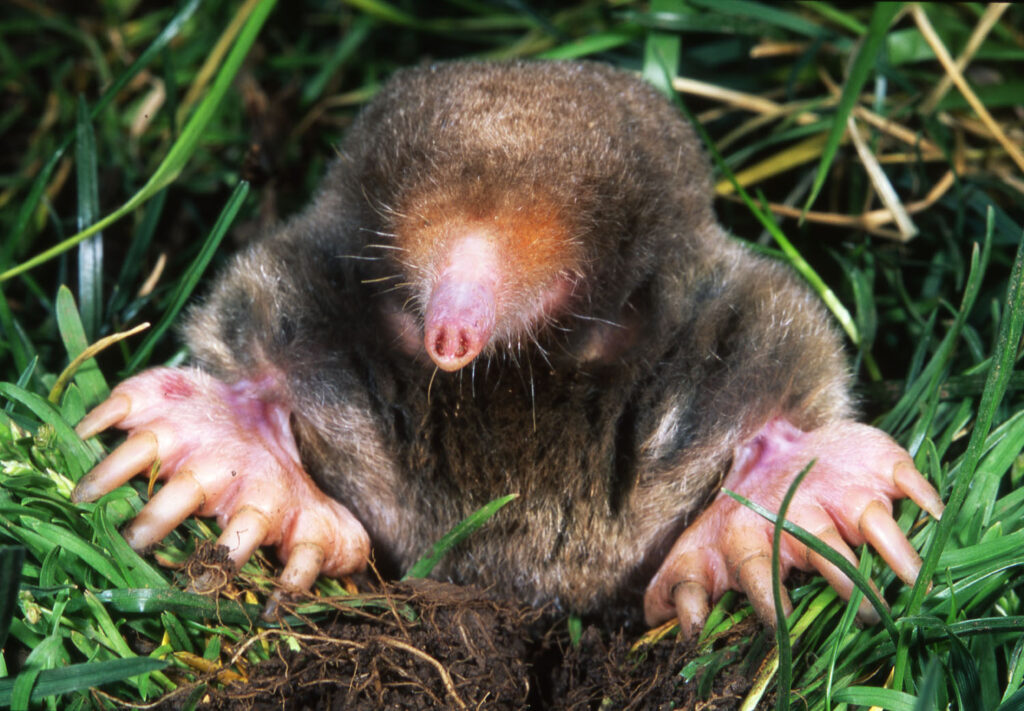
For the shrews, Linnaeus named three species of Sorex, Sorex araneus, Sorex cristatus, and Sorex aquaticus, with their habitats Europe, Pennsylvania, and America, respectively. Sorex araneus is recognized today as the common shrew (see image), distributed in Great Britain, much of the European continent, and far into Russia. However, the other two are not shrews, but are moles! Today, we recognize these as the star-nosed mole, Condylura cristata, and the Eastern mole, Scalopus aquaticus (see image). The former has a broad distribution in Pennsylvania with the latter only in the eastern part of the state. 
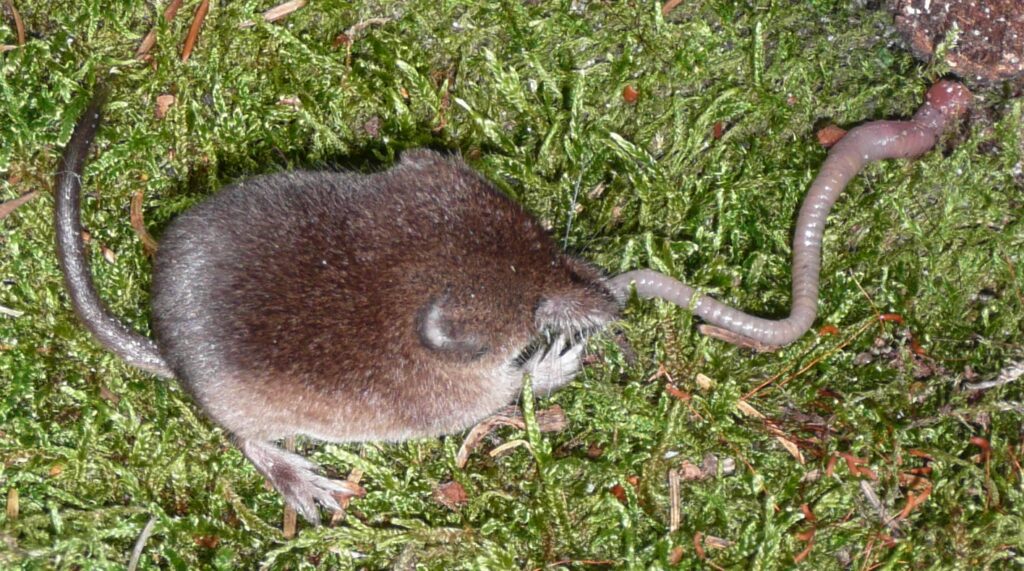
common shrew and a worm
Common shrew, Sorex araneus. Photo credit: Soricida, CC BY-SA 3.0, via Wikimedia Commons 
close-up of an eastern mole
Eastern mole, Scalopus aquaticus. Photo credit: Kenneth Catania, Vanderbilt University, CC BY-SA 3.0, via Wikimedia Commons 

Just before the shrews in the tenth edition, Linnaeus named two species of moles, Talpa europaea and Talpa asiatica, with their habitats Europe and Siberia, respectively. Given the remarkable similarity in body form between the Old World and New World moles, it is surprising that Linnaeus did not recognize these four species (Sorex cristatus, Sorex aquaticus, Talpa europaea, and Talpa asiatica) as closely related.  

Regarding the Eastern mole, subsequent nineteenth century authors realized Sorex aquaticus did not belong in the shrew genus Sorex. However, it was bounced around between several mole genera, including Talpa, and it was not until 1905 that the Latin binomial we use today, Scalopus aquaticus, was first used, 147 years after Linnaeus! The formal naming of species is not static, but evolves over time as we discover more about our natural world that causes us to reconsider and reevaluate past practices. Changing the shrew aspect of the common name lagged behind the formal one, as it was not for quite some time that the shrew moniker imparted by Linnaeus disappeared. A halfway point is in the famous 1846 “The Viviparous Quadrupeds of North America” by John J. Audubon and Reverend John Bachman, where they called it the common American shrew mole.  

From the short text in the “Systema Naturae” where Linnaeus named Sorex aquaticus, his motivation for identifying the Eastern mole as a shrew is unclear. Equally or perhaps more enigmatic is his motivation for using the specific name aquaticus. A direct translation of Sorex aquaticus is “water shrew,” with the strong implication that this mammal lived in the water or at least spent considerable time in the water. However, Linnaeus did not travel to America and so never saw Sorex aquaticus in the wild. The Eastern mole is a fossorial (burrowing) animal that spends most of its life underground with enormous forepaws for digging. Skin covers its tiny eyes, although it does perceive light and dark, and it lacks an external ear. Maybe its enlarged forepaws were viewed as flipper-like by Linnaeus. Yet, these paws resemble those of the Old World Talpa named by Linnaeus as true moles. In 1936, mammalogist A.V. Arlton stated, “The term “aquaticus,” as applied to our common species refers to the webbed hind feet, which indicated to some early writers a possible use in swimming” (Journal of Mammalogy, 17, p. 355). Unfortunately, Arlton did not name names for these early writers! Consequently, his statement cannot be fact checked. The bottom line is that in his description of Sorex aquaticus, Linnaeus did not mention webbing for either the fore- or hind feet. And ultimately, as the namer of the species, it is Linnaeus’ motivation that we need to know.  

There are some general rules for naming new species. For example, you can’t name a new species after yourself. In the Linnean era, the general trend was to apply Latin or Greek descriptors that would capture some aspect of the organism in question, a tradition continued today by most authors. For instance, our species, Homo sapiens, was named by Linnaeus and it translates to “wise man.” While we might debate the appropriateness of that as the binomial for our species, there is no debate that Sorex aquaticus is inappropriate for our ground dwelling Eastern mole. 

John Wible is Curator of Mammals at Carnegie Museum of Natural History.

Related Content

Why Do Some Shrews Have Dark Red Teeth?

The Naming of the Shrew

Star-Nosed Mole: The Nose That “Sees”

Carnegie Museum of Natural History Blog Citation Information

Blog author: Wible, John
Publication date: August 9, 2024

Share this post!

  • Share on Twitter Share on Twitter
  • Share on Facebook Share on Facebook
  • Share on Pinterest Share on Pinterest
  • Share on LinkedIn Share on LinkedIn
  • Share on Reddit Share on Reddit
  • Share via Email Share via Email

Filed Under: Blog Tagged With: John Wible, mammals, Science News

February 16, 2024 by Erin Southerland

World Pangolin Day 2024 – The Mysterious Mammalian “Wishbone”

by John Wible

World Pangolin Day 2024 is on February 17, a day to raise awareness of pangolins or scaly anteaters, one of the most unique and endangered mammals on Earth. Their scales are harvested for traditional medicines that see them as cure-alls, but their scales are made of keratin like your fingernails and hair. Their scales are as medicinally effective as biting your nails.

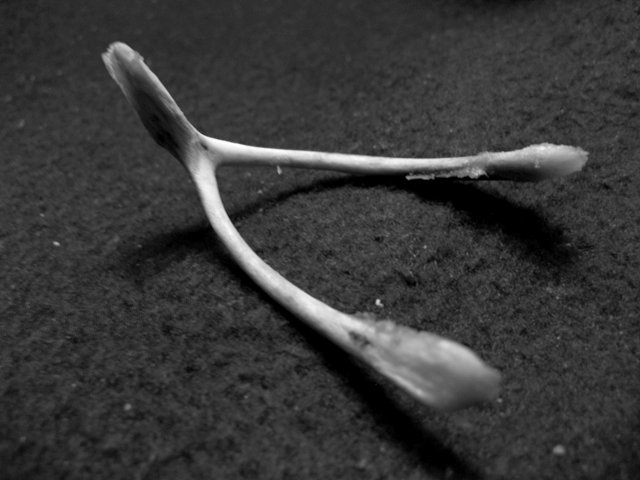
Although I will get to pangolins, I am starting with our feathered avian friends. Birds have a Y-shaped bone in their chest called a furcula (Latin for little fork). It is part of the flight apparatus and is thought to be formed by the fusion of the right and left clavicles (our collarbones). However, some researchers think it might be a different bone called the interclavicle, which in mammals is only found in monotremes, the egg-laying mammals. Some non-avian dinosaurs have a furcula, which is part of the evidence placing them on the bird family tree. The furcula is commonly called the wishbone because of the practice of making a wish on the bone! You grab one arm and someone else grabs the other; both make wishes and then pull; whoever gets the larger piece will have their wish come true.

Chicken furcula. Photo credit: Clyde Robinson/Flickr Creative Commons

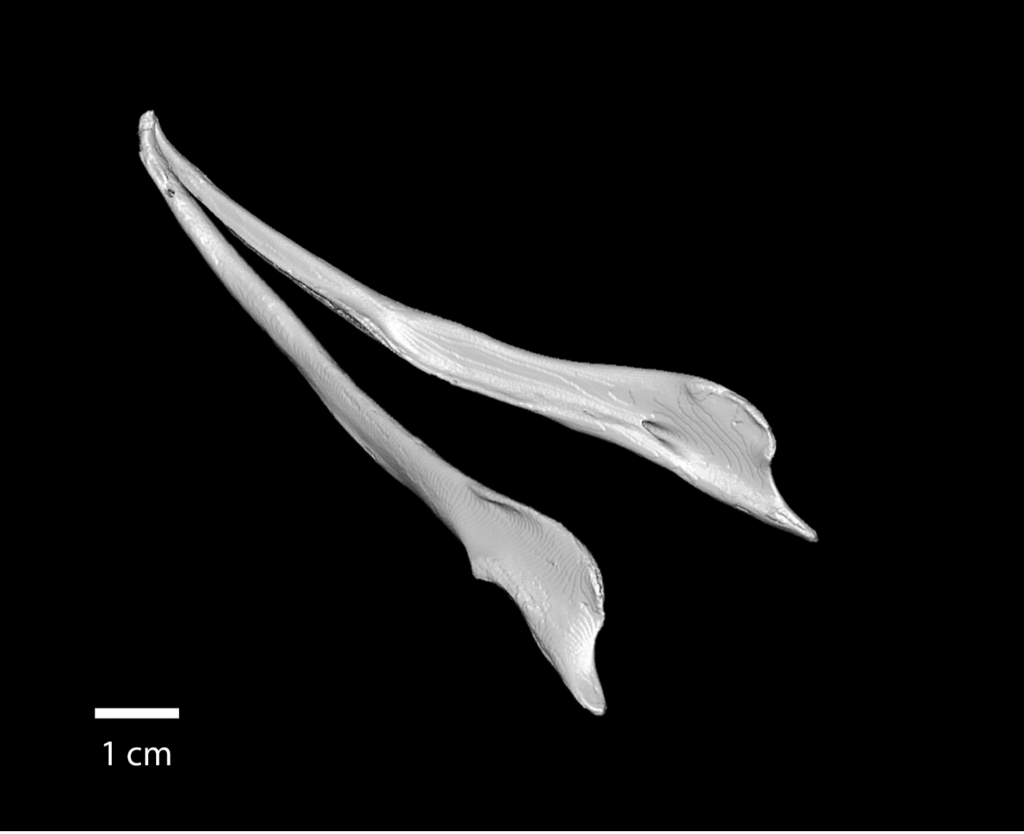
In celebration of World Pangolin Day, I want to introduce you to a mammal “wishbone.” If you search through the mammalian literature, you will not encounter a bone identified as a wishbone. Nevertheless, a small, select group of mammals have a pair of bones that looks, to me anyway, like a furcula. Here is an example.

Lower jaw of the northern tamandua, Tamandua mexicana. American Museum of Natural History 23437 made from CT scan data by Hannah Barton, University of Pittsburgh.

The lower jaw, the mandible, is made up of right and left bones called dentaries. They meet on the midline at the chin. In humans, the right and left bones are filled with teeth, fused on the midline, and don’t look like a furcula! The northern tamandua from Central America differs in that there are no teeth, the right and left bones are held together only by soft tissues, and it looks like a furcula! How does the tamandua survive without teeth? Tamanduas are social insect feeders (ants and termites) that swallow their prey whole; tamandua parents don’t have to worry about their kids chewing with their mouths open. Now, although the tamandua lower jaw looks kind of like a wishbone, when pulled apart there won’t be a winner as the split will be down the middle with the two halves the same size.

The vast majority of the 6,500 species of living mammals have teeth; some have dentaries fused like humans and some have them unfused like the tamandua. Of the 6,500 species, there are 31 that are toothless as their normal condition. These 31 fall into two camps: 15 are baleen whales, including the Earth’s largest animal, the blue whale, which are filter feeders; and 16 are social insect feeders like the tamandua. However, all 31 have a mandible that is reminiscent of an avian wishbone. The 16 social insect feeders are from three unrelated lineages that have convergently adapted to eating ants and termites. The three lineages are:

  • Spiny anteaters or echidnas (monotremes) found in Australia and New Guinea (four species).
  • True anteaters (myrmecophagids) found in South and Central America (four species including two kinds of tamandua).
  • Pangolins (pholidotans) found in Africa and Asia (eight species).

The mandibles of the #1 and #2 look like that of the northern tamandua. The left and right sides are not fused and the mandible is skinny in the front and larger in the back where it articulates with the skull. #3, the pangolins, are really different. The left and right sides are fused at the midline and the mandible is larger at the front.

Lower jaw of the Sunda pangolin, Manis javanica, United States National Museum 144418 made from CT scan data by the author.
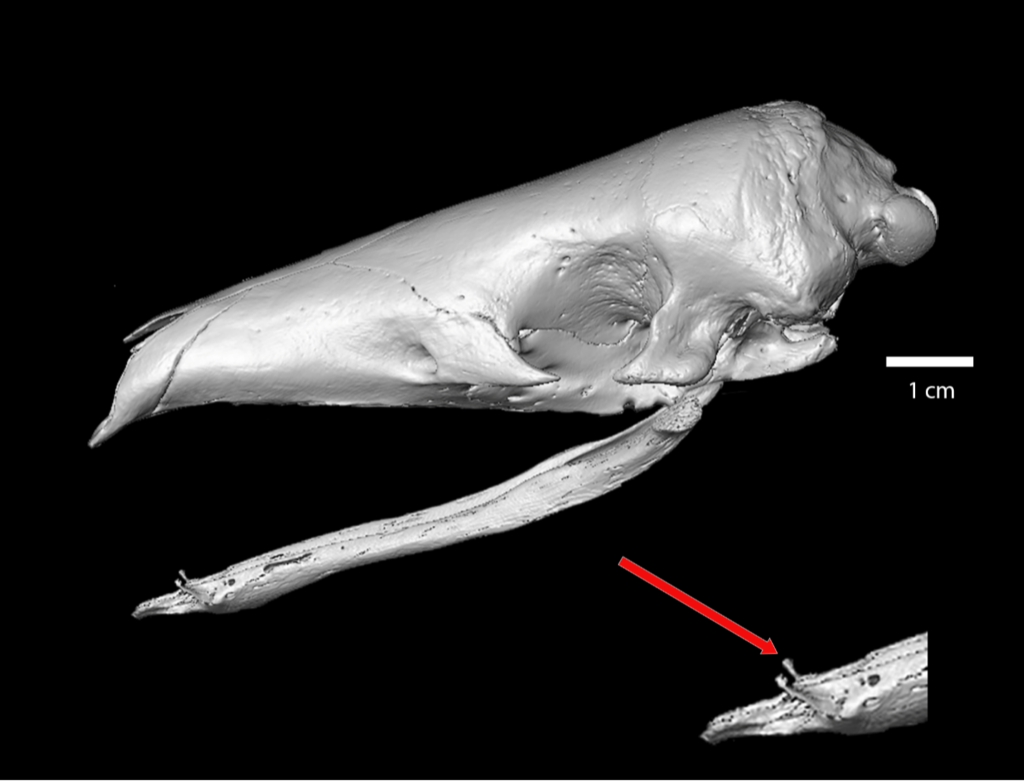
Skull of the Sunda pangolin, Manis javanica, United States National Museum 144418 made from CT scan data by the author. Red arrow points to the two bony mandibular prongs in the close-up.

The other very odd thing about the pangolin mandible is that it has a pair of bony prongs at the front that look somewhat like teeth (red arrow). Doran and Allbrook (1973: Journal of Mammalogy) dissected the pangolin tongue and reported that the lower lip was attached to these prongs, but they did not illustrate this or explain it further. Pangolins are clearly doing something different with their mandible than the tamanduas and echindas are, but what, I don’t know. Whatever it is, it has been around in pangolins for at least 35 million years! There was a pangolin that lived in the American West during the late Eocene named Patriomanis americana and it has a set of mandibular prongs just like those in the Sunda pangolin shown here. The other difference with the pangolin mandible is that when subjected to a wishbone pull, it might not break down the middle and be more like a furcula.

I have left the baleen whales until the end. Are their mandibles more like the tamandua, the pangolin, or neither?

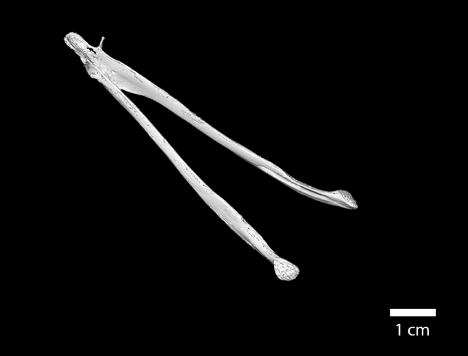
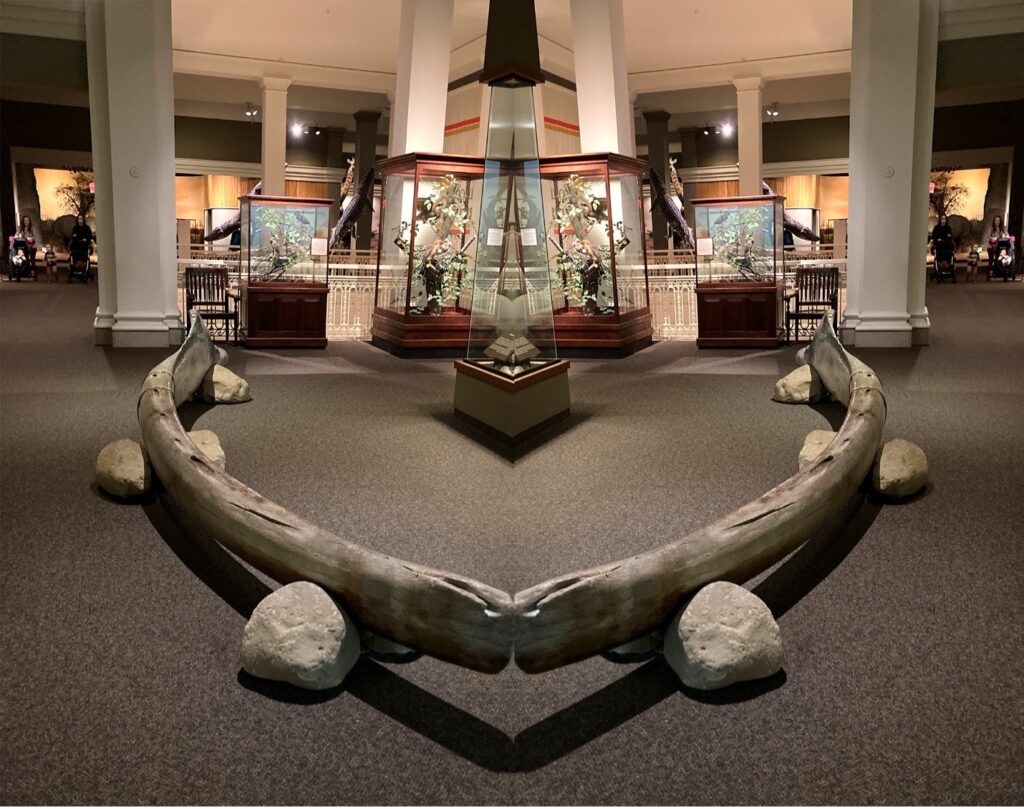
Mandible of the blue whale, Balaenoptera musculus. Only the left dentary is on display in the Hall of North American Wildlife at Carnegie Museum of Natural History. The author manipulated the photograph to create the world’s largest “wishbone.”

Baleen whales are more like the tamandua with the right and left sides unfused and the mandible larger in the back than the front. If you were able to do the wishbone pull on the blue whale, there would be no winner and someone would likely lose by throwing their back out!

John Wible is Curator of Mammals at Carnegie Museum of Natural History.

Related Content

World Pangolin Day 2023 – The Mysterious Brain Bone

World Pangolin Day 2022

E is for Echidna

Carnegie Museum of Natural History Blog Citation Information

Blog author: Wible, John
Publication date: February 16, 2024

Share this post!

  • Share on Twitter Share on Twitter
  • Share on Facebook Share on Facebook
  • Share on Pinterest Share on Pinterest
  • Share on LinkedIn Share on LinkedIn
  • Share on Reddit Share on Reddit
  • Share via Email Share via Email

Filed Under: Blog Tagged With: Hall of African Wildlife, John Wible, mammals, Science News

February 2, 2024 by Erin Southerland

Groundhog Day 2024: Punxsutawney Phil’s Alpine Cousin

by Suzanne McLaren and John Wible

Beginning in 1887 in Punxsutawney, Pennsylvania, the celebration of Groundhog Day has made the groundhog (Marmota monax) a familiar animal to people who live far beyond the range of this species. While this large ground squirrel may get the most publicity, especially on February 2nd every year, there are twelve related species that live elsewhere in North America, Europe, and Asia. In Europe, the Alpine marmot (Marmota marmota), which lives in mountainous areas of the continent’s central and western regions, is particularly well-known. Like the groundhog, it spends most of the year fattening up so that it can survive the winter months by hibernating.  

two alpine marmots
Credit: Sylvouille at French Wikipedia. – Transferred from fr.wikipedia to Commons., CC BY-SA 1.0

While our local groundhog leads a more solitary existence, the Alpine marmot lives in a communal setting that includes a single breeding pair and around 15-20 of their offspring. They live in underground burrows that are passed down for generations within the family group, expanding over time into complex systems of tunnels. The tunnels eventually lead to a large chamber or den, where the entire family hibernates during the winter months. This concentrates body heat among the group and helps younger individuals to survive. Similar to prairie dogs, family members are friendly and playful with each other, grooming and touching noses when they greet. One individual, serving as a guard at the mouth of the burrow, will give off a loud whistle, to warn the rest of the family about the approach of an enemy – either a predator or even a non-family member of its own species.  

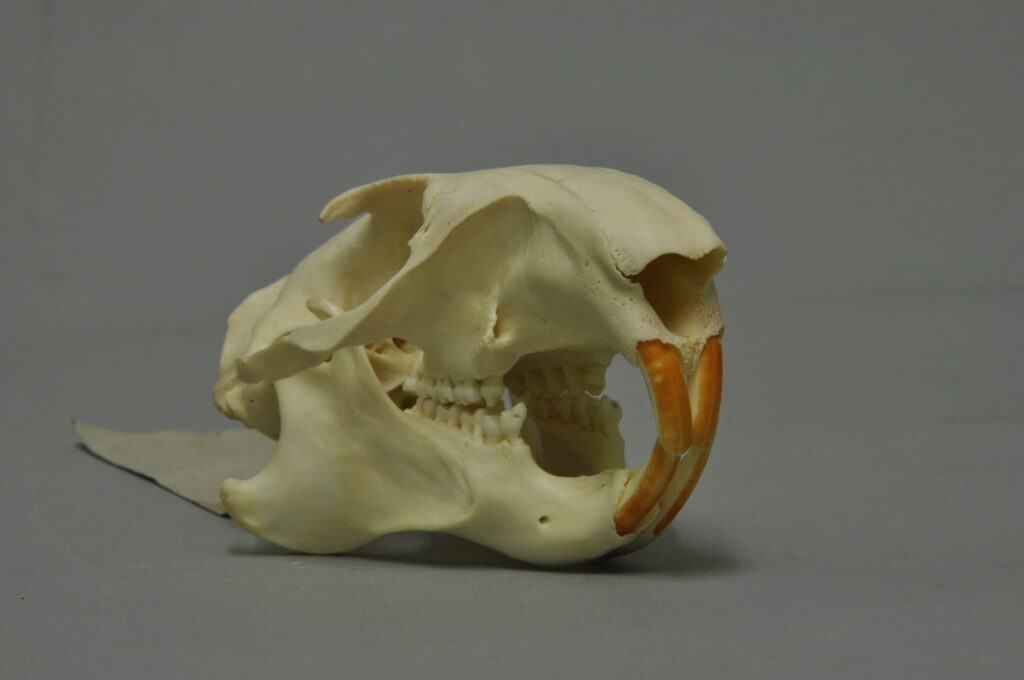
Humans have hunted this species for hundreds of years for its meat. They are still hunted by the thousands for sport in Switzerland and Austria, with the large, ever-growing, yellowish-orange upper incisors sometimes displayed on hunters’ belts.

alpine marmot skull
Picture of Alpine marmot skull showing large incisors, Klaus Rassinger und Gerhard Cammerer, Museum Wiesbaden, CC BY-SA 3.0, via Wikimedia Commons

It is also reported that rendered Alpine marmot fat is still sought after as a folk remedy for arthritis. It is not taken internally but rubbed on sore joints.  

two glass containers of rendered marmot fat
Picture of rendered marmot fat. Credit: H. Zell, CC BY-SA 3.0

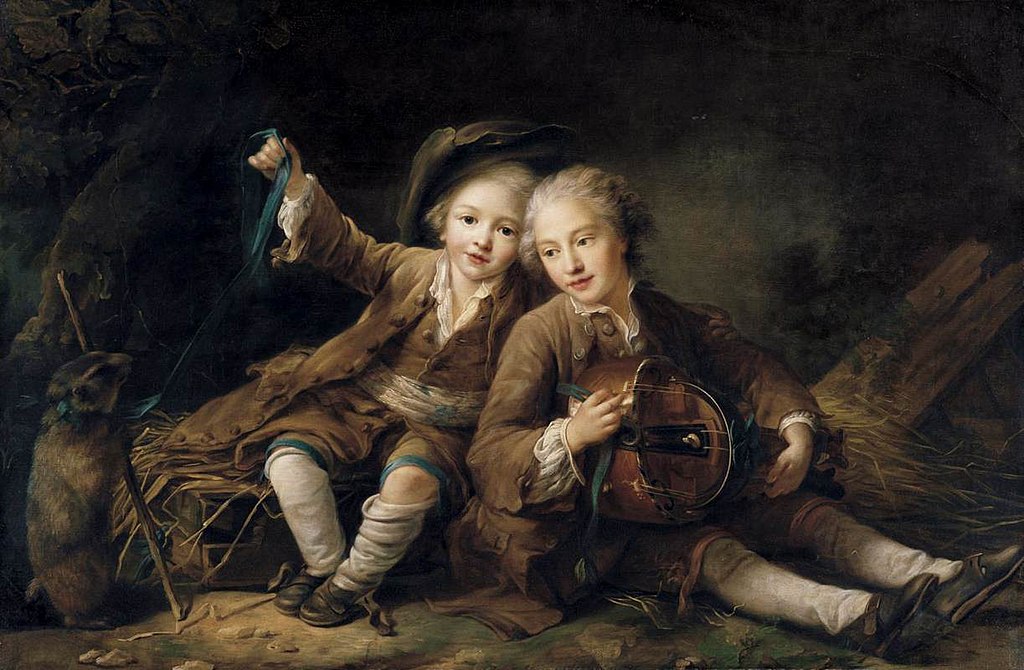
Perhaps the most surprising anecdote about the interaction of humans and the Alpine marmot is the use of the animal for entertainment, though not for weather forecasting like Punxsutawney Phil. Stories of a trained Alpine marmot on a leash, accompanying a “hurdy-gurdy man”, somewhat like the organ grinder and his monkey, date to at least the mid-1700s as evidenced by François Hubert Drouais’ painting Les Enfants d’ Ilustre Naissance. Here, two boys sit together, one playing the hurdy-gurdy, a stringed instrument, and the other holding a dancing marmot on a leash. The traveling entertainer carried his marmot from town to town in a box. If you’ve ever witnessed the belligerent behavior of a local groundhog you might find it hard to believe that any Pennsylvania groundhog, other than Punxsutawney Phil, would allow itself to be led around on a leash or kept in a box!

picture of the painting "The Children of the Duc de Bouillion" by Francois-Hubert Drouais
Credit: François-Hubert Drouais, Public domain PD-US, via Wikimedia Commons

Suzanne McLaren is Collection Manager of Mammals and John Wible is Curator of Mammals at Carnegie Museum of Natural History.

Related Content

Groundhog Day 2023

Groundhog Architecture

Groundhog Day 2020!

Carnegie Museum of Natural History Blog Citation Information

Blog author: McLaren, Suzanne; Wible, John
Publication date: February 2, 2024

Share this post!

  • Share on Twitter Share on Twitter
  • Share on Facebook Share on Facebook
  • Share on Pinterest Share on Pinterest
  • Share on LinkedIn Share on LinkedIn
  • Share on Reddit Share on Reddit
  • Share via Email Share via Email

Filed Under: Blog Tagged With: John Wible, mammals, Science News, Suzanne McLaren

February 16, 2023 by Erin Southerland

World Pangolin Day 2023 – The Mysterious Brain Bone

by John Wible

The third Saturday in February marks World Pangolin Day, celebrating the scaly anteater that is sometimes called the pinecone mammal. Pangolins are covered with scales made of keratin, the same stuff in your fingernails and hair. Because some traditional medicines mistakenly impart curative powers to their scales, pangolins have become the most heavily illegally trafficked animal on the planet. Pangolins lack teeth and live exclusively on social insects, like ants and termites, which they catch with their very long sticky tongue. Today, there are eight species of pangolins, four in Asia and four in Africa. The fossil record reveals greater diversity and geographic distribution for these unusual creatures, including Europe and North America. 

I study the evolutionary relationships of mammals, building family trees based on the anatomy of living and extinct species. In the 1800s and 1900s, pangolins were grouped with other mammals that are toothless or have very reduced teeth, such as anteaters, aardvarks, sloths, and armadillos, in the aptly named Edentata (think edentulous, or “toothless”). In the last 25 years, the study of DNA has revealed a totally different set of relationships for these edentate mammals. Aardvarks are in an African group with elephants, elephant shrews, tenrecs, and hyraxes; anteaters, sloths, and armadillos are in a South American group; and pangolins are most closely related to Carnivora (dogs, bears, cats, hyaenas, raccoon, etc.). It is hard to imagine that the gentle, toothless pangolins are close kin to the ferocious meat-eater lineage that includes lions, tigers, and saber-toothed cats. 

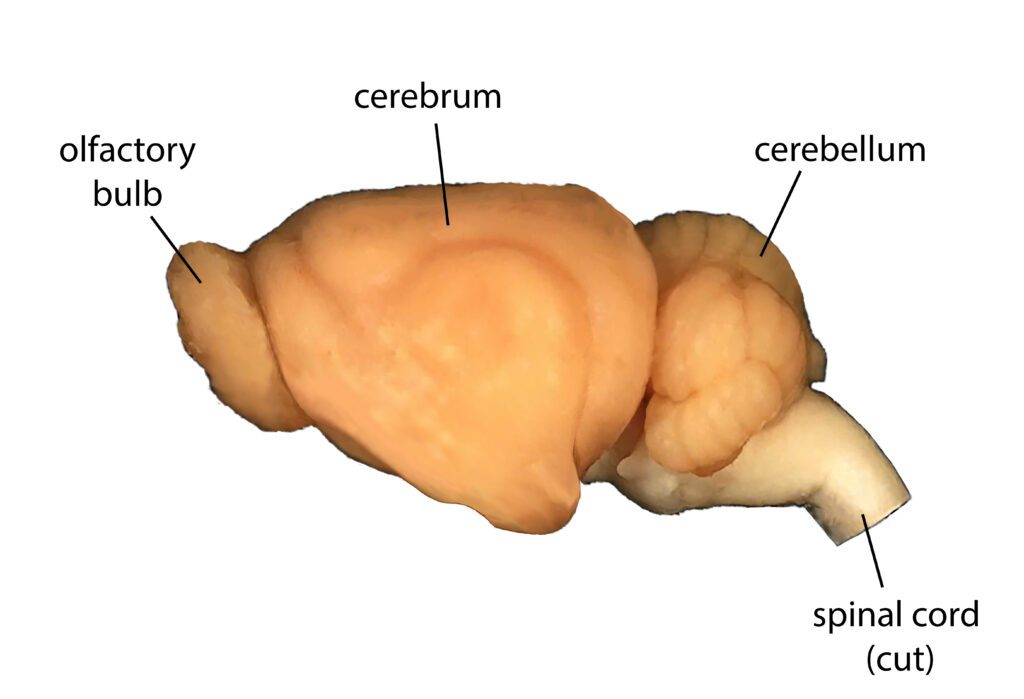
Although DNA supports relationships of pangolins and carnivorans, we are hard pressed to find anatomical features that link the two groups. One unusual feature shared by both and, therefore, hypothesized to be present in their common ancestor is the os tentorium or brain bone! A typical mammalian brain is composed of three parts delimited by deep grooves, termed sulci, the fore-, mid-, and hindbrain, which correspond respectively to the olfactory bulbs, cerebrum, and cerebellum. 

This brain of the African white-bellied tree pangolin, Phataginus tricuspis, is modified from Iman et al. (2018: Journal of Comparative Neurology 256: 2548-256), courtesy of Paul Bowden, Carnegie Museum of Natural History.

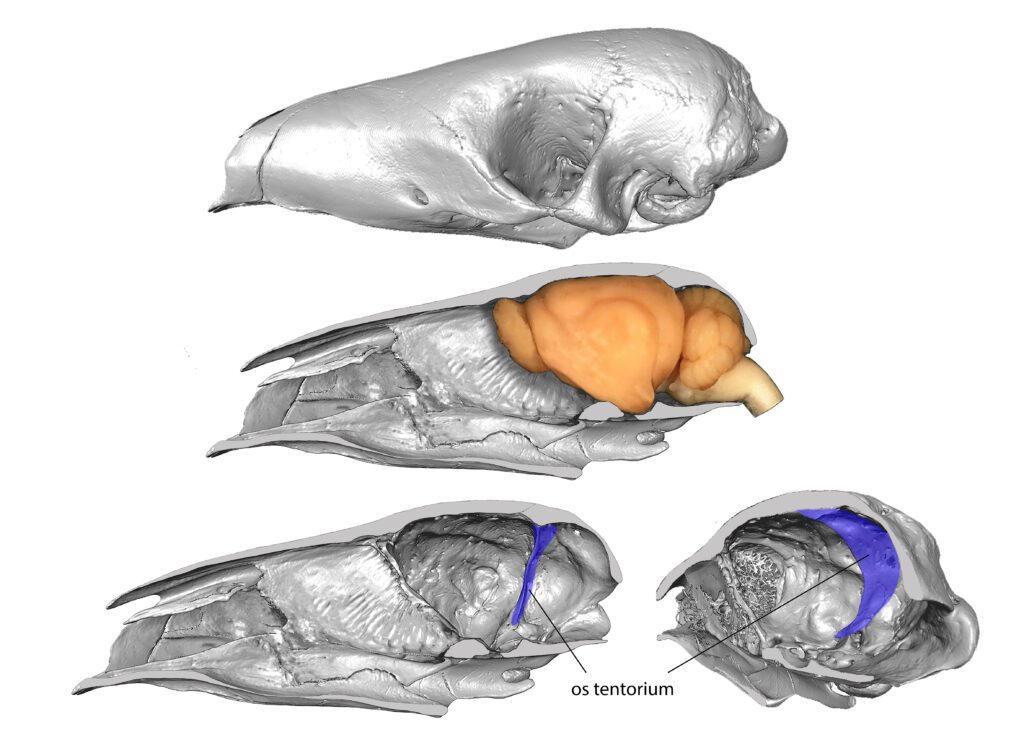
The human brain is dominated by its greatly enlarged cerebrum with tiny olfactory bulbs; pangolins and carnivorans have a much better sense of smell with well-developed olfactory bulbs and relatively smaller cerebrum. The brain in mammals is encased in a fluid-filled space surrounded by layers of connective tissue and within the bony braincase of the skull. One of the connective tissue layers, the dura mater, has a fold called the tentorium cerebelli (meaning the tent of the cerebellum) that fits in the deep sulcus between the cerebrum and cerebellum. In pangolins and carnivorans, the connective tissue tentorium has a layer of bone in it, creating a partial bony separation between the cerebrum and cerebellum. In pangolins and carnivorans, the os tentorium is not a single bone, but is made up of contributions from three or four skull bones. There are other mammals that independently have evolved an os tentorium, including horses, but it is not as extensive as that in pangolins and carnivorans. 

Chinese pangolin, Manis pentadactyla, CT scan data. Top, whole cranium; middle, sagittally sectioned cranium with brain added; bottom, sagittally sectioned cranium with blue indicating os tentorium.

Okay, so we have a nice anatomical feature allying pangolins and carnivorans. However, we are left with one very large unanswered question. Why? If it is such a good thing to partially separate the cerebrum and cerebellum by bone, why don’t all mammals do it? The os tentorium is said to be “protective” of the brain, but protective how? Did a random mutation some 60 million years ago in the common ancestor of pangolins and carnivorans lead to the formation of the brain bone in the living forms? Is the brain bone somehow linked to another innovation that is strongly selected for? Is there some function to the brain bone that our brains cannot fathom? As an anatomist, I can study the structure and distribution of the brain bone in living and extinct mammals but to get at the “why” question may require a deep dive into molecular biology. Understanding the genetics behind the os tentorium may be the only path forward on cracking this mystery.

John Wible is Curator of Mammals at Carnegie Museum of Natural History.

Related Content

World Pangolin Day 2022

A is for Aardvark

What Is in a Tail?

Carnegie Museum of Natural History Blog Citation Information

Blog author: Wible, John
Publication date: February 16, 2023

Share this post!

  • Share on Twitter Share on Twitter
  • Share on Facebook Share on Facebook
  • Share on Pinterest Share on Pinterest
  • Share on LinkedIn Share on LinkedIn
  • Share on Reddit Share on Reddit
  • Share via Email Share via Email

Filed Under: Blog Tagged With: Hall of African Wildlife, John Wible, mammals, Science News

January 31, 2023 by Erin Southerland

Groundhog Day 2023

by John Wible

January 21, 2023 was Squirrel Appreciation Day! With Groundhog Day, which commemorates our most famous squirrel, Punxsutawney Phil, right around the corner, I thought it appropriate to celebrate squirrels with this blog.

Rodents are the most diverse lineage of living mammals with more than 2,500 species, which represents nearly 40% of the species diversity of living mammals. Squirrels (Sciuridae) are one of 36 families of living rodents. There are nearly 300 species of squirrels found in the Americas, Eurasia, and Africa; a few squirrels have been introduced into Australia by humans. Broadly speaking, there are three main types of squirrels: tree, ground, and flying. Tree and ground are descriptive of their main habitats; flying squirrels also inhabit trees but are so called because of their unique locomotory pattern, which actually isn’t flying but gliding! Regarding their evolutionary relationships, all flying squirrels are more closely related to each other than to other squirrels, supporting a single origin of gliding in their common ancestor. The tree and ground squirrels do not show the same pattern; all ground squirrels are not each other’s closest relatives and the same is true of all tree squirrels. The fossil record (see text below) supports tree life as the earliest squirrel habitat, with multiple episodes of ground invasion from the trees.

In Pennsylvania, we are fortunate to have seven native species of squirrels (two ground, three tree, and two flying). You can learn more about Pennsylvania mammals at our website: https://mammals.carnegiemnh.org/pa-mammals/

Allegheny County has six of the seven PA squirrel species: the two ground squirrels (the Eastern chipmunk, Tamias striatus, and the groundhog, Marmota monax); the three tree squirrels (the gray squirrel, Sciurus carolinensis, the fox squirrel, Sciurus niger, and the red squirrel, Tamiasciurus hudsonicus); and one of the two flying squirrels (the Southern flying squirrel, Glaucomys volans). Depending on where you are in Allegheny County, you may see all six squirrels, although the Southern flying squirrel is likely the most elusive because of its nocturnal (nighttime) activities.

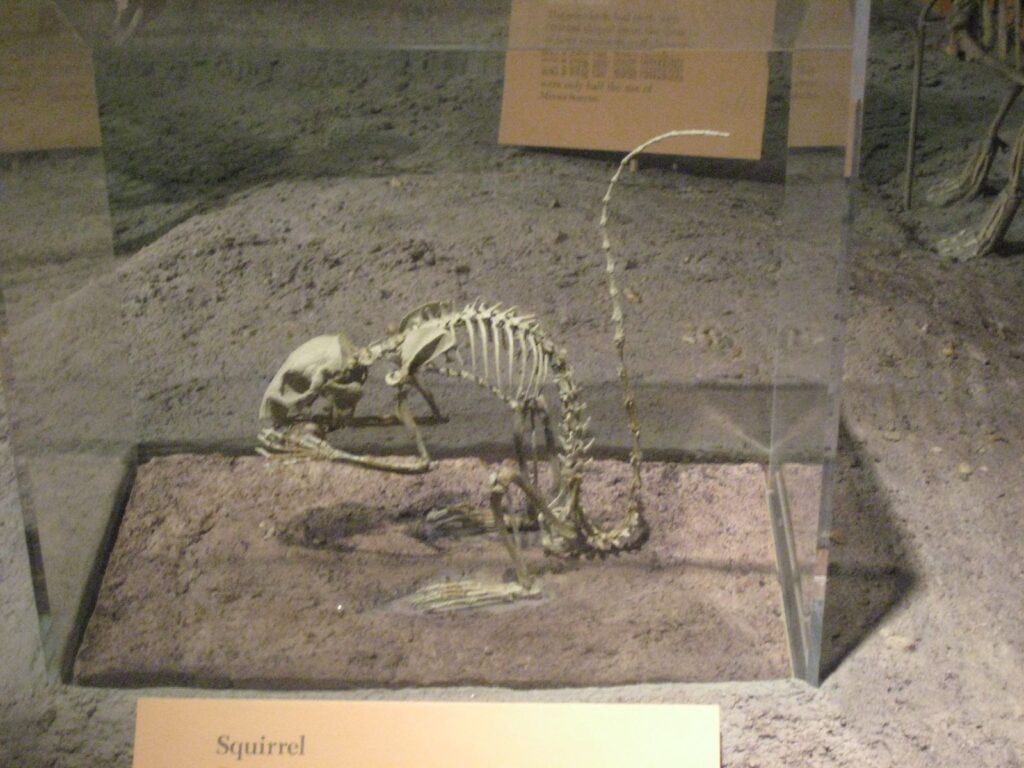
Squirrels have a long evolutionary history. The oldest fossils identifiable as squirrels first appeared around 34 million years ago in western North America, all showing adaptations to tree life. One of these, Protosciurus, is on display at the Smithsonian in Washington, D.C. (see below). Its skeleton is remarkably like those of living gray squirrels, both in size and morphology. Given that this remarkable similarity occurred over 30 million years of geological time, scientists consider our gray squirrel and tree-adapted relatives to be living fossils, that is, not dramatically changed compared to their very ancient relatives.

Reconstruction of the skeleton of Protosciurus on display at the Smithsonian’s National Museum of Natural History in Washington, D.C. Image credit: Claire H. from New York City, USA, CC BY-SA 2.0 https://creativecommons.org/licenses/by-sa/2.0, via Wikimedia Commons

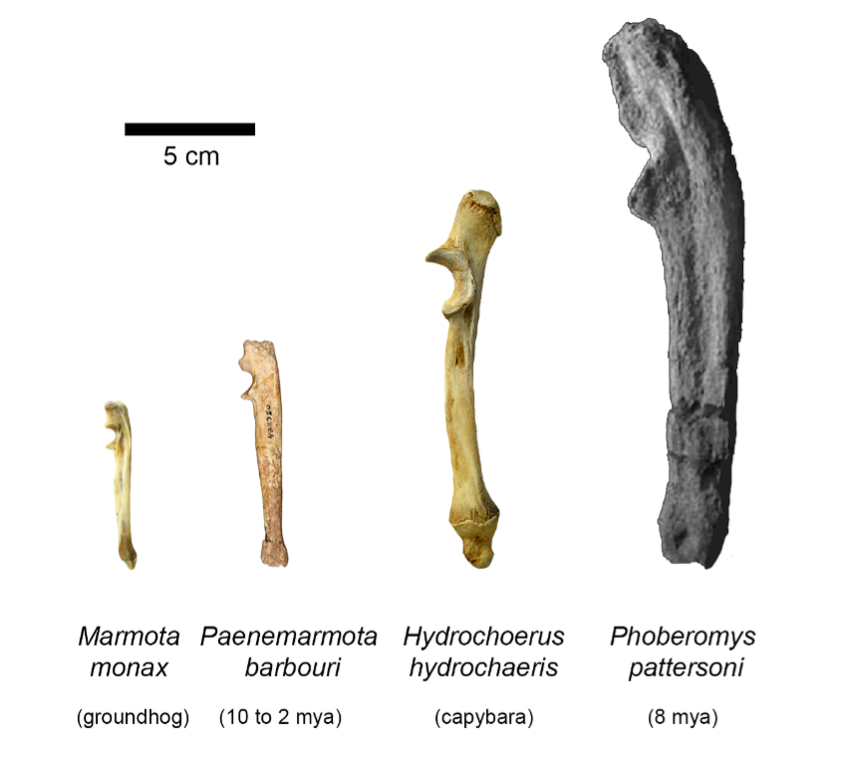
Most rodents are small mammals; think mice and their relatives. Punxsutawney Phil is the second largest living squirrel; his cousin, the hoary marmot, Marmota caligata, from the Pacific Northwest is slightly larger, with adult males typically over 20 pounds. There was a larger ground squirrel that lived in western North America between 10 and two million years ago, Paenemarmota, a Latin name that translates to “almost a marmot.” Some of my colleagues have called it the “giant marmot,” which should be taken with a gigantic grain of salt! Below is an image of four ulnae, one of the two bones in the forearm. On the left is the living groundhog and next to it is the “giant marmot.” Anatomically, the bones are nearly identical, with one a little larger than the other. Weight estimates for the “giant marmot” are around 35 pounds. Yes, that is big for a squirrel, but not compared to some truly giant rodents. Next to the “giant marmot” is the ulna of the largest living rodent, the semiaquatic Central and South American capybara, Hydrochoerus, which translates to “water pig.” Capybaras, which can grow to nearly 150 pounds, are related to guinea pigs! But wait, there is more. Capybaras pale in comparison to the largest rodent that ever lived. The 8-million-year-old Proberomys from Venezuela was estimated to be the size of a large African antelope at 300 to 550 pounds. Yikes, now that is a giant guinea pig.

Ulna (forearm bone) of select living and extinct rodents.

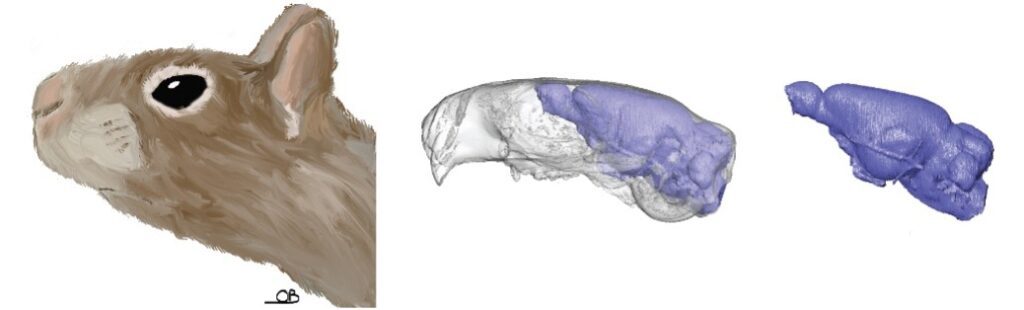
Recently, one of my colleagues, Ornella Bertrand from the Universitat Autònoma de Barcelona, Spain, and coauthors have studied the evolution of the brain in squirrels. From CT scans of fossil skulls (see images below), they were able to recreate various parameters of the brain, including the relationship between brain size and body size. They found that squirrels living in trees had larger brains to their body size than other squirrels, that life in the complex arboreal environment was a driver of brain evolution in squirrels. The result of this evolutionary story for us may be that we will always be hard pressed to build a bird feeder that those big-brained tree squirrels can’t get into!

Images courtesy of Ornella Bertrand. Middle, skull taken from CT scans of the 32-million-year-old fossil squirrel Cedromus wilsoni from Wyoming with the blue indicating the reconstructed brain, shown separately to the right; left is Ornella’s reconstruction of the animal’s head. For 3D models made by Ornella Bertrand and more, see https://ornellabertrand.wordpress.com/3d-models/

John Wible, PhD, is the curator of the Section of Mammals at Carnegie Museum of Natural History.

Related Content

Groundhog as Archaeologist

Groundhog Architecture

Groundhog with a Malocclusion

Carnegie Museum of Natural History Blog Citation Information

Blog author: Wible, John
Publication date: January 31, 2023

Share this post!

  • Share on Twitter Share on Twitter
  • Share on Facebook Share on Facebook
  • Share on Pinterest Share on Pinterest
  • Share on LinkedIn Share on LinkedIn
  • Share on Reddit Share on Reddit
  • Share via Email Share via Email

Filed Under: Blog Tagged With: Hall of North American Wildlife, John Wible, mammals, Science News

June 2, 2022 by Erin Southerland

Do Any Mammals Lay Eggs?

by Dr. John R. Wible

Scientists recognize three major types of living mammals: placentals, marsupials, and monotremes, all of which produce milk to nourish their young. Of the 6,495 mammal species recognized in 2018 (Burgin et al., Journal of Mammalogy vol. 99), 6,111 are placentals, 379 are marsupials, and 5 are monotremes. 

Placentals and marsupials are viviparous, meaning they give birth to live offspring. Marsupials, such as kangaroos, koalas, and our local Virginia opossum, give birth to very immature, embryo-like offspring that complete their development outside the womb usually attached to a nipple in a pouch. In contrast, placentals, such as dogs, cats, and humans, give birth to more developed offspring and have no pouch. Both marsupials and placentals have a placenta that nourishes the developing offspring in the womb, but this organ is more efficient in placental mammals than in marsupials. 

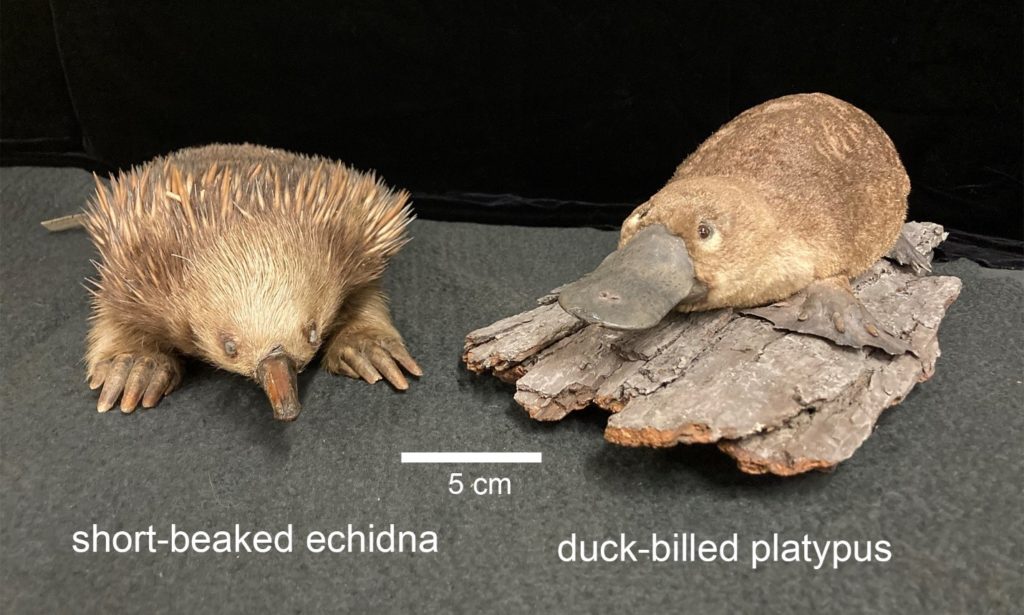
But what about monotremes? The five species of living monotremes include the duck-billed platypus found only in eastern Australia, the short-beaked echidna found in Australia and New Guinea, and the three species of the long-beaked echidna found only in New Guinea. Echidnas are also known as spiny anteaters.

echidna and platypus taxidermy mounts

In contrast to the viviparous marsupials and placentals, monotremes are oviparous, a word that means they “give birth to eggs”. Unlike the hard-shelled eggs of birds, monotreme eggs have a leathery exterior, like those of most reptiles.  The platypus has one mating season per year and produces one to three eggs with an average of two. Pregnancy lasts about 21 days and incubation of the hatched egg in a nest of wet vegetation is about 10 days. The lima bean-sized platypus newborn or puggle (or platypup to some) is embryo-like, but more advanced than a newborn joey (kangaroo). It crawls onto the mother’s belly in search of milk, which oozes from the skin surface, as monotremes don’t have nipples.

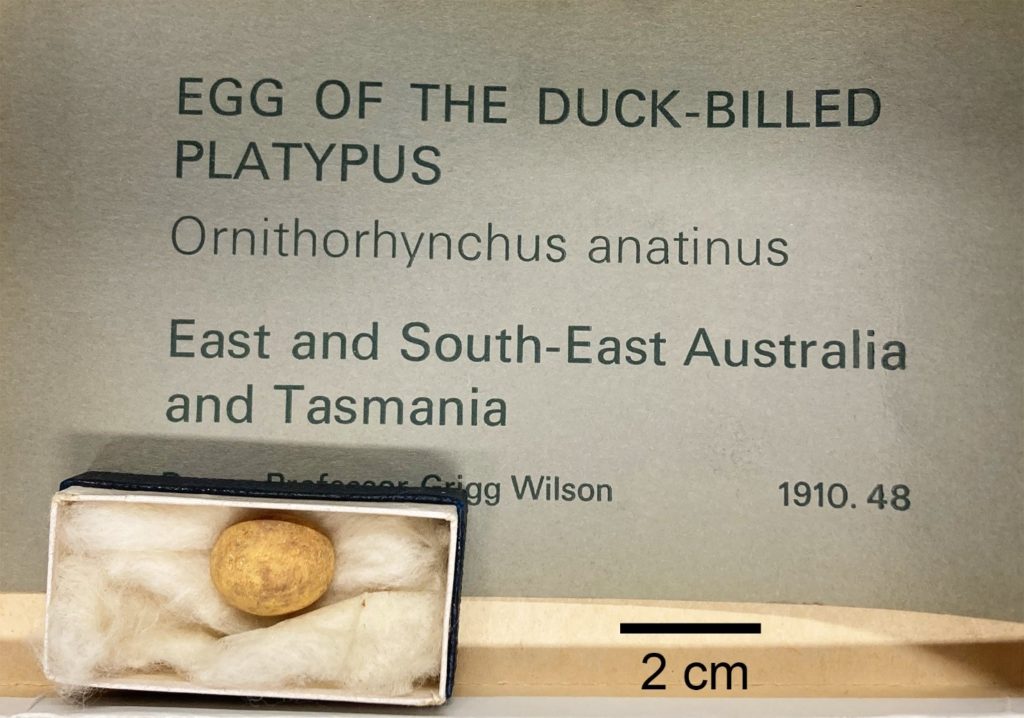
On a recent research trip to Edinburgh in the United Kingdom, I visited the mammal collection of the National Museum of Scotland. There I came across a model of the egg of a platypus, which was the inspiration for this blog. This three-quarter-inch-long egg will hatch and grow into a house cat-sized animal. Given that monotremes, most reptiles, and all birds are oviparous, the common ancestor of mammals is thought to have been an egg-layer as well. This primitive mode of birth was retained in living monotremes, but evolved into live birth in the common ancestor of placentals and marsupials.

Platypus egg in a box with a label next to it that says "Egg of the duck-billed platypus, Ornithorhynchus anatinus, East and South-East Australia and Tasmania."

John Wible is the Curator of Mammals at the Carnegie Museum of Natural History.

Related Content

E is for Echidna

Armadillos: Identical Quadruplets Every Time

Mesozoic Monthly: Volaticotherium

Carnegie Museum of Natural History Blog Citation Information

Blog author: Wible, John R.
Publication date: June 2, 2022

Share this post!

  • Share on Twitter Share on Twitter
  • Share on Facebook Share on Facebook
  • Share on Pinterest Share on Pinterest
  • Share on LinkedIn Share on LinkedIn
  • Share on Reddit Share on Reddit
  • Share via Email Share via Email

Filed Under: Blog Tagged With: John Wible, mammals, Science News

  • Page 1
  • Page 2
  • Page 3
  • Page 4
  • Go to Next Page »

sidebar

About

  • Mission & Commitments
  • Directors Team
  • Museum History

Get Involved

  • Volunteer
  • Membership
  • Carnegie Discoverers
  • Donate
  • Employment
  • Events

Bring a Group

  • Groups of 10 or More
  • Birthday Parties at the Museum
  • Field Trips

Powdermill

  • Powdermill Nature Reserve
  • Powdermill Field Trips
  • Powdermill Staff
  • Research at Powdermill

More Information

  • Image Permission Requests
  • Science Stories
  • Accessibility
  • Shopping Cart
  • Contact
  • Visitor Policies
One of the Four Carnegie Museums | © Carnegie Institute | Privacy Policy | Terms of Use | Accessibility
Rad works here logo