• Skip to primary navigation
  • Skip to main content
  • Skip to primary sidebar

Carnegie Museum of Natural History

One of the Four Carnegie Museums of Pittsburgh

  • Visit
    • Buy Tickets
    • Visitor Information
    • Exhibitions
    • Events
    • Dining at the Museum
    • Celebrate at the Museum
    • Powdermill Nature Reserve
    • Event Venue Rental
  • Learn
    • Field Trips
    • Educator Information
    • Programs at the Museum
    • Bring the Museum to You
    • Guided Programs FAQ
    • Programs Online
    • Climate and Rural Systems Partnership
  • Research
    • Scientific Sections
    • Science Stories
    • Science Videos
    • Senior Science & Research Staff
    • Museum Library
    • Science Seminars
    • Scientific Publications
    • Specimen and Artifact Identification
  • About
    • Mission & Commitments
    • Directors Team
    • Museum History
  • Tickets
  • Give
  • Shop

Kaylin Martin

February 18, 2019 by Kathleen

11,000 Baby Turtles and 4 Pallets of Jars: An Update on the Alcohol House

Speaker: Kaylin Martin, Curatorial Assistant of Amphibians and Reptiles, Carnegie Museum of Natural History

Funded by a grant from the National Science Foundation, our historic and beloved Alcohol House is undergoing a much needed renovation through a series of ongoing collection projects, including the mystery of the Ewert Turtle Collection, taxonomic updating, and the press for digitization.
Tagged With: Kaylin Martin

January 30, 2019 by wpengine

The Search for the Near Threatened Green Salamander, Aneides aeneus

By Kaylin Martin

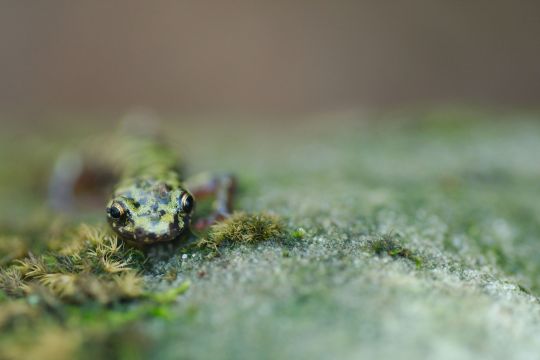
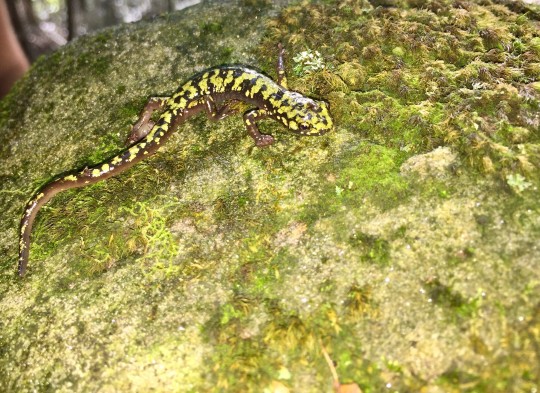
green salamander
Photo credit: Aaron Semasko

Fueled by caffeine and the promise of a sighting of the elusive and threatened green salamander, I made my way to the assigned meeting point in Fayette County, Pennsylvania. I was told we would be meeting a contact that could lead us to his secret location wherein there was prime habitat for green salamanders. Slowly, a muddy truck approached us and motioned for us to follow him. Thirty minutes of unpaved, unmarked, pothole riddled roads later I was standing in front of a hillside with rough terrain.

I knew I was in for an intense hike. Green salamanders are found in rock crevices in outcroppings or on the sides of cliffs. Unlike most salamanders that can be found abundantly under damp logs or rocks, green salamanders are extreme habitat specialists. Because of their habitat requirements, these salamanders are considered Near Threatened by the IUCN Red List of Threatened Species. The green salamander is listed as Endangered in Indiana, Ohio, Maryland, and Mississippi, as Threatened in Pennsylvania, and as Protected in Georgia. Some herpetologists argue that they should be nationally classified as Endangered, given that population sizes are decreasing due to habitat loss, drought and road development.

Armed with flashlights, our group of enthusiastic herpetologists made our way toward outcrops of rock along the hillside. We pointed our flashlights into every small crevice big enough to fit a salamander, hoping to see two large round eyes staring back at us. Within the first hour, we found a handful of common slimy salamanders, Plethodon glutinosus. Distinguished by their black color with silver or gold spots running along their backs, slimy salamanders are most known for the sticky substance they exude when threatened. Mostly found under logs or stones, the slimy salamander is also known to utilize its climbing abilities to crawl into crevices of shale banks, the same habitat that green salamanders favor.

green salamander

As I was photographing an eastern red-backed salamander, Plethodon cinereus, I heard a yelp of excitement, “A green! A GREEN!” A few agonizing minutes of scrambling through brambles and rocky terrain to get to my colleague ensued. As I approached, I was filled with excitement. Being the Curatorial Assistant of Amphibians and Reptiles allows me to catalogue specimens from all over the world, collected by renowned scientists in my field. This position gives me a platform to tell the public about why amphibians and reptiles are so important to our ecosystem. The thrill of seeing a Near Threatened salamander in its natural habitat reaffirmed my love for my career and the honor I feel in being an ambassador for amphibians and reptiles. Nothing beats the opportunity to photograph the species camouflaged into the moss around it, or the few minutes where you promise yourself and the species in front of you that your life’s goal is to promote environmental awareness of Pennsylvania herpetofauna (reptiles and amphibians), and the hope that maybe the green salamander will thrive in Pennsylvania in the age of the Anthropocene.

What can you do? Check out the Pennsylvania Amphibians and Reptiles Survey at https://paherpsurvey.org/.If you find an amphibian or reptile, take a photo and send it to the PA Herp Survey to help document the biodiversity and status of Pennsylvania herpetofauna.

Kaylin Martin, M.Sc, is the curatorial assistant in the Section of Amphibians and Reptiles. Museum employees are encouraged to blog about their unique experiences and knowledge gained from working at the museum.

Filed Under: Blog Tagged With: amphibians, amphibians and reptiles, Anthropocene, herpetology, Kaylin Martin, pennsylvania, reptiles

March 8, 2018 by wpengine

Ask a Scientist: What is inside the Alcohol House?

Curatorial Assistant Kaylin Martin gives us a brief tour of one of the museum’s fascinating hidden collections, the Alcohol House— home to more than 200,000 reptile and amphibian specimens that are jarred and preserved in alcohol.


Ask a Scientist is a new short video series where we ask our research staff questions about the millions of amazing objects and specimens stored in our collection. Tune in on YouTube, and submit your own questions via Twitter @CarnegieMNH.

Filed Under: Blog Tagged With: alcohol house, Kaylin Martin, reptiles

January 8, 2018 by wpengine

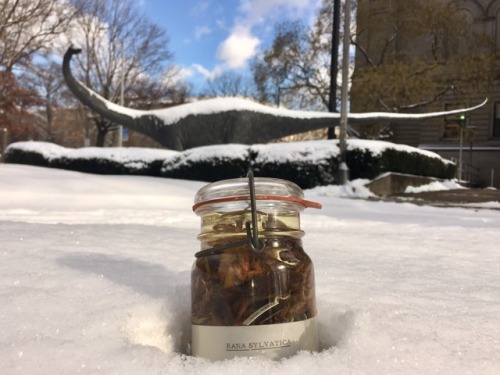
Frogsicles?! 

jar of frog specimens in the snow in front of the Dippy statue

Rana sylvatica (also formally known as Lithobates sylvaticus) freeze 2/3 of their bodies in the winter during hibernation! They stop breathing and their hearts stop beating.

How do they do this? Cryoprotectants. Their body produces an excess of urea and glucose in order to avoid cell shrinkage and ice formation. When spring arrives, the frog simply thaws and returns to a normal life.


Kaylin Martin is a Curatorial Assistant in the Section of Herpetology. She blogs about the collection in Carnegie Museum of Natural History’s historic Alcohol House, which is home to thousands of fluid-preserved specimens.

Filed Under: Blog Tagged With: amphibians, Kaylin Martin

August 3, 2017 by wpengine

Behind the scenes

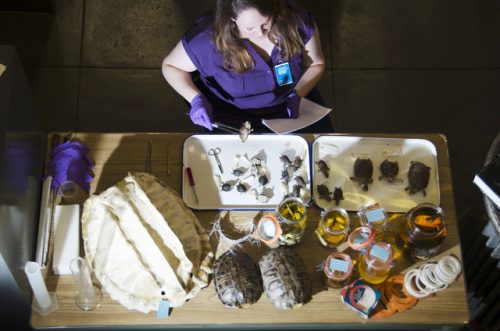
Kaylin working with reptile specimens
Behind the scenes in Carnegie Museum of Natural History’s Alcohol House with Curatorial Assistant Kaylin Martin
(Courtesy Kathy Hair)

Filed Under: Blog Tagged With: alcohol house, Kaylin Martin

March 6, 2017 by wpengine

Preserving museum specimens

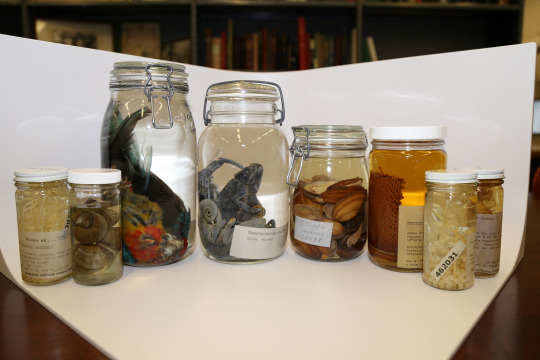
plant and animal specimens preserved in glass jars
Pictured above from left to right: Maianthemum racamosum flowers, Cipangopaludina chinensis, Platycercus eximius, Chameleo gracilis gracilis, Elliptio jayensis, Monstera of Costa Rica, Maianthemum racamosum fruits, and Polygonatum biflorum

by Kaylin Martin

Reptile and amphibian specimens are not the only things stored in 70% ethanol in Carnegie Museum of Natural History’s Alcohol House!

Departments such as Ornithology, Botany, and Mollusks preserve select specimens in fluid for further scientific use. This method preserves soft tissues that would otherwise need to be removed, maintains the natural three-dimensional shape, and slows down DNA degradation.

Fluid collections are more difficult to maintain, however, as they take up more space and have to be regularly monitored to prevent the specimens from drying out.

Keep an eye out for our future Alcohol House public tours to see these specimens up close and to meet collection managers.


Kaylin Martin is a curatorial assistant in the Section of Herpetology. She blogs about the collection in Carnegie Museum of Natural History’s historic Alcohol House, which is home to thousands of fluid-preserved specimens.

Filed Under: Blog Tagged With: alcohol house, herpetology, Kaylin Martin

  • Page 1
  • Page 2
  • Go to Next Page »

sidebar

About

  • Mission & Commitments
  • Directors Team
  • Museum History

Get Involved

  • Volunteer
  • Membership
  • Carnegie Discoverers
  • Donate
  • Employment
  • Events

Bring a Group

  • Groups of 10 or More
  • Birthday Parties at the Museum
  • Field Trips

Powdermill

  • Powdermill Nature Reserve
  • Powdermill Field Trips
  • Powdermill Staff
  • Research at Powdermill

More Information

  • Image Permission Requests
  • Science Stories
  • Accessibility
  • Shopping Cart
  • Contact
  • Visitor Policies
One of the Four Carnegie Museums | © Carnegie Institute | Privacy Policy | Terms of Use | Accessibility
Rad works here logo