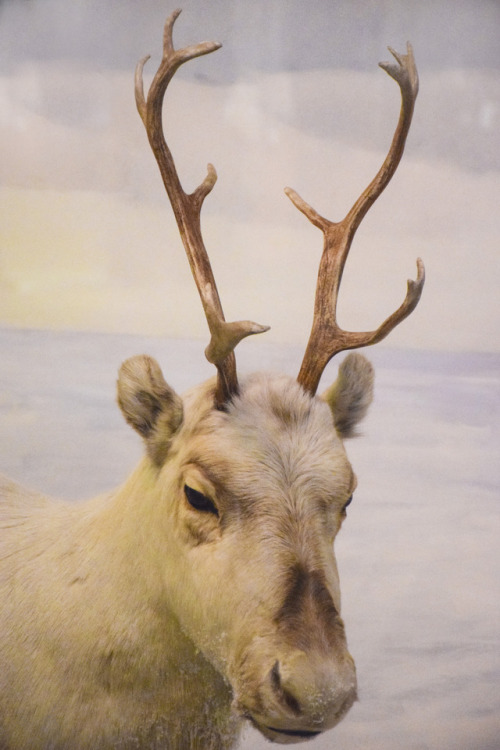
Arctic animals, such as the caribou, exhibit dramatic seasonal color changes in fur that help them blend with their natural surroundings. In this diorama, the caribou adapts to a white, winter environment.
(photo by Hayley Pontia)
Carnegie Museum of Natural History
One of the Four Carnegie Museums of Pittsburgh
Arctic animals, such as the caribou, exhibit dramatic seasonal color changes in fur that help them blend with their natural surroundings. In this diorama, the caribou adapts to a white, winter environment.
(photo by Hayley Pontia)
By John Wible
Those with pet dogs or cats at home are familiar with what a mammal’s tail can do. It acts as a counterbalance for your cat in executing amazing leaps and bounds. It is used for communication, more so by your dog, expressing a broad range of emotions by its action or lack thereof. Cows and horses use their tails to swat flies. Some mammals have a prehensile tail, which acts like a fifth appendage and is used in grasping, supporting, or in the case of a spider monkey even swinging from a tree branch. For marine mammals (whales, seals, and walruses), the tail is the major propulsive organ for swimming.
But what is in a tail? Your back is made of a series of small bones stacked together called vertebra (plural is vertebrae). This is the reason why animals with vertebrae, such as fish, amphibians, reptiles, birds, and mammals, are called vertebrates. A typical mammalian back shows five regional variants or types of vertebrae. These are neck (cervical) vertebrae supporting the head, thoracic vertebrae anchoring the ribcage, lumbar vertebrae with the abdomen, sacral vertebrae with the pelvis, and caudal vertebrae with the tail. These five types are readily distinguished from each other, with their structure reflective of their function and position within the spine or vertebral column. A back walks a delicate balance between two seemingly incongruent functions—strength to provide support and flexibility to allow movement. It is the battle between these that in bipeds like us often ends in back pain.
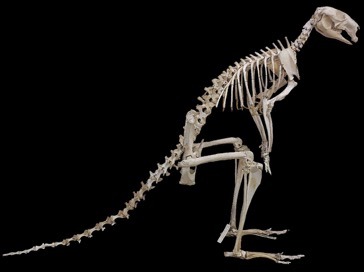
Regarding the numbers of vertebrae in different regions, the most stable is the neck, with the vast majority of mammals having seven cervical vertebrae. Even the giraffe with its incredibly long neck has the same number of cervical vertebrae as you and me. However, the numbers in the other regions differ considerably across mammalian species, with the thorax between 11 and 23, lumbar between two and eight, and the sacrum between one and nine. But it is the tail that wins the prize with a range between two and 49! The red kangaroo, Macropus rufus, pictured above has a vertebral count from head to tail of seven cervical, 13 thoracic, six lumbar, two sacral, and 21 caudal.
But wait a minute. Some mammals, including us, do not have tails. Why isn’t the range for caudal vertebra between zero and 49. The fact is that even tailless mammals have some very reduced caudal vertebrae. In the case of humans, our “tail” is composed of three to five greatly reduced caudal vertebrae that are collectively referred to as the coccyx (Greek for cuckoo, from the resemblance of these bones to this bird’s beak).
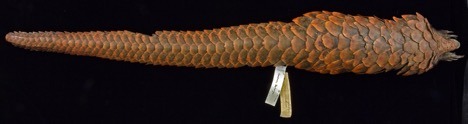
How should I end my tale? Given our penchant for world records, I would be remiss if I did not announce the winner of the living mammal with the highest number of caudal vertebrae at a whopping 49. It is the aptly named long-tailed pangolin, Phataginus tetradactyla, from West Africa (the tags in the photo above are attached to the hind foot, giving you some idea of tail length). It is one of the eight species of pangolins or scaly anteaters found in parts of Africa and Asia. It is the most arboreal of the pangolins, the reason why its tail is prehensile, and a good swimmer to boot. Pangolin scales are made of keratin, like your fingernails, and provide protection from predators and prey (they feed on biting social insects). Sadly, the scales are also a reason why pangolins are critically endangered as they are used in traditional medicine practices.
John Wible, PhD, is the curator of the Section of Mammals at Carnegie Museum of Natural History. John’s research is focused on the tree of life of mammals, understanding the evolutionary relationships between living and extinct taxa, and how the mammalian fauna on Earth got to be the way it is today. He uses his expertise on the anatomy of living mammals to reconstruct the lifeways of extinct mammals. John lives with his wife and two sons in a house full of cats and rabbits in Ross Township.
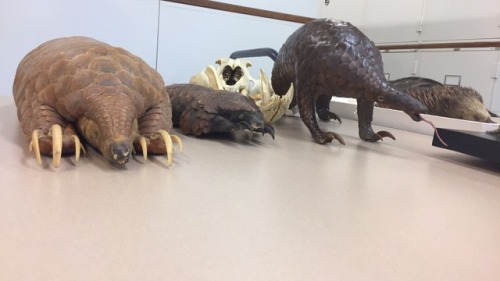 What do all of these scaly mammals from the museum’s hidden collection have in common? They don’t have teeth!
(Well… all except that tiger skull in the back. It has some big chompers!)
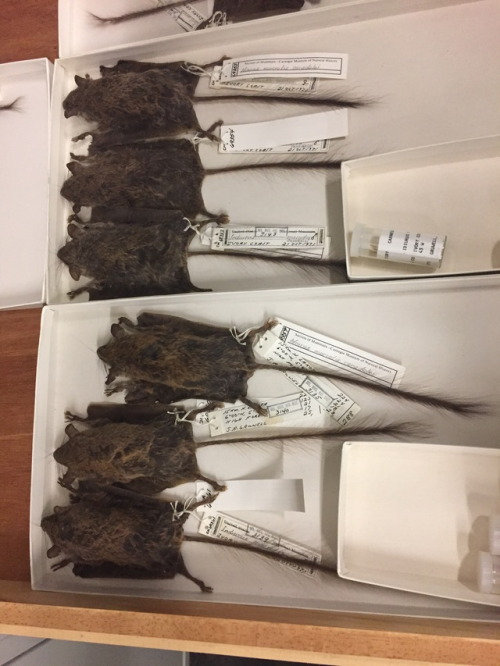
These flying squirrel specimens (Idiurus macrotis) are preserved in the Section of Mammals at Carnegie Museum of Natural History.
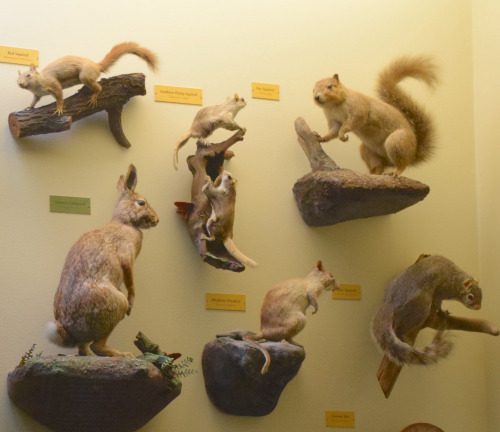
This display shows mammals found in Pennsylvania. How many have you seen in your backyard?
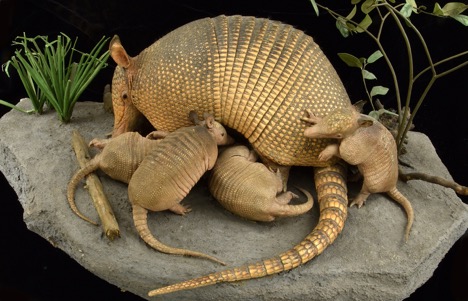
Armadillos are placental mammals that first appeared in the fossil record in South America 60 million years ago. Today, there are 21 species, only one of which is found in North America—the nine-banded armadillo, Dasypus novemcinctus.
All armadillos have a protective shell, or carapace, made of bony plates in the skin. These osteoderms not only cover the trunk, but the head, limbs, and, except for the naked-tail armadillo, even the tail. Armadillo in Spanish means “little armored one,” but the Aztec name is more descriptive, translating to “turtle-rabbit.” The carapace of the nine-banded armadillo has two major shields, one at the shoulders and the other at the pelvis, connected by a series of overlapping bands, which provide some degree
of flexibility. As you can guess from its name, there are usually nine such bands in Dasypus novemcinctus (as in the mother pictured here), but this varies from seven to 10. The underbelly is not similarly protected with osteoderms, but the skin is tough and leathery.
The evolution and biology of the nine-banded armadillo, the state small mammal of Texas, have fascinated me for years. However, because we just celebrated Mother’s Day, I want to comment on the amazing armadillo mother. Dasypus novemcinctus is the only vertebrate that gives birth to identical quadruplets every time! A female produces a single egg that, once fertilized, splits into four genetically identical embryos that share one placenta. How and why this unique pattern evolved and continues to be maintained is a mystery. We usually consider genetic diversity a plus for organisms with multiple births as
it increases the chances that some offspring will survive in an ever-changing environment, but the nine-banded armadillo bucks this by producing clones.
Other than making milk for her young, the nine-banded armadillo mother is not particularly attentive, and the father is even less so. Yet, perhaps her major role is providing sufficient nutrition for her young to grow and prosper. Building a bony carapace requires extra nutrients, primarily calcium, and phosphate. Although ossification of the osteoderms begins in utero, you can imagine that birth (of four babies no less!) is facilitated by them having a thin and flexible carapace, that is, one that
is not fully formed. Indeed, thankfully, most of the carapace’s development occurs after birth.
The armadillo mother makes this all happen largely on an insectivorous diet, a generally poor source of calcium. Add to that, armadillos have a lower metabolic rate than most mammals. Somehow, despite these perceived handicaps, the young born at 100 grams (less than a quarter pound) grow rapidly and are able to forage for themselves at two months. How the armadillo mother is able to do all this for her four identical babies is as mysterious as how she had four identical babies in the first place.
John Wible, PhD, is curator of mammals at Carnegie Museum of Natural History. He studies the evolutionary history of mammals and lives in a house full of them, some human (wife and two sons) and some non-human (cats, rabbits, and guinea pigs).
