• Skip to primary navigation
  • Skip to main content
  • Skip to primary sidebar

Carnegie Museum of Natural History

One of the Four Carnegie Museums of Pittsburgh

  • Visit
    • Buy Tickets
    • Visitor Information
    • Exhibitions
    • Events
    • Dining at the Museum
    • Celebrate at the Museum
    • Powdermill Nature Reserve
    • Event Venue Rental
  • Learn
    • Field Trips
    • Educator Information
    • Programs at the Museum
    • Bring the Museum to You
    • Guided Programs FAQ
    • Programs Online
    • Climate and Rural Systems Partnership
  • Research
    • Scientific Sections
    • Science Stories
    • Science Videos
    • Senior Science & Research Staff
    • Museum Library
    • Science Seminars
    • Scientific Publications
    • Specimen and Artifact Identification
  • About
    • Mission & Commitments
    • Directors Team
    • Museum History
  • Tickets
  • Give
  • Shop

Suzanne Mills

October 1, 2021 by wpengine

Meet the Fossil Detectives in the Basement

by Suzanne Mills and Albert Kollar

Gray metal storage cabinets march in rows across the concrete floor. The collection space has no windows and there is a constant hissing sound from the overhead air ducts. No matter, the staff is looking for clues of the geologic and paleontological past, or History of the Earth, through the vast collection of fossil invertebrates. The staff and volunteers of the Section of Invertebrate Paleontology (IP) are tasked to reorganize, preserve, and curate fossils through the leadership of the Collection Manager Albert Kollar.
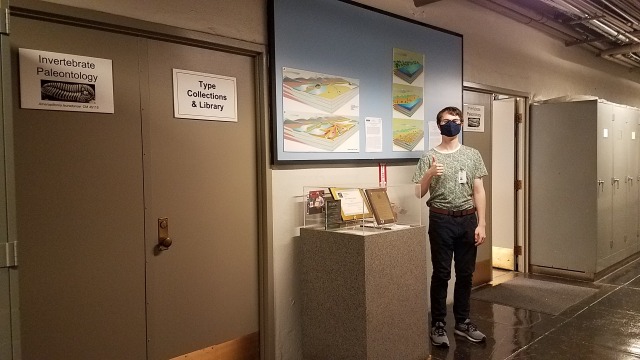
Person in a hallway lined with gray cabinets
Collection Assistant Kevin Love at the doors of the Invertebrate Paleontology section.

On any given workday, you’ll find us hefting drawers full of fossil-bearing rocks and playing specimen-box Tetris to make fossils fit in the available cabinet space. We examine century-old inventory books, search out (usually Google) maps to find absconded valuables (historical fossil sites), and decipher written scripts in unfamiliar French and German for valuable geologic data.

Long-term volunteers in IP include Rich Fedosick, a researcher assisting in the project to document the Carnegie building stones; John Harper, an expert on fossil snails taxonomy, Roman Kyshakevych, who is deciphering the famous Coppi collection from Italy; Tamra Schiappa, a paleontologist at Slippery Rock University who is updating fossil cephalopod identifications; and Vicky Sowinski, who performs collection support. Student researchers include collection assistant and graphic artist Kay Hughes, a 2021 Mount Holyoke College graduate who coauthored four peer-reviewed scientific publications produced by IP; and collection assistant Will Vincentt, who researched two Bayet collections, the Hunsruck Slate of Germany and Lyme Regis of England. Tara Pallas-Sheetz, a part-time assistant, has worked on various projects over the years.

Hear from some of our newest staff and summer volunteers in their own words below.
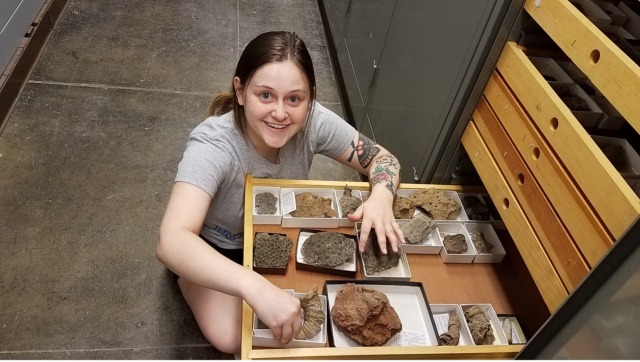
Woman with a drawer of coral fossils
Lizzie Begley with large fossil corals

Name: Lizzie Begley

About me: B.A. Anthropology Penn State 2021; masters candidate in Museum Studies and Non-profit Management certification in progress at Johns Hopkins University

Why IP: Working “behind the scenes” in IP has helped me develop a better sense of what it looks like to work in a museum such as the Carnegie. As an aspiring museum professional, experience behind gallery floors is invaluable as I work to find my place in the field. For this experience I couldn’t be more grateful and, honestly, couldn’t be having more fun!
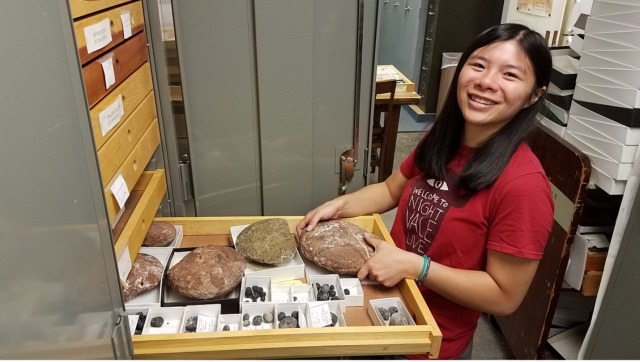
woman with a drawer of fossil ammonites
Katie Golden with fossil ammonites

Name: Katie Golden

About me: B.S. Biology, Juniata College 2023 (expected)

Why IP: When I was in preschool, I told people I wanted to be a paleontologist when I grew up. Here in IP, I like exploring a part of the museum that most people don’t get to see. I particularly enjoy puzzle-piecing together fossils that need repair. The intricate ammonites, trilobites, and insects preserved in amber are especially beautiful. My favorite fossil organism is Anomalocaris.
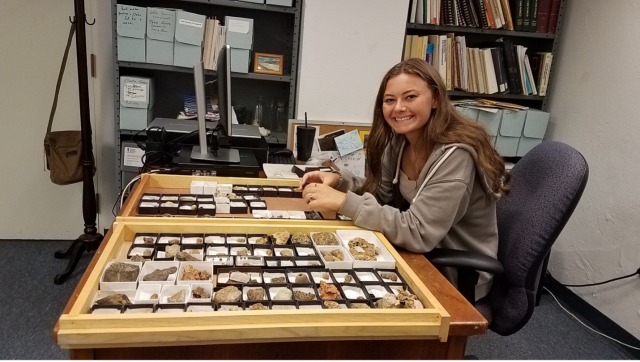
Woman at a table with fossil corals
Tori Gouza with fossil corals

Name: Tori Gouza

About me: B.A. History and Anthropology, University of Pittsburgh 2023 (expected)

Why IP: I love working in IP. It is so exciting to be able to interact with others in the section and to learn what projects they are currently working on. Albert Kollar has encouraged not only discussion but also collaboration. It is great to converse with others who are passionate about their work.
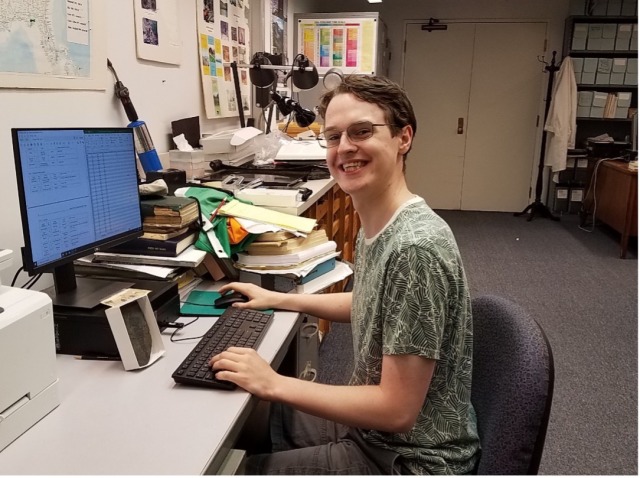
Man sitting at a computer in an office
Kevin Love enters data about a fossil eurypterid

Name: Kevin Love

About me: IP Collection Assistant; B.S. Geology and Ecology & Evolution summa cum laude, University of Pittsburgh 2021

Why IP: I like solving puzzles at work. I find invertebrate fossils aesthetically appealing, but the main reason I like this job is that I get to understand little enigmas from Earth’s past. I like solving historical questions and compiling more information about fossils in the collection.
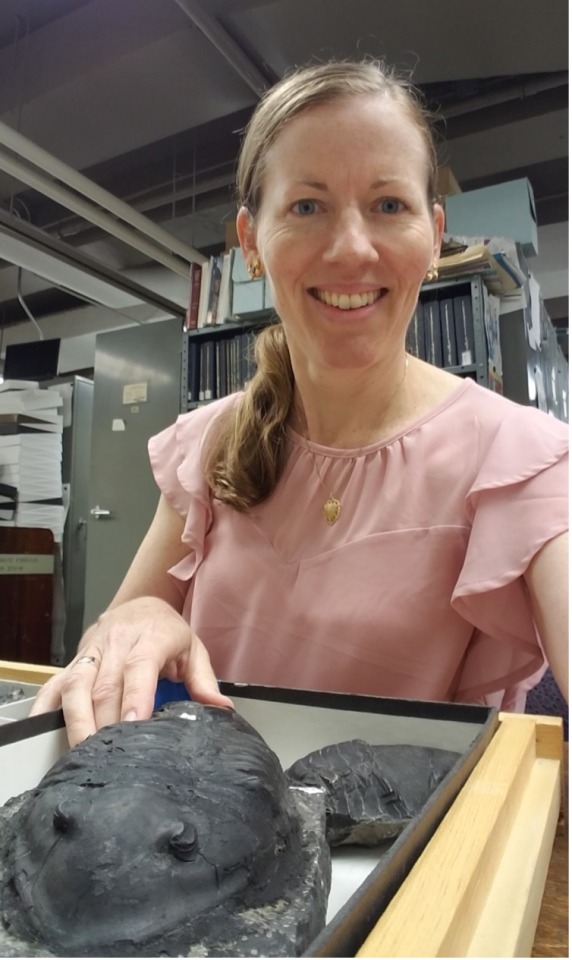
woman with a fossil trilobite
Suzanne Mills with fossil trilobite Isotelus gigas

Name: Suzanne Mills

About me: IP Collection Assistant, Professional Geologist, mom

Why IP: Every day is different when you work with a collection of 800,000 specimens. I may come across a 100-million-year-old ammonite sparkling with crystals inside, or a drawer full of trilobites acquired by the museum in 1903, when Andrew Carnegie was alive. I love that my work requires me to learn more about fossils which are beautiful, historical, and scientifically significant.
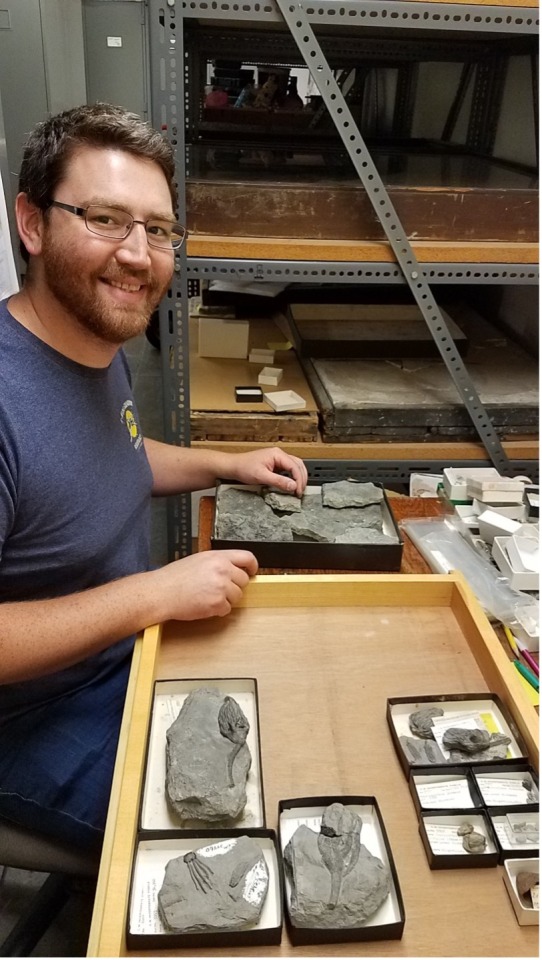
person with a drawer of fossil crinoids
Ellis Peet with fossil crinoids

Name: Ellis Peet

About me: B.S. Environmental Geoscience with Geology concentration, Slippery Rock University 2021

Why IP: The management and staff of IP are smart, kind, personable, and they take paleontology seriously. I also like the environment at IP because it smells like a library and limestone dust, which reminds me of the geology department at Slippery Rock.
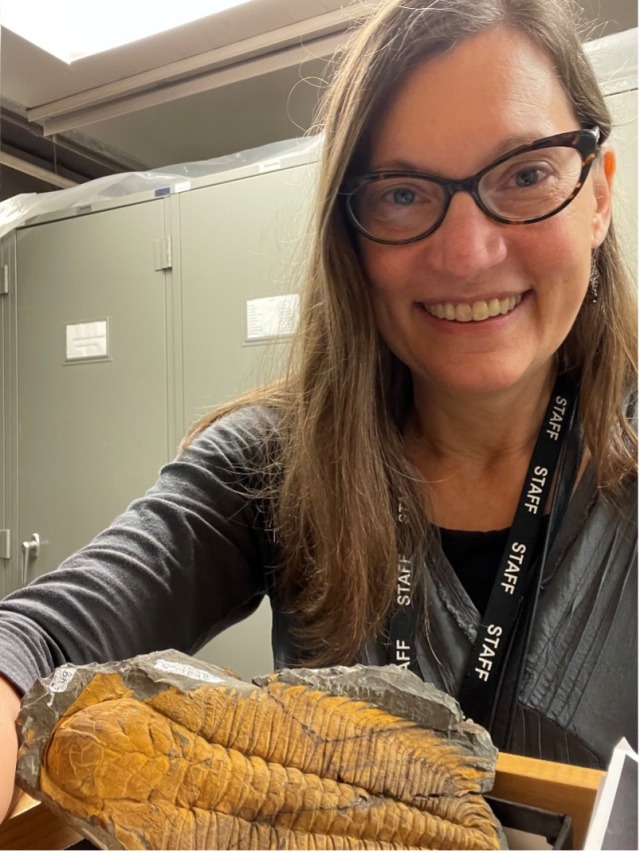
Woman with a fossil trilobite
Joann Wilson with fossil trilobite Paradoxides spinosus from the Baron de Bayet collection.

Name: Joann Wilson

About me: Interpreter for the Department of Education, Carnegie Museum of Natural History

Why IP: Fossils inspire awe.  I enjoy unravelling the stories behind the individuals that discovered, studied and collected these breathtaking specimens.

Suzanne Mills is a Collection Assistant and Albert Kollar is Collections Manager in the Section of Invertebrate Paleontology at Carnegie Museum of Natural History. Museum employees are encouraged to blog about their unique experiences and knowledge gained from working at the museum.

Related Content

Smoking Fossils

From Collector to Director

Bayet and Krantz: 16 Words

Carnegie Museum of Natural History Blog Citation Information

Blog author: Mills, Suzanne; Kollar, Albert
Publication date: October 1, 2021
Share this post!

  • Share on Twitter Share on Twitter
  • Share on Facebook Share on Facebook
  • Share on Pinterest Share on Pinterest
  • Share on LinkedIn Share on LinkedIn
  • Share on Reddit Share on Reddit
  • Share via Email Share via Email

Filed Under: Blog Tagged With: Albert Kollar, invertebrate paleontology, Science News, Suzanne Mills

August 24, 2021 by wpengine

Bringing Light to Dark Places

by Suzanne Mills

“May it be a light to you in dark places, when all other lights go out.” ― J.R.R. Tolkien, The Fellowship of the Ring

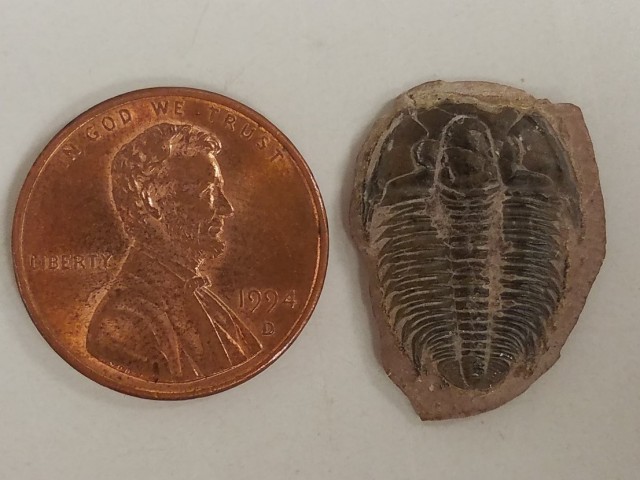
“Elrathia kingi,” the small square of paper declares. Regal yet a bit mysterious, the Latin name on the museum-issue label conjures Tolkien. From an unlidded box small enough to hold a wedding ring, I remove a chalky gray pebble. Its minute weight slides easily through my fingers; it seems as inconsequential as a penny. But it is not hard to see what gives this iota of stone its value. As if sculpted in bas-relief, a pair of tiny eyes peek out of a crescent-shaped head. Thin ridges of a segmented body, symmetrically paired about two fine center lines, taper to a tail. Each detail is delicately edged in violet. It is a fossil trilobite, an extinct relative of the horseshoe crab.

Penny next to a trilobite fossil, both are approximately the same size.
The trilobite Elrathia kingi.

But she is a humble beauty who lives a secret life. She is found behind the scenes in the Section of Invertebrate Paleontology (IP). In the fluorescent-lit museum basement, Elrathia kingi idles quietly in a long drawer with dozens of equally elegant companions. It is just one of thousands of drawers shelved in rows upon rows of gray metal cabinets. The cabinets stand silently at attention, protecting their specimens from dust, light, and heat while awaiting further orders.

More than 800,000 fossil marine organisms call the IP lab home. Collected from all over the world, they range in age from several thousand to almost a billion years old. Four thousand of these specimens have been featured in over 400 peer-reviewed publications. But others have never been studied in detail and hold valuable “dark data,”¹ ² undocumented information useful for studies about extinction³ and climate change.⁴ These data are central to the future advance of the science of paleontology and geology.⁵

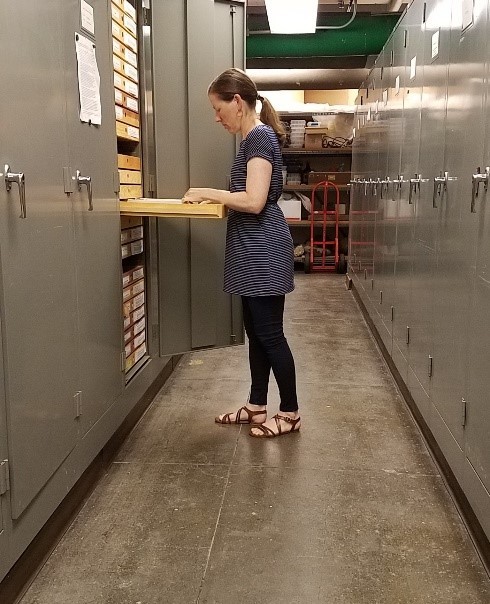
Woman looking through a drawer in a large cabinet.
Suzanne Mills working with the collections.

As a part-time Collection Assistant, I help bring this “dark data” to light. My main tools are a laptop and a microscope. When I examine a trilobite, or fossil “bug,” under the microscope, I look for characteristics that verify the biological classification, based on what is written on the fossil’s label. Further information recorded on the label about the geologic layer and location where it was found helps to validate the scientific value. I verify all this information in professional peer-reviewed publications. Finally, I enter the data I glean into a new digital database and develop charts and graphs to summarize it. This is the beginning of highlighting the IP collection’s “dark data.”

The task of bringing more than three-quarters of a million IP specimens to light is daunting. My colleagues and I bow our heads to that number and acknowledge that it is far more than a life’s work. But we persist, hoping to help the world see the value of Elrathia kingi and her ancient ocean companions, one fossil at a time.

Suzanne Mills is a Collection Assistant in the Section of Invertebrate Paleontology at Carnegie Museum of Natural History. Museum employees are encouraged to blog about their unique experiences and knowledge gained from working at the museum.

Citations:

1. California Academy of Sciences. 2018. Scientists quantify the vast and valuable finds stored on museum shelves: Quantifying “dark data” in fossil collections is a call to arms; heralds a digital revolution. ScienceDaily. https: /www.sciencedaily.com/releases/2018/09/180920102122.htm (accessed July 21, 2021)

2. Thiers, Barbara, John Bates, Andrew C, Bentley, Linda S, Ford, David Jennings, Anna K, Monfils, Jennifer M, Zaspel, James P, Collins, Manzour Hernando Hazbón, and Jyotsna L, Pandey. 2021. Implementing a Community Vision for the Future of Biodiversity Collections. BioScience, Volume 71, Issue 6, June. Pages 561–563.  https://doi.org/10.1093/biosci/biab036 (accessed July 23, 2021)

3. Casey, M. M., E. E. Saupe, and B. S. Lieberman. 2021. The effects of geographic range size and abundance on extinction during a time of “sluggish” evolution. Paleobiology, 47:54-67.

4. Lawing, A. M. 2021. The geography of phylogenetic paleoecology: integrating data and methods to better understand biotic response to climate change. Paleobiology, 47:178-197.

5. The Unique role of the Curator in Palaeontology. Special Papers in Palaeontology, 22, 7-15.

Special thanks to Albert Kollar and Joann Wilson for their insightful comments.

Related Content

Smoking Fossils

The Giant Eurypterid Trackway

Ask a Scientist: What is a trilobite?

Carnegie Museum of Natural History Blog Citation Information

Blog author: Mills, Suzanne
Publication date: August 24, 2021

Share this post!

  • Share on Twitter Share on Twitter
  • Share on Facebook Share on Facebook
  • Share on Pinterest Share on Pinterest
  • Share on LinkedIn Share on LinkedIn
  • Share on Reddit Share on Reddit
  • Share via Email Share via Email

Share this post!

  • Share on Twitter Share on Twitter
  • Share on Facebook Share on Facebook
  • Share on Pinterest Share on Pinterest
  • Share on LinkedIn Share on LinkedIn
  • Share on Reddit Share on Reddit
  • Share via Email Share via Email

Filed Under: Blog Tagged With: invertebrate paleontology, paleontology, Science News, Suzanne Mills

May 5, 2021 by wpengine

Understanding Fossil Fuels through Carnegie Museums’ Exhibits

by Albert D. Kollar, Collection Manager, with assistance from Suzanne Mills, Collection Assistant, and Joann Wilson, Volunteer Section of Invertebrate Paleontology

The exhibits of Carnegie Museum of Natural History and Carnegie Museum of Art are ideal for a multidisciplinary study of fossil fuels in Pennsylvania and beyond. Such a study must properly begin with some historical background about the landmark Oakland building that houses both museums, as well as some background information about fossil fuels.

When the Carnegie Library of Pittsburgh opened in 1895, the architects, Longfellow, Alden, and Harlow incorporated roof skylights for maximum daytime lighting in the Italian Renaissance designed building1. Nighttime activities were illuminated by interior gas lighting fixtures, possibly supplied by the Murrysville gas field, which began production in 1878.  With the opening of the Carnegie Institute Extension in 1907, the Bellefield Boiler Plant was built in Junction Hollow to supply in-house steam heat and electricity from bituminous coal1. From the 1970’s, coal and natural gas had been used to heat the boilers that supply heat to the Oakland Campus, Phipps, the University of Pittsburgh and the Oakland hospitals.  In 2009 coal was eliminated as a fuel source.  Electricity on the other hand, is supplied through Talen Energy from multiple sources (coal, gas, and renewal energy sources). For the future, Carnegie Museums of Pittsburgh plans to receive its electricity from renewable solar energy via Talen Energy2.

What are Fossil Fuels?

Coal, oil, and natural gas (methane), known collectively as fossil fuels, are sources of energy derived from the remains of ancient life forms that usually  are found preserved in coal rock, black shale, and sandstone.

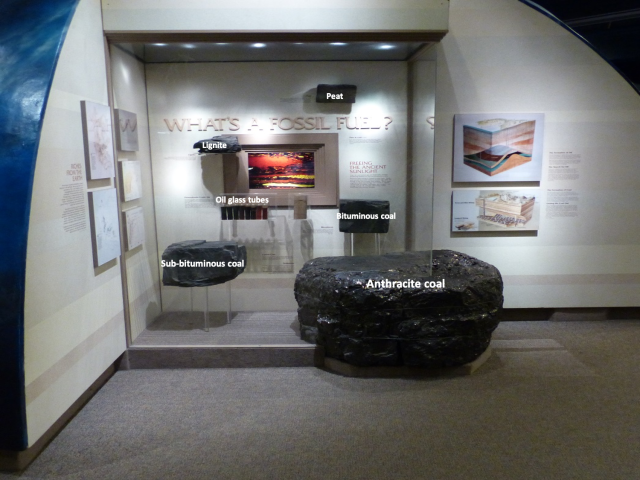
Exhibit called "What's a Fossil Fuel?" Fossil fuels on display are labeled clockwise from the top as follows: peat, bituminous coal, anthracite coal, sub-bituminous coal, oil glass tubes, lignite.
Figure 1.

Coal is a rock. The coalification process starts from a thick accumulation of plant material in reducing environments where the organic matter does not decay completely. This deposit of plant residue that thrives in freshwater swamps at high latitudes forms peat, an early stage or rank in the development of coal. With the burial of peat over geologic time and a low temperature form of metamorphism produces a progression of the maturity or “rank” of the organic deposits that form the coal ranks of lignite, sub-bituminous, bituminous, and anthracite)3 (Fig. 1). The Pennsylvanian Period was named for the rocks and coals of southwestern Pennsylvania that formed more than 300 million years ago.

Oil and natural gas, collectively known as hydrocarbons, were forming in the Devonian rocks of Pennsylvania between 360 and 390 million years ago. These hydrocarbon deposits or kerogens are made of millions of generations of marine plankton and animal remains that accumulated in a restricted anoxia ocean basin that extended from southern New York, through western Pennsylvania, northern West Virginia to eastern Kentucky4. The thick layers of sediment formed black shales or mud rocks such as the Marcellus Shale. Black shales are rich in oil and gas and are called source rocks. Sandstones such as the Oriskany Sandstone that is older than the Marcellus Shale is a reservoir rock. An amorphous mass of organic matter or kerogen undergo complex geochemical reshuffling of the hydrocarbon molecules first with burial then by thermal “cracking” as heat and pressure through the geologic process of metamorphism over millions of years transform kerogen into modern day fossil fuels4.

Fossil Fuels in Modern Society

As commodities converted to fuels for our modern world, these resources account for 80% of today’s energy consumption in the United States5. All three fossil fuels, in furnaces of vastly different design, have been used to directly heat homes, schools, workplaces, and other structures. In power plants, all three have been used for generating electricity for lighting, charging mobile phones, and powering computers, home appliances, and all manner of industrial machines. In the United States, , coal became the country’s primary energy source in the late 1880s, displacing the forest-destroying practice of burning wood. It ceded the top spot to petroleum in 1950 but enjoyed a late-20th-century renaissance as the primary fuel for power plants5. Coal now generates approximately 11% of our country’s supply down from 48% just 20 years ago. Natural gas is currently used to generate approximately 35% of US electricity supplanting the use of coal6. While petroleum is less than1%6.

Transportation accounts for approximately 37% of total energy consumption. Coal played a historic role in powering railroads, and both compressed natural gas and batteries (charged with electricity generated from various sources) are of growing importance, however, refined oil products currently power 91% of the transportation sector6.

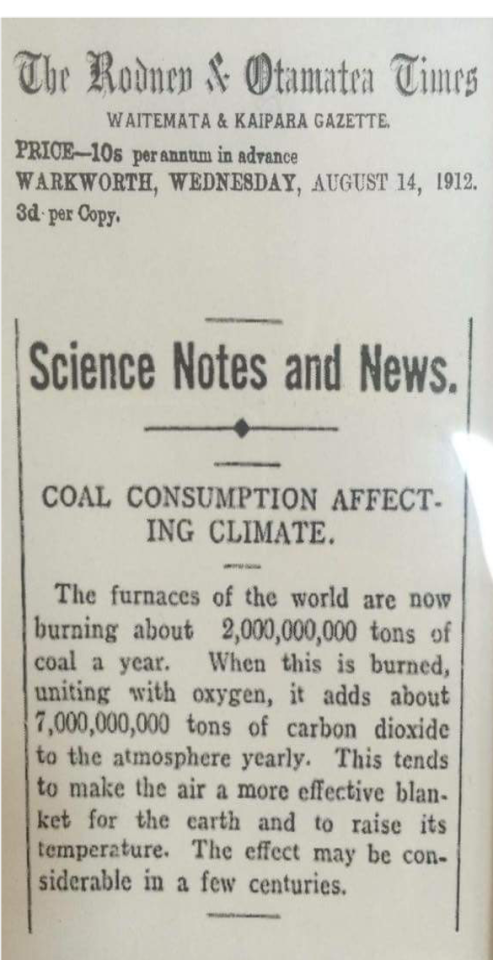
Newspaper clipping from The Rodnen & Otamatea Times dated Wednesday, August 14, 1912. The story shown is as follows: Science Notes and News. Coal Consumption Affecting Climate. The furnaces of the world are now burning about 2,000,000,000 tons of coal a year. When this is burned, uniting with oxygen, it adds about 7,000,000,000 tons of carbon dioxide to the atmosphere yearly. This tends to make the air a more effective blanket for the earth and to raise its temperature. The effect may be considerable in a few centuries.
Figure 2.

In the early 20th century, scientists warned about how the burning of coal could create global warming in future centuries by raising the level of carbon dioxide, a greenhouse or heat-holding, gas, in the atmosphere. (Fig. 2 ). It took less than a century for evidence to mount of climate change associated with the burning of fossil fuels, the clearing of forests associated with industrial scale livestock production, and from waste management and other routine processes of modern life. In recent decades headlines have routinely proclaimed the risks of a warming planet, including damage to terrestrial ecosystems, the oceans, and a rise in sea level7.

Fossil Fuels and Museum Geology Displays

When architects Frank E. Alden and Alfred B. Harlow designed the Carnegie Institute Extension (1907), they incorporated Andrew Carnegie’s vision to create an introduction hall to the museum named Physics, Geology and Mineralogy8. This hall (the forerunner to Benedum Hall of Geology) was intended to introduce Pittsburghers to the regional natural history subjects of geology, paleontology, and economic geology (fossil fuels)9.

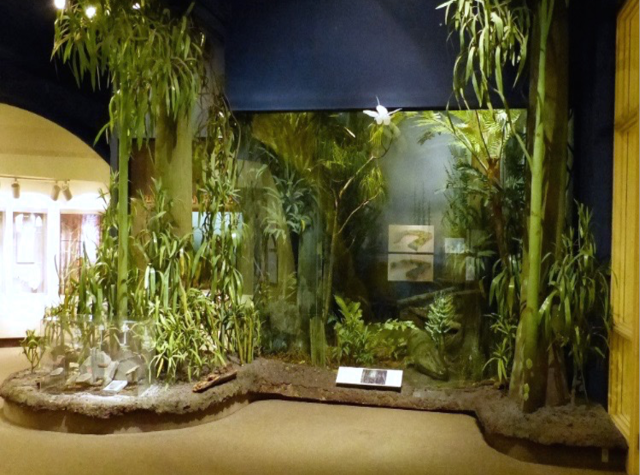
Exhibit in Benedum Hall of Geology with fake trees in the foreground and a swamp diorama in the background.
Figure 3.

In the 1940s, the 300-million-year-old Pennsylvanian age coal forest diorama was installed in a corner space of what is now part of the Benedum Hall of Geology (Fig. 3). Because coal converted to coke is a vital ingredient in steel production, this three-dimensional depiction of the conditions under which Pittsburgh’s economically important coal deposits formed was (and remains) an important public asset.

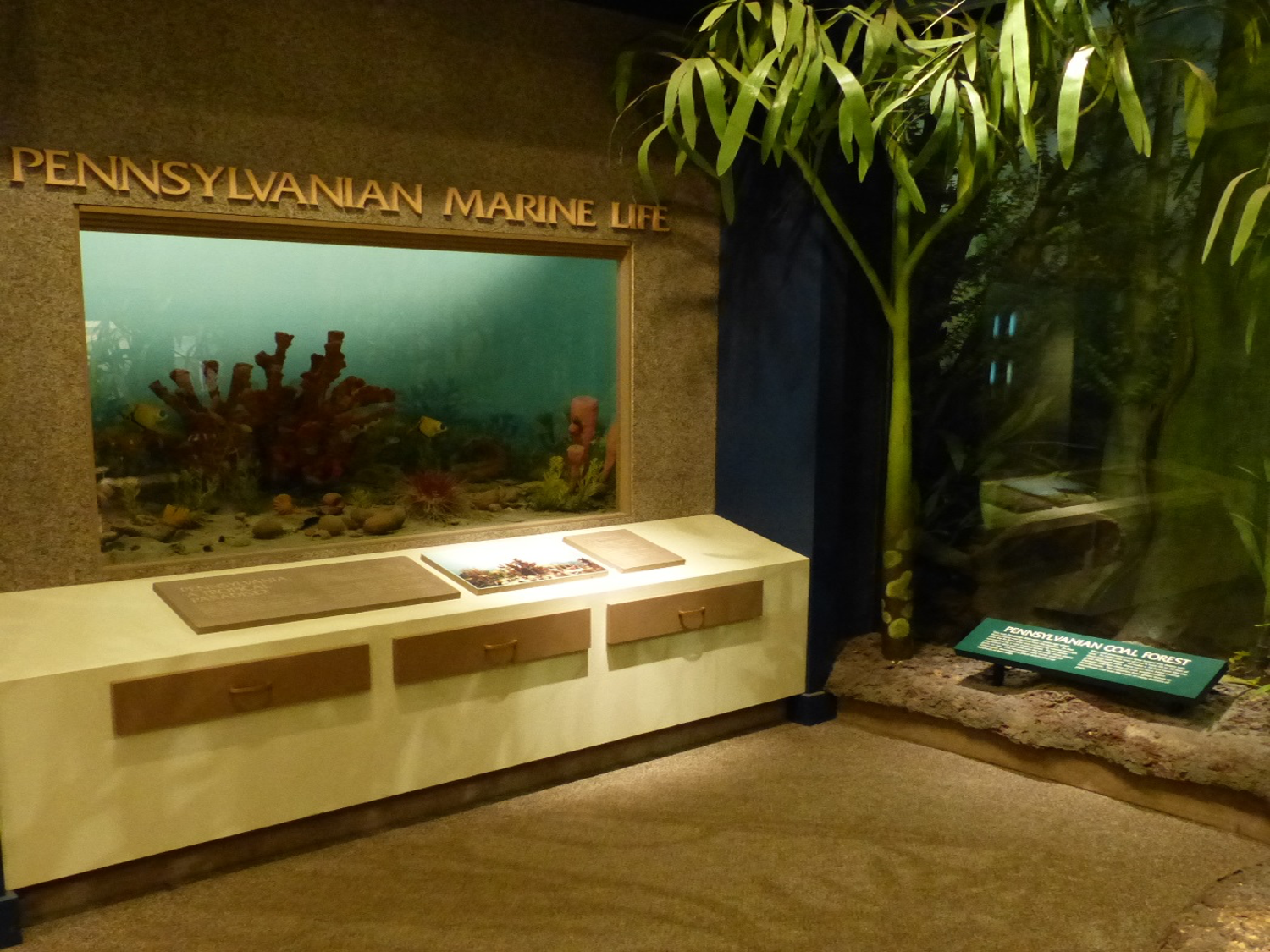
Exhibit labeled Pennsylvanian Marine Life. Below the sign is a diorama designed to look like an aquarium.
Figure 4.

In 1965, as part of an overall plan to bring more of the natural history museum’s fossil collection to the public, Paleozoic Hall opened with funding from the Richard King Mellon Foundation10. This exhibition featured nine dioramas that recreate the ancient environments through 290 million years of Earth history. Sadly, only one of the nine units remains on display, the diorama depicting the Pennsylvanian age marine seaway (Fig. 4 ), in the Benedum Hall of Geology.

Since the Benedum Hall of Geology opened to the public in 1988 the exhibition has featured an economic geology component with displays explaining differences between coal ranks Lignite coal to anthracite coal, and a variety of Pennsylvania’s crude oils and lubricants processed from the historic well Edwin Drake drilled in Titusville in 1859 (Fig. 1 )11.

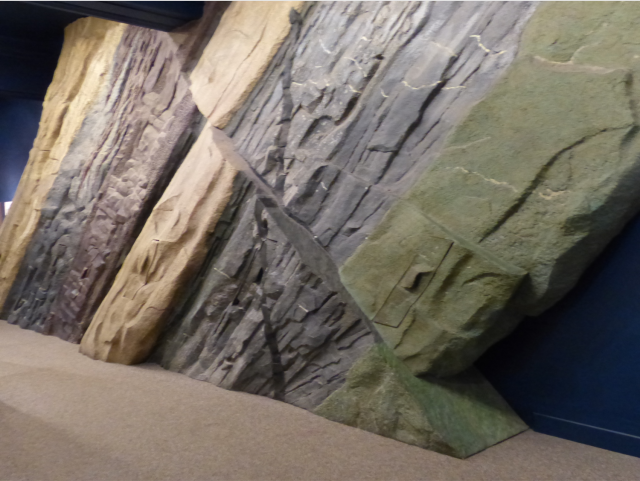
Benedum Hall of Geology strata wall. Shows different colors of rock stratigraphy from left to right: tan, blue-grey, maroon, beige, dark gray, olive green.
Figure 5.

Today, the Hall’s “strata wall,” a towering depiction of some of the rock layers found thousands of feet below western Pennsylvania, is in my opinion, an under-utilized display in terms of conveying information about fossil fuels. Although the wall is not currently documented with any geologic information, minor changes might allow visitors to use the lens of rock strata  to better understand historical events such as the Drake Well, and economically important geologic reservoirs such as the Marcellus Shale (the second largest gas deposit in the United States), the natural gas storage reservoir of the Oriskany Sandstone, and the gas and liquid condensate (ethane) extracted from the Utica Formation (Ordovician Age) for making plastic products at the Shell Cracker Plant in Beaver County, PA (Fig. 5 ).

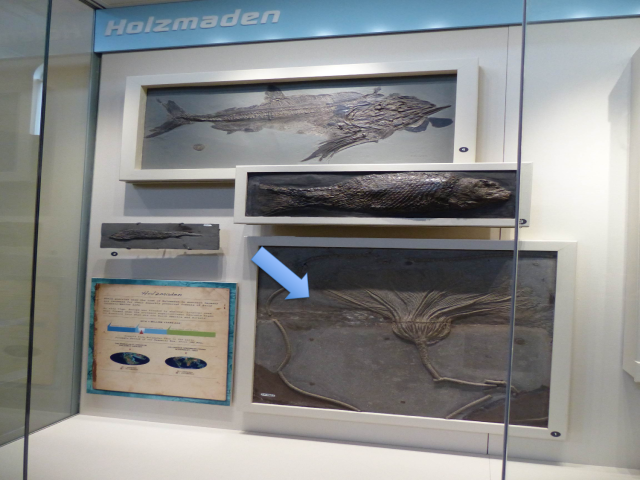
Exhibit case labeled Holzmaden. A blue arrow points to a crinoid fossil.
Figure 6.

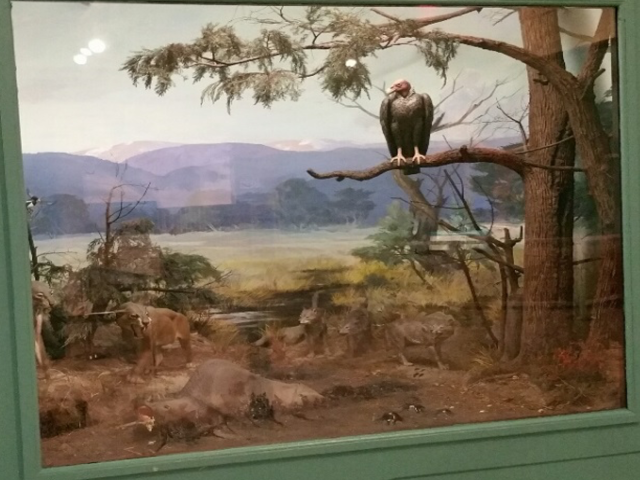
Elsewhere in the museum, visitors can learn more about the topic of fossil fuels at several other locations. At the Holzmaden fossil exhibit in Dinosaurs in Their Time, there is a large fossil crinoid preserved in a dark gray limestone of Jurassic age, that represents a  reservoir of crude oil in Germany (Fig. 6). At the mini diorama of the La Brea tar pits, oil seeps from natural fractures from an approximately six-million-year-old rock of Miocene age,  to the unconsolidated surface sediment in what is now part of the City of Los Angeles (Fig. 7).

La Brea tar pits diorama. A vulture sits on a tree above the tar pits.
Figure 7.

Looking for Fossil Fuel Evidence in Art

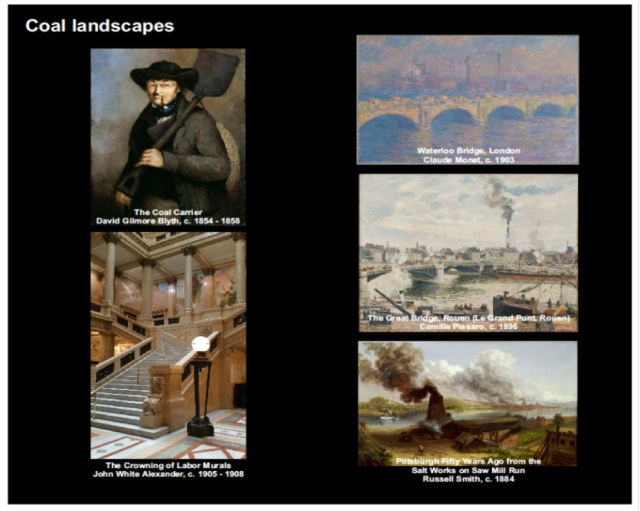
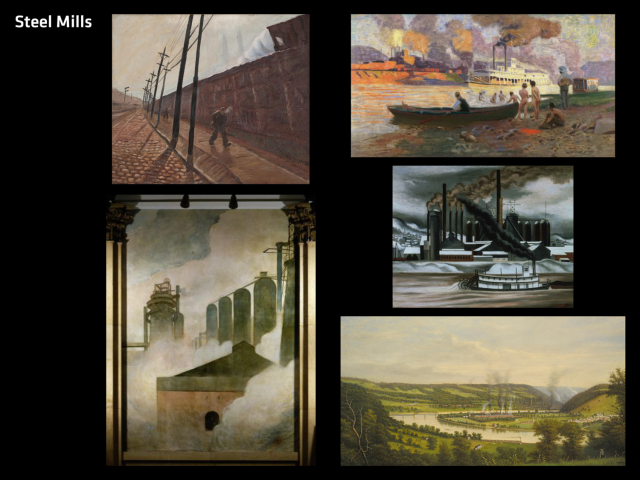
In 2018, I reviewed 58 landscape paintings and the John White Alexander wall murals on the first and second floors of the Grand Staircase within Carnegie Museum of Art (CMOA) galleries to look for artistic documentation of what I interpreted to be causes for climate change based on the science. I found many examples based on the use of coal as a fossil fuel for power and coking in steel mills and the natural formation of bio-methane as portrayed in ecosystem landscapes of  the industrial age of the middle 19th and early 20th century12.

Collage of coal landscapes. Clockwise from top right: Waterloo Bridge, London, Claude Monet c. 1903; The Great Bridge, Rouen (Le Grand Pont, Rouen), Camille Pissarro, c. 1896; Pittsburgh Fifty Years Ago from the Salt Works on Saw Mill Run, Russell Smith, c. 1884; The Crowning of Labor Murals, John White Alexander, c. 1905 - 1908; The Coal Carrier, David Gilmore Blyth, c. 1854 - 1858
Figure 8.

Collage of five illustrations of steel mills
Figure 9.

Searching for the CMOA landscapes paintings takes a little patience, but the visitor is rewarded by taking a new look at some of the art museum’s classic paintings (Fig. 8 and 9).

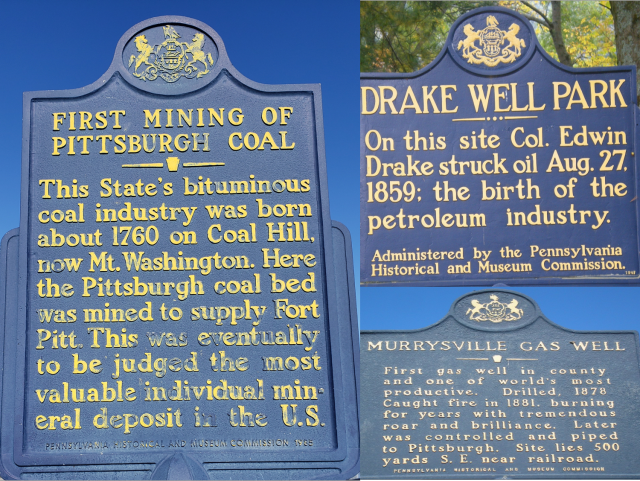
Three historic landmark signs. On left: First Mining of Pittsburgh Coal. This State's bituminous coal industry was born about 1760 on Coal Hill, now Mt. Washington. Here the Pittsburgh coal bed was mined to supply Fort Pitt. This was eventually to be judged the most valuable individual mineral deposit in the U.S. Sign on the top right: Drake Well Park. On this site Col. Edwin Drake struck oil Aug. 27, 1859; the birth of the petroleum industry. Sign on the bottom right: Murrysville Gas Well: First gas well in county and one of the world's most productive. Drilled, 1878. Caught fire in 1881, burning for years with tremendous roar and brilliance. Later was controlled and piped to Pittsburgh. Site lies 500 yards S.E. near railroad.
Figure 10.

Within day trip visiting distance of Carnegie Museums are historic plaques highlighting the discovery of coal on Mount Washington, natural gas in Murrysville, and oil in Titusville, Pennsylvania. (Fig. 10). At all three stops you’ll have a better understanding of the significance if you begin your investigation of fossil fuels at Carnegie Museums.

Albert D. Kollar is the Collection Manager for the Section of Invertebrate Paleontology. Suzanne Mills is the Collection Assistant and Joann Wilson is a volunteer Section of Invertebrate Paleontology. Museum employees are encouraged to blog about their unique experiences and knowledge gained from working at the museum.

References

  1. Kollar, A.D. 2020. CMP Travel Program and Section of Invertebrate Paleontology promotes the 125th Anniversary of the Carnegie Library of Pittsburgh with an outdoor walking tour. https://carnegiemnh.org/125th-anniversary-carnegie-library-of-pittsburgh-outdoor-walking-tour/
  2. Personal communications Anthony J. Young, Vice President (FP&O) Carnegie Museums of Pittsburgh.
  3. Brezinski, D. K. and C K. Brezinski. 2014. Geology of Pennsylvania’s Coal. PAlS Publication Number 18.
  4. Geology of the Marcellus Shale. 2011. Brezinski, D.K., D. A. Billman, J.A. Harper, and A.D. Kollar. PAlS Publication 11.
  5. https://www.bloomberg.com/news/articles/2021-05-03/coal-consumption-in-the-u-s-declines-as-natural-gas-solar-wind-energy-rise
  6. United States Energy Agency (EIA) 2019.
  7. Bill Gates. 2021. How to Avoid A Climate Disaster.
  8. Kollar et al. 2020. Carnegie Institute Extension Connemara Marble: Cross-Atlantic Connections Between Western Ireland and Gilded Age Architecture in Pittsburgh, Pennsylvania. ACM, 86, 207-253.
  9. Dawson, M. R. 1988. Benedum Hall of Geology. Carnegie Magazine, 12-18.
  10. Eller, E. R. 1965. Paleozoic Hall. Carnegie Magazine, 255-338.
  11. Harper and Dawson 1992. Benedum Hall-A Celebration of Geology. Pennsylvania Geology, 23, 12-15.
  12. Kollar et al. 2018. Geology of the Landscape Paintings at the Carnegie Museum of Art, a Reflection of the “Anthropocene” 1860-2017. Geological Society of America, Abstracts with Programs, v. 49, 243.

Related Content

The Story of Oil in Western Pennsylvania: What, How, and Why?

The Giant Eurypterid Trackway: A Great Fossil Discovery on Display

Cities Are Not Biological Deserts

Carnegie Museum of Natural History Blog Citation Information

Blog author: Kollar, Albert
Publication date: May 5, 2021

Share this post!

  • Share on Twitter Share on Twitter
  • Share on Facebook Share on Facebook
  • Share on Pinterest Share on Pinterest
  • Share on LinkedIn Share on LinkedIn
  • Share on Reddit Share on Reddit
  • Share via Email Share via Email

Filed Under: Blog Tagged With: Albert Kollar, Benedum Hall of Geology, invertebrate paleontology, Joann Wilson, Suzanne Mills, We Are Nature 2

sidebar

About

  • Mission & Commitments
  • Directors Team
  • Museum History

Get Involved

  • Volunteer
  • Membership
  • Carnegie Discoverers
  • Donate
  • Employment
  • Events

Bring a Group

  • Groups of 10 or More
  • Birthday Parties at the Museum
  • Field Trips

Powdermill

  • Powdermill Nature Reserve
  • Powdermill Field Trips
  • Powdermill Staff
  • Research at Powdermill

More Information

  • Image Permission Requests
  • Science Stories
  • Accessibility
  • Shopping Cart
  • Contact
  • Visitor Policies
One of the Four Carnegie Museums | © Carnegie Institute | Privacy Policy | Terms of Use | Accessibility
Rad works here logo