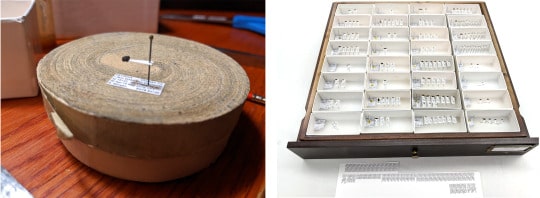
• Skip to primary navigation
  • Skip to main content
  • Skip to primary sidebar

Carnegie Museum of Natural History

One of the Four Carnegie Museums of Pittsburgh

  • Visit
    • Buy Tickets
    • Visitor Information
    • Exhibitions
    • Events
    • Dining at the Museum
    • Celebrate at the Museum
    • Powdermill Nature Reserve
    • Event Venue Rental
  • Learn
    • Field Trips
    • Educator Information
    • Programs at the Museum
    • Bring the Museum to You
    • Guided Programs FAQ
    • Programs Online
    • Climate and Rural Systems Partnership
  • Research
    • Scientific Sections
    • Science Stories
    • Science Videos
    • Senior Science & Research Staff
    • Museum Library
    • Science Seminars
    • Scientific Publications
    • Specimen and Artifact Identification
  • About
    • Mission & Commitments
    • Directors Team
    • Museum History
  • Tickets
  • Give
  • Shop

SWK2

May 10, 2021 by wpengine

Natural History Discoveries

by Vanessa Verdecia

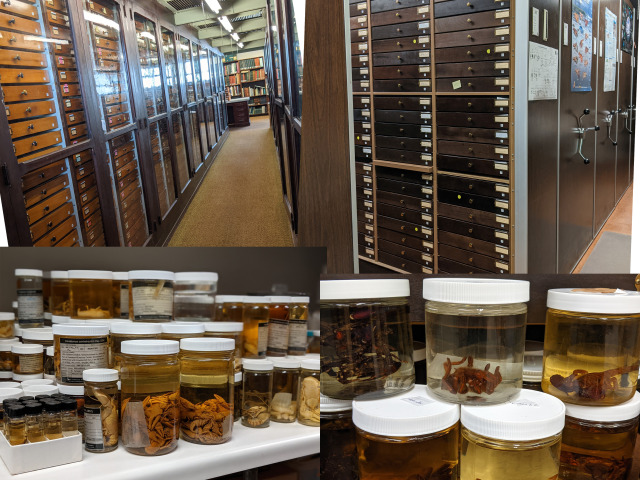
Collage of photos from the Section of Invertebrate Zoology. The top two photos show cabinets of drawers. The bottom two photos show jars of specimens preserved in liquid.

“Why do you collect so many?” That’s a common question we get from people who experience a glimpse into the Invertebrate Zoology collection at Carnegie Museum of Natural History. The Invertebrate Zoology collection, which consists of mostly insects, but also includes crayfish, spiders, and other invertebrates like millipedes and centipedes, is the largest collection at CMNH.

There are several reasons why we collect so many specimens. Nature is not always easy to interpret, even for the most knowledgeable scientists. In fact, an expert’s knowledge develops in part from time spent looking at many specimens, an unparalleled experience which helps create an accurate understanding of complicated species. So, one of the reasons we collect so many is to have enough material to look at and make informed decisions regarding species determinations. Some species can have significant variations across individuals. Having a lot of material also allows scientists to sacrifice some specimens for dissections or for use in molecular studies.

Another important reason for collecting so many is to create records of species occurring across as many geographical regions as possible and at different times of the year. By sampling and re-sampling, there is more data available to be analyzed and used to arrive at stronger conclusions. Having a historical collection is important for research that looks at species composition over time. Such collections help to answer questions about how biodiversity has been affected by climate change and other factors over time.

Collections as Scientific Tools

For these reasons, the insect collection at the Carnegie is an incredible scientific tool. We get many requests to borrow specimens, requests to visit the collection to gather data from the specimens, and requests for images of published specimens that are designated as types and deposited at CMNH. Type specimens are among the most scientifically valuable specimens, and the Invertebrate Zoology collection holds tens of thousands of specimens in type series that are referenced in scientific research and provide comparison material during the discovery of new species.
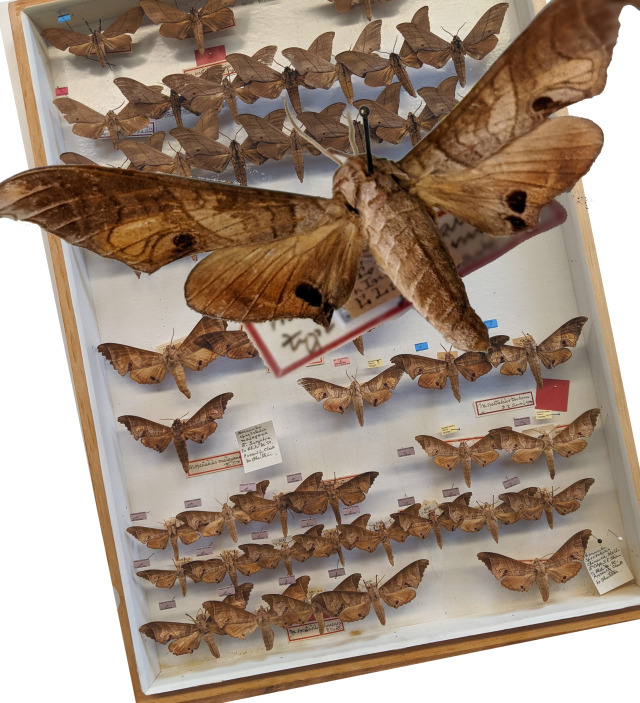
Drawer full of moth specimen with a larger moth over top.
Marumba drawer with types.

This background information leads to a nice little story for me to share. Sometimes requests for collection access come with a very special “thank you.” A request for images of type specimens in the Sphingidae (hawkmoths) collection earlier this year led to a publication that included new species, and instead of the usual acknowledgment, one of the authors named a new species after me—Marumba verdeciae. This type of taxonomic work, which involves making detailed observations related to the form and structures on the new specimens, requires the use of published museum specimens for comparative reference. Without access to the types, researchers would not be able to verify their discoveries, since comparison to the type material is essential in confirming the new species.
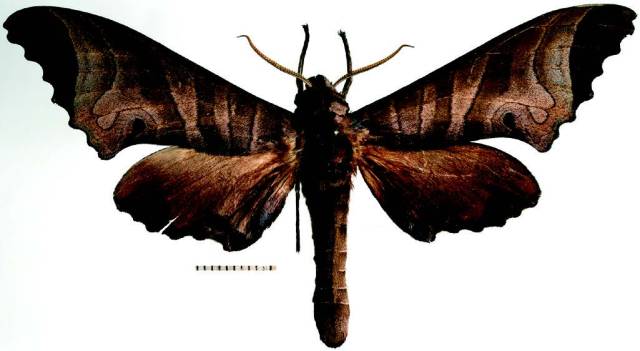
specimen of the moth Marumba verdeciae
Marumba verdeciae. Image from original description. Eitschberger, U. and H.B. Nguyen. 2021. Erster Schritt zur Revision des Marumba saishiuana auct. Artenkomplexes (nec Okamoto, 1924) (Lepidoptera, Sphingidae). Neue Entomologische Nachrichten 75: 123-327

Naming Species

Biological species are given a Latin name in the form of a genus and species. Placement of a species in a given genus is based on a biological relationship, but the species name is unique. There should be a section in the published work that explains the root of the name, which is often based on a Latin descriptive term related to a distinct feature of the species. However, sometimes a new species is dedicated to a person. In the case of Marumba verdeciae, the genus (Marumba) already existed, and one of the new species was dedicated to me as recognition of the effort I put into locating and imaging type specimens needed as a reference for the research the authors were doing with this group of moths. People might have a species dedicated to them for various reasons, which range from participating in or facilitating the research, to achieving prominence as an expert in a group of organisms. The species name verdeciae is a Latin conjugation of my last name, Verdecia.

The focus of this story, however, should be the importance of CMNH collections, and other museum collections across the world. In this case, the researchers in Germany needed to reference type specimens deposited at CMNH in order to complete their research. But CMNH scientists also need to borrow and request images of type specimens deposited at other museums when doing their research. Strong collaboration between scientists is very important. As stewards of our collections, we are not only maintaining the specimens for our use, but for use by the entire scientific community.
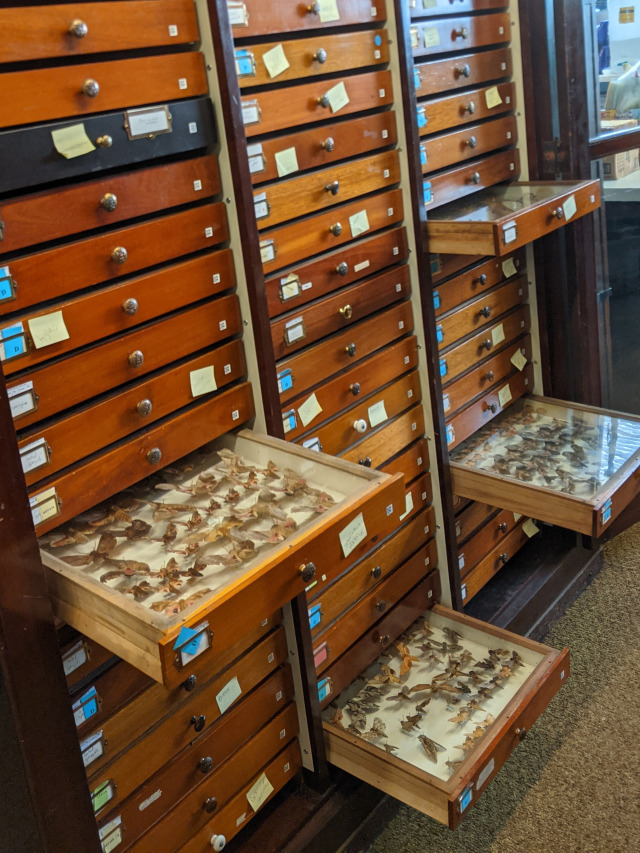
Cabinet of drawers with four drawers open showing specimens preserved inside.
Columns of Sphingidae protem.

Although it is an honor to have a new species named after me, the next step is the most exciting—the ongoing use of the new published work to hunt for specimens of the newly described species in our own collection. We have a vast collection in Invertebrate Zoology, and the moths and butterflies (Lepidoptera) comprise about 2/3 of the entire collection. There are many drawers with specimens that are not curated and there are over 100 drawers of mixed Sphingidae that, depending upon the geographical represented, might include some of the new species of Marumba. When new research like this is published, it allows curatorial staff to go into their collections to curate specimens, and update identifications. The Invertebrate Zoology collection is a work in progress, with many specimens waiting to be curated, and many discoveries yet to be made.

Vanessa Verdecia is Scientific Preparator in the museum’s Invertebrate Zoology Section. Museum employees are encouraged to blog about their unique experiences and knowledge gained from working at the museum.

Related Content

How to Prepare Insect Specimens

Ask a Scientist: What is a caterpillar database?

Garden for the Birds (or bees, or butterflies, or creepy crawlies, or you get the picture)…

Carnegie Museum of Natural History Blog Citation Information

Blog author: Verdecia, Vanessa
Publication date: May 10, 2021
Share this post!

  • Share on Twitter Share on Twitter
  • Share on Facebook Share on Facebook
  • Share on Pinterest Share on Pinterest
  • Share on LinkedIn Share on LinkedIn
  • Share on Reddit Share on Reddit
  • Share via Email Share via Email
  • Share on Twitter Share on Twitter
  • Share on Facebook Share on Facebook
  • Share on Pinterest Share on Pinterest
  • Share on LinkedIn Share on LinkedIn
  • Share on Reddit Share on Reddit
  • Share via Email Share via Email

Filed Under: Blog Tagged With: insects, Invertebrate Zoology, Science News, SWK2, Vanessa Verdecia

August 18, 2020 by wpengine

How to Prepare Insect Specimens

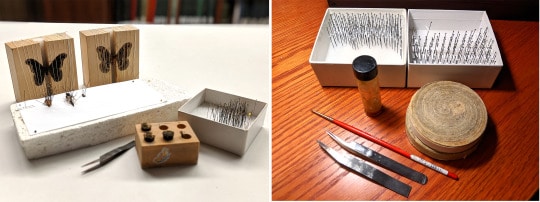
specimens and specimen preparation tools

Museum collections play a significant role in helping scientists answer questions about biodiversity and in providing data that may be used for conservation studies.  Every specimen in the Invertebrate Zoology collection tells a story and all together they contribute to the story of life on Earth.  Picture it, millions of specimens prepared and labeled.  Each has a story to tell about where, when, and how it was collected.  This critically important data is also gathered when samples are collected in the field.

The next step is processing the sample and picking specimens to be prepared.  So, how do we prepare specimens?  Lepidoptera (moths and butterflies) are usually pinned in the field or preserved in the freezer and then pinned and spread in the lab.  Most non-Lepidoptera are preserved in alcohol and prepared in the lab.  Preparation techniques differ, therefore, with what is being collected.

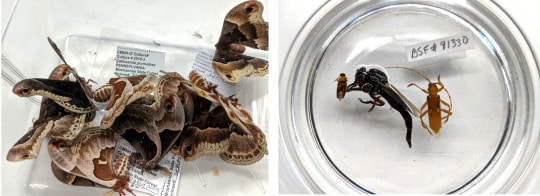
specimens before preparation

High quality scientific preparation is important, not just for aesthetic reasons but also for a specimen’s future in the service of research.  In some situations, characters on the bodies of the specimens need to be viewed under a microscope, sometimes segments need to be counted to identify a species, and more excitingly, a new species might need to be described from a series of specimens.

Handling of specimens that will be prepared needs to be done when the specimens are flexible—either from an alcohol sample, or a dry specimen that was rehydrated overnight.  The pin should be inserted within the thorax, which is the mid region of the body.  Insects are bilaterally symmetrical (left and right sides are duplicates), so the pin is always inserted slightly to the right of the midline.  This will preserve the integrity of the midline which might possess unique characters that are not duplicated.

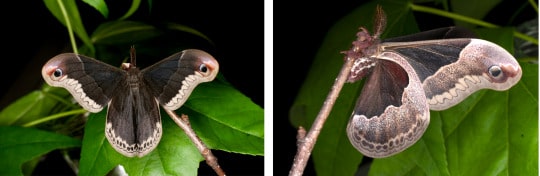
In 2018 a culture of Callosamia promethea caterpillars were reared.  A record of each stage of metamorphosis was preserved in alcohol and stored with reared caterpillars in the collection. Some of the cocoons were kept alive to allow the adult moths to emerge.  The adults were then preserved in the freezer so they could be prepared and added to the collection as a record of the offspring from that culture.

moths on leaves at night

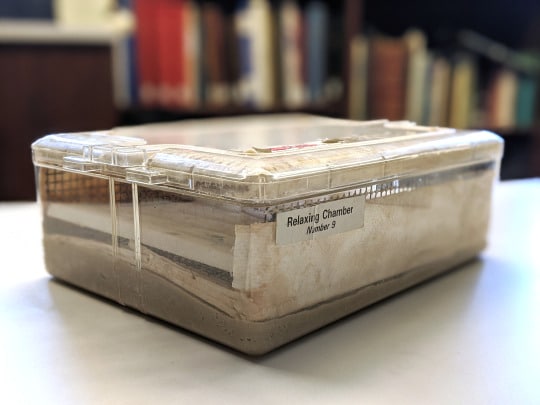
The moths were placed in a humidifying chamber overnight.  This chamber is kept humid by adding water to the absorbent paper towels that are layered in above a layer of sand mixed with an antifungal agent that keeps the specimens from getting moldy.

container labeled moth relaxing chamber number 3

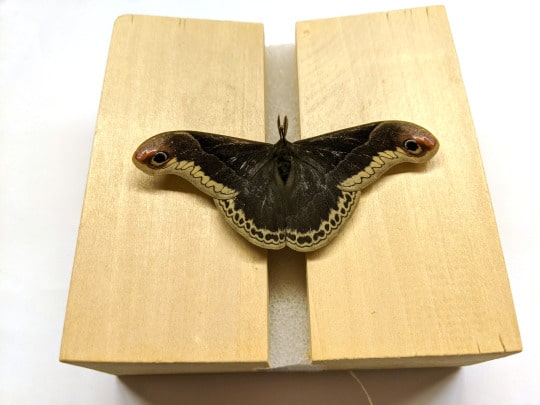
The specimens were thawed, and moisture kept the specimens relaxed enough to handle.  Specimens were pinned through the thorax and placed in a wooden pinning block designed for spreading the wings.

lepidoptera specimen laid out on blocks

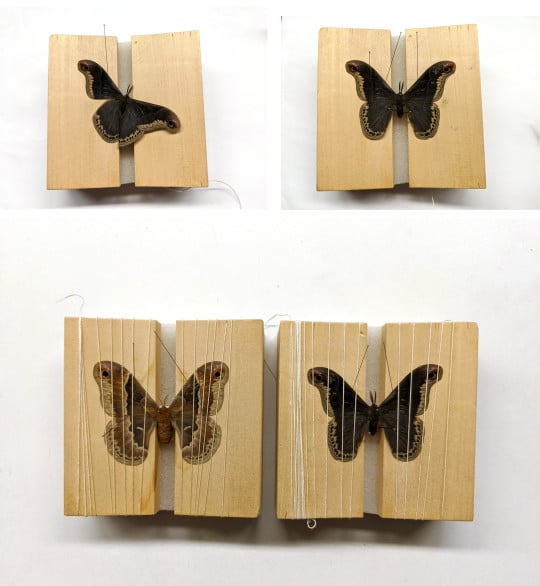
A series of very thin pins (size #000) were used to arrange the wings by carefully moving the forewings up high enough to expose the hindwings.  String was then wrapped around the block to hold the wings down and allow the specimens to dry.  Spread specimens remain on the spreading blocks for about a week to ensure they are completely dry and remain in the desired position.  Spreading moths and butterflies allows for all the characters on the hindwings to be visible, and it also allows the underside of the specimen to be viewed more easily.  The string is carefully unwrapped a week later, and specimens are removed from the blocks and ready to be labelled.

lepidoptera specimen on blocks in various stages of preparation

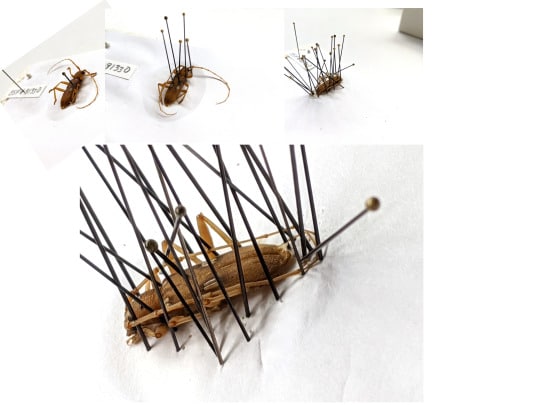
Non-Lepidoptera are usually pinned straight out of alcohol, when they are flexible enough to handle.  If they are collected and kept dry before preparation, then a relaxing chamber may be used to rehydrate them.  After the pin is inserted, the specimen is placed on a Styrofoam board lined with white paper.  Legs, antennae, and wings are arranged using brace pins that hold everything close to the body.  Specimens remain on the board for about a week until they are fully dry.

pinned specimens

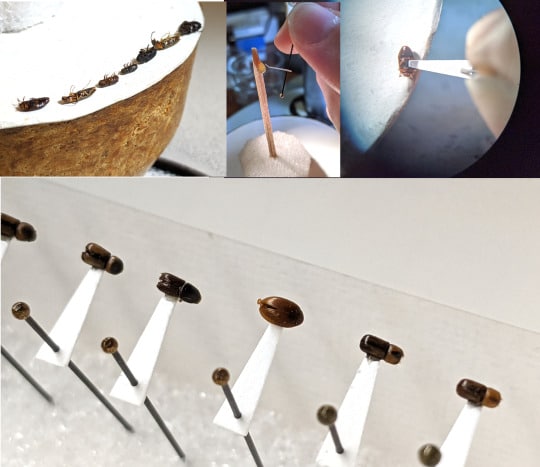
If specimens are too small to be pinned, they are mounted on paper points using shellac glue.  The pin goes through the point made from archival paper using a tool known as a point punch.  After laying the specimens with the underside facing up, the tip of the point gets a dab of glue and each specimen is glued on to the tip of the point.

specimens mounted on paper

Guess what the next step is…labeling!

As mentioned before, specimens tell an important story.  The data is just as valuable as the specimens, and that data is printed on archival paper using a laser printer.  A labeling block is used to apply the label on the pin, below the specimen.  Any specimen that is prepared and labeled is ready to be identified and curated into the collection.

materials for labeling specimens

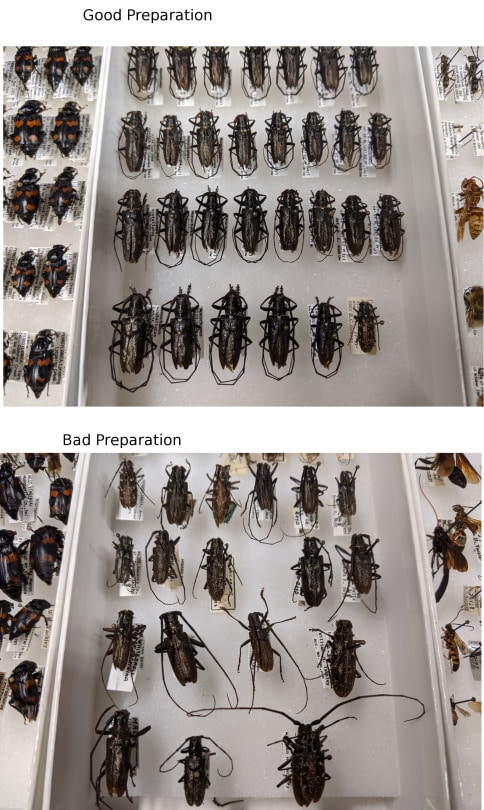
In a collection with 13.5 million specimens, space is valuable.  Well prepared specimens take up less space and are less vulnerable to damage.  A damaged specimen is still valuable because of the story it tells through its labels, even if damage makes the story incomplete.  High-quality preparation is important because it allows for easier examination of the specimens and interpretation of the differences between species.  These specimens are not just a bunch of bugs—all together, they are part of the record of life on Earth.

examples of good specimen preparation and bad specimen preparation

Vanessa Verdecia is Scientific Preparator in the museum’s Invertebrate Zoology Section. Museum employees are encouraged to blog about their unique experiences and knowledge gained from working at the museum.

Related Content

Traub Flea Data Books

Hillbilly Gourmets: Snail-eaters of the Yew Mountains

Ask a Scientist: What is a Caterpillar Database?

Filed Under: Blog Tagged With: Invertebrate Zoology, Science News, Section of Invertebrate Zoology, SWK2, Vanessa Verdecia

April 1, 2019 by wpengine

Bayet’s Bounty: The Invertebrates That Time Forgot

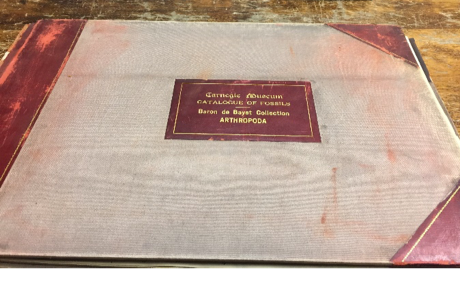
book about the baron de bayet collection
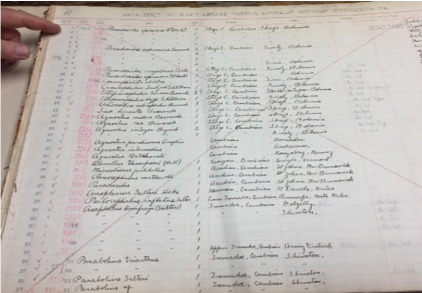
interior of book about baron de bayet collection

Albert Kollar, Collections Manager for the Carnegie Museum of Natural History Section of Invertebrate Paleontology, is on a mission to re-examine the Bayet Collection, a collection of 130,000 invertebrate and vertebrate fossils brought to the Carnegie more than 100 years ago.  Albert is re-examining the invertebrate portion of the Bayet (pronounced “Bye-aye”), which as it turns out, is 99.9% of the collection.

The story starts with a last-minute trip that began on July 8, 1903 by Carnegie Director William Holland, who had received word of a world-class fossil collection that had been put up for sale in Europe by the Baron de Bayet, secretary to the cabinet of Leopold II of Belgium.  Holland immediately booked passage to Europe on the steamer “New York” to complete the deal.  At stake were 130,000 invertebrates, combined with a small number of vertebrate fossils (several on display in the Dinosaurs in Their Time exhibition), sought by museums throughout Europe, Great Britain and the United States.  This collection became the largest addition to the department of paleontology at the Carnegie Institute, since the discovery of the dinosaur Diplodocus carnegii, at Sheep Creek, Wyoming in 1899.

Mr. Carnegie personally wrote a check for $25,000 for the project, a sum so large it exceeded the entire 1903 budget for all art and natural history acquisitions combined. Eventually, Mr. Holland negotiated a price of just under $21,000 with the Baron de Bayet for the entire collection. Another $2,300 was spent to pack, insure and transport everything back to Pittsburgh.  Twenty men and women worked for three weeks to meticulously wrap each fossil in cotton, batting, or straw and by September 1903, two hundred and fifty-nine crates arrived safely in Pittsburgh.  Storage of the crates was an issue, since the Carnegie Museum building would not be completed until 1907; so Mr. Holland rented space in a warehouse on 3rd Street in Pittsburgh for storage of 210 of the 259 crates.

This decision, however, almost destroyed the collection when a fire broke out on the upper floors of the 3rd Street warehouse.  On December 30, 1903, Mr. Holland wrote, “Yesterday brought with it a fire in which it appeared as if the Bayet collection, the acquisition of which we had so prided ourselves, was destined to go up in smoke.”  Fortunately, the Pittsburgh Fire Department contained the fire to the upper floors and the Bayet collection, stored on the lower floor, and meticulously wrapped and crated, survived with minimal damage. The crates returned to the Carnegie Institute to dry out.

In early 1904, William Holland hired Dr. Percy Raymond, a graduate of Yale University, to be the first curator of Invertebrate Paleontology.  His primary directive was to catalog and organize the Invertebrate portion of the Bayet collection. Today, over 100 years later, Albert Kollar with the help of Pitt Geology student E. Kevin Love, is undertaking a multi-year project to translate Percy Raymond’s beautifully hand-written catalogs and to migrate all 130,000 specimens into a new database.

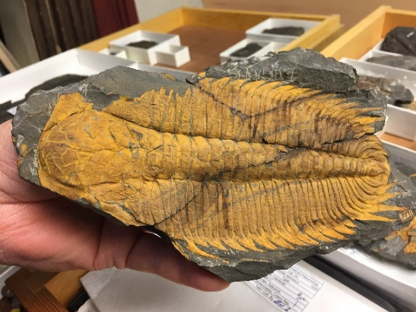
Pictured below is (BH1) the very first Bayet specimen cataloged by Percy Raymond.  BH1 is an exquisite 510-million-year-old, CM 1828 Paradoxides spinosus, a 17.17 cm or 7” long trilobite from Skreje, Bohemia – or the Czech Republic of today.

trilobite fossil

Albert’s goal in revisiting the Bayet collection is to better understand the great history of the how, why and where of fossils collected in the late 19th century, especially in Europe the birthplace of paleontology and geology.  “This project will give us insight into why certain Bayet fossils were recovered from classic European fossil localities, many of which are designated stratotype (significant geologic time reference) regions.  These fossils and localities have been used to document the validity of evolution, extinction, and the Geologic Time Scale over the last 100 years.  With an improved database, we hope to better appreciate the scientific value of the entire collection and create new statistical measures for future research and education.”

When asked if he expected any surprises as we go forward, Albert smiled, “Not until all the data has been analyzed will we have an opportunity to review the collection’s full scientific worth.”

Check back in a few months, Bayet’s invertebrates may have a few secrets yet to share.

Many thanks to Carnegie Museum Library Manager, Xianghua Sun for help researching this post.

Joann Wilson is an Interpreter in the Education department at Carnegie Museum of Natural History. Museum employees are encouraged to blog about their unique experiences and knowledge gained from working at the museum.

Filed Under: Blog Tagged With: Albert Kollar, Andrew Carnegie, fossils, geology, invertebrate paleontology, paleontology, Pittsburgh, SWK2, Trilobite, William Holland

  • « Go to Previous Page
  • Page 1
  • Page 2

sidebar

About

  • Mission & Commitments
  • Directors Team
  • Museum History

Get Involved

  • Volunteer
  • Membership
  • Carnegie Discoverers
  • Donate
  • Employment
  • Events

Bring a Group

  • Groups of 10 or More
  • Birthday Parties at the Museum
  • Field Trips

Powdermill

  • Powdermill Nature Reserve
  • Powdermill Field Trips
  • Powdermill Staff
  • Research at Powdermill

More Information

  • Image Permission Requests
  • Science Stories
  • Accessibility
  • Shopping Cart
  • Contact
  • Visitor Policies
One of the Four Carnegie Museums | © Carnegie Institute | Privacy Policy | Terms of Use | Accessibility
Rad works here logo