• Skip to primary navigation
  • Skip to main content
  • Skip to primary sidebar

Carnegie Museum of Natural History

One of the Four Carnegie Museums of Pittsburgh

  • Visit
    • Buy Tickets
    • Visitor Information
    • Exhibitions
    • Events
    • Dining at the Museum
    • Celebrate at the Museum
    • Powdermill Nature Reserve
    • Event Venue Rental
    • Gift Cards
  • Learn
    • Field Trips
    • Educator Information
    • Programs at the Museum
    • Bring the Museum to You
    • Guided Programs FAQ
    • Programs Online
    • Climate and Rural Systems Partnership
  • Research
    • Scientific Sections
    • Science Stories
    • Science Videos
    • Senior Science & Research Staff
    • Museum Library
    • Science Seminars
    • Scientific Publications
    • Specimen and Artifact Identification
  • About
    • Mission & Commitments
    • Directors Team
    • Museum History
  • Tickets
  • Give
  • Shop

Walton Hall of Ancient Egypt

July 16, 2018 by wpengine

Does it sound strange to walk like an Egyptian on painted floors?

By Dr. Erin Peters

We often see paintings hung on walls today, so it may be hard to believe ancient Egyptians could walk on them! Many surfaces were painted in ancient Egyptian temples and tombs, even floors. We have a fragment of a painted floor from the Meru-Aten palace/temple at Akhetaten (modern Tell el-Amarna) in the Section of Anthropology’s storage. Amarna was the capital city of the pharaoh Akhenaten and his wife, Nefertiti, who famously changed Egyptian religion from polytheistic – worshiping many gods – to monotheistic – worshiping a single god. Akhenaten and Nefertiti’s single god was the Aten, the sun itself.
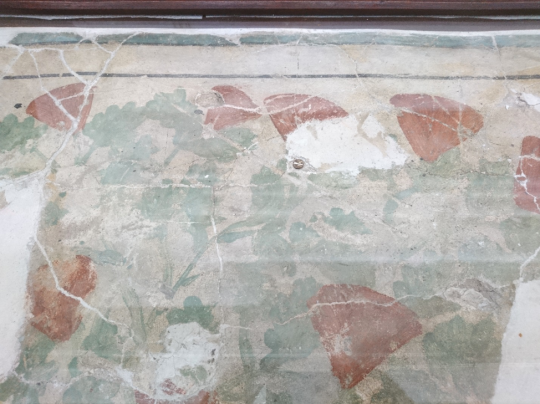
Fragment of a painted floor pavement from the Meru-Aten, Akhetaten
1. Fragment of a painted floor pavement from the Meru-Aten, Akhetaten (el-Amarna), Dynasty 18, acc. # 7106.

Nature was essential to all eras of Egyptian society, but the change to worshiping one natural element heightened this relationship in the Amarna Period. We see this in the art and architecture that survives, like our painted floor pavement. As you can see in the detail, the painting depicts red poppies, a common flower in ancient Egypt. The exquisite interlacing leaves and flowers, along with the visible brush-strokes of the ancient artisan, give the poppies a sense of naturalism characteristic of Akhenaten’s reign.
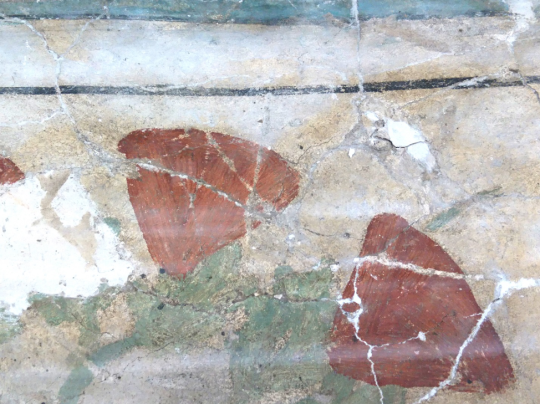
Detail of fragment of a painted floor pavement from the Meru-Aten, Akhetaten (el-Amarna)
2. Detail of fragment of a painted floor pavement from the Meru-Aten, Akhetaten (el-Amarna), Dynasty 18, acc. # 7106.

This naturalism contrasts with art and architecture produced before and after the Amarna Period, like the painting in the Dynasty 19 tomb of Sennedjem at Deir el-Medina. Half of Sennedjem’s tomb is recreated in our Walton Hall of Ancient Egypt. You may be familiar with the scene of Sennedjem and his wife adoring several gods in two rows within a shrine. The other half of the tomb shows Sennedjem and his wife in the Field of Reeds (what we think of as the Afterlife). The fields are surrounded by water and abundant trees and plants, including the mandrake, cornflower, and red poppy in the row at the bottom.
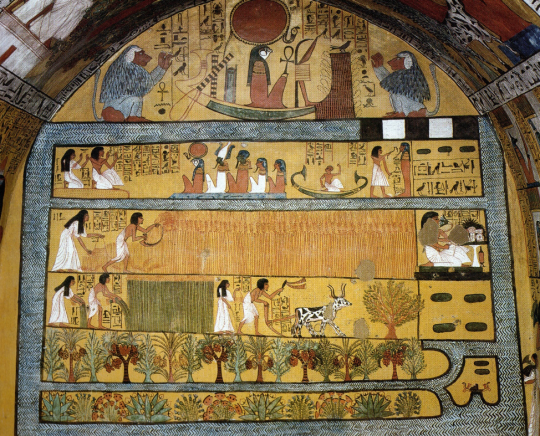
tympanum of the East Wall of the tomb of Sennedjem, Deir el-Medina
3. The tympanum of the East Wall of the tomb of Sennedjem, Deir el-Medina, Dynasty 19.

This detail shows rows of mandrakes, cornflowers, and poppies – all are painted in a more stylistic, or abstract way, than the poppies on our Amarna Period floor pavement.
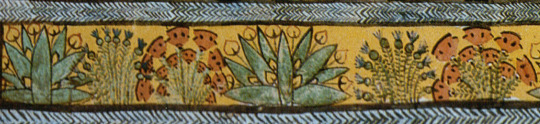
Detail showing mandrake, cornflowers, and red poppies
4. Detail showing mandrake, cornflowers, and red poppies in the tympanum of the East Wall of the tomb of Sennedjem, Deir el-Medina, Dynasty 19.

While we see more naturalistic representations in the Amarna Period, floors were painted in all periods – so walking like an Egyptian could often mean walking on paintings!

Erin Peters is joint assistant curator of science and research at Carnegie Museum of Natural History. Museum employees are encouraged to blog about their unique experiences working at the museum.
Filed Under: Blog Tagged With: ancient egypt, egypt, Erin Peters, Walton Hall of Ancient Egypt

June 21, 2018 by wpengine

Why Were Cats Mummified in Ancient Egypt?

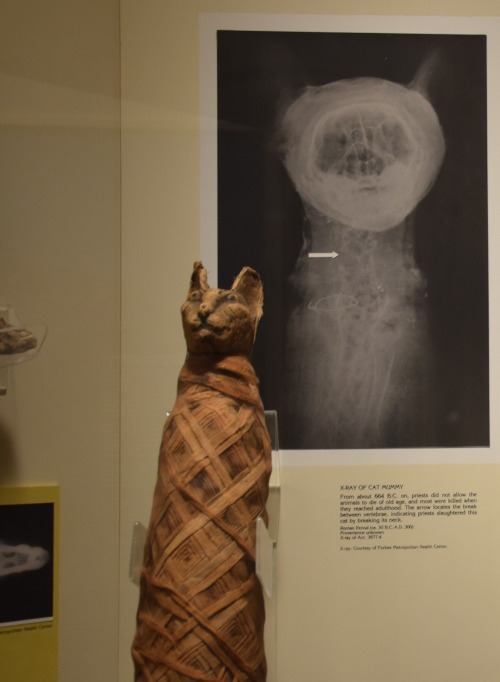
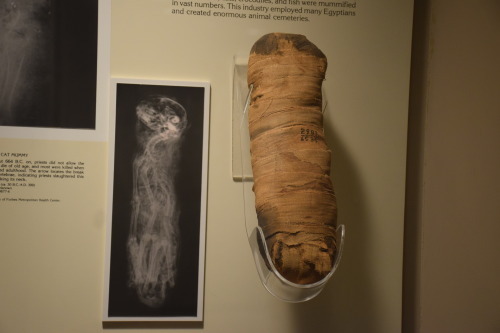
mummified cats and x-rays of them

In ancient Egypt, cats were sacred animals. People dedicated mummified cats at the sanctuary of the cat goddess Bastet as offerings. The sanctuary was located in the city of Bubastis where the remains of numerous cat mummies and small cat sculptures have been found.

Cats were also pets, just like they are today, and were sometimes mummified and placed in tombs with their owners. The belief was that by placing cats and their owners in the same tomb the pair could remain together in the Afterlife.

mummified cats and x-rays of them

Pictured above are mummified cats and x-rays of them on display in Carnegie Museum of Natural History’s Walton Hall of Ancient Egypt.

Related Content

Archaeological Adventures in Ancient Egypt

Egypt and the Nile

Tunic Decoration from Egypt

Filed Under: Blog Tagged With: ancient egypt, cats, mummy, Walton Hall of Ancient Egypt

June 21, 2018 by Kathleen

Book and Tour with Dr. Erin Peters

At the next Book and Tour, discuss the historical novel Memoirs of Hadrian by Marguerite Yourcenar with Carnegie Museum of Natural History Assistant Curator Dr. Erin Peters. Yourcenar’s book reimagines the life of the Emperor Hadrian from his childhood through his time as emperor. It is written from the perspective of Hadrian as if he were writing to Marcus Aurelius, a tactic which Yourcenar used successfully to bring Hadrian’s world to life.

Dr. Peters offers perspective on this book from her research at Antinoupolis, a city named for Hadrian’s companion–the Greek youth, Antinous. Supposedly, on a trip down the Nile with Hadrian in 130 CE, Antinous fell from the boat and drowned. Because of Egyptian beliefs, Antinous was deified after death, and Hadrian founded the city for the cult of the new god.

Dr. Peters will take you on a tour that focuses on objects in the Walton Hall that date to the Ptolemaic and Roman periods to give a sense of the ancient Mediterranean leading up to and during Hadrian’s time.

This is a free event, but those wishing to attend must sign up. To sign up, please join our Meetup group and RSVP.

Tagged With: ancient egypt, Erin Peters, Walton Hall of Ancient Egypt

June 11, 2018 by wpengine

The Ba in Ancient Egyptian Culture

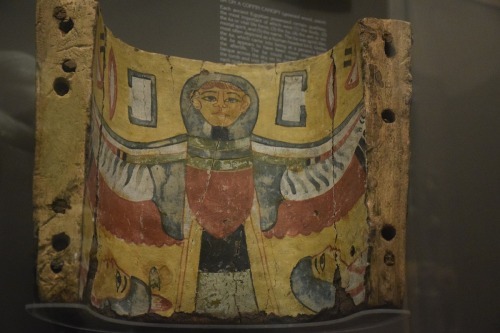
The Ba depicted as a bird with a human head.

The image on this coffin canopy in Walton Hall of Ancient Egypt represents the ba, which was a spirit-like quality Egyptians believed all people possessed.

The ba is most often depicted as a human-headed bird.  A person’s ba was considered important in the afterlife, where it could visit the world of the living during the day and return to the world of the deceased at night.

Filed Under: Blog Tagged With: Walton Hall of Ancient Egypt

April 16, 2018 by wpengine

Reinstallation of Walton Hall of Ancient Egypt

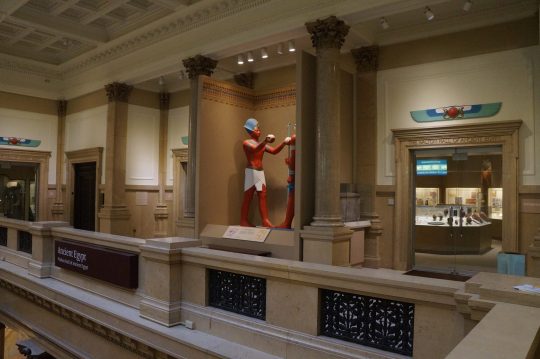
entrace way to Walton Hall of Ancient Egypt

Building on our National Endowment for the Humanities (NEH) Digital Projects for the Public Discovery Grant, Carnegie Museum of Natural History is excited to announce that NEH also awarded us an Exhibitions Planning Grant for a reinstallation of our current Walton Hall of Ancient Egypt. This will be a groundbreaking and highly interactive exhibition, exploring the natural and human history of Ancient Egypt and featuring anthropological artifacts and natural sciences specimens. @NEHgov #NEHGrant


Filed Under: Blog Tagged With: egypt, Walton Hall of Ancient Egypt

January 11, 2018 by wpengine

Did you know that in addition to needing a larger museum…

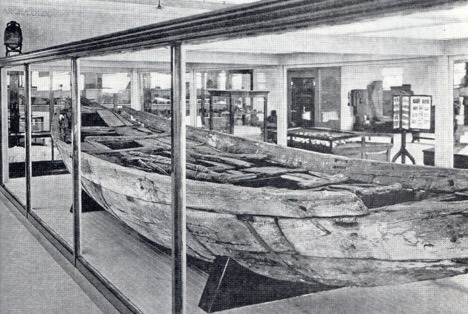
Egyptian funerary boat

Did you know that in addition to needing a larger museum building to house our Diplodocus, Dippy, the 1907 expansion was required because Andrew Carnegie purchased our 32-foot long wooden Egyptian funerary boat?

Carnegie apparently purchased the boat without the knowledge of then Director, W.J. Holland, who upon its
arrival, told The Pittsburgh Times that he “had not been in correspondence with anyone regarding such a relic.”

Still, by July 24, 1901, Holland reported to The Pittsburgh Post that “Mr. Carnegie is ever on the lookout to purchase antiquities that will tend to carry out his idea of making the Carnegie Museum the most comprehensive and complete institution of the kind in the world… Mr. Carnegie is thoughtful to the extreme in this respect and we are never at a loss to find a good place for anything that may come.”

This boat is still on display today in Walton Hall of Ancient Egypt!

Filed Under: Blog Tagged With: Andrew Carnegie, museum history, Walton Hall of Ancient Egypt

  • « Go to Previous Page
  • Page 1
  • Page 2
  • Page 3
  • Page 4
  • Interim pages omitted …
  • Page 6
  • Go to Next Page »

sidebar

About

  • Mission & Commitments
  • Directors Team
  • Museum History

Get Involved

  • Volunteer
  • Membership
  • Carnegie Discoverers
  • Donate
  • Employment
  • Events

Bring a Group

  • Groups of 10 or More
  • Birthday Parties at the Museum
  • Field Trips

Powdermill

  • Powdermill Nature Reserve
  • Powdermill Field Trips
  • Powdermill Staff
  • Research at Powdermill

More Information

  • Image Permission Requests
  • Science Stories
  • Accessibility
  • Shopping Cart
  • Contact
  • Visitor Policies
One of the Four Carnegie Museums | © Carnegie Institute | Privacy Policy | Terms of Use | Accessibility
Rad works here logo