• Skip to primary navigation
  • Skip to main content
  • Skip to primary sidebar

Carnegie Museum of Natural History

One of the Four Carnegie Museums of Pittsburgh

  • Visit
    • Buy Tickets
    • Visitor Information
    • Exhibitions
    • Events
    • Dining at the Museum
    • Celebrate at the Museum
    • Powdermill Nature Reserve
    • Event Venue Rental
  • Learn
    • Field Trips
    • Educator Information
    • Programs at the Museum
    • Bring the Museum to You
    • Guided Programs FAQ
    • Programs Online
    • Climate and Rural Systems Partnership
  • Research
    • Scientific Sections
    • Science Stories
    • Science Videos
    • Senior Science & Research Staff
    • Museum Library
    • Science Seminars
    • Scientific Publications
    • Specimen and Artifact Identification
  • About
    • Mission & Commitments
    • Directors Team
    • Museum History
  • Tickets
  • Give
  • Shop

We Are Nature: Living in the Anthropocene

January 17, 2019 by wpengine

Fish Story

by Patrick McShea

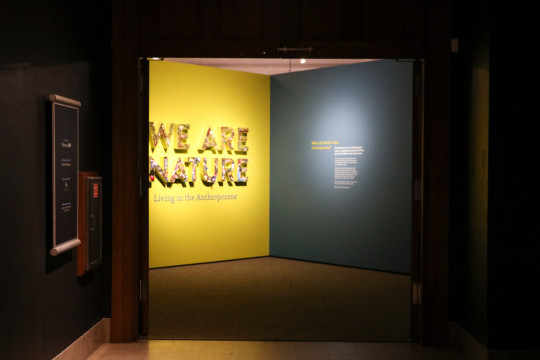
entrance to We Are Nature exhibition

Museum educators who helped interpret We Are Nature: Living in the Anthropocene during the ground-breaking exhibition’s ten-month run now pay close attention to explanations of Anthropocene-related themes. When exceptional examples are encountered, we feel compelled to share them.

Recently, in a New York Times article about how a decades-long decline in insect populations is now causing alarm, author Brooke Jarvis addresses the apparent invisibility of environmental degradation that occurs over generations.

She presents the term “shifting baseline syndrome” for the phenomenon, and by way of memorable example summarizes the results of an unusual research study from 2008.

Marine biologist Loren McClenachan, of the Scripps Institute of Oceanography, quantified the decline of fish associated with Florida Keys coral reefs by examining historic photos, 1956 – 2007, of the sportfishing customers and catches of three long established charter boat companies.

Although smiles remained consistent across the decades, prize fish got considerably smaller. As Jarvis notes in her summary, “The world never feels fallen, because we grow accustomed to the fall.”
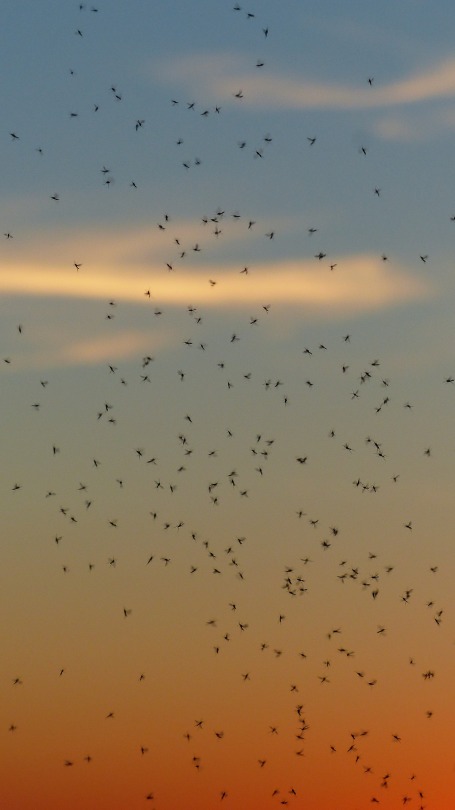
mosquitos at sunset - insect apocalypse

For more details, check out Brooke Jarvis’ full article, The Insect Apocalypse Is Here.

Patrick McShea works in the Education and Visitor Experience department of Carnegie Museum of Natural History. Museum employees are encouraged to blog about their unique experiences and knowledge gained from working at the museum.

Related Content

Fish and the Fourth of July?

Rising Through the Educator Ranks

Stage and Screen Sharing

Carnegie Museum of Natural History Blog Citation Information

Blog author: McShea, Patrick
Publication date: January 17, 2019
Share this post!

  • Share on Twitter Share on Twitter
  • Share on Facebook Share on Facebook
  • Share on Pinterest Share on Pinterest
  • Share on LinkedIn Share on LinkedIn
  • Share on Reddit Share on Reddit
  • Share via Email Share via Email

Filed Under: Blog Tagged With: Anthropocene, fish, Pat McShea, We Are Nature, We Are Nature: Living in the Anthropocene

September 4, 2018 by wpengine

Smoke Scenery

by Pat McShea

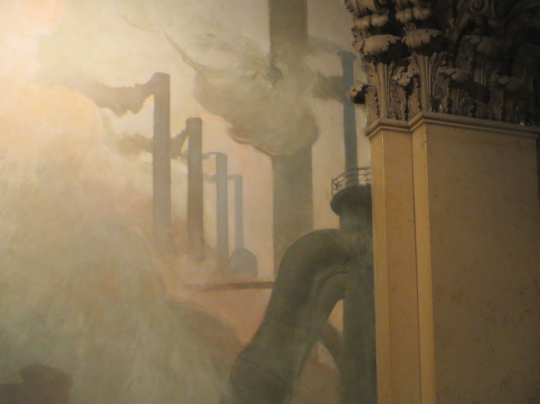
Detail from The Apotheosis of Pittsburgh mural by John White Alexander

A museum educator from Norway offered a novel way to interpret We Are Nature: Living in the Anthropocene. “This should be part of the story.” explained Bergsveinn Thorssonas he gestured at century-old steel industry scenes depicted in second-floor portions of the multi-level grand staircase mural painted by John White Alexander.

Thorsson, a PhD student who is studying how museums present current environmental issues, was fascinated by the smoky scenes and their marble pillar frames. “Owning our industrial history is important to understanding our current situation.” he added before conceding that he didn’t have advice for accomplishing such a task.

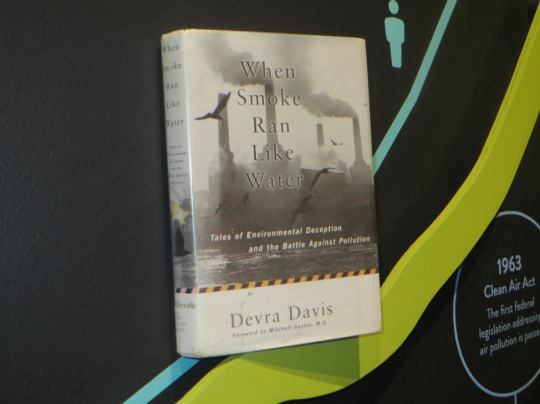
A copy of When Smoke Ran Like Waterpositioned at the 1948 mark on the population and atmospheric carbon level graph in We Are Nature
A copy of When Smoke Ran Like Water positioned at the 1948 mark on the population and atmospheric carbon level graph in We Are Nature

Since 2002, an excellent book-form model of industrial acknowledgement has existed in When Smoke Ran Like Water, by Donora, Pennsylvania native Devra Davis. The book, which Davis summarizes as an argument for “a fundamentally new way of thinking about health and the environment,” begins with a recounting of the most significant air pollution disaster in the United States – the build-up in Donora, some 25 miles southeast of Pittsburgh, during a five-day period in late October 1948, of a toxic fog of steel and zinc industry emissions that resulted in 20 deaths and 600 hospitalizations.

In Davis’s account, family histories, with all their hopes, accomplishments, and compromises, are central to the tragedy. A quote from her mother captures a common attitude toward the smoky scenery: “Look, today they might call it pollution. Back then it was just a living.”

Patrick McShea works in the Education and Visitor Experience department of Carnegie Museum of Natural History. Museum employees are encouraged to blog about their unique experiences and knowledge gained from working at the museum.

Filed Under: Blog Tagged With: Anthropocene, Pittsburgh, pollution, We Are Nature, We Are Nature 2, We Are Nature: Living in the Anthropocene

August 16, 2018 by wpengine

Mapping Pittsburgh’s Plastic Waste

By James Whitacre

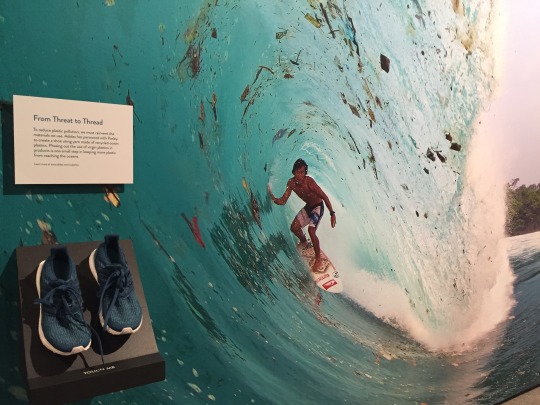
If you have visited the museum recently, you have probably seen the We Are Nature: Living in the Anthropocene exhibition (if not, you have less than a month to check it out!!). When I walked through the exhibition the first time, I was struck by the image of the surfer gliding across a wave with plastic and other debris floating all around him. It is a bleak image of how the beauty and ecology of our oceans, rivers, and lakes is being tarnished and even destroyed by the accumulation of so much plastic waste.

surfer in wave with plastic

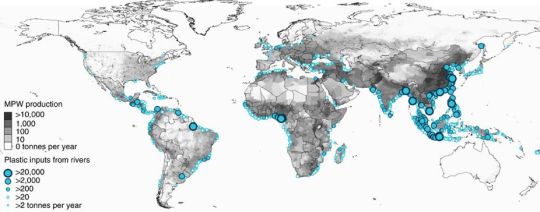
Recently, I also came across an interesting 2017 article, ‘River plastic emissions to the world’s oceans,‘ in which the authors have developed a global model using spatial and temporal data on waste management, population density, and hydrology to measure the amount of plastic in rivers that makes its way into oceans. They found that the top 20 polluting rivers account for 67% of the global total of plastic waste, which is between 1.15 and 2.41 million tonnes of plastic a year. While most of the top 20 rivers are in Asia, and none are in the U.S., their findings have great implications for how plastic waste should be managed and mitigated at global and local scales.

Diagram of mass of river plastic flowing into oceans in tonnes per year.
Mass of river plastic flowing into oceans in tonnes per year. This work is licensed under a Creative Commons Attribution 4.0 International License. Source: https://www.nature.com/articles/ncomms15611/figures/1


This article got me thinking…How can we, as humans living in the Anthropocene, do something to decrease and even eliminate the accumulation of plastic in our waterways? Many people are thinking about this, but what about our beloved three rivers of Pittsburgh? How much do we as a community contribute to the global plastic waste epidemic? Well, to start answering these questions, we need data to know where the plastic waste is…

How often have you walked through your neighborhood, a local or state park, or even been driving around, and noticed plastic waste (and likely other trash)? With this in mind, we’d like to invite you into an experiment…to help us map Pittsburgh’s plastic waste. The GIS Lab, located at Powdermill Nature Reserve, has developed a simple mapping survey to help track plastic waste in our area. To participate, all you have to do is fill out the form using your GPS-enabled smartphone or mobile device when you encounter plastic waste:

Plastic Waste Survey


What will we do with this data?

Well, right now this is just an experiment…But we are thinking of some cool ways to map and analyze this data. We will definitely share a map that shows the data, so stay tuned. We would also like to help our community understand what happens to the plastic if left in the environment. So, here are some example research questions we hope to shed some light on in the near future:

  • If you find some plastic near your house, what stream will it end up in, and what is the shortest path to the ocean from there?
  • How much rain or wind would it take to move that plastic to a stream or river?
  • Where is the nearest recycling center that I can take a few bags or a large heap of plastic (and other) waste?

Data can be very powerful, and sometimes more powerful than we can imagine on our own. So if you have any other ideas for how we could use this data, please email the GIS Lab!

What is Survey123?

The GIS Lab used Survey123 to build this survey, which is part of the ArcGIS platform. Survey123 for ArcGIS is a simple and intuitive form-centric data gathering solution that makes creating, sharing, and analyzing surveys easy using GIS software. Download the free Survey123 app to use the form we created.

James Whitacre is the GIS Research Scientist for Carnegie Museum of Natural History, where he primarily manages the GIS Lab at Powdermill Nature Reserve, the museum’s environmental research center. Museum employees are encouraged to blog about their unique experiences and knowledge gained from working at the museum.

Filed Under: Blog Tagged With: Anthropocene, GIS lab, Pittsburgh, Powdermill Nature Reserve, We Are Nature: Living in the Anthropocene

July 30, 2018 by wpengine

None Like It Hot

By Joylette Portlock

July. Long known across the U.S. for fireworks, barbecues, and a desire to stay cool any way we can. Whether it’s air conditioning, swimming pools, beaches or popsicles, the dog days of summer are often reminders that as humans, our comfort depends on an experienced ambient temperature roughly somewhere between 59 and 77 degrees (Fahrenheit).

But what if, instead of 77, it’s a full 40 degrees more: 117 degrees, like it was in California on July 6? Or 105, like it was in Japan last week? Then, it’s more than an issue of comfort; our lives depend on finding a way to stay cool, and in fact more than a hundred people have perished in heat-related deaths globally already this year.

Life in this new age, the Anthropocene, is marked by many things, including a human-caused increase in global heat, commonly referred to as global warming, or climate change. Risk from heat (or wildfires, or floods) is no longer something we have to rely on the overwhelmingly strong scientific consensus about global warming to tell us; every year, climate change impacts are becoming more and more obvious to everyone, whether you have a degree in climate science or not.

Weather and climate are different. Weather is what happens on a day-to-day basis. Climate is the range of weather that we expect and consider normal (i.e., summer is hot) – but normal is changing.

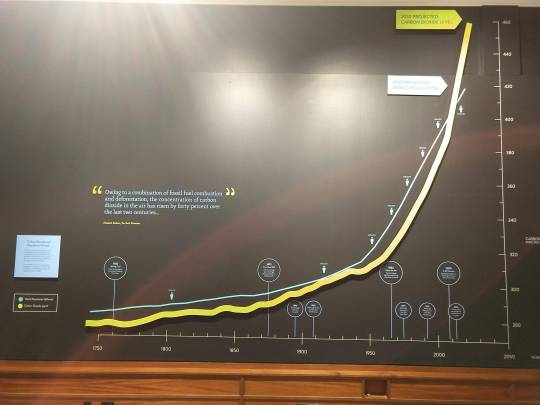
Graph showing the amount of CO2 in the atmosphere and human population
Photo: Graph showing the amount of CO2 in the atmosphere and human population from We Are Nature, on display until September 2018.

We’re now up to over 400 consecutive warmer-than-average months and counting. Carnegie Museum of Natural History’s collections, which span more than 140 years, can help show these shifts in many ways. One of the most important things we can do is to make connections and show the relevance between the basic scientific principles underlying natural phenomena and the evidence all around us; between what’s happening globally and what’s happening locally.

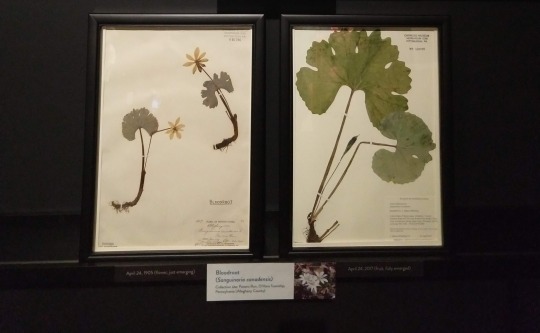
side by side comparison of plant specimens collected 100 years apart
Photo: The growth of plants collected today versus 100 years ago in the same locations, shown in We Are Nature, corroborates the observation of increasingly earlier springtime by documenting earlier maturation of these species.

The globe’s increasing heat is a result of fossil fuel use, food production, and our land use practices. We need energy and food, of course; but it’s critical that we recognize that the systems we impact also impact us. It’s not just our actions, but our interactions with the world around us that are the story. To understand what’s happening and improve our interactions with nature, we have to look at the big picture, and work to meet our needs in ways that minimize disruption to the overall system.

As summer heat waves get longer, more numerous, and more intense (and it seems the whole world is on fire, with deadly fires everywhere from California to Greece to inside the Arctic Circle) one connection is obvious: our need to be cool.

Joylette Portlock, Ph.D., is associate director of science and research at Carnegie Museum of Natural History. She is also executive director of Communitopia, a nonprofit focused on climate change communication, and holds many other roles in the community.

Filed Under: Blog Tagged With: Anthropocene, climate change, global warming, We Are Nature, We Are Nature: Living in the Anthropocene

July 13, 2018 by wpengine

Migrate or Die

By Dr. Nicole Heller

Becoming Migrant was this year’s theme for the Carnegie Nexus. The series explored the science and art of passage through creative programming. Migration is a very important issue for wildlife conservation in the Anthropocene. Roads and building developments heavily fragment landscapes, leading more animals to be hit by cars or run into trouble with people. Movement is especially hard for animals that don’t fly and need large home ranges to gather sufficient food, such as American Black Bears and bobcats, two large mammal species that live here in Allegheny County.

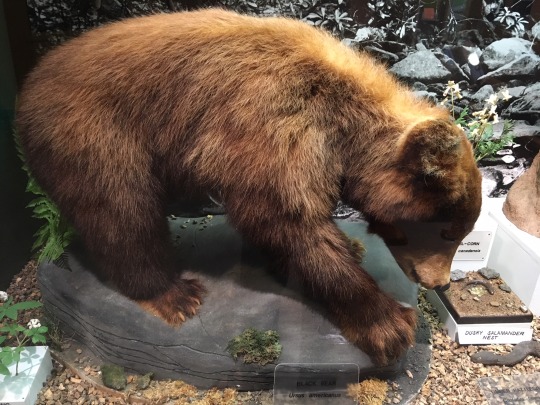
baby black bear taxidermy
Baby black bear, Ursus americanus, on display at Powdermill Nature Reserve.

Conservation has long recognized the need to create connectivity between protected areas to support the movement of large mammals in the landscape, but with climate change, connectivity has become paramount to the long-term success of protected areas and species in general.  As the climate changes, plants and animals must migrate to track suitable climate conditions.  This means that more species are becoming migrant, and their long-term survival depends on it.

Prioritizing connectivity planning and making sure we do it in ways that are climate-smart is a leading edge of conservation science.  There are many different types of corridor projects, from building crossings over particularly dangerous roads, such as the Liberty Canyon Wildlife Crossing in Los Angeles, CA. Or large-landscape connectivity projects to create continental migration pathways such as Y2Y project.

I first wrote about climate adaptation 10 years ago. In this research, I identified that the most impactful thing we could do to help species survive climate change is to create habitat connectivity in the landscape. Recently, I published two scientific articles, with a group of colleagues, further exploring the issue of climate change and connectivity. In one paper, published in Environmental Research Letters, we explore the best models and methods for incorporating climate change into connectivity conservation planning. And in the other paper, published in Conservation Biology, we consider best practices to take corridors from idea to implementation on the ground.

We hope this information will be helpful to conservation groups around the world who are working to make sure the landscape supports wildlife today and into the future.

Dr. Nicole Heller is Curator of the Anthropocene for Carnegie Museum of Natural History. Museum employees are encouraged to blog about their unique experiences working at the museum.

Filed Under: Blog Tagged With: Anthropocene, climate change, Nicole Heller, We Are Nature, We Are Nature: Living in the Anthropocene

July 2, 2018 by wpengine

We Are Nature: Future Thinking

By: Pat McShea

image

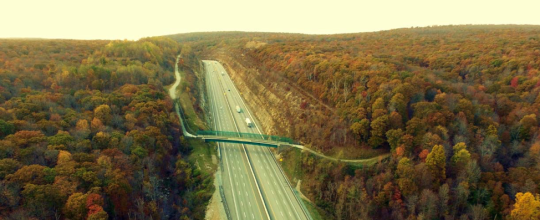
Although activities in the Future Thinking Lab section of We Are Nature seldom focus on the past, historic examples of the process are important. Some 50 miles southeast of Pittsburgh, travelers on the Pennsylvania Turnpike pass steel and concrete proof of regional future thinking dating back to at least the 1960s.

image

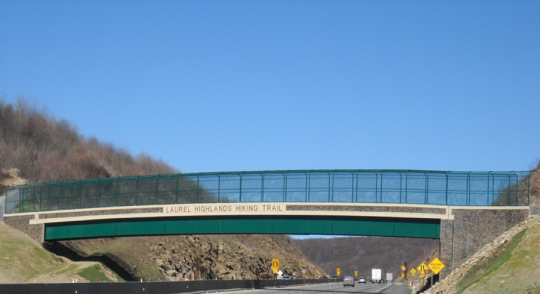
Photo credit: Gibson-Thomas Engineering

At mile mark 100.5, where the busy east/west route crosses over the crest of the mountain fold known variously as Laurel Hill, Laurel Mountain, and Laurel Ridge, the highway passes under the Laurel Highlands Hiking Trail.

image

Photo: Gibson-Thomas Engineering

image

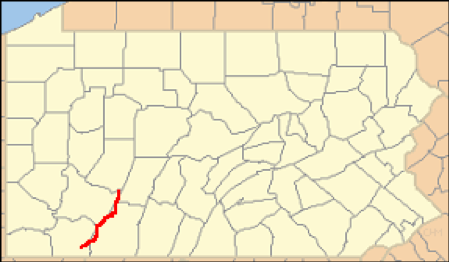
This 70-mile long footpath winds along the ridge crest between water gaps carved by the Conemaugh River on the north, and the Youghiogheny River on the south. The turnpike crossing is located between mile posts 36 and 37, as measured from the trail’s southern terminus in Ohiopyle.

Credit for this recreational resource, which was officially dedicated in 1976, rests largely with the Western Pennsylvania Conservancy and Pennsylvania’s Bureau of State Parks. The WPC, an 86-year-old Pittsburgh-based conservation organization, began acquiring key tracts on the ridge in the 1960’s for state parks, game lands, and forests. The Bureau of State Parks, which constructed the trail across the resulting patchwork of public and private land, has maintained the path under the auspices of Laurel Ridge State Park.

The trail is but one “product” from decades of future thinking, future planning, and future actions by many organizations and individuals. Far-sighted land conservation efforts on Laurel Hill, which include the establishment and operation of the Museum’s Powdermill Nature Reserve, also protect water supplies and biodiversity, and create recreational opportunities ranging from bicycling to downhill skiing.

Patrick McShea works in the Education and Visitor Experience department of Carnegie Museum of Natural History. Museum employees are encouraged to blog about their unique experiences and knowledge gained from working at the museum.

Filed Under: Blog, Exhibitions, Featured Exhibitions Tagged With: We Are Nature, We Are Nature: Living in the Anthropocene

  • Page 1
  • Page 2
  • Page 3
  • Interim pages omitted …
  • Page 7
  • Go to Next Page »

sidebar

About

  • Mission & Commitments
  • Directors Team
  • Museum History

Get Involved

  • Volunteer
  • Membership
  • Carnegie Discoverers
  • Donate
  • Employment
  • Events

Bring a Group

  • Groups of 10 or More
  • Birthday Parties at the Museum
  • Field Trips

Powdermill

  • Powdermill Nature Reserve
  • Powdermill Field Trips
  • Powdermill Staff
  • Research at Powdermill

More Information

  • Image Permission Requests
  • Science Stories
  • Accessibility
  • Shopping Cart
  • Contact
  • Visitor Policies
One of the Four Carnegie Museums | © Carnegie Institute | Privacy Policy | Terms of Use | Accessibility
Rad works here logo