Zebra mussels (Dreissena polymorpha) are eastern European freshwater bivalves that invaded North America. Something unusual about their biology facilitated this invasion.
In marine waters, many benthic (living on the bottom) animals add their babies to the plankton, the mix of small and microscopic organisms largely adrift in the water column.
The situation is different in freshwater where almost all benthic animals lay their eggs on the bottom. (Freshwater plankton exist, but the organisms that compromise it spend their whole lives as plankton.) I don’t know why marine and freshwater animals differ that way, but they do. Zebra mussels are a major exception to this rule; they live in freshwater, but they put their babies (larvae) in the plankton.
How did zebra mussels invade North America? Partially loaded ships require ballast to safely navigate at sea. Decades ago, ships were loaded with rocks and dirt (and slug eggs) as ballast, and when they reached their intended port these materials were removed and replaced with cargo. That is why so many invasive slugs (essentially all your garden slugs are non-native) arrived first in seaports and spread from there. Ballast tanks that can be easily filled with water and drained are a design feature of modern ships, and depending upon some ship’s departure points, their ballast water sometimes contains larval zebra mussels. For many years, ships were slow enough that zebra mussel larvae arrived in North America dead, but eventually reductions in ocean crossing time worked in the invaders’ favor. In 1988 some larval zebra mussels arrived alive in the ballast water pumped out into Lake St. Clair near Detroit. By 1990, zebra mussels had infested all the Great Lakes and now they occur in more than half of the 50 United States.
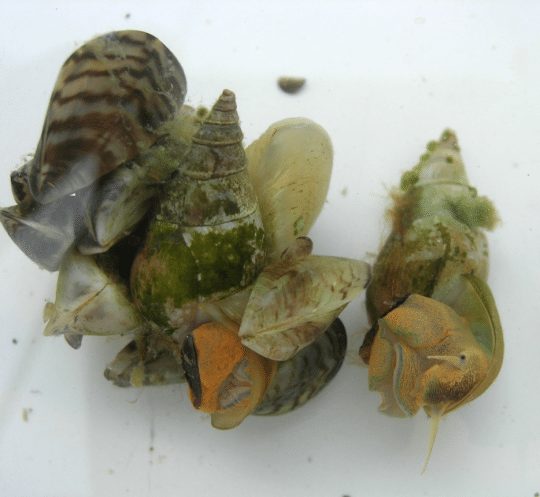
The economic and ecological devastation caused by zebra mussels is legendary. Zebra mussels make threads (byssal threads) for attaching to hard objects. They clog intake pipes of city water supplies and power station cooling pipes, requiring costly removal. They compete with native mussels and young fish for food and can smother or hinder movements of our native mussels, snails (Fig. 1), and crayfish when they settle in large numbers.
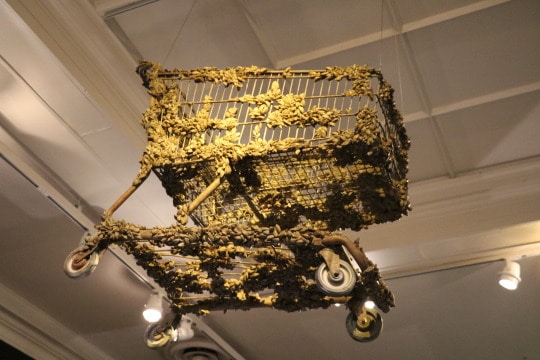
A noteworthy item that became encrusted with zebra mussels is a shopping cart that was dredged out of Lake Superior in 2012. A replica of the shopping cart was on display during the We Are Nature exhibit at Carnegie Museum in 2018 (Fig. 2).
Lest you think I am biased against zebra mussels, I will note two possibly positive things you can say about them. First, they filter water efficiently and because they pump up to a liter (quart) per day, they cleaned up the formerly polluted water in Lake Erie. But even that can be negative, because they removed so much plankton from the water that our native species now have a hard time finding enough to eat. Second, because zebra mussels selectively concentrate certain toxic metals, including uranium, they have potential to be used in bioremediation efforts to clean water of this radioactive pollutant (Immel et al. 2016). But those are the only good things you can say about them. Mostly, they wreak havoc.
Literature Cited
Immel, F., Broussard, C., Catherinet, B., Plasseraud, L., Alcaraz, G., Bundeleva, I. & Marin, F. 2016. The shell of the invasive bivalve species Dreissena polymorpha: biochemical, elemental and textural investigations. PloS One, 11(5): e0154264. https://doi.org/10.1371/journal.pone.0154264
Timothy A. Pearce, PhD, is the head of the mollusks section at Carnegie Museum of Natural History. Museum employees are encouraged to blog about their unique experiences and knowledge gained from working at the museum.
Related Content
Oysters Swim Towards a Siren Soundscape
Slowest Process Ever Observed: A Trillion Times Longer Than the Age of the Universe
