• Skip to primary navigation
  • Skip to main content
  • Skip to primary sidebar

Carnegie Museum of Natural History

One of the Four Carnegie Museums of Pittsburgh

  • Visit
    • Buy Tickets
    • Visitor Information
    • Exhibitions
    • Events
    • Dining at the Museum
    • Celebrate at the Museum
    • Powdermill Nature Reserve
    • Event Venue Rental
  • Learn
    • Field Trips
    • Educator Information
    • Programs at the Museum
    • Bring the Museum to You
    • Guided Programs FAQ
    • Programs Online
    • Climate and Rural Systems Partnership
  • Research
    • Scientific Sections
    • Science Stories
    • Science Videos
    • Senior Science & Research Staff
    • Museum Library
    • Science Seminars
    • Scientific Publications
    • Specimen and Artifact Identification
  • About
    • Mission & Commitments
    • Directors Team
    • Museum History
  • Tickets
  • Give
  • Shop

Anthropocene

January 2, 2019 by wpengine

Earth History in Your Hand

By Gil Oliveira

© Chart: The Conversation, CC-BY-ND

In my previous blog, I wrote about the last Jurassic World movie, which ends with the rise of a new fictional Jurassic Age, where humans and dinosaurs must learn to coexist. The Jurassic is one of the most famous geological time-periods. But when exactly was the Jurassic? The Jurassic Period ran from 200 to 145 million years ago. A long time ago… To put it into perspective, the origin of our species, Homo sapiens, dates back approximately 300 thousand years ago, which also seems a long time ago, but represents only 0.007% of the entire history of the planet (4.5 billion years)! What happened on Earth the 99.993% of the time when we did not yet even exist?

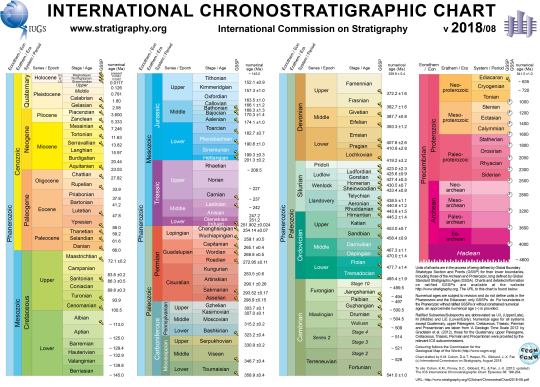
To understand earth history, natural history museums travel back through time. To do this they use a communication tool called the Geological Time Scale. In the same way we measure time with segments (such as years, months, weeks, and days), geologists subdivide deep time into useable, agreed upon units (eons, eras, periods, epochs, and ages).
chronostratigraphic chart
© ICS: http://www.stratigraphy.org, CC BY-NC-ND

But the Geological Time Scale is not exactly a calendar, because these time intervals are not equal in length like the hours in a day. Instead, divisions are based on significant events in the history of the Earth, that are detectable in rock, fossil and ice records, such as the extinction of the dinosaurs 66 million years ago, which defines the beginning of the Cenozoic era.

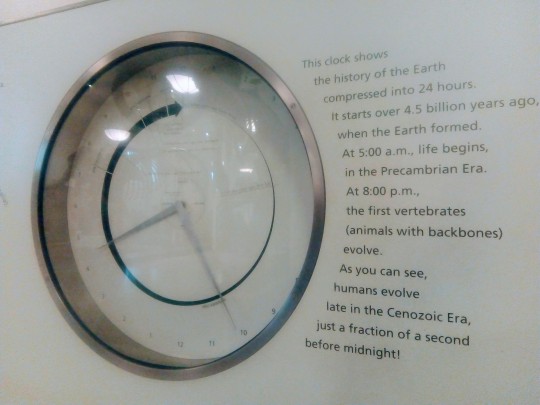
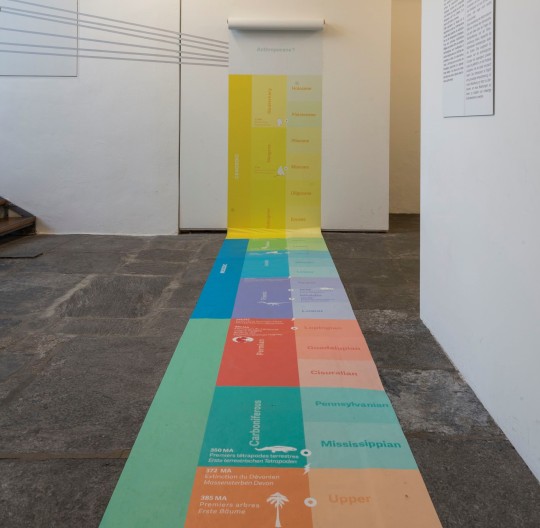
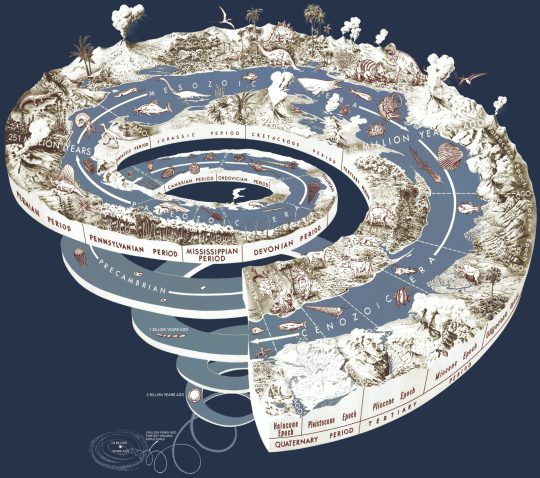
Museums don’t seek to teach the official chart of geologic time. But they seek to teach about deep time and the planet’s history, helping to put current times into a longer historical context. Museums use different techniques to make the geological time scale comprehensible. One approach is linear and usually consists of a strip of paint that represents the geological time scale rolled out on a surface. It was used for instance in the Objective Earth: Living in the Anthropocene exhibition at the Valais Nature Museum (Switzerland), which rolled out a linear poster around 30 feet long on the ground (and the wall). A second approach I have seen is more focused on aesthetics and takes the form of a spiral of time. Another technique is to take the age of the Earth and compress it into one year or one day. The American Museum of Natural History in New York used this approach with a 24-hour clock. The label indicates that life began at 5 am and the first vertebrates evolved at 8 am. As for the humans, they appeared just a fraction of a second before midnight.
Objective Earth. Living the Anthropocene © Robert Hofer


illustration of deep time
© USGS https://pubs.usgs.gov/gip/2008/58/


clock illustrating deep time
© Gil Oliveira

Each approach has benefits and disadvantages. The Geologic Time Spiral for instance can be visually striking, but the perspective of the spiral’s depth runs the risk to lose any perception of the proportion of geological time, which is the main information. It may also give a false impression of accelerating events (geological, biological, climatic, human) as we move closer to the present.

In 2007, the Cuvier Museum in Montbeliard (France) came up with a new way to represent the geological time scale. Thierry Malvesy, now curator of Geology Collections at the museum of natural history of Neuchatel (Switzerland), did it using cubes of different volumes. The advantage is to respect the proportions of time while allowing the public to see everything at a glance. It was used to explain the principle of biological evolution, emphasizing the importance of time in the evolution of life.
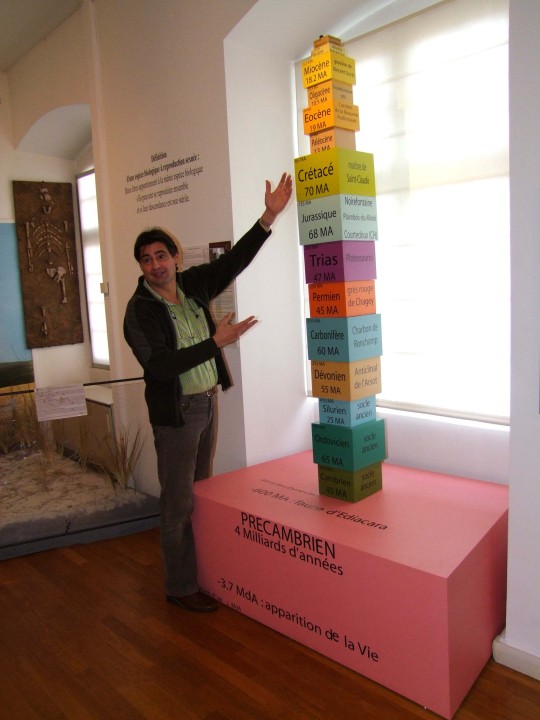
Cuvier Museum, 2007 © Thierry Malvesy

What is the best way to make the geological time scale understandable? There’s no easy answer. Each approach is a compromise in a way. The dinosaurs exhibit at the Smithsonian’s National Museum of Natural History uses both the spiral and the linear approach. This choice may only be temporary, as the new hall called The David H. Koch Hall of Fossils—Deep Time will open in less than a year. I wonder which approach they will use to help visitors connect to Earth’s distant past?
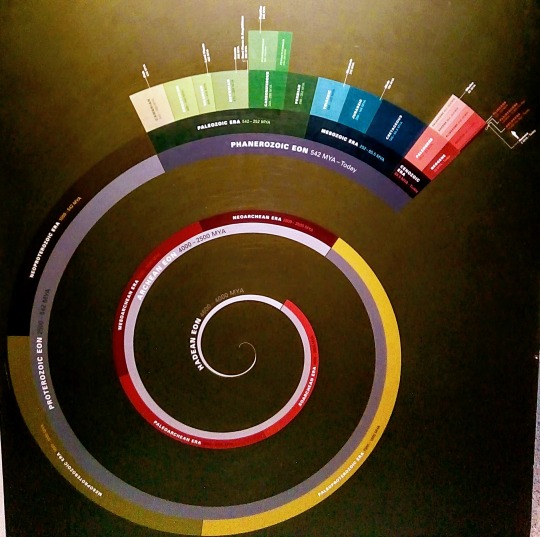
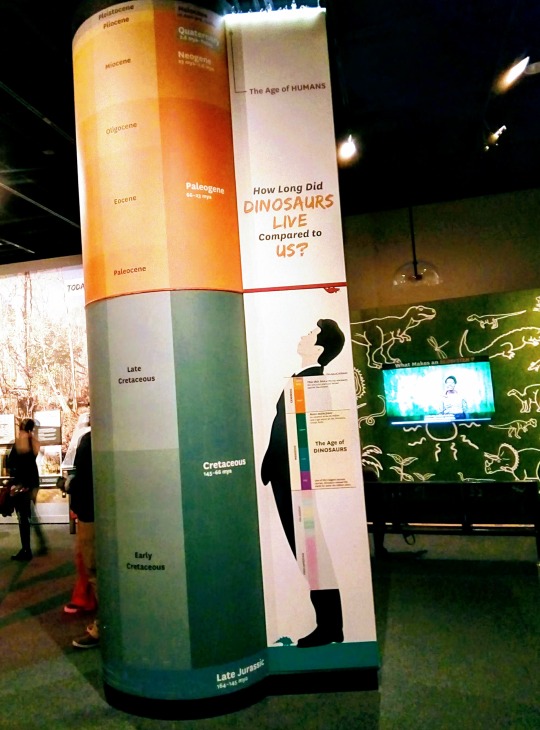
illustration of deep time
© Gil Oliveira

how long did dinosaurs live compared to us?
© Gil Oliveira


As the Carnegie Museum of Natural History is embracing the Anthropocene as a major theme for the future, it is important to place this newly proposed epoch in deep time. It is equally important for museums to find the best way to do it.

Gil Oliveira is postgraduate student working as an intern in the Section of the Anthropocene at the Carnegie Museum of Natural History. Museum employees are encouraged to blog about their unique experiences working at the museum.

Filed Under: Blog Tagged With: Anthropocene, Anthropocene Living Room, Gil Oliviera, museums

October 22, 2018 by wpengine

This is not about the Anthropocene, or is it?

by Gil Oliveira

“How many times do you need to see the evidence? How many times must the point be made? We’re causing our own extinction. Too many red lines have been crossed. […] We’re going to have to adjust to new threats we can’t even imagine. We’ve entered a new era.”

This is not about climate change, mass extinction, or ocean acidification. Rather, this quote comes from the closing scene of the recent movie Jurassic World: Fallen Kingdom. It’s about the beginning of a new fictional Jurassic-Age, where humans and dinosaurs must learn to coexist.

sunset

The final scene is visually spectacular. But what really caught my attention was the idea connecting dinosaurs and a new era. Similarly, the Anthropocene is a newly proposed time period when geological and human timescales are colliding. It entails Earth’s distant past, and also invites us to consider our actions and decisions in light of their effects long into the future. In order to link past, present and future, and make sense of it, humans construct narratives.

In a time of uncertainty, when we are indeed crossing red lines at the planetary scale in real life, one can’t help but wonder what will the future look like? What narratives do we need to live better in this new world? At their most fundamental level, narratives speak about the human condition (and its limits), so how can we better understand the role of humans as actors capable of affecting the entire Earth System?

Yuval Noah Harari, the author of Sapiens. A Brief History of Humankind, posits that humans rule the world because they are the only animal that can cooperate flexibly in large numbers (see Harari’s website). But, he asks, what is the mysterious glue that enables millions of us to cooperate seemingly more effectively than other animal societies. The glue, he argues, is the stories we tell ourselves. It is our ability to create and believe in fiction. As Jonathan Gottschall puts it: sapiens are “the great ape with the storytelling mind.”

Humans use stories to understand the world. You and I think in them. Today, dominant cultural narratives gravitate around unlimited technology, endless progress and growth, and ferocious competition. Museums have not been spared. They too have been telling stories, focused on the law of the jungle and the survival of the fittest, on nature as a realm distinct from human life, on the progress of evolution and humans as its most highly evolved product. These imaginaries have contributed to shape our representations of the world. They shape our attitudes, our beliefs, our behaviors.

Coming back to Jurassic World: Fallen Kingdom, the last scene shows a scientist appearing before a congressional committee and declaring that “Humans and Dinosaurs are now going to be forced to co-exist. These creatures were here before us and if we’re not careful they’re going to be here after.” This new pretend era seems to be characterized by a dependence between dinosaurs and humans, and humility regarding the human place in the world.

This moral may have relevance to the Anthropocene. The stories we tell and consume shape us profoundly. Stories can help us connect with the non-human world. Like science fiction, museums too are powerful spaces for storytelling. They hold great potential for generating new stories and sensibilities that may help adapt our understanding and connection to nature to better serve us in confronting the challenges of the Anthropocene.

Gil Oliveira is a postgraduate student working as an intern in the section of the Anthropocene at the Carnegie Museum of Natural History. Museum employees are encouraged to blog about their unique experiences working at the museum.
Filed Under: Blog Tagged With: Anthropocene, climate change, dinosaurs, extinction

October 1, 2018 by wpengine

A Day at the Beach: The Anthropocene on Vacation

by Bob Jones

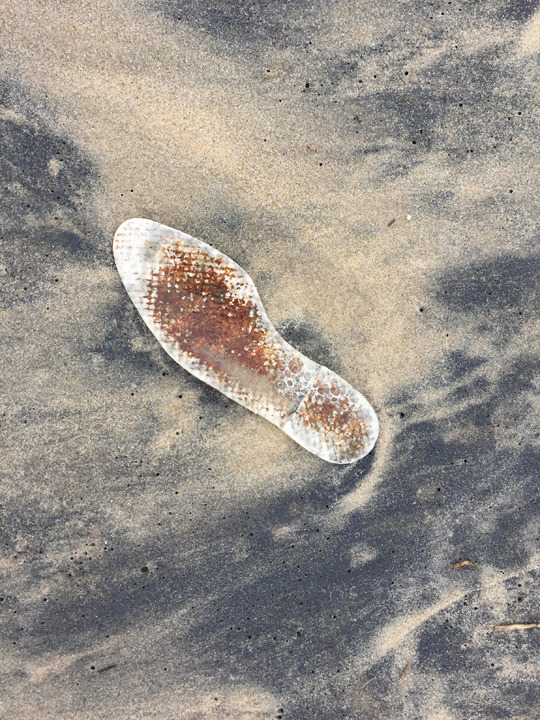
shoe insole on the beach

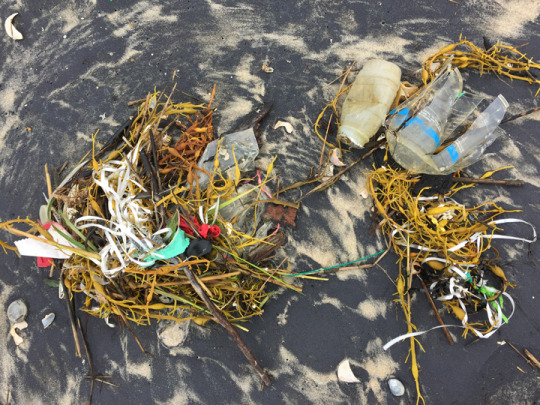
While on vacation, my wife and I took a morning walk on the beach to enjoy the sights and sounds of the surf while getting some exercise. The beach was mostly empty this morning and the sky was grey with the storm warnings of Hurricane Florence approaching to the south of our location in Delaware. It didn’t take long to notice a disturbing sight as we made our way on the sand. Plastic trash and lots of it. Bottles, bottle caps, beach toys, cups, straws, food containers, shoes, insoles, cigar tips and lots more. From a distance things look fine. Some clumps of seaweed on the sand. Just another day at the beach. Upon closer inspection, there are a wide variety of multi-colored bits of debris mixed throughout the tangles.

litter and seaweed on the beach

Since participating in the recent exhibition We Are Nature: Living in the Anthropocene at the Carnegie Museum of Natural History my awareness of our impact on the world that we inhabit has been raised to a new level. Of course, I’ve noticed trash on the beach in years past but the gradual increase over time is insidious in its’ nature. It creeps up on you slowly, so you hardly notice. It’s a bit like the metaphor of boiling a frog. The premise is that if a frog is put suddenly into boiling water, it will jump out, but if the frog is put in tepid water which is then brought to a boil slowly, it will not perceive the danger and will be cooked to death. I used to be more aware of avoiding stepping on jagged seashells, but now I find myself avoiding treading on the trash left on and washed up on the beach.

Don’t get me wrong, it’s not yet at an epidemic proportion at this location, but why wait until it reaches that point to act? To be honest, I couldn’t tell you if it was this bad last year or if I’m more conscious of it now. Either way, I want to share my experience and hopefully encourage others to make improvements wherever we can. After taking pictures to document the situation I felt the need to grab a trash bag and start collecting the debris for disposal. I realize that this is a big problem and it is easy to become overwhelmed. My first response is disgust and anger at the lack of care and respect that people give to the environment. My next response is, “What’s the use? Even If I bag this up it’s just sending the problem to another location.” My best response is to act with a purpose. I know that I’m just one person, but if one person can influence one other, ten others, a hundred others, to make a positive change then we have the potential to create a movement. With enough momentum, we can hold back the tide of trash and plastic that is choking our oceans and rivers.

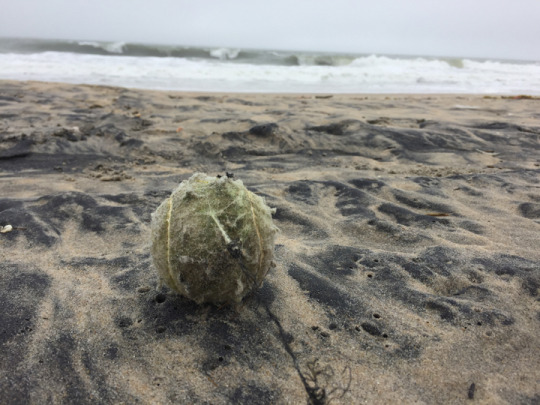
tennis ball on the beach

I am old enough to remember when the air in Pittsburgh was so bad that it was impossible to see 100 feet ahead in the morning because of all the pollution released from the mills during the night. As a boy, I used to think that the buildings in downtown and Oakland were constructed with black stone because of the amount of soot built up on their surface. I was amazed when they were sandblasted in the 1980s and 90’s to reveal the brightness of the granite that lay beneath the layer of grime. The Monongahela River was thick with sludge and garbage being dumped into the water rendering it unsafe to swim in. My brother and I used to fish from the shore in the SouthSide snagging way more old tires and junk than fish. The only fish in the rivers were carp and catfish. Today, they hold tournaments to catch bass in the three rivers. That is a phenomenal improvement. In the last forty years, we have made tremendous improvements by addressing what the problem is and taking corrective action.

It is up to each one of us to not only recognize the problems that we face, but to seek and apply solutions to put things right. I was taught that when spending any time in nature I should leave things in better condition than I found them. The simple act of picking up trash and erasing any signs that I had been there is a step in the right direction. The importance of leaving the environment in good shape so the next person can enjoy the wonders of nature, as it is intended. Working together we can make a difference.

Bob Jones is the Print Shop Manager at the Carnegie Museum of Natural History. Museum employees are encouraged to blog about their unique experiences and knowledge gained from working at the museum.

Filed Under: Blog Tagged With: Anthropocene, Bob Jones, climate change, pollution

September 17, 2018 by wpengine

Combating Climate Change with Plants

by Steve Tonsor

aster

It is easy for everyone to overlook plants as being at the heart of Earth’s carbon and oxygen cycles; they are simply background and decoration as the default for many.  Yet they make the planet livable by producing atmospheric Oxygen and the ozone layer that reduces ultraviolet light to livable levels.  They scrub carbon dioxide and use the carbon to store the sun’s energy in molecules that are the basis of food, fuel, and fiber, nearly everything we use in one way or another.  They are also the most cost-effective way of sequestering carbon and reducing global change.

To understand the issue we are having with greenhouse gasses is to understand the carbon cycle. To understand the carbon cycle is to understand what plants do.

Growing more plants, by tending them ourselves and supporting organizations that do, is a low-cost way to make a positive contribution to the carbon cycle. It’s a method of combating climate change implementable on any scale you choose from backyard to continental.

Learn more about why low-cost, easy to implement ways to reduce climate change are critical in “A low-tech method for comabting climate change” from The Washington Post.

Steve Tonsor is Director of Science and Research at the Carnegie Museum of Natural History. Museum employees are encouraged to blog about their unique experiences and knowledge gained from working at the museum.

Filed Under: Blog Tagged With: climate change, plants

  • « Go to Previous Page
  • Page 1
  • Page 2
  • Page 3

sidebar

About

  • Mission & Commitments
  • Directors Team
  • Museum History

Get Involved

  • Volunteer
  • Membership
  • Carnegie Discoverers
  • Donate
  • Employment
  • Events

Bring a Group

  • Groups of 10 or More
  • Birthday Parties at the Museum
  • Field Trips

Powdermill

  • Powdermill Nature Reserve
  • Powdermill Field Trips
  • Powdermill Staff
  • Research at Powdermill

More Information

  • Image Permission Requests
  • Science Stories
  • Accessibility
  • Shopping Cart
  • Contact
  • Visitor Policies
One of the Four Carnegie Museums | © Carnegie Institute | Privacy Policy | Terms of Use | Accessibility
Rad works here logo