• Skip to primary navigation
  • Skip to main content
  • Skip to primary sidebar

Carnegie Museum of Natural History

One of the Four Carnegie Museums of Pittsburgh

  • Visit
    • Buy Tickets
    • Visitor Information
    • Exhibitions
    • Events
    • Dining at the Museum
    • Celebrate at the Museum
    • Powdermill Nature Reserve
    • Event Venue Rental
  • Learn
    • Field Trips
    • Educator Information
    • Programs at the Museum
    • Bring the Museum to You
    • Guided Programs FAQ
    • Programs Online
    • Climate and Rural Systems Partnership
  • Research
    • Scientific Sections
    • Science Stories
    • Science Videos
    • Senior Science & Research Staff
    • Museum Library
    • Science Seminars
    • Scientific Publications
    • Specimen and Artifact Identification
  • About
    • Mission & Commitments
    • Directors Team
    • Museum History
  • Tickets
  • Give
  • Shop

Who put the Smile in Smilax?

by John Wenzel

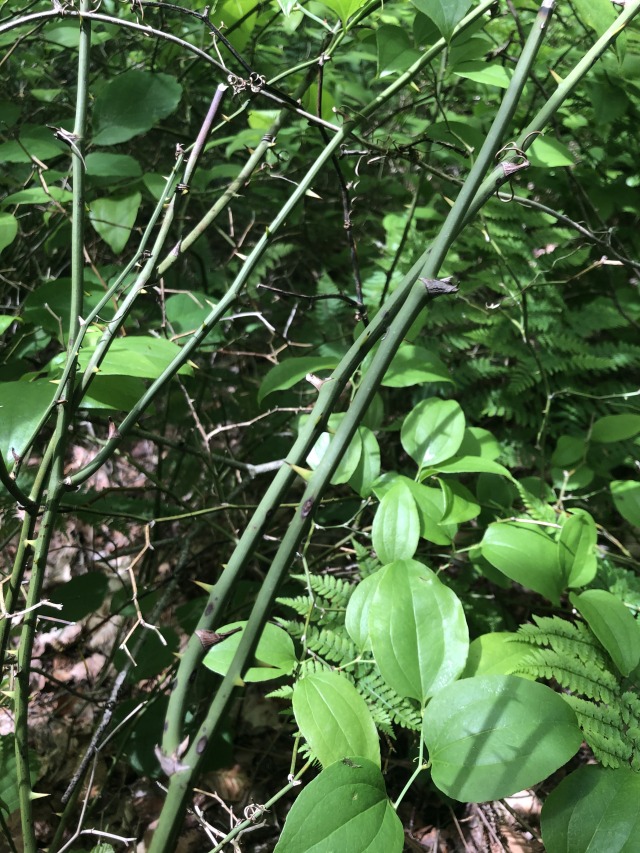
Smilax plants

The genus Smilax is one of our most common woodland plants. Known as greenbriar, sweetbriar, or catbriar, there are about 20 species in North America, and about 300 world-wide. Technically, the plant is defended by “prickles,” which are outgrowths of the outer tissue of the stem, and not “thorns,” which are modified woody branches, as are found on hawthorn or locust trees. By contrast, “spines,” as found in cactuses, are actually modified leaves. Male and female Smilax flowers occur on different plants, with females producing dense bunches of showy black, blue, or red berries. Some species are deciduous and some are evergreen. Light loving, they are typical of disturbed habitats, and will climb up and over shrubs, up to 30 feet high. The green stems have chlorophyll, meaning that even if deer eat all the leaves, the plants will continue to photosynthesize and survive.

Thickets of briars that have their tops bitten off are an indication of severe browsing by deer. When deer densities are high, other plants may be browsed out entirely, leaving behind an understory composed of only briars and a few plants deer do not eat, such as ferns. Briars may provide good cover for small mammals to escape from larger predators, as is related in Uncle Remus’ African folktales of Bre’r Rabbit. The stout prickles have different orientations along a stem and can be difficult to remove if more than one pierces the skin at the same time. Getting into (and out of!) a briar thicket is a very sticky situation, as we have inadvertently demonstrated after a minor slip-and-fall in the woods!

Close up of man's face with blood on it after injury from briar prickles.

John Wenzel is the Director at Powdermill Nature Reserve, Carnegie Museum of Natural History’s environmental research center. Museum employees are encouraged to blog about their unique experiences and knowledge gained from working at the museum.

Related Content

Can’t Touch This

Expanding the Scope of Environmental Education

Called On This Day in 1982: One Specimen Isn’t Always Enough

Carnegie Museum of Natural History Blog Citation Information

Blog author: Wenzel, John
Publication date: June 14, 2021

Share this post!

  • Share on Twitter Share on Twitter
  • Share on Facebook Share on Facebook
  • Share on Pinterest Share on Pinterest
  • Share on LinkedIn Share on LinkedIn
  • Share on Reddit Share on Reddit
  • Share via Email Share via Email

Share this post!

  • Share on Twitter Share on Twitter
  • Share on Facebook Share on Facebook
  • Share on Pinterest Share on Pinterest
  • Share on LinkedIn Share on LinkedIn
  • Share on Reddit Share on Reddit
  • Share via Email Share via Email

sidebar

About

  • Mission & Commitments
  • Directors Team
  • Museum History

Get Involved

  • Volunteer
  • Membership
  • Carnegie Discoverers
  • Donate
  • Employment
  • Events

Bring a Group

  • Groups of 10 or More
  • Birthday Parties at the Museum
  • Field Trips

Powdermill

  • Powdermill Nature Reserve
  • Powdermill Field Trips
  • Powdermill Staff
  • Research at Powdermill

More Information

  • Image Permission Requests
  • Science Stories
  • Accessibility
  • Shopping Cart
  • Contact
  • Visitor Policies
One of the Four Carnegie Museums | © Carnegie Institute | Privacy Policy | Terms of Use | Accessibility
Rad works here logo
