• Skip to primary navigation
  • Skip to main content
  • Skip to primary sidebar

Carnegie Museum of Natural History

One of the Four Carnegie Museums of Pittsburgh

  • Visit
    • Buy Tickets
    • Visitor Information
    • Exhibitions
    • Events
    • Dining at the Museum
    • Celebrate at the Museum
    • Powdermill Nature Reserve
    • Event Venue Rental
    • Gift Cards
  • Learn
    • Field Trips
    • Educator Information
    • Programs at the Museum
    • Bring the Museum to You
    • Guided Programs FAQ
    • Programs Online
    • Climate and Rural Systems Partnership
  • Research
    • Scientific Sections
    • Science Stories
    • Science Videos
    • Senior Science & Research Staff
    • Museum Library
    • Science Seminars
    • Scientific Publications
    • Specimen and Artifact Identification
  • About
    • Mission & Commitments
    • Directors Team
    • Museum History
  • Tickets
  • Give
  • Shop

January 10, 2023 by

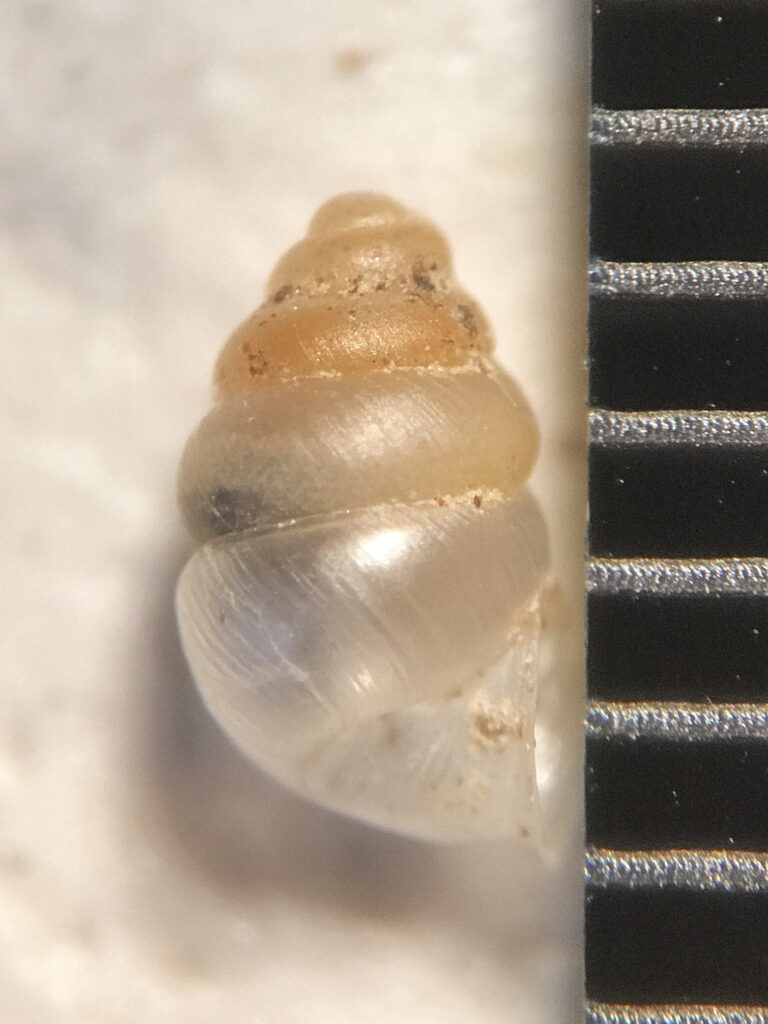
Gastrocopta contracta

Image Usage Information

  • David Lang
  • CC BY-NC 4.0 DEED
  • Additional information about this specimen

Family: Gastrocoptidae

Common name: Bottleneck Snaggletooth

Discovery: Say, 1822

Identification

Height: ~2.3 mm
Width: ~1.2 mm
Whorls: 5

This animal has a whitish, cone-shaped shell with a fine radial microsculpture. The final whorl narrows before it expands widely at the aperture, which is crowded with five irregular lamellae. This species is easily distinguished from all other eastern Gastrocopta species by its strongly conical shell and folded, sheet-like parietal lamella in the center of the aperture (Nekola & Coles, 2010).

Ecology

Gastrocopta contracta occurs in leaf litter and under logs in a wide range of habitats, ranging from mesic to wet, and forested to open. Although occurring in higher numbers in base-rich sites, it is also frequently present in base-poor locations (Nekola & Coles, 2010). In Tennessee this species was found in a wide variety of habitats but had an affinity for neutral soils and late stages of forest succession (Coney et al., 1982).

Taxonomy

Synonyms for this animal’s name include Pupa contracta, P. deltostoma, P. nebraskana (Pilsbry, 1948), Gastrocopta contracta climeana.

Distribution

Gastrocopta contracta is one of the most wide-spread eastern North American pupillids (pupa-shaped shells), ranging from southeastern New Mexico and southern Manitoba east to northern Maine and the Florida Keys. It also extends south to Cuba, Jamaica and Veracruz in Mexico (Pilsbry, 1948).

In Virginia this species has been reported from many parts of the state. Its apparent absence from the Piedmont is almost certainly due to under-reporting.

Conservation

NatureServe Global Rank: G5, Secure.
January 10, 2023 by

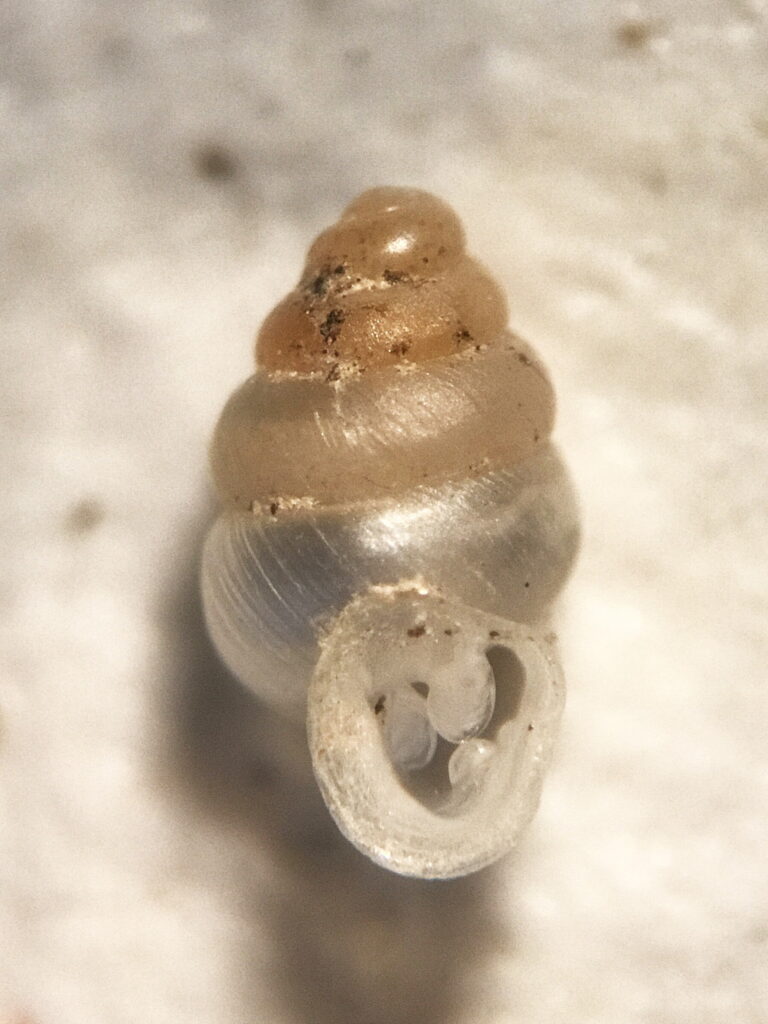
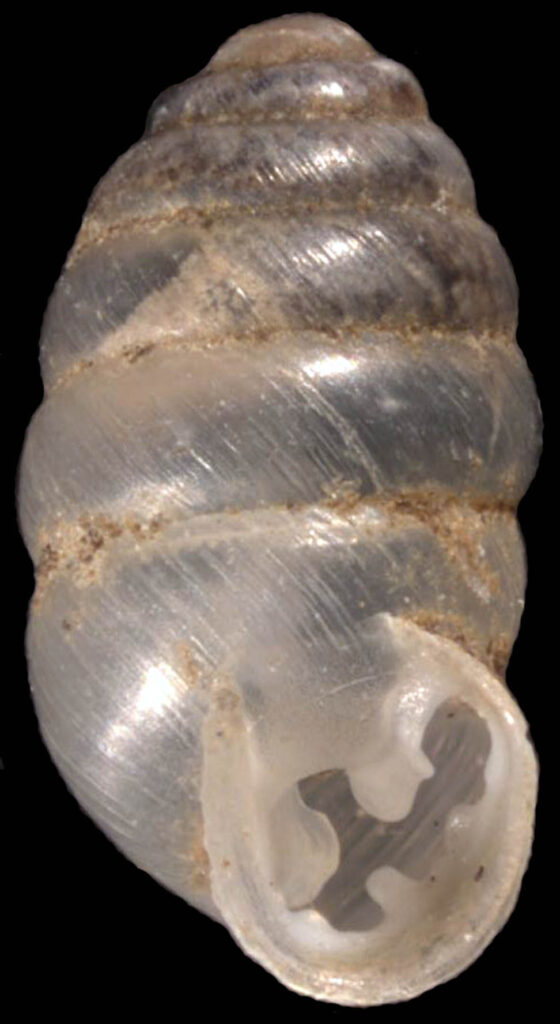
Gastrocopta clappi

Image Usage Information

  • Jeff Nekola
  • CC BY-NC 4.0 DEED

Family: Gastrocoptidae

Common name: Bluegrass Snaggletooth

Discovery: Sterki, 1909

Identification

Height: ~3.7 mm
Width: ~1.9 mm
Whorls: 6-7

This species and Gastrocopta armifera are easily distinguished by their tall, white-clear shells that are at least 3.5 mm tall. Gastrocopta clappi can be separated from the very similar G. armifera by its sheet or plate-shaped columellar lamella, which is more deeply inserted into the shell on its bottom side (Hubricht, 1972).

Ecology

Gastrocopta clappi is restricted to dry (xeric) limestone glades and grasslands, where it occurs around the base of grass clumps and under sparse vegetation and rock slabs.

Taxonomy

Synonyms for this animal’s name include Gastrocopta armifera clappi.

Distribution

This animal has one of the most limited ranges for any North American pupillid land snail, being known only from west of the Blue Ridge from western Virginia and Alabama, to central Kentucky and the Nashville Basin in Tennessee (Nekola & Coles, 2010). In Virginia this species is limited to cedar glade habitats in the far western counties. Museum records north of western Virginia warrant verification.

Conservation

NatureServe Global Rank: G4/G5, Secure.
NatureServe State Global Rank: Virginia, S1S2,Iimperiled.
Virginia’s wildlife action plan: Tier III

January 10, 2023 by

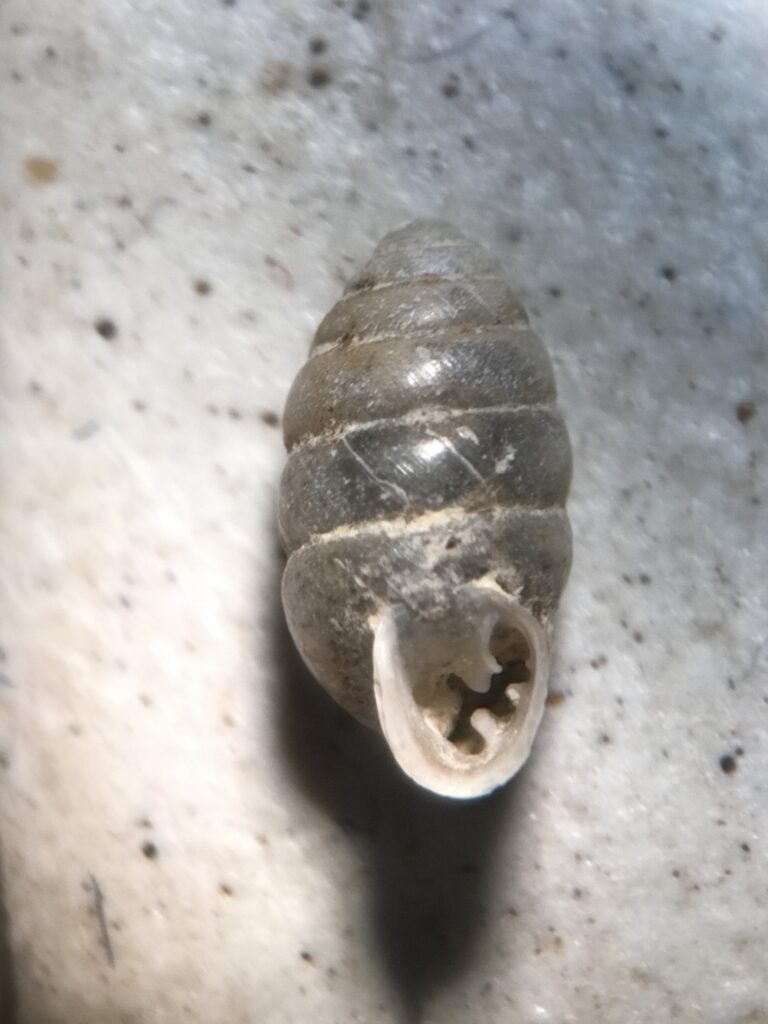
Gastrocopta armifera

Image Usage Information

  • David Lang
  • CC BY-NC 4.0 DEED
  • Additional information about this specimen

Family: Gastrocoptidae

Common name: Armed Snaggletooth

Discovery: Say, 1821

Identification

Height: ~4.7 mm
Width: ~2.5 mm
Whorls: 7

Gastrocopta armifera is the largest member of its genus.  Along with Gastrocopta clappi and Gastrocopta similis, these three species are distinguished from all other pupa-shaped land snails in Virginia by possessing a clear to white shell more than 3.5mm tall. Gastrocopta armifera is most easily separated from G. clappi and G. similis by the shape of the columellar lamella (on the left side of the aperture), which in G. armifera is roughly pyramidal in shape (Hubricht, 1972).

Ecology

This calcium-loving species is found in leaf litter accumulations on bedrock glades, rich rocky woodlands, and floodplain forests. Shells may be encountered on small limestone ledges or at the foot of limestone outcrops.

Taxonomy

Synonyms for this animal’s name include Pupa armifera and Bifidaria armifera.

Distribution

Gastrocopta armifera ranges from the Ozarks and southeastern Minnesota, east to the Piedmont of Georgia, the coastal plain of Virginia, and the Lake Champlain valley of northern Vermont (Nekola & Coles, 2010). In Virginia this species has been reported across the entire state.

Conservation

NatureServe Global Rank: G5, Secure.
January 10, 2023 by

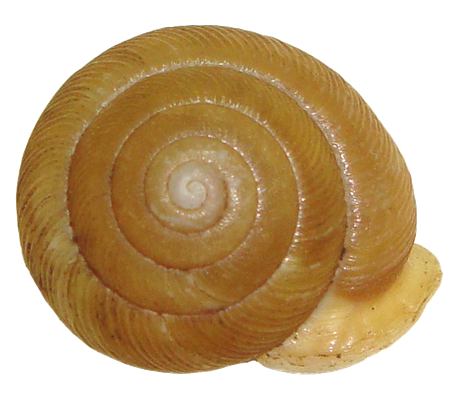
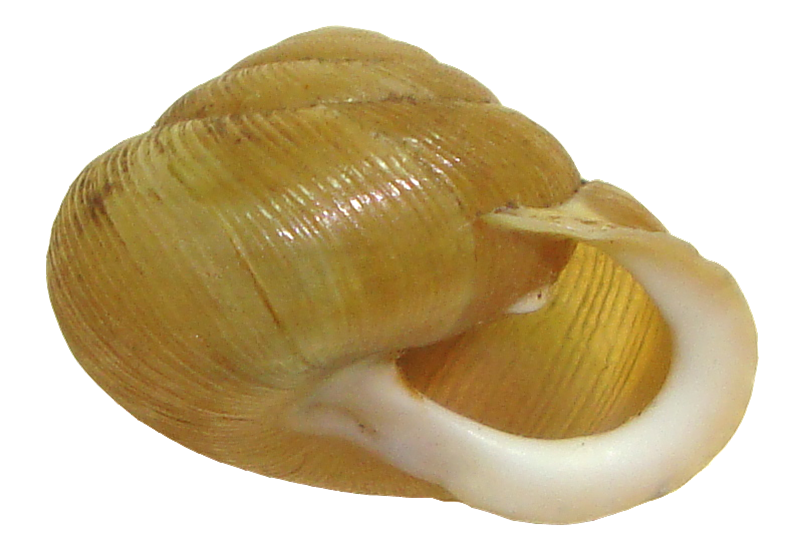
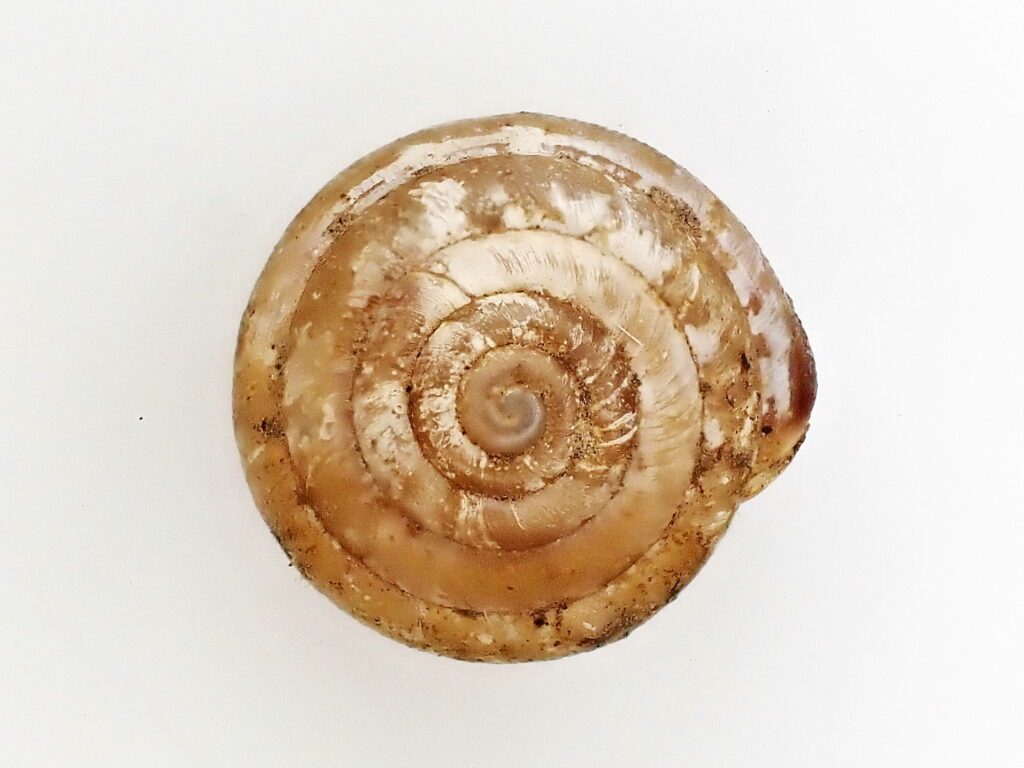
Fumonelix whealteyi

Image Usage Information

  • Dan Dourson
  • CC BY-NC 4.0 DEED

Family: Polygyridae

Common name: Cinnamon Covert

Discovery: Bland, 1860

Identification

Width: 14.5-18.0 mm
Height: 9.5-12.0 mm
Whorls: 5+

Fumonelix wheatleyi has a brown, cinnamon-colored shell with strong radial striae that give the shell a textured feel. Its umbilicus is open, and the aperture has a widely-reflected lip and a small bump-like parietal tooth. There are no spiral lines, and adult shells do not have hairs, though immature shells may.

Ecology

This is a snail that lives above 2,000’, including mountain summits. It may be found under rocks, logs, and leaf litter (Hubricht, 1985). In the Smoky Mountains it is found in a variety of habitats (Dourson & Dourson, 2007).

Taxonomy

Synonyms for F. wheatleyi include: Helix wheatleyi, Mesodon wheatleyi, and Polygyra wheatleyi.

Distribution

Fumonelix wheatleyi is known from Georgia to Virginia, and there is a rare subspecies F. w. clingmanicus in the Great Smoky Mountains. In Virginia, specimens from Grayson and Smyth Counties have been identified as this subspecies, possibly mistakenly.

Conservation

NatureServe Global Rank: G4
NatureServe State Rank: Virginia, S1/S2 Imperiled(for F. w. clingmanicus, possibly in error)
Virginia’s wildlife action plan: Tier III (for F. w. clingmanicus)

January 10, 2023 by

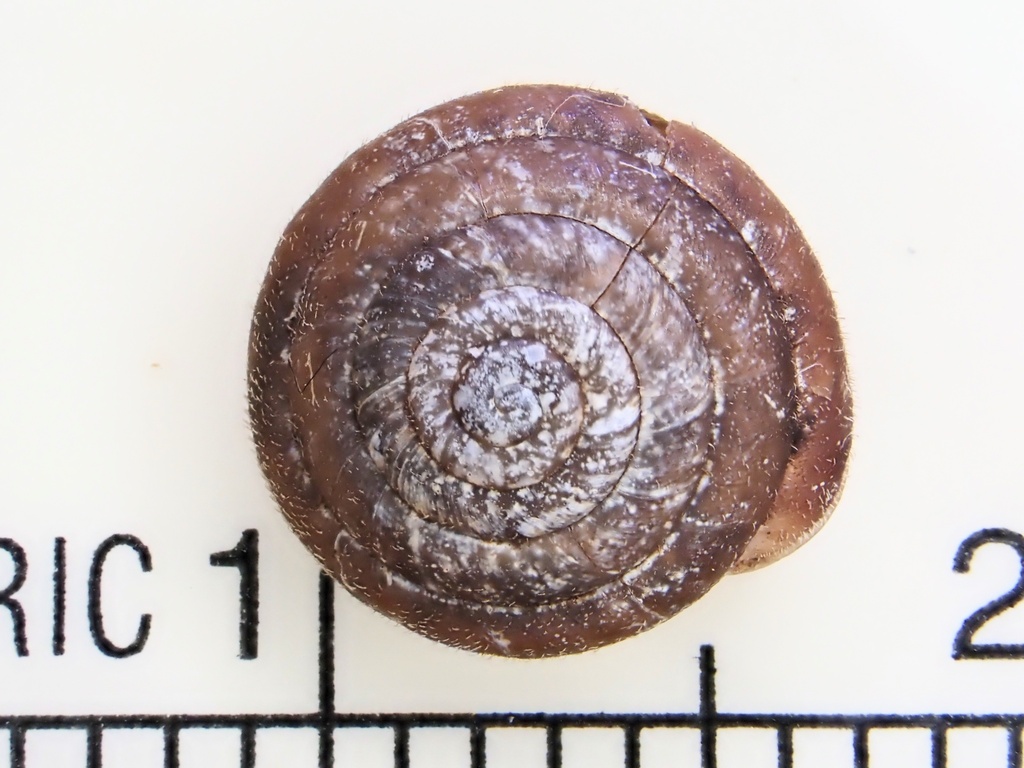
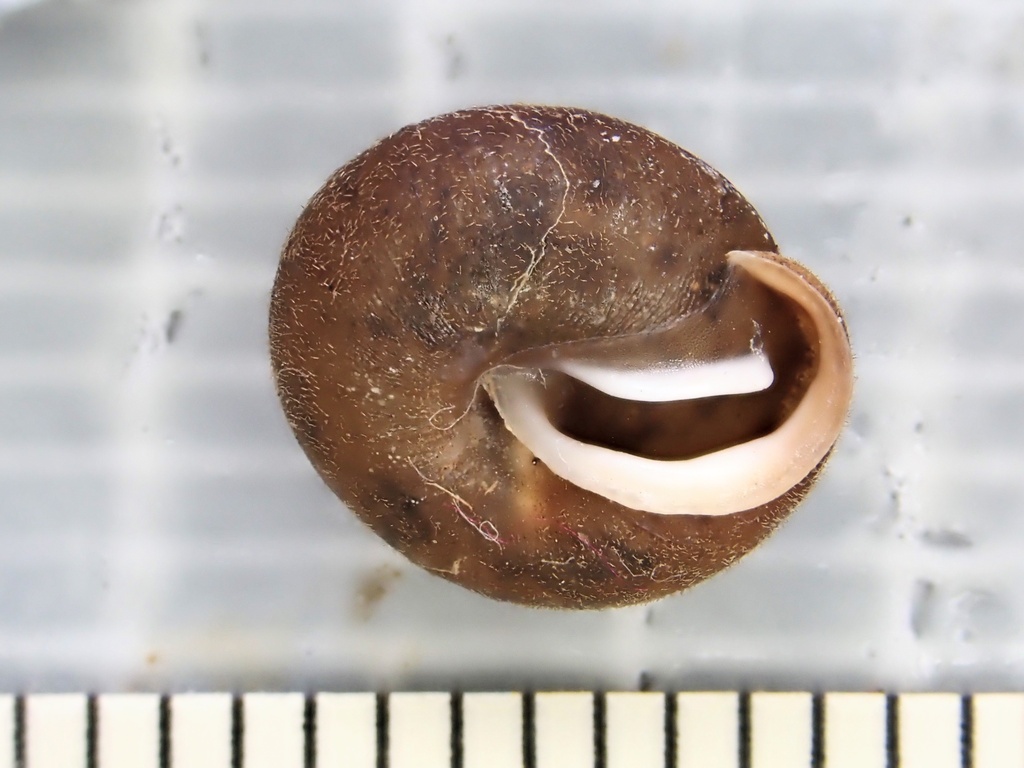
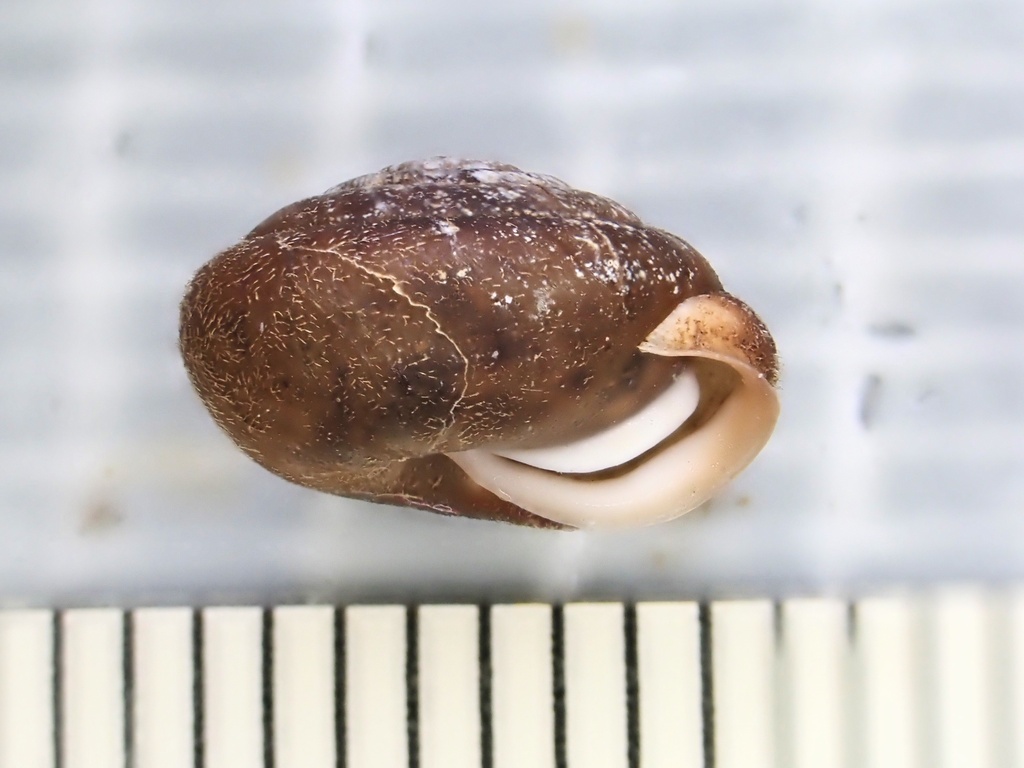
Euchemotrema leaii

Image Usage Information

  • MC Barnhart
  • CC BY-NC 4.0 DEED
  • Additional information about this specimen

Family: Polygyridae

Common name: Lowland Pillsnail

Discovery: A. Binney, 1841

Identification

Width: 7.0-9.5 mm
Height: 4-6 mm
Whorls: 6+

Euchemotrema leaii has a similar rounded shape to E. fraternum, but it is slightly smaller, smoother and less hairy, and more tightly-whorled, having one more shell revolution. The narrow aperture holds a single blade-like tooth, or lamella. The reflected lip nearly covers the umbilicus.

Ecology

This animal’s habitat is primarily low, wet terrain. Euchemotrema leaii may be found in marshes and swamps, floodplains, and grassy meadows (Hubricht, 1985).

Taxonomy

Synonyms for E. leaii include: Helix leai, H. monodon, Polygyra monodon, P. m. peoriensis, Stenotrema leai, and S. monodon.

Distribution

The Lowland Pillsnail is distributed widely in central North America – from southern Canada and the upper Midwest to the Gulf Coast. The subspecies E. leai leai is recognized to the north, and E. leai aliciae to the south. Specimens are sometimes confused with E. fraternum.

Conservation

NatureServe Global Rank: G5
NatureServe State Rank: Virginia, S1S3
Virginia’s wildlife action plan: Tier IV

January 10, 2023 by

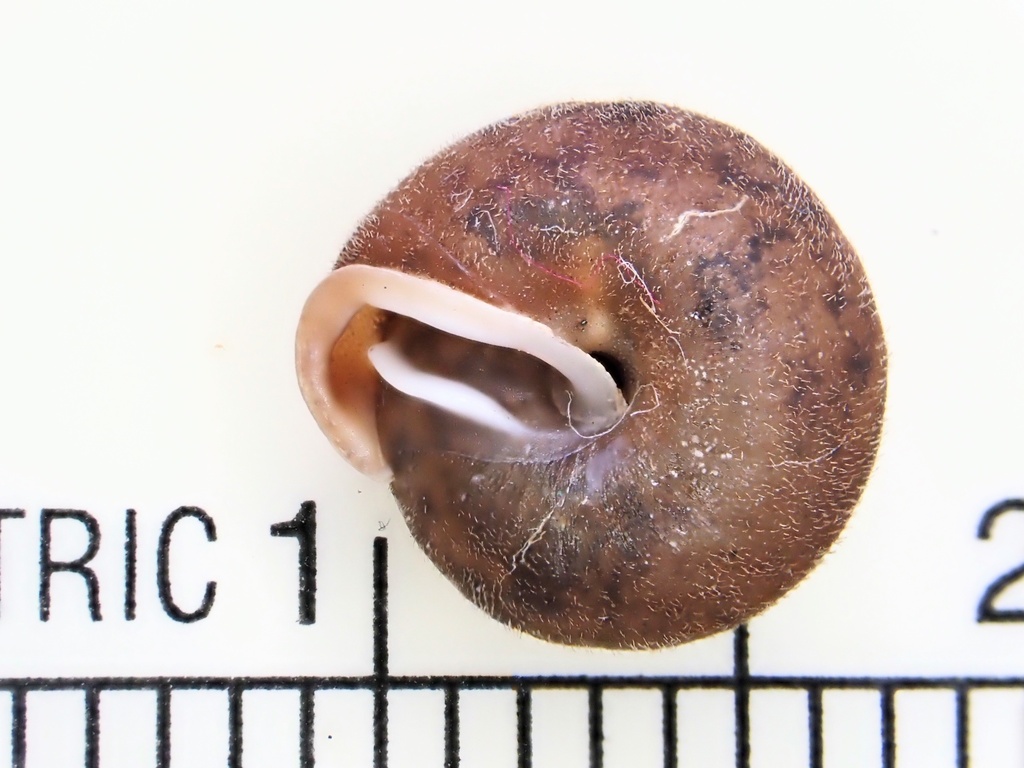
Euchemotrema fraternum

Image Usage Information

  • David Lang
  • CC BY-NC 4.0 DEED
  • Additional information about this specimen

Family: Polygyridae

Common name: Upland Pillsnail

Discovery: Say, 1824

Identification

Width: 9.0 -10.5 mm
Height: 5-7 mm
Whorls: 5+

Euchemotrema fraternum is well-protected against predators, with a thick, round-ish, crush-resistant shell, and a narrow aperture. The shell is covered with fine bristles that may help to camouflage it with a dull, non-reflective texture, and by trapping dust and cobwebs. The aperture holds a single blade-like tooth, or lamella. The reflected lip nearly covers the umbilicus. Live Euchemotrema fraternum are dark brown or dark gray above.

This species is distinguished from E. leai by being more densely hairy, and by having a slit-like umbilicus, while the umbilicus of E. leai is approximately half to two-thirds covered.

Ecology

This animal inhabits relatively higher sites than its close relative Euchemotrema leai. It is a good climber for its small size, sometimes found on maple or beech trunks. It is most often encountered in leaf litter and log debris, and usually at low densities.

Taxonomy

Euchemotrema fraternum has also been known as Helix fraterna, H. convexa, H. monodon, Polygyra fraterna, P. f. var. albida, P. monodon fraternal, and S. monodon.

Distribution

Euchemotrema fraternum occurs from the Midwest and Middle Atlantic states, north to Minnesota and the Canadian Maritimes and south to Louisiana and Mississippi (Hubricht, 1985). In Virginia it is found in western and northern counties.

Conservation

NatureServe Global Rank: G5
In northern Maine this species seems to have declined significantly over the past century and is now uncommon (Nikola, 2008; Hotopp, pers. obs.).

  • « Go to Previous Page
  • Page 1
  • Interim pages omitted …
  • Page 38
  • Page 39
  • Page 40
  • Page 41
  • Page 42
  • Interim pages omitted …
  • Page 53
  • Go to Next Page »

sidebar

About

  • Mission & Commitments
  • Directors Team
  • Museum History

Get Involved

  • Volunteer
  • Membership
  • Carnegie Discoverers
  • Donate
  • Employment
  • Events

Bring a Group

  • Groups of 10 or More
  • Birthday Parties at the Museum
  • Field Trips

Powdermill

  • Powdermill Nature Reserve
  • Powdermill Field Trips
  • Powdermill Staff
  • Research at Powdermill

More Information

  • Image Permission Requests
  • Science Stories
  • Accessibility
  • Shopping Cart
  • Contact
  • Visitor Policies
Stay in the loop! Sign up for our newsletter(s).
One of the Four Carnegie Museums | © Carnegie Institute | Privacy Policy | Terms of Use | Accessibility
Rad works here logo