• Skip to primary navigation
  • Skip to main content
  • Skip to primary sidebar

Carnegie Museum of Natural History

One of the Four Carnegie Museums of Pittsburgh

  • Visit
    • Buy Tickets
    • Visitor Information
    • Exhibitions
    • Events
    • Dining at the Museum
    • Celebrate at the Museum
    • Powdermill Nature Reserve
    • Event Venue Rental
  • Learn
    • Field Trips
    • Educator Information
    • Programs at the Museum
    • Bring the Museum to You
    • Guided Programs FAQ
    • Programs Online
    • Climate and Rural Systems Partnership
  • Research
    • Scientific Sections
    • Science Stories
    • Science Videos
    • Senior Science & Research Staff
    • Museum Library
    • Science Seminars
    • Scientific Publications
    • Specimen and Artifact Identification
  • About
    • Mission & Commitments
    • Directors Team
    • Museum History
  • Tickets
  • Give
  • Shop

Amy Henrici

December 10, 2017 by wpengine

Vertebrate Fossils from Bears Ears National Monument, Utah

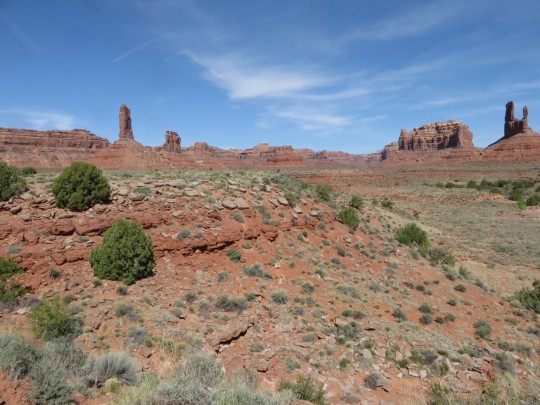
dessert with giat red rocks rising the back
Valley of the Gods area of Bears Ears National Monument.

By Amy Henrici, Collection Manager of Vertebrate Paleontology

You may have noticed that Bears Ears National Monument, southeastern Utah, has been in the National news lately. This vast area of spectacular red rock canyons with Native American ruins was designated in 2016 but is proposed to be reduced by 85%. What hasn’t received much media attention are the Late Paleozoic (~315-280 million years ago) vertebrate fossils collected from this region.

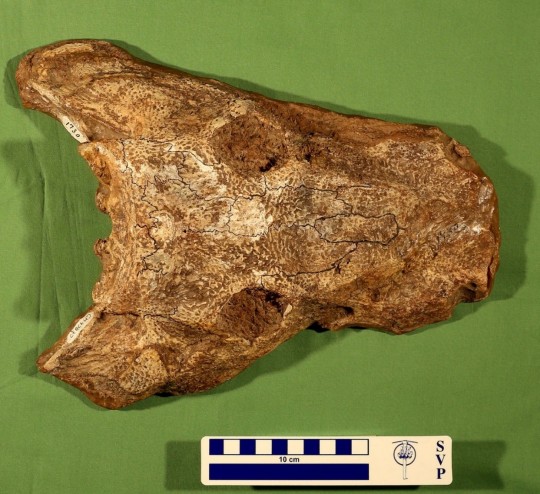
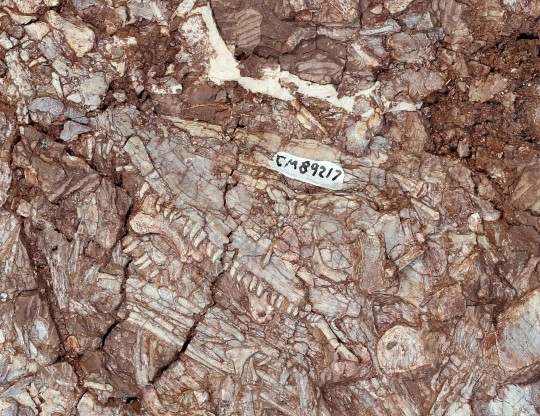
Fossils from Bears Ears N.M. include a variety of freshwater sharks and fishes and amphibians and reptiles, creatures which once inhabited a coastal plain adjacent to an inland seaway. Through the Late Paleozoic the seaway filled with sediment shed from the Ancestral Rocky Mountains to the northeast, and, as the climate became more arid, dunes encroached the coastal plain. The fauna of this changing environment records a primitive stage of the terrestrial ecosystem in which carnivores greatly outnumber herbivores, a stark contrast to modern ratios in which herbivores greatly outnumber carnivores. The most common animals represented in this fossil record are the heavy-bodied, semi-aquatic, carnivore Eryops and the semi-aquatic carnivorous mammal-like reptile, Ophiacodon.
brown skull fossil on a green background
Skull of Eryops grandis, CM 47817.


ground with fossils protruding
Skull of Ophiacodon navajovicus as preserved in bone bed.

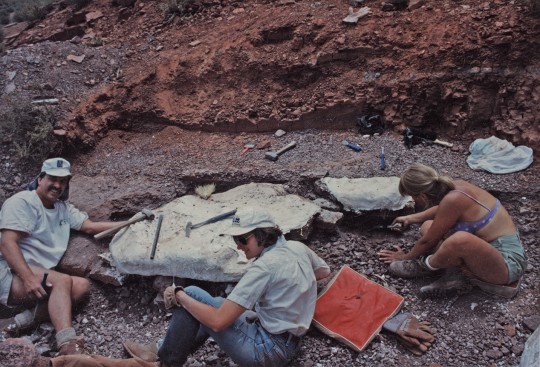
The Section of Vertebrate Paleontology has the best collection of vertebrate fossils from Bears Ears National Monument. Curator Emeritus Dave Berman collected fossils here as a student of Peter Vaughn at the University of California (UCLA). The UCLA Late Paleozoic collection was donated to CMNH in 1988. Berman renewed collecting in the Bears Ears region in 1990, resulting in the discovery of a significant bone bed. CMNH crews in collaboration with researchers from the Illinois State Geologic Survey, University of California at San Bernardino, University of Chicago, and University of Southern California have worked this site since, and a potential new bone bed was discovered last summer.

Funding for field work has been provided by the Bureau of Land Management, Carnegie Museum of Natural History, and the National Geographic Society.
three researchers gathered around a bed of fossils
1991 excavation of the bone bed discovered in 1990.


Filed Under: Blog Tagged With: Amy Henrici, Vertebrate Paleontology

October 13, 2017 by wpengine

Upper Jurassic Frog Fossil

This small fossil found in Dinosaurs in Their Time is the most...-media-1

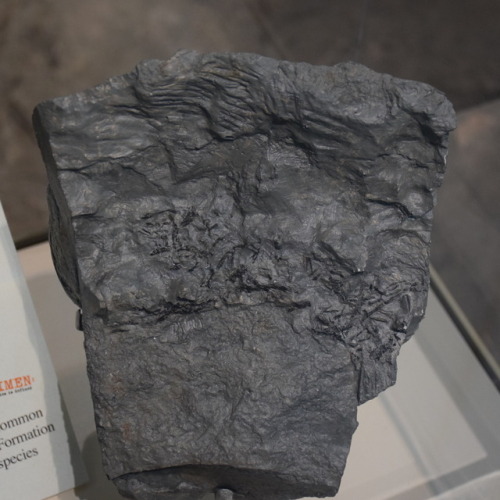
This small fossil found in Dinosaurs in Their Time is the most complete frog fossil known from the Upper Jurassic Morrison Formation. It was named by Carnegie Museum of Natural History’s paleontologist, Amy Henrici, in 1998.

Filed Under: Blog Tagged With: Amy Henrici, dinosaurs in their time

December 19, 2016 by wpengine

Paleo Field Tools

By Patrick McShea

Although work gloves, rock hammers, chisels, and protective goggles remain standard field equipment for fossil field work, electronic devices have become critical search tools. In both the Elko Hills and South Egan Wilderness, Vertebrate Paleontology Collections Manager Amy Henrici regularly referred to her iPad’s topographic map app which utilized a GPS function to provide accurate on-screen tracking of our movement across the landscape.

Other sometimes overlooked field tools are described below.

Reliable Transportation

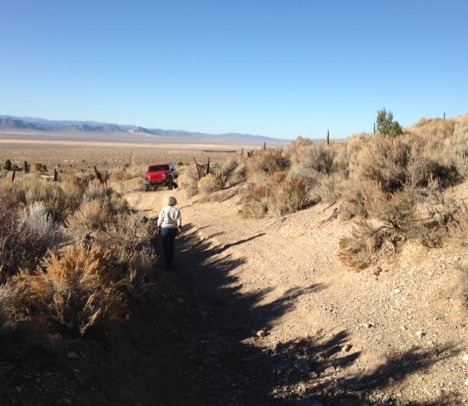
Jeep Wranlger on a rugged dirt path

A rented Jeep Wrangler proved to be an indispensable field tool. Unlike the high speed off-road travel depicted on television commercials, during a steep ascent from sage brush flats to the zone of pinyon and juniper we climbed in a low gear crawl. (Above) In places where the track crossed dry stream washes, it was sometimes necessary to scout routes into and out of the deeply eroded channels.

Fields Notes

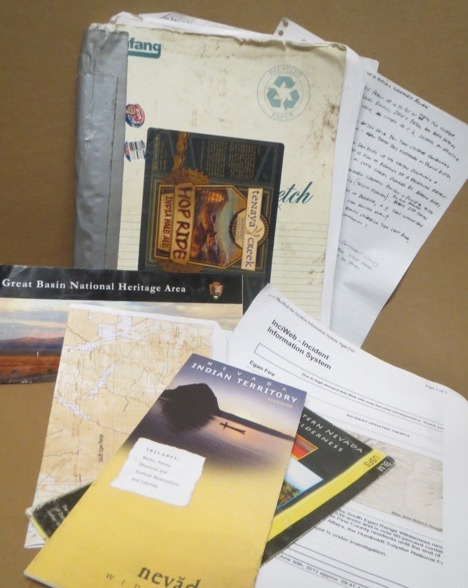
Field notebooks

Field notes add a layer of documentation to scientific fossil collecting. Details about localities, the field crew, the vegetative cover, and even the weather might prove to be important information for a future paleontologist re-examining a particular set of fossils.

As an educator, the field work journal I kept doesn’t have direct association with particular fossils. Instead the duct tape-bound notebook, which bears the label of a Nevada-brewed IPA, serves as portable file, holding hand-written notes, related maps, brochures, and reports.

Place-related Information

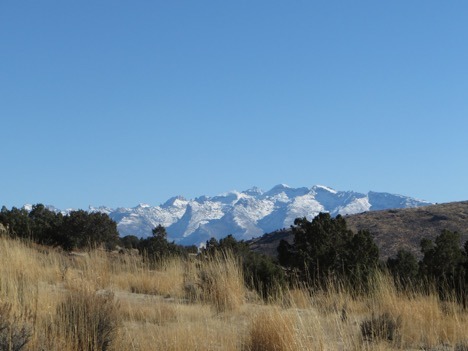
field with mountain range in the distance
Nevada’s Ruby Mountains from the hills outside Elko.


Because western scenery differs so much from that of east, a guide to the contrasts is useful tool, even for visitors focused on finding fossils. Observations by author Wallace Stegner aid in the appreciation of western landscapes.

In a dry land the brinks of hills will be clifflike, not rounded; valleys will often be canyons; hills are likely to be buttes and mesas and barerock movements; the coloration will not be the toned greens of wetter regions but the red and ochre and tan and gray and black of raw rock, the gray of sagebrush, the yellow of dry grass.

– Wallace Stegner “Why I Like the West” Marking the Sparrow’s Fall Henry Holt and Company, New York, 1998


Patrick McShea is a museum educator who is traveling through Nevada with Vertebrate Paleontology Collections Manager Amy Henrici to search for frog fossils. He frequently blogs about his experiences.

Filed Under: Blog Tagged With: Amy Henrici, Paleolab, paleontology

November 29, 2016 by wpengine

Fossil Search: Expert Assistance

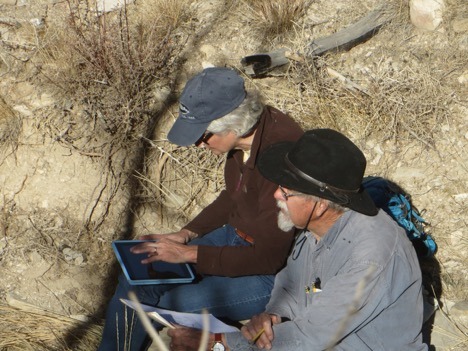
paleontologists using GPS
During a search for the contact point of two different Sheep Pass Formation rock units, Amy Henrici uses GPS-linked topographic maps in her iPad to locate the zone referenced in a stratigraphic map held by Richard Hilton.

by Patrick McShea

The frog fossil expedition workforce doubled briefly with the arrival of a two-person team affiliated with Sierra College in Rocklin, California. Earth Science professor Richard Hilton and field assistant Tina Campbell drove east from the Sacramento area, crossing the Sierra Nevada and a large portion of the Great Basin to meet us for two days of field work. They then proceeded to another fossil locality in the region to retrieve material discovered during earlier summer field work.

The Sheep Pass Formation within the South Egan Wilderness was familiar territory for both. In 2012 and 2013 they participated in larger expeditions to the area that involved not just Carnegie Museum of Natural History and Sierra College, but also the University of Nevada at Las Vegas.

Because Hilton is chairmen of Sierra College’s natural history museum,  our fireside conversations included the potential for using blog posts to broaden the audience for information about paleontological field work. Through the combination of his generosity, two-burner stove, and culinary skills, camp meals also improved.

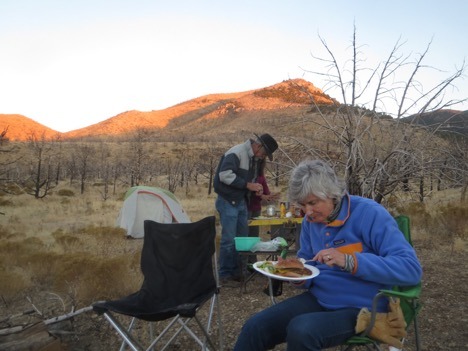
paleontologists eating at campsite
Dinner at dusk, including Caesar salad, baked beans, and hamburgers.

Patrick McShea is a museum educator who is traveling through Nevada with Vertebrate Paleontology Collections Manager Amy Henrici to search for frog fossils. He frequently blogs about his experiences.

Filed Under: Blog Tagged With: Amy Henrici, fossils, frogs, paleontology

November 28, 2016 by wpengine

Shifting Formations

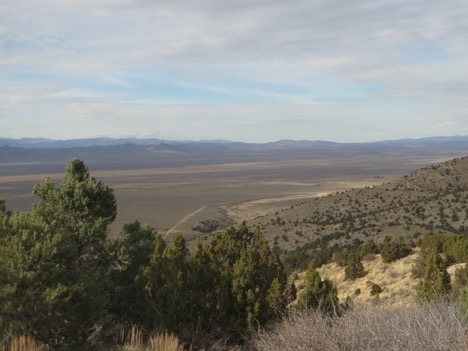
Nevada’s White River Valley from high ground in the South Egan Wilderness.

by Patrick McShea

From Elko, Nevada, the Carnegie Museum of Natural History frog fossil expedition shifted some 125 miles southeast to steep winding canyons within the South Egan Wilderness, a mountainous tract of more than 67,000 acres.

The move involved a change in the age of the rock outcrops we searched. Near Elko our efforts were confined to various associated rock layers, which geologists categorize as the Elko Formation, a thick and wide spread unit which formed some 46 – 39 million years ago during the Eocene Epoch. In the South Egan Wilderness, we explored the Sheep Pass Formation, a sequence of far older rocks which formed during the Late Cretaceous through middle Eocene Epochs some 70-46 million years ago.

Daily procedures were far different in the BLM-managed wilderness than on the outskirts of Nevada’s 15th largest city.

Instead of commuting to outcrops from a motel in Elko’s center, we hiked to rock exposures more than a mile from our simple camp site, proceeding up dry stream beds and ascending eight staircase-like water falls to reach the fossil-bearing units at elevations exceeding 6,700 feet. Evenings were cold, star-filled, and absolutely quiet but for the occasional howls and yips of coyotes.

Because a 2012 wildfire burned over 10,000 acres of sage brush, juniper, and pinyon pine, our camp area was a surreal landscape of charred trees.


Patrick McShea is a museum educator who is traveling through Nevada with Vertebrate Paleontology Collections Manager Amy Henrici to search for frog fossils. He frequently blogs about his experiences.

Filed Under: Blog Tagged With: Amy Henrici, fossils, frogs, paleontology

November 16, 2016 by wpengine

Where to Look for Fossils

Amy Henrici
Vertebrate Paleontology Collections Manager Amy Henrici in the field.

As I travelled west from Pittsburgh to meet Carnegie Museum of Natural Hisotry Vertebrate Fossil Collection Manager Amy Henrici for a frog fossil hunting expedition in eastern Nevada, the same question was asked by each of my airplane seat mates.

“How do you know where to look for fossils?“

For the sites we planned to visit the answer was simple. Earlier written reports by geologists mapping rock formations and mineral deposits noted the occasion occurrence of fossils in certain rock layers.

Fossil searches involved locating and visiting sites where such rock layers are exposed on the surface, and then examining fragments that have eroded from these outcrops.The full process, which might stretch over decades, is an example of how published findings allow one branch of science to serve another.

As a geologist friend takes great pleasure in explaining, “Geologists let paleontologists know where fossils are in the multitude rock layers of Earth’s history, in time and in place.”


Patrick McShea is a museum educator who is traveling through Nevada with Vertebrate Paleontology Collections Manager Amy Henrici to search for frog fossils. He frequently blogs about his experiences.

Filed Under: Blog Tagged With: Amy Henrici, expedition, fossils, frogs, geology, museums, paleontology

  • « Go to Previous Page
  • Page 1
  • Page 2
  • Page 3
  • Page 4
  • Page 5
  • Go to Next Page »

sidebar

About

  • Mission & Commitments
  • Directors Team
  • Museum History

Get Involved

  • Volunteer
  • Membership
  • Carnegie Discoverers
  • Donate
  • Employment
  • Events

Bring a Group

  • Groups of 10 or More
  • Birthday Parties at the Museum
  • Field Trips

Powdermill

  • Powdermill Nature Reserve
  • Powdermill Field Trips
  • Powdermill Staff
  • Research at Powdermill

More Information

  • Image Permission Requests
  • Science Stories
  • Accessibility
  • Shopping Cart
  • Contact
  • Visitor Policies
One of the Four Carnegie Museums | © Carnegie Institute | Privacy Policy | Terms of Use | Accessibility
Rad works here logo