• Skip to primary navigation
  • Skip to main content
  • Skip to primary sidebar

Carnegie Museum of Natural History

One of the Four Carnegie Museums of Pittsburgh

  • Visit
    • Buy Tickets
    • Visitor Information
    • Exhibitions
    • Events
    • Dining at the Museum
    • Celebrate at the Museum
    • Powdermill Nature Reserve
    • Event Venue Rental
    • Gift Cards
  • Learn
    • Field Trips
    • Educator Information
    • Programs at the Museum
    • Bring the Museum to You
    • Guided Programs FAQ
    • Programs Online
    • Climate and Rural Systems Partnership
  • Research
    • Scientific Sections
    • Science Stories
    • Science Videos
    • Senior Science & Research Staff
    • Museum Library
    • Science Seminars
    • Scientific Publications
    • Specimen and Artifact Identification
  • About
    • Mission & Commitments
    • Directors Team
    • Museum History
  • Tickets
  • Give
  • Shop

dinosaurs in their time

October 13, 2025 by

Daniel G. And Carole L. Kamin Hall of Dinosaurs

Plan an expedition to the Kamin Hall of Dinosaurs—Carnegie Museum of Natural History’s core exhibition featuring real dinosaur fossils.

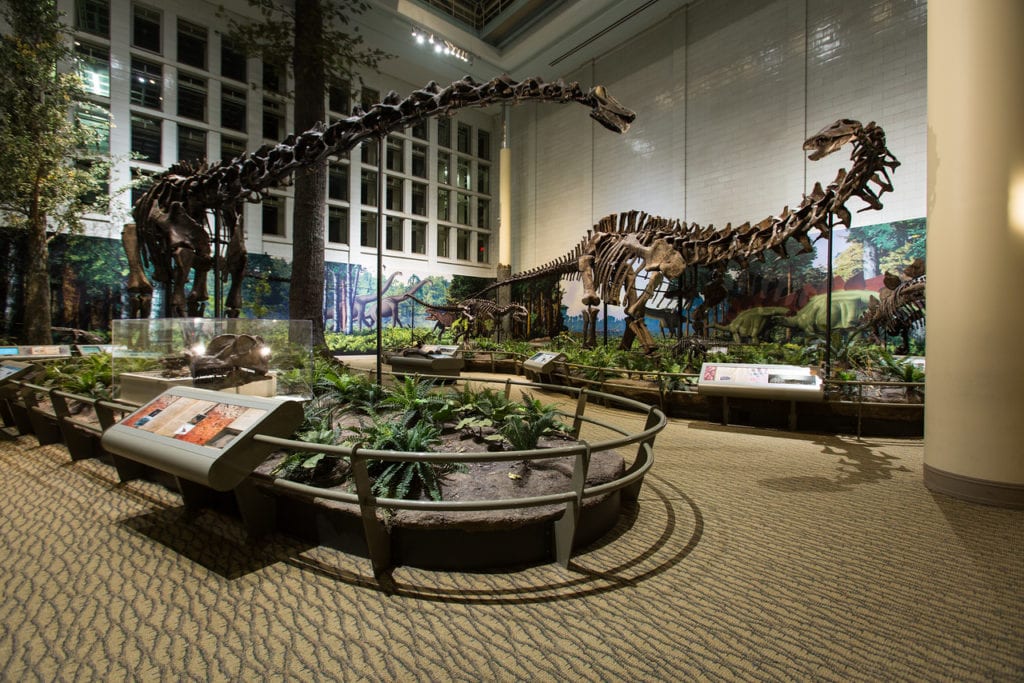
This exhibition is home to dozens of original fossils from throughout the Mesozoic Era displayed in scientifically accurate reconstructions of their ancient habitats.

Are the Dinosaur Fossils on Display Real?

About 75% of the more than 230 objects on display are original fossils from one of the finest paleontological collections in the world, and most of the exhibition’s dinosaur skeletons are real, not replicas. Several of these skeletons—including those of the iconic dinosaurs Apatosaurus louisae, Diplodocus carnegii, and Tyrannosaurus rex—are holotypes, the original specimens upon which their respective species are based.

In the many decades since the discovery of Diplodocus, scientific interpretations of dinosaurs and their lifestyles have changed dramatically. This exhibition uses up-to-date paleontological evidence—much of which has been provided by the museum’s own scientists—to accurately reconstruct the appearance and behavior of these colossal creatures.

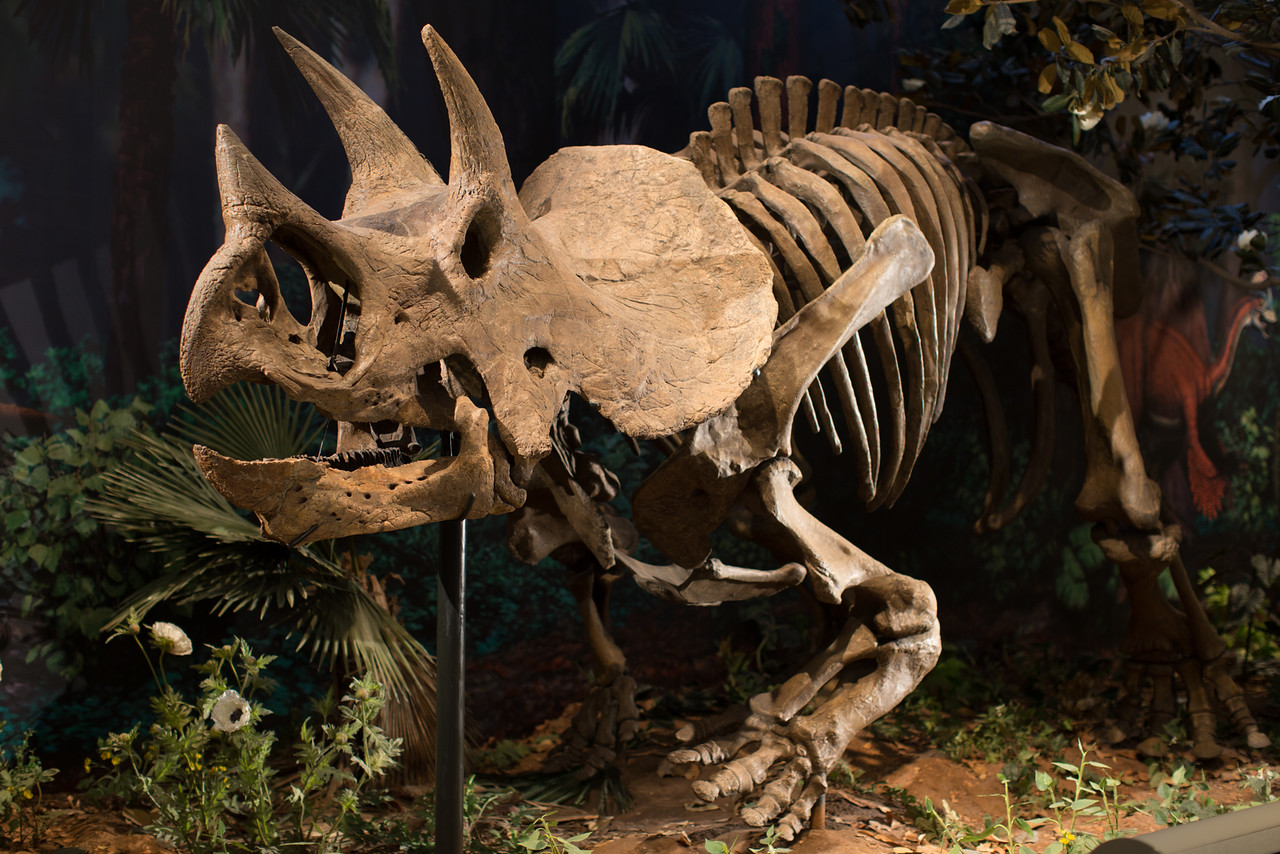
For instance, we now know that Apatosaurus and Diplodocus (two famous long-necked dinosaurs) did not spend their lives wallowing in swamps and that predatory dinosaurs such as T. rex walked with their tails held off the ground and their backs horizontal. The three-horned Triceratops may have used its famous headgear more for display than for fighting, whereas some theropod dinosaurs (such as Anzu wyliei, the notorious “Chicken from Hell”) would have closely resembled their modern descendants—modern birds.

Dinosaur Exhibition Layout

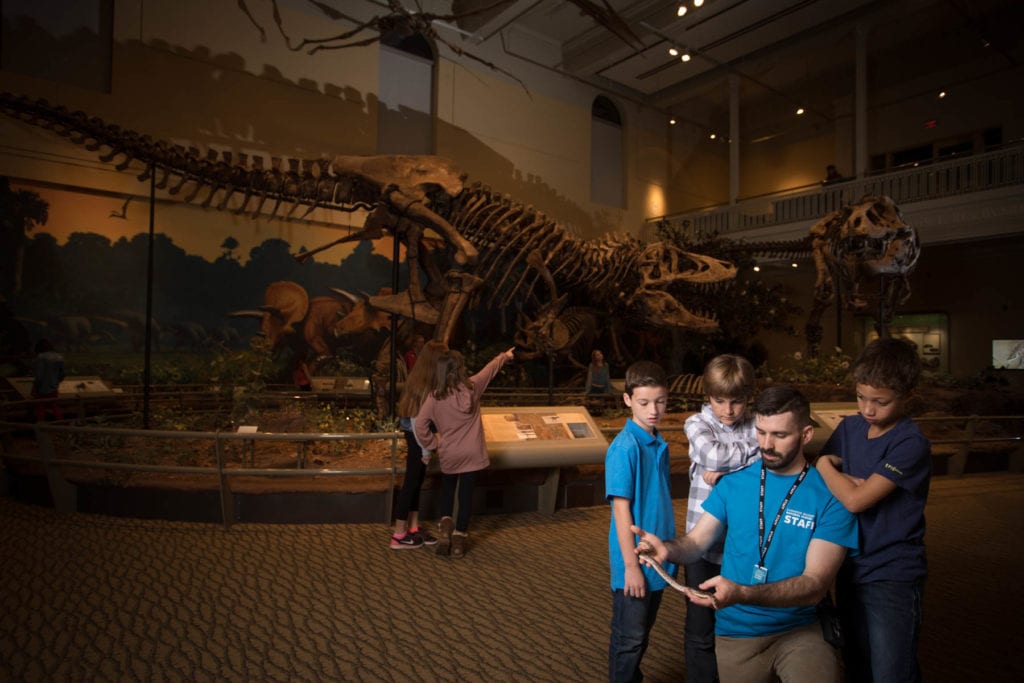
Many museum exhibitions group extinct species according to geologic time, but this exhibition takes this concept several steps further. In this exhibition, dinosaurs and other Mesozoic animals are shown in extraordinarily detailed reconstructions of their respective environments. Like the dinosaurs themselves, the habitats in this exhibition are firmly grounded in scientific evidence.

A panicked Apatosaurus smashes a small tree known from fossils found in the same Jurassic-aged rocks. A sculpted trackway of a hungry T. rex is based directly on the only known footprint of this terrifying meat-eater. The cat-sized Cretaceous mammal Didelphodon angrily confronts a much larger Triceratops. In short, in our museum’s exhibition, when dinosaur species are exhibited together, they actually lived together—their fossils are found in the same rock formations, and in many cases, the same quarries.
  • First Floor
triceratops
Visitors in Dinosaurs in their Time
herbivores in Dinosaurs in their Time

Meet our Vertebrate Paleontologists

Lamanna, Matt

Matt Lamanna, Ph.D.

Mary R Dawson Associate Curator

Learn More

sarah davis

Sarah Davis, Ph.D.

Collection Manager

Learn More

Meet the rest of the Fossil Vertebrate (Vertebrate Paleontology) Section

Science Stories
  • Stepping Back in Time

    Stepping Back in Time

    by Suzanne Nuss I grew up in the silent Canadian Arctic, so sounds switch me to alertness. Once alert, I pause to …
  • Jurassic Days: Icarosaurus

    Jurassic Days: Icarosaurus

    by Zach Lyons-Weiler Both visitors and staff love Carnegie Museum of Natural History’s Dinosaurs in Their Time exhibition for many reasons. For …
  • What Did Dinosaurs Sound Like?

    What Did Dinosaurs Sound Like?

    A Brief Foray into Paleoacoustics in Science and Film by Niko Borish and Caroline Lee Did Dinosaurs Roar? When you think about …
  • MESOZOIC MONTHLY: Volaticotherium

    MESOZOIC MONTHLY: Volaticotherium

    by Lindsay Kastroll Once again, spring has sprung. Prepare to see the gorgeous forests of Pennsylvania launch back into action. I, for …
Filed Under: Uncategorized Tagged With: dinos, dinosaurs, dinosaurs in their time

July 3, 2024 by Kathleen

Storytime at the Museum

When: Daily from 11:00 a.m.–11:30 a.m.

Where: Carnegie Museum of Natural History

Tickets: Free with Museum Admission

Join us for Storytime at the Museum! Hear nature and science stories read by our Natural History Interpreters and get a chance to touch museum specimens. Stop by for one page, one book, or stay for the whole time. Meets in Discovery Basecamp. Registration is not required.

Storytime at the Museum will not occur on Saturday, June 13 or Friday, June 26–Sunday, June 28, 2026. We encourage you to join us for DinoFest (June 13) and Polar World Closing Weekend (June 26–June 28) instead.

Purchase museum admission in advance →


Tagged With: dinosaurs in their time, tours

July 3, 2024 by Kathleen

Storytime at the Museum

When: Daily from 11:00 a.m.–11:30 a.m.

Where: Carnegie Museum of Natural History

Tickets: Free with Museum Admission

Join us for Storytime at the Museum! Hear nature and science stories read by our Natural History Interpreters and get a chance to touch museum specimens. Stop by for one page, one book, or stay for the whole time. Meets in Discovery Basecamp. Registration is not required.

Storytime at the Museum will not occur on Saturday, June 13 or Friday, June 26–Sunday, June 28, 2026. We encourage you to join us for DinoFest (June 13) and Polar World Closing Weekend (June 26–June 28) instead.

Purchase museum admission in advance →


Tagged With: dinosaurs in their time, tours

July 3, 2024 by Kathleen

Storytime at the Museum

When: Daily from 11:00 a.m.–11:30 a.m.

Where: Carnegie Museum of Natural History

Tickets: Free with Museum Admission

Join us for Storytime at the Museum! Hear nature and science stories read by our Natural History Interpreters and get a chance to touch museum specimens. Stop by for one page, one book, or stay for the whole time. Meets in Discovery Basecamp. Registration is not required.

Purchase museum admission in advance →


Tagged With: dinosaurs in their time, tours

July 3, 2024 by Kathleen

Storytime at the Museum

When: Friday, Saturday, and Sunday from 10:00 a.m.–10:45 a.m.

Where: Carnegie Museum of Natural History

Tickets: Free with Museum Admission

Join us for Storytime at the Museum! Hear nature and science stories read by our Natural History Interpreters and get a chance to touch museum specimens. Stop by for one page, one book, or stay for the whole 45 minutes. Meets at the bench in the entrance of the Kamin Hall of Dinosaurs. Registration is not required.

Buy your tickets in advance!

[swaddtocarttimed site=”6″ group=”279″ sw_msg_add_to_cart=’Proceed to Cart.‘]


Tagged With: dinosaurs in their time, tours

December 19, 2022 by Erin Southerland

Stepping Back in Time

by Suzanne Nuss

I grew up in the silent Canadian Arctic, so sounds switch me to alertness. Once alert, I pause to hear spoken words. During a recent late afternoon in Dinosaurs in Their Time, I focused on a sound that moved me to alertness until it became the voice of the museum’s Gallery Experience Presenter Shannon McGuinn saying, “I found a footprint.” 

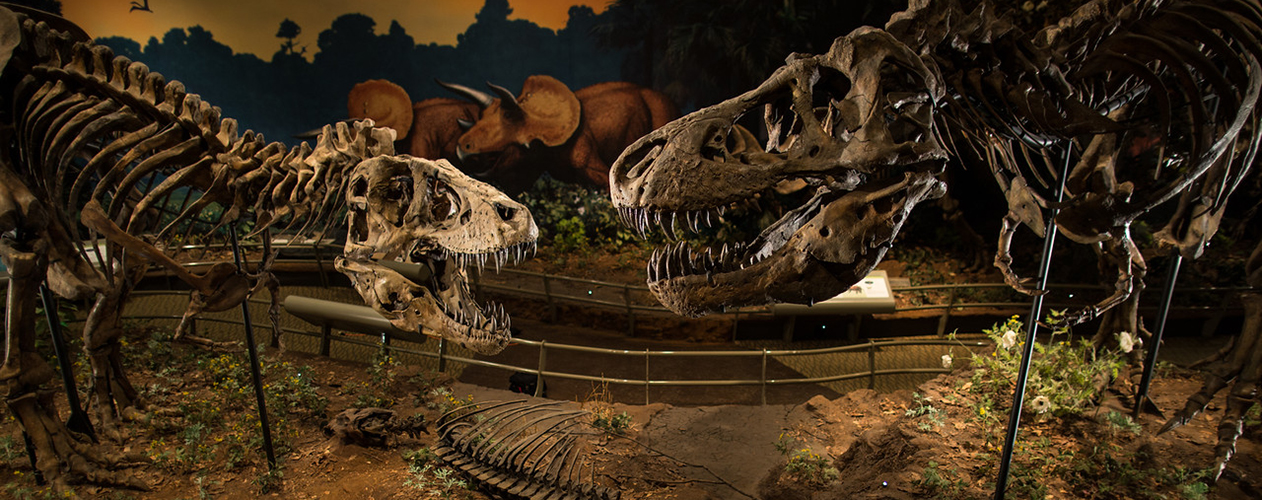
Because the exhibition hall was mostly empty of visitors, I had been standing near and contemplating the visually striking display of the holotype Tyrannosaurus rex fighting in a field of replica Cretaceous poppies against a cast of another T. rex skeleton, the fossil that since its discovery in 1997 has been known informally as Peck’s Rex. As a Natural History Interpreter, I have been walking these halls for more than six years, yet I had never noticed a footprint. “Hmm,” I thought. “Really?”

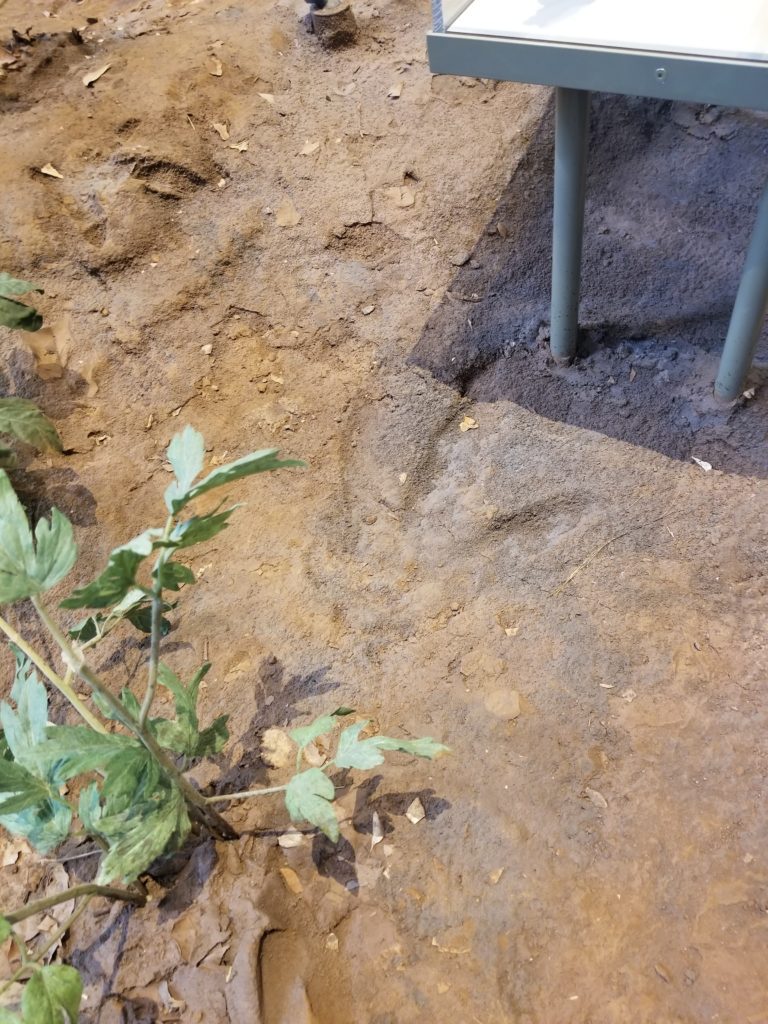
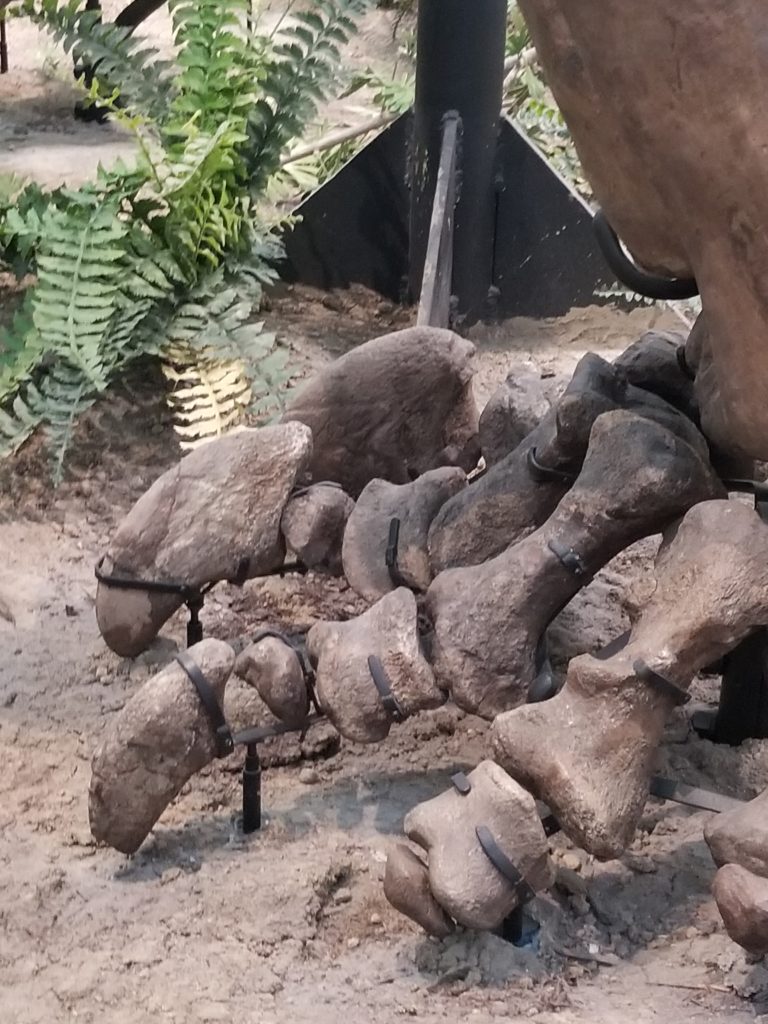
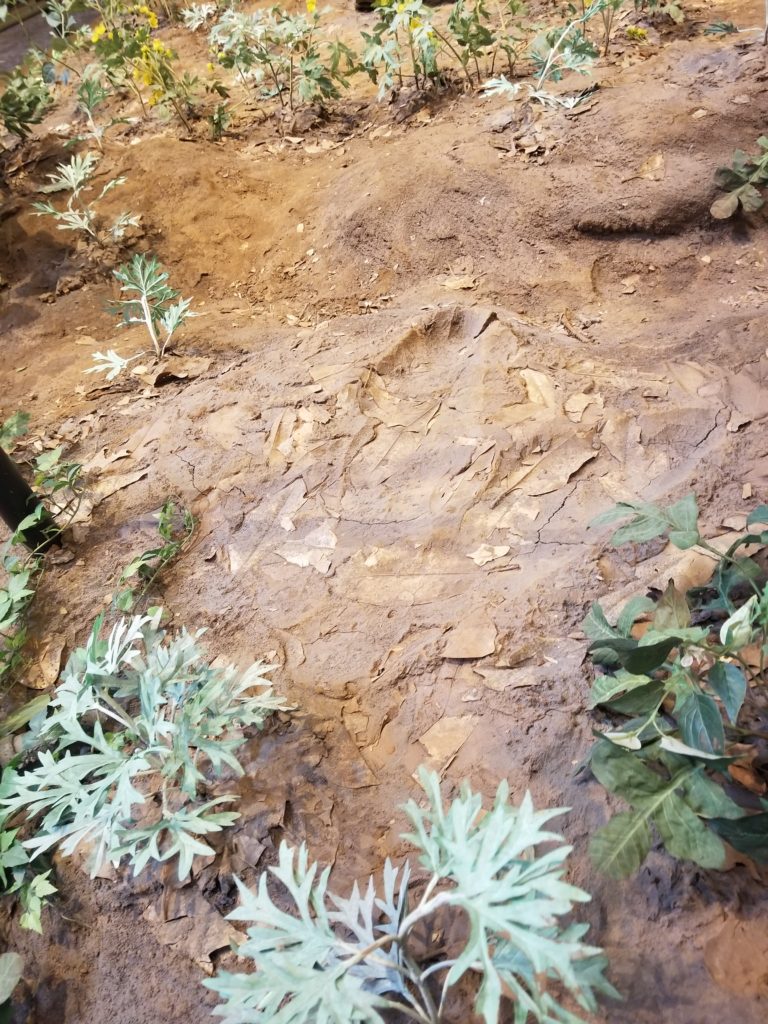
 I followed Shannon. She pointed. There it was: faint but unmistakable, on the recreated ground surface of the exhibit base, the impressions of three digits resembling a gigantic bird footprint. 

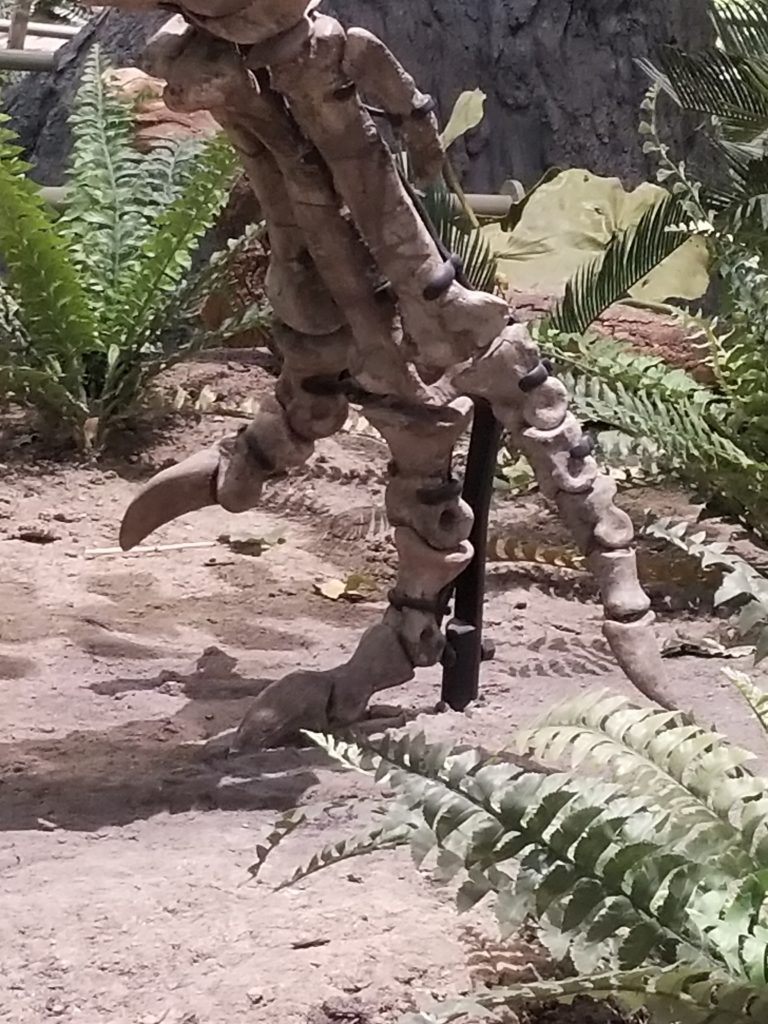
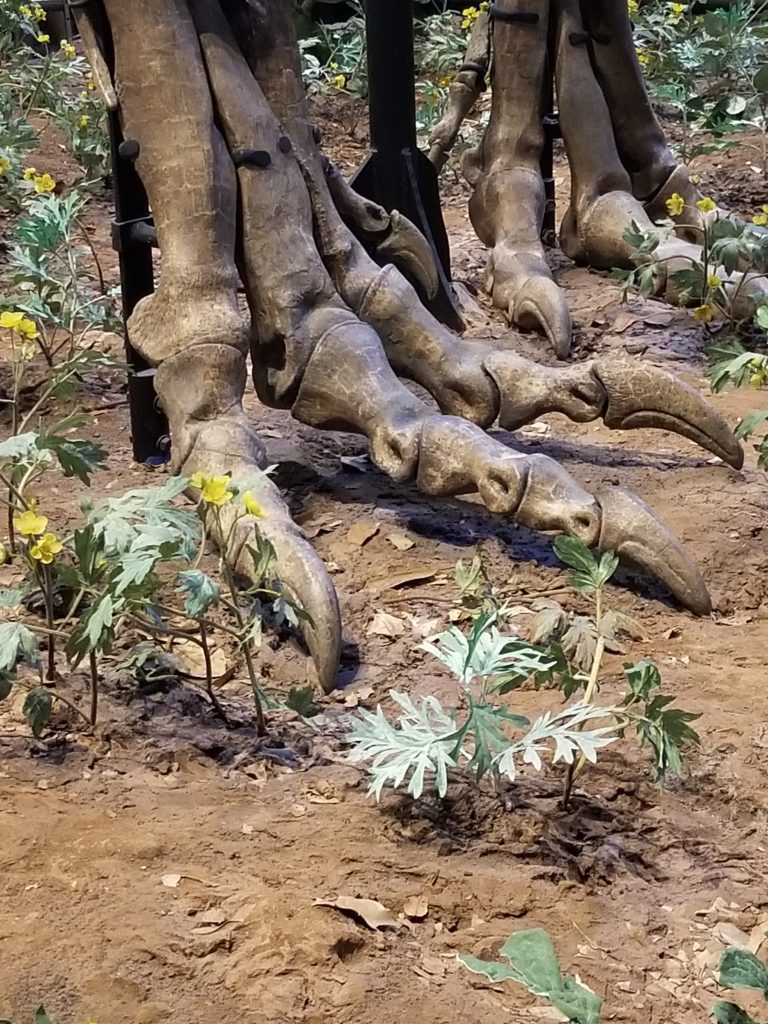
  • T. rex fossil foot

We both entertained the same thought: if there’s one track, could there be more? We trotted over behind Peck’s Rex and yes. A second footprint was visible, two feet behind and under the tail, as if the animal had been ambling along.

At this point, Dr. Matt Lamanna, the person most responsible for the scientific content of the now-15-year-old hall, walked by. Gurgling with excitement, we showed him the footprints. He was delighted by our find. “Yes. Two ‘Easter Eggs.’ When Dinosaurs in Their Time was built, we included many simulated footprints, sculpted on the basis of actual fossilized dinosaur tracks. I only wish I’d been able to add a few fake coprolites (fossil poop) too.”

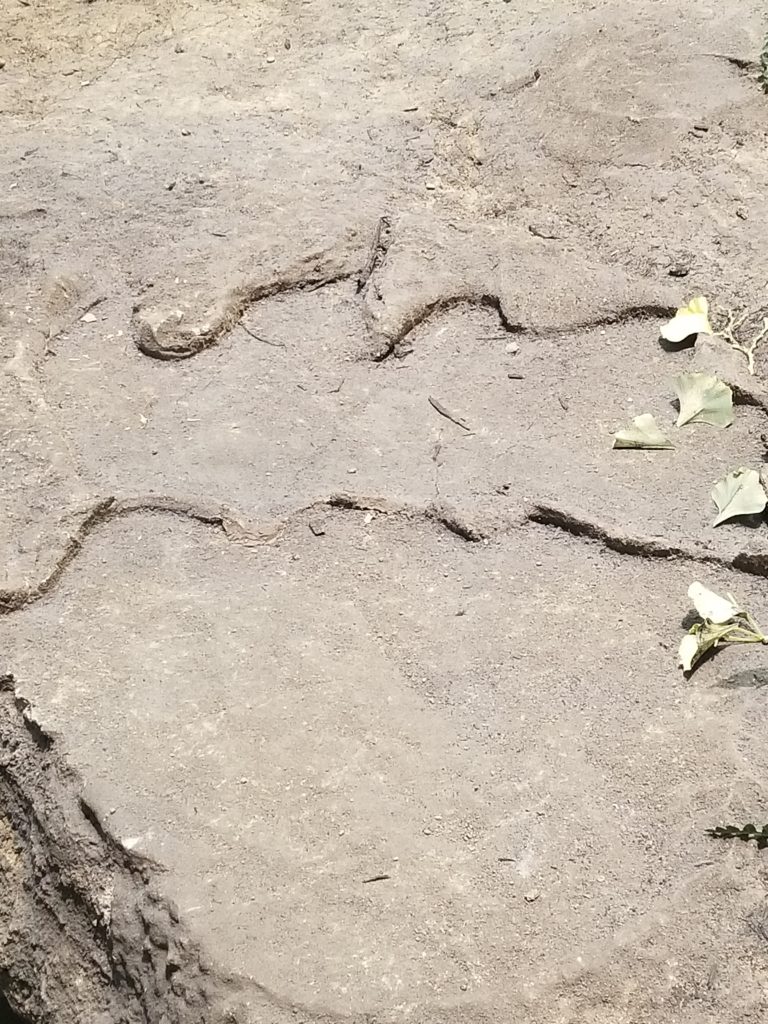
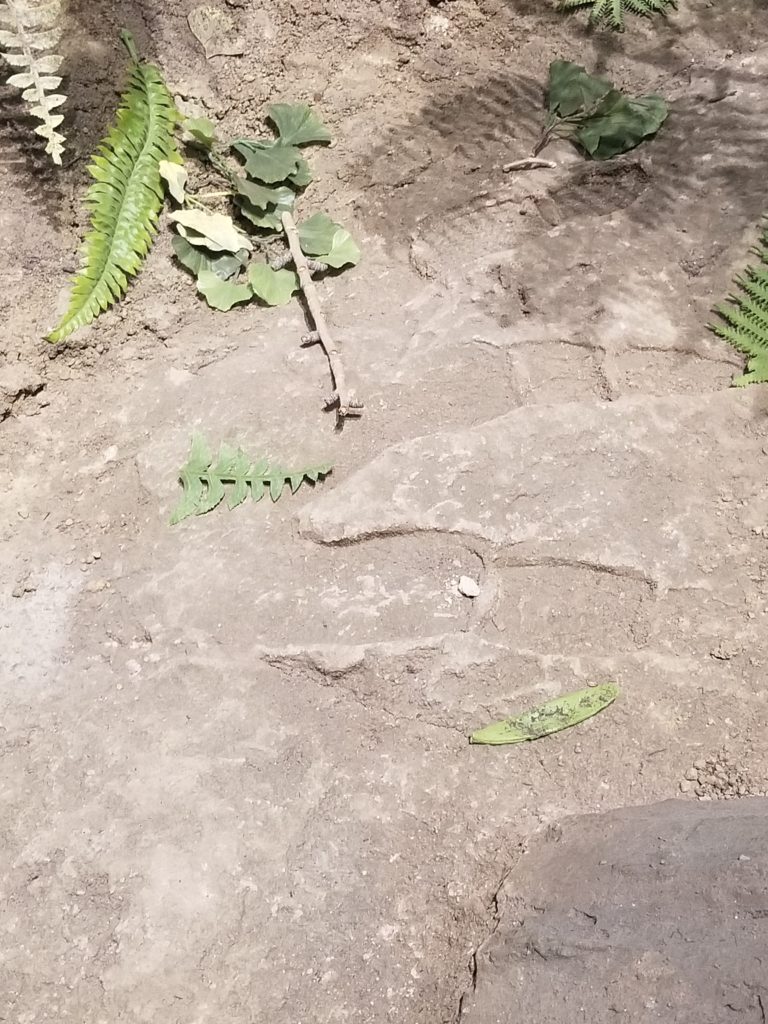
 We continued to hunt, with Matt now with us. Three toes again, much smaller. Now that we recognized the tracks as intentional creations, we wondered what animal tracks we might find.  Our third discovery, pictured below, was a faux footprint of the bird-like oviraptorosaur Anzu wyliei.

fossil footprint in a museum display

Moving into the Jurassic portion of the exhibition, we stepped back in time, figuratively speaking, by more than 80 million years, and were dwarfed by huge, long-necked, plant-eating dinosaurs (sauropods). We also found very different-looking tracks, some of which were overlapping. Our questions multiplied: could tracks like this indicate that these enormous beasts walked in herds? Is it possible to match up the toes of the foot with the footprint? Was the wide, flat heel of sauropods important for weight distribution?   

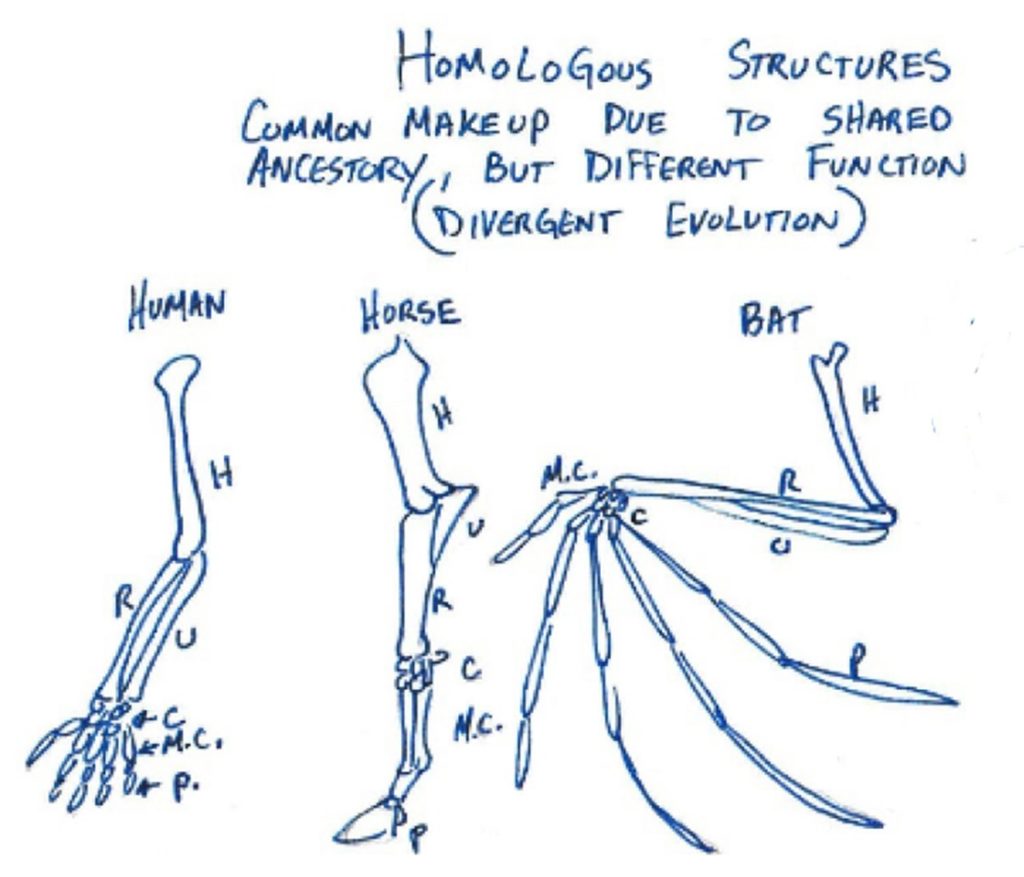
Those thoughts captivated me, mainly because I was introduced to D’Arcy Thompson’s book, On Growth and Form, when I studied biophysics at McGill University in Montreal. One section of the book was devoted entirely to demonstrating how the many kinds of tetrapods (four-limbed, backboned animals such as amphibians, reptiles, birds, and mammals) all had the same fundamental form: head, torso, and tail, with forelimbs attached at the shoulder girdle and hind limbs attached to the hip. I loved the accompanying images that stretched all the body parts to ‘morph’ one tetrapod into another. A more technical term for this concept is “homologous structures.” In the image below, a simple letter key is used to mark forelimb bones: (H) humerus, (R) radius, (U) ulna, (C) carpals, (MC) metacarpals, and (P) phalanges (the latter better known as finger and toe bones). The hind limbs match up  in a similar way.

Drawing of human, horse, and bat limb skeletons side by side

I thought about what a human footprint looks like, and then a horse footprint, and even a bat footprint. Bears and humans walk with their heels on the ground (a stance known as plantigrade). Horses and giraffes walk on the very tips of their toes (unguligrade), whereas cats, dogs, and predatory dinosaurs such as Allosaurus and T. rex walked on their toes (digitigrade). 

Returning to my original spot within the dinosaur exhibition, I was determined to take a closer look. Could I tell from the fossil evidence how the species on display walked? Was it possible to identify the femur, tibia, and fibula of each skeleton?

The colorful murals lining the walls of the exhibition helped. The depictions of each creature are based upon well-studied fossils and biomechanical modelling. I could start musing about how they walked and make a guess. Each guess became a test, which produced a working hypothesis. I have since discovered that the museum’s Bird Hall and Hall of North American Wildlife are also great places to think about feet, footprints, and the biomechanics of animal movement, and why some dinosaur footprints look so much like bird footprints. 

Footprints have stories to tell about movement, behavior, and speed. Properly interpreted, footprints can reveal how long their makers’ legs might have been, the width of these animals’ hips, and even whether adults and young traveled together in family groups. What, I have been steadily wondering, would the footprints recording a fight look like? 

I don’t want to look anything up yet. I need to muddle through with my own thinking first. When I am ready, I might start with legged robot studies to clarify the physical constraints that must be considered in moving through space. I have since found simulated tracks of Allosaurus and Stegosaurus, and in my searching have also discovered how even an exhibition I know well still holds tremendous potential for inquiry and further learning.

Suzanne Nuss is a Natural History Interpreter at Carnegie Museum of Natural History.

Related Content

The Strange Saga of Spinosaurus, the Semiaquatic Dinosaurian Superpredator

The Two-Headed Dinosaur

The Bromacker Fossil Project

Carnegie Museum of Natural History Blog Citation Information

Blog author: Nuss, Suzanne
Publication date: December 19, 2022

Share this post!

  • Share on Twitter Share on Twitter
  • Share on Facebook Share on Facebook
  • Share on Pinterest Share on Pinterest
  • Share on LinkedIn Share on LinkedIn
  • Share on Reddit Share on Reddit
  • Share via Email Share via Email

Filed Under: Blog Tagged With: dinosaurs in their time, Matt Lamanna, Suzanne Nuss, Vertebrate Paleontology

  • Page 1
  • Page 2
  • Page 3
  • Interim pages omitted …
  • Page 12
  • Go to Next Page »

sidebar

About

  • Mission & Commitments
  • Directors Team
  • Museum History

Get Involved

  • Volunteer
  • Membership
  • Carnegie Discoverers
  • Donate
  • Employment
  • Events

Bring a Group

  • Groups of 10 or More
  • Birthday Parties at the Museum
  • Field Trips

Powdermill

  • Powdermill Nature Reserve
  • Powdermill Field Trips
  • Powdermill Staff
  • Research at Powdermill

More Information

  • Image Permission Requests
  • Science Stories
  • Accessibility
  • Shopping Cart
  • Contact
  • Visitor Policies
Stay in the loop! Sign up for our newsletter(s).
One of the Four Carnegie Museums | © Carnegie Institute | Privacy Policy | Terms of Use | Accessibility
Rad works here logo