• Skip to primary navigation
  • Skip to main content
  • Skip to primary sidebar

Carnegie Museum of Natural History

One of the Four Carnegie Museums of Pittsburgh

  • Visit
    • Buy Tickets
    • Visitor Information
    • Exhibitions
    • Events
    • Dining at the Museum
    • Celebrate at the Museum
    • Powdermill Nature Reserve
    • Event Venue Rental
  • Learn
    • Field Trips
    • Educator Information
    • Programs at the Museum
    • Bring the Museum to You
    • Guided Programs FAQ
    • Programs Online
    • Climate and Rural Systems Partnership
  • Research
    • Scientific Sections
    • Science Stories
    • Science Videos
    • Senior Science & Research Staff
    • Museum Library
    • Science Seminars
    • Scientific Publications
    • Specimen and Artifact Identification
  • About
    • Mission & Commitments
    • Directors Team
    • Museum History
  • Tickets
  • Give
  • Shop

Andrea Kautz

April 10, 2019 by wpengine

Another Reason to Love Ladybugs

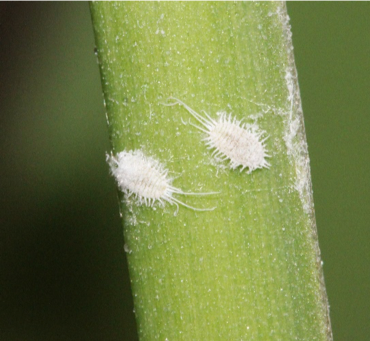
mealy bugs on plant

The Marsh Machine at Powdermill is great for recycling the nature center’s wastewater. It’s also great for building up huge populations of pests, such as aphids, scales, and mealy bugs (Picture 1). These plant-feeding insects thrive in the warm greenhouse environment, free from the natural predators they would encounter in an outdoor setting.
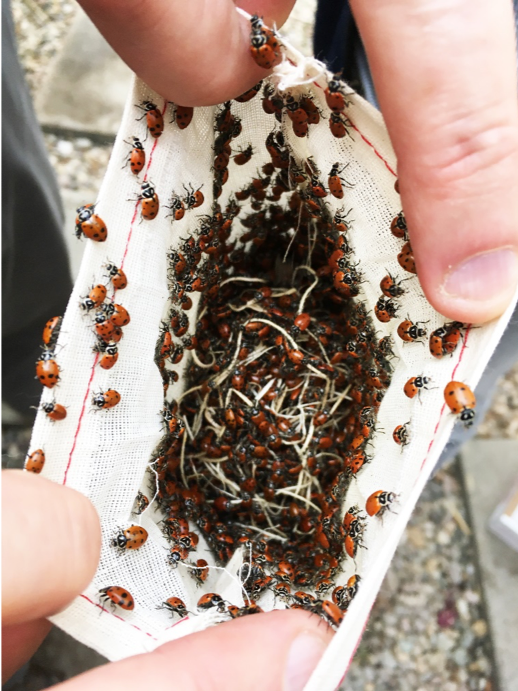
lady bugs crawling out of a canvas bag

So what would be the logical solution to combatting these pests, which are highly destructive to the Marsh Machine plants that are working so hard to treat our wastewater? Bring the predators in, of course! The convergent ladybug (Hippodamia convergens), is a native predatory beetle that prefers just the types of insects that infest the Marsh Machine. We purchased 4,000 of these ladybugs (Picture 2) and have just released them into our greenhouse. The voracious predators immediately began their search and started feasting on a buffet of teeny bugs (Picture 3).
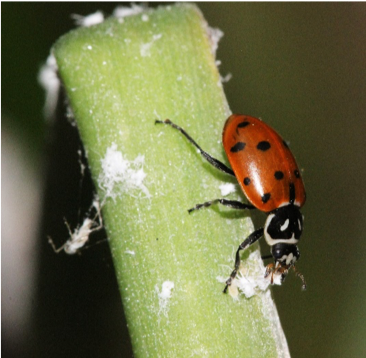
ladybug eating a mealy bug on a plant

According to our ladybug vendor, each adult ladybug can consume about 5,000 aphids in its lifetime! The adult females lay about 10-15 eggs a day, and the larvae that hatch out consume 50-60 aphids per day. At this rate, we anticipate our infestation will be under control in no time!

Note: While releasing ladybugs is an effective way to control greenhouse pests, releasing them outdoors generally results in the ladybugs flying away from the intended target, so keep this in mind when considering pest control options in your own backyard. Other options include eliminating the use of pesticides, which also kill the beneficial predators (and pollinators), and gardening with native plants, which are adapted to defend against native pests.

Andrea Kautz is a Research Entomologist at Carnegie Museum of Natural History’s Powdermill Nature Reserve. Museum employees are encouraged to blog about their unique experiences and knowledge gained from working at the museum.
Filed Under: Blog Tagged With: Andrea Kautz, Anthropocene, bugs, insects, Powdermill Nature Reserve

February 25, 2019 by wpengine

Bugs on Bugs on Bugs…on Birds

Big fleas have little fleas

Upon their backs to bite ‘em;

And little fleas have lesser fleas

And so, ad infinitum.

-Ogden Nash

Flat flies, louse flies, keds. The distinctive members of the fly family Hippoboscidae go by many names. All are obligate blood feeders found on mammals or birds and have a flattened body shape suitable for sliding in between the feathers and fur of their hosts. Their life history is as strange as their appearance, I assure you. While the vast majority of flies and other insects lay numerous eggs to reproduce, female hippoboscids prefer a more mammalian strategy. A single fertilized egg hatches within the female, and the developing larva is nourished within the mother through specialized “milk” glands until it is fully grown. The hugely swollen female then gives birth to a mature larva which immediately pupates, and later emerges as a winged adult hungry for a blood meal.

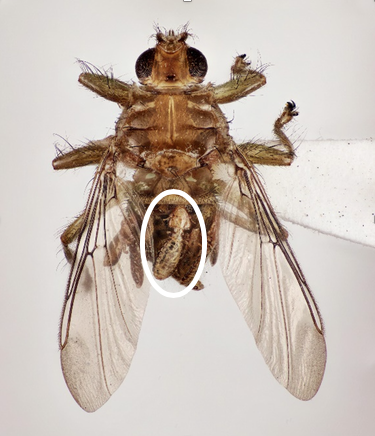
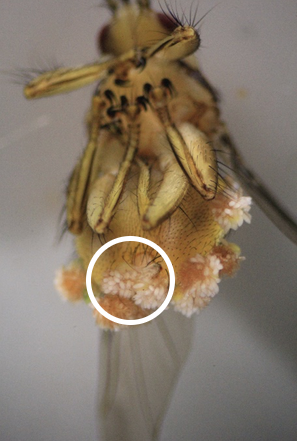
Hippoboscids are frequently encountered at the banding station at Powdermill Nature Reserve. Last year, most of the birds that were processed here were checked for these parasites, which were collected. Not much is known about these flies on songbirds as most of the research conducted deals with raptors. While identifying the flies under a microscope, we discovered these flies were often carrying some smaller bugs with them on their abdomens. These hitchhikers were bird lice and avian skin mites (see photos).

fly with white circle drawn around bird lice on abdomen
Dorsal view of a hippoboscid fly with several bird lice hitching a ride on its abdomen.


fly with white circle drawn around mites
Ventral view of a hippoboscid fly carrying several female avian skin mites (Epidermoptidae), each surrounded by a cluster of white eggs.

Both of these small parasites are wingless and poor dispersers, but can conveniently get from bird to bird by riding on the hippoboscid flies, a strategy called phoresy. In the case of the skin mites, the females actually require a hippoboscid to reproduce. They attach themselves to the body of the fly and lay their eggs all around them in a clump. To add to the craziness, sometimes the mites attach to the lice which attach to the fly, which you find on birds. So there you have it. Bugs on bugs on bugs… on birds!

Andrea Kautz is a Research Entomologist at Carnegie Museum of Natural History’s Powdermill Nature Reserve. Museum employees are encouraged to blog about their unique experiences and knowledge gained from working at the museum.
Filed Under: Blog Tagged With: Andrea Kautz, avian research, Birds, bugs, Powdermill Nature Reserve

November 26, 2018 by wpengine

It’s my flower, and I’ll fruit when I want to

by Andrea Kautz

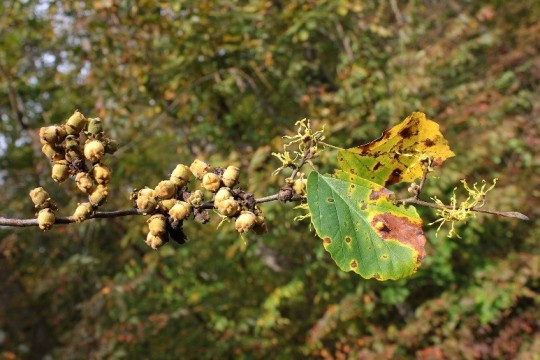
Witch hazel branch with fruits and flowers together

At this point in the year, there aren’t many blooms to be seen on a crisp hike through the woods. However, now is the perfect time to find Common witch hazel (Hamamelis virginiana) both flowering and fruiting!

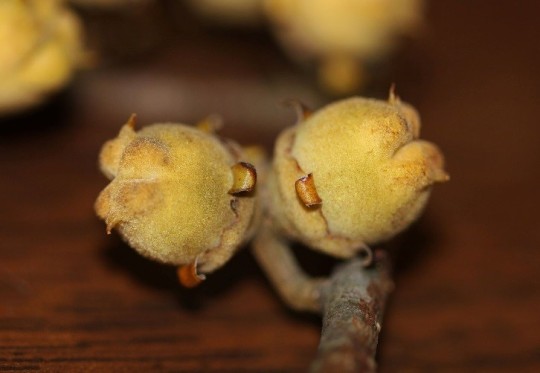
witch hazel fruits
Witch hazel fruits

Hamamelis, from the Greek words meaning “together” and “fruit,” refers to the presence of fruits and flowers at the same time. The velvety fruits you see on witch hazel at this time of year are actually from the flowers that bloomed a year ago. Once ripe, the fruit pops open and the shiny black seeds are forcibly ejected up to 30 feet away! This method of seed dispersal gives the witch hazel another common name, snapping hazelnut. The plant is medically useful for problems of the digestive tract, insect bites, minor burns, skin irritation, or colds and fevers.

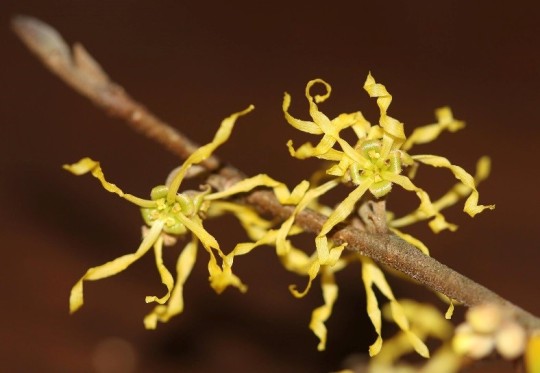
witch hazel flowers
Witch hazel flowers

While this species of witch hazel is one of the last woodland plants to bloom, the Chinese species of witch hazel is one of the first of the year to bloom in late winter, making this delightful group of plants a real rule-breaker! Be sure to keep an eye out for the curly yellow petals of the witch hazel flower on your next fall or winter hike!

Andrea Kautz is a Research Entomologist at Carnegie Museum of Natural History’s Powdermill Nature Reserve. Museum employees are encouraged to blog about their unique experiences and knowledge gained from working at the museum.
Filed Under: Blog Tagged With: Andrea Kautz, Botany, plants, Powdermill

August 1, 2018 by wpengine

Black Bears at Powdermill

By Andrea Kautz

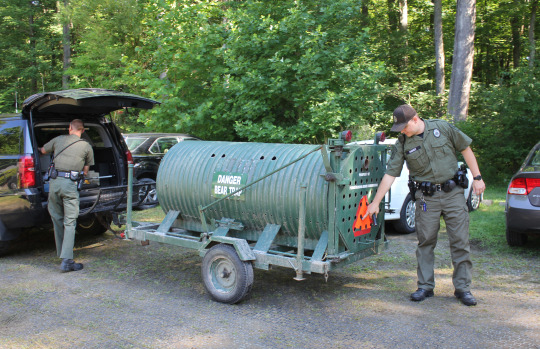
Recently, the PA Game Commission brought a black bear to Powdermill to release in the nearby state forest. It was a healthy, 300-pound male that was relocated because it was becoming a nuisance on a farm more than 30 miles away. Powdermill staff were grateful to have the opportunity to watch as the game wardens sedated and tagged the animal before release. The bear received two ear tags and a lip tattoo for identification. A small milk tooth was extracted which will be used later to determine his age. An infected claw was treated, but otherwise he appeared to be in good health.

Game Wardens arrive at Powdermill
Game Wardens Barron (left) and Harvey (right) arrive at Powdermill with the trap, which is on wheels for easy transport.

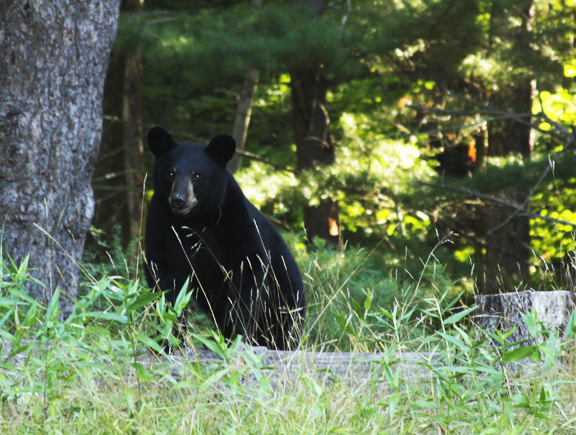
The Game Commission estimates the Pennsylvania bear population to be thriving at around 20,000 individuals. Compared to neighboring states, Pennsylvania black bears breed earlier and have more cubs. Bear populations are managed through seasonal harvesting, although only about 2% of those receiving permits are successful hunting a bear. In 2017, the largest bear taken was a 707-pound male from Monroe County!

black bear in Pennsylvania
American black bear. Photo credit: George Pankewytch

Hopefully, this male will find another place to call home, but relocating these animals can be tricky as they have a very good sense of direction and can cover long distances. At this time last year, one radio-collared male walked from Johnstown to Grove City to Pittsburgh, then east along the turnpike and up through the Laurel Highlands and back to Johnstown in about a month.  We give special thanks to the game commission for putting so much effort into maintaining a healthy population of bears that can live in harmony with humans and ensuring that Pennsylvania can continue to be a supportive environment for these spectacular beasts.

Andrea Kautz is a Research Entomologist at Carnegie Museum of Natural History’s Powdermill Nature Reserve. Museum employees are encouraged to blog about their unique experiences and knowledge gained from working at the museum.
Filed Under: Blog Tagged With: Andrea Kautz, conservation, mammals, nature, Powdermill, Powdermill Nature Reserve

  • « Go to Previous Page
  • Page 1
  • Page 2

sidebar

About

  • Mission & Commitments
  • Directors Team
  • Museum History

Get Involved

  • Volunteer
  • Membership
  • Carnegie Discoverers
  • Donate
  • Employment
  • Events

Bring a Group

  • Groups of 10 or More
  • Birthday Parties at the Museum
  • Field Trips

Powdermill

  • Powdermill Nature Reserve
  • Powdermill Field Trips
  • Powdermill Staff
  • Research at Powdermill

More Information

  • Image Permission Requests
  • Science Stories
  • Accessibility
  • Shopping Cart
  • Contact
  • Visitor Policies
One of the Four Carnegie Museums | © Carnegie Institute | Privacy Policy | Terms of Use | Accessibility
Rad works here logo