• Skip to primary navigation
  • Skip to main content
  • Skip to primary sidebar

Carnegie Museum of Natural History

One of the Four Carnegie Museums of Pittsburgh

  • Visit
    • Buy Tickets
    • Visitor Information
    • Exhibitions
    • Events
    • Dining at the Museum
    • Celebrate at the Museum
    • Powdermill Nature Reserve
    • Event Venue Rental
  • Learn
    • Field Trips
    • Educator Information
    • Programs at the Museum
    • Bring the Museum to You
    • Guided Programs FAQ
    • Programs Online
    • Climate and Rural Systems Partnership
  • Research
    • Scientific Sections
    • Science Stories
    • Science Videos
    • Senior Science & Research Staff
    • Museum Library
    • Science Seminars
    • Scientific Publications
    • Specimen and Artifact Identification
  • About
    • Mission & Commitments
    • Directors Team
    • Museum History
  • Tickets
  • Give
  • Shop

Blogs about the Anthropocene

Scientists use fossils and other traces to understand how the planet changed over time. In the past these changes were caused by forces like volcanic eruptions and shifts in oceans currents. Now there’s a new force of nature shaping the planet: humans. The effects on air, land, and water are significant enough that scientists propose we are a new geological time – the Anthropocene – or age of Humans.

These blogs are about the many facets of human impact on the Earth, documenting this new age.

September 10, 2020 by wpengine

Feeding the Monster in the Sewer

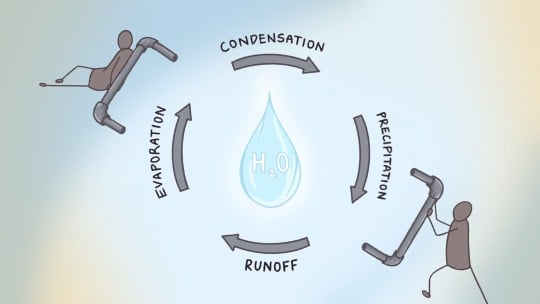
Water is a resource that I often take for granted. I take daily showers, wash my dishes, and do my laundry without a second thought to the amount or quality of water that is used. I only experience small aspects of the natural water cycle on a daily basis, from a bit of condensation on a cold glass of water to the sporadic downfall of rain that occurs in Pittsburgh. The water cycle that I’ve learned about in school can be boiled down to: precipitation, surface runoff, infiltration, evaporation, and condensation; but how do I, as a human being, fit into all of this? What is the human water cycle and how have parts of the water cycle changed within the Anthropocene?
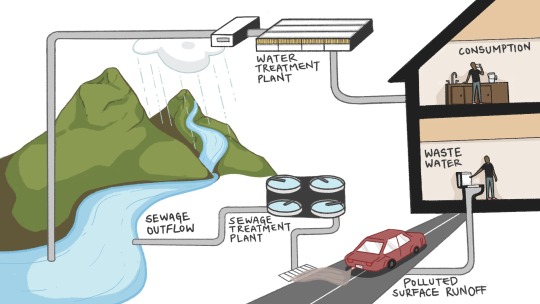
drawing of the city water cycle from waste water to drinking water

As intrigued as I was, I didn’t know enough about my own impact on the water cycle, so I took a deeper dive into learning about what was actually happening to the water that I used. In order to explore the concept of the human water cycle I needed to start by looking at infrastructure. In the case of water infrastructure, outside of irrigation, the water purification systems and sewage systems are some of the most impactful additions human beings have included into the planet’s water cycle. These infrastructural systems span thousands and thousands of miles underground, connecting houses, neighborhoods, and cities. And yet, at least for me, there was a vast mental disconnect between the water that flows underneath us and the water that we consume. I wasn’t sure how to visualize something that was happening underground, hidden away from sight. That’s when I learned about fatbergs.

In 2017 an 820 foot long mass weighing 130 metric tons was discovered in the sewers of Whitechapel in London, England. The same type of mass, weighing 42 metric tons was found in Melbourne, Australia during the outbreak of the COVID-19 virus, most likely due to the flushing of “toilet paper substitutes” (i.e. paper towels, sanitary products, facial tissues). These masses are called fatbergs and can be found in most major cities, especially those with older sewage systems like Pittsburgh. A fatberg is a solidified mass of fat, formed overtime in sewers, that sticks to the build-up of un-flushable sewage. Fatbergs cost hundreds of thousands of dollars to remove, and also reduce river and stream water quality by making sewer overflows more likely. In the Pittsburgh Area, whenever the combined storm and sanitary sewer system is overloaded, excess flow is dumped directly into the rivers.
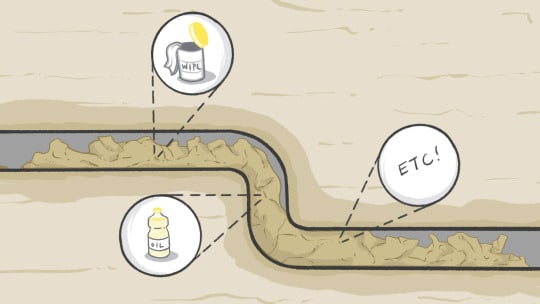
drawing of a pipe with a fatberg forming in it

Fatbergs are a human phenomenon that directly impacts both us and the greater environment. The sewer overflows that they cause impact both the built and natural environment, introducing pollutants such as human waste from our toilets and fats from our kitchen sinks into the living domain. But as harmful as they are, they can be easily prevented.

How, you ask? The solution is simple… don’t flush down anything other than toilet paper and bodily waste. But why? What makes toilet paper any different from other paper-like materials? The answer lies in the unique quality of the material that toilet paper is made up of. Unlike paper towels that use long fiber pulps, which improves the strength and absorptivity of the material, and facial tissues that contain additives that hold the fibers together, toilet paper is made using approximately 70% hardwood pulps with short fibers and 30% softwood pulps with longer fibers. Due to the hardwood pulps, once the toilet paper makes contact with water, the short fibers, which also help keep the toilet paper soft to touch, are able to untangle and fall away into smaller fragments, eventually dissolving into tiny bundles of short fiber that can easily flow through the sewage system.
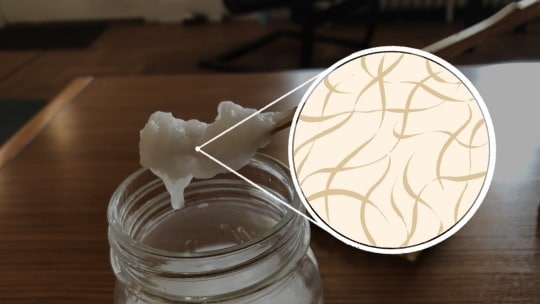
jar, wet paper, and a drawing of paper fibers

Objects like ‘flushable wipes’, unlike toilet paper, take hours to days to break down. This means that just because we are able to flush something down, doesn’t necessarily make it safe for sewer and septic systems. If you want to try an experiment to explore this concept, try putting ‘flushable’ wipes and toilet paper into two separate containers of water. See for yourself what happens.

Fatbergs are all the more relevant to us during the times of the pandemic, especially in the United States. As people stay home, more objects that aren’t healthy for the sewage system are being flushed. Think about the times you flushed anything other than toilet paper. Are you feeding a potential fatberg in your neighborhood?

Daniel Noh is an intern for the Center for Anthropocene Studies, Carnegie Museum of Natural History. Museum employees are encouraged to blog about their unique experiences and knowledge gained from working at the museum.

Related Content

From the Allegheny to Our Kitchen Sinks

We Are Nature: Living in the Anthropocene (Video)

I Love this Interspecies Friendship!

Filed Under: Blog Tagged With: Anthropocene, Anthropocene Living Room, Anthropocene Section, Anthropocene Studies, Daniel Noh, Museum from Home, Science News

September 9, 2020 by wpengine

From the Allegheny to our Kitchen Sinks

There are more than 326 million trillion gallons of water on our planet. Our bodies are made up of around 60% water. Even the air that we breathe has water vapors in it. Water is everywhere, but the water we can use is limited. According to the National Groundwater Association, the Earth is made up of about 71% water. Out of that, 99.7% is trapped in oceans, icecaps, soil, and the atmosphere. That leaves us with around 0.3% of the Earth’s water to use and drink. The same water that all living and nonliving things have used again and again since water has been on the planet.

drawing of people drinking water

Every morning I go downstairs to the kitchen and pour myself a glass of cold water from a water filter. Without a second thought, I drink the water because I consider this water to be safe. After all, the porous, activated carbon filters absorb various chemicals, including chlorine, lead, and mercury, which ‘purifies’ the water. Furthermore, I don’t have to worry about what could be in the water, because I know that the water is thoroughly cleaned before it enters the house. But how is it cleaned? Where does this water come from and what does it go through in order to splash into my kitchen sink?

Let’s start with a broader concept: rivers. Most major cities can be found along rivers: Paris along the Seine River, London along the River Thames, Seoul along the Han River, and New York along the Hudson River. This is no surprise, as communities need fresh, drinking water as an essential part of building a city. Pittsburgh is no different. In fact, in Pittsburgh, two rivers, the Monongahela and the Allegheny form a third, the Ohio, which on its passage through Pennsylvania, West Virginia, Ohio, Kentucky, Indiana, and Illinois, is the primary water source for over five million people. Within the city, the Allegheny River provides us, the people of Pittsburgh, with fresh water that we use on a daily basis.

illustration of the water cycle: condensation, precipitation, runoff, evaporation

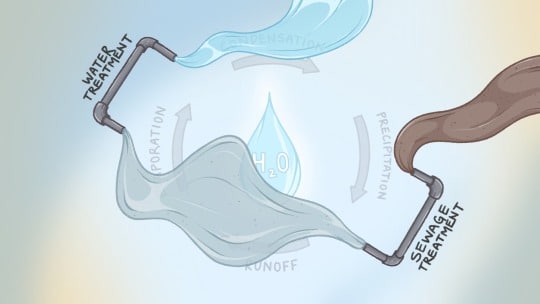
If my water comes from the Allegheny River, what’s the difference between drinking tap water and river water? That’s where the Pittsburgh Water and Sewer Authority, or the PWSA, enters the picture. PWSA is the organization in charge of providing quality water throughout the city of Pittsburgh. The organization’s drinking water system “contains approximately 965 miles of water lines, five reservoirs, and 11 tanks with a water storage capacity of 455 million gallons” (pgh2o.com). And their process for making clean water looks like this. First, the collected river water is coagulated using ferric chloride, potassium permanganate, carbon, and catatonic polymer, which react to the polluting particles in the water, causing them to stick and clump together. The water is then taken through the filtration process, where it flows through pulverized anthracite coal and sand to remove any of the remaining particles. Afterwards, the water is disinfected with sodium hypochlorite, a type of chlorine compound that is used to remove microbial particles. Lastly, once the water has been completely purified, fluoride, the processed form of a naturally occurring mineral, is added back into the water as recommended by the Center for Disease Control to prevent tooth decay.

image of sewage treatment and water treatment over water cycle

As complex as this purification process is, it isn’t perfect. The quality of the water that we receive is affected by what we put into it and there are countless compounds that cannot be completely filtered out by the processes used in water treatment plants. For example, trace amounts of dioxane, a likely human carcinogen from plastic manufacturing runoff, can be found in Pittsburgh’s own water system. Moreover, as of 2019, the PWSA has introduced orthophosphate in order to reduce lead levels, originating from the city’s ancient water pipes, in our tap water. In the end, all the water treatment plants can do is clean the water, test for contaminants, and research new ways to produce and deliver as clean a product as possible. The rest is up to us, the community. It’s up to us to be cautious of how we treat water by watching what we flush, preventing littering, or even reducing plastic use to reduce both microplastics and plastic production.

Water treatment is a growing process; new methods to remove previously unfilterable chemicals are constantly being discovered. With this in mind, think about your relationship with water. How do you treat it? What kind of objects do you flush down the toilet? What are your direct and indirect interactions with our water system? All of our actions matter. Because what we put into the river, will eventually come back to us.

Daniel Noh is an intern for the Center for Anthropocene Studies, Carnegie Museum of Natural History. Museum employees are encouraged to blog about their unique experiences and knowledge gained from working at the museum.

Resources

https://blogs.scientificamerican.com/guest-blog/the-purest-of-them-all/

https://www.portpitt.com/pages/monongahela-river

https://www.wpxi.com/news/what-you-need-to-know-about-pittsburghs-three-rivers/739536503/

http://www.orsanco.org/river-facts/

https://coolcosmos.ipac.caltech.edu/ask/67-How-much-water-does-Earth-have-#:~:text=There%20are%20more%20than%20326,in%20ice%20caps%20and%20glaciers

Related Content

The Inequity of Summer Heat

Hip and “Trashy” Ice Cream

Finding Nature in Your Local Streams

Filed Under: Blog Tagged With: Anthropocene, Anthropocene Living Room, Anthropocene Section, Anthropocene Studies, Daniel Noh, Museum from Home, Science News

June 12, 2020 by wpengine

The inequity of summer heat

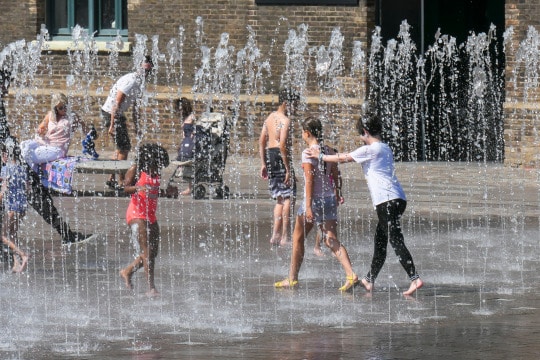
photo of kids playing in a fountain

Ah, summertime! In Pittsburgh, after months of cold, grey days, the warm temperatures and sunshine bring a collective sigh of relief. Plants are roaring back, coloring the world green. Animals are out and about singing and foraging; people are picnicking, barbequing, gardening. Life feels abundant. But summer can quickly become oppressive, even deadly, if it gets too hot. Extreme heat is among the deadliest weather-related phenomena in the US, and cities are most at risk for this hazard.

The concentration of impervious surfaces and low-rise buildings in cities raises temperatures significantly, creating what is termed the urban heat island effect. Temperatures in a single urban area can vary as much as 18 F depending on the density of the grey stuff (buildings, sidewalks, roadways, and parking lots) relative to the green stuff (trees, parks). The urban heat island effect also interacts with global climate change. Rising temperatures due to emissions of heat-trapping gases from the extraction and burning of fossil fuels is making urban communities increasingly vulnerable to extreme heat. And like so many other pressing issues in the early summer of 2020, namely the coronavirus pandemic and police violence, extreme heat is experienced inequitably.

In the US, communities of color and resource limited communities are both disproportionately exposed and sensitive to extreme heat. One recent study explores this climate inequity and its relationship to the historic racially discriminating housing policy, called ‘redlining’. In an analysis published in the journal Climate in January 2020, Jeremy Hoffman, Chief Scientist at the Science Museum in Virginia, and colleagues ask: “do historical policies of redlining help to explain current patterns of exposure to intra-urban heat in US cities? and how do these patterns vary by geographic location of cities?” As the study describes, in the 1930s, redlining distinguished neighborhoods that were considered “best” (outlined in green) and “hazardous” (outlined in red) for investment by the Home Owner’s Loan Corporation, a federally funded program. Categorization on a scale from A (best) to D (hazardous) was based largely on racial makeup. The program prioritized white neighborhoods for economic investment and access to credit. While the practice ended in 1968 with passage of the Fair Housing Act, its legacy has persisted in structuring the social-economic and ecological landscape of US cities today. The study examines the pattern of land surface temperatures in cities today in relation to historic housing policy.

The results for 108 urban areas in the United States can be explored in an open access article, and also shared through an explorable map. Overall, Hoffman and colleagues found that yes, for 94% of US cities, historical policies of redlining track surface land temperatures. Historically redlined neighborhoods are about 5 degrees F warmer on average today than historically greenlined neighborhoods. While temperature patterns within a city are complex and influenced by microclimates and other factors, the authors argue that the heat burden in redlined neighborhoods has been aggravated by housing policy. Redlined neighborhoods have significantly fewer trees, and an abundance of public highway projects and large building projects that create especially high asphalt to vegetation ratios.

Examining the map of the analysis in Pittsburgh, shows a complex relationship between redlining and land surface temperature, part of which I would guess reflects our extremely variable topography and a complex history of shifting neighborhood demographics associated with the boom and bust of the steel industry. I encourage you to investigate the results yourself.

Hoffman’s research demonstrates how structural inequities and institutional racism in the US affects people’s differential experience with the Anthropocene. Anthropocene challenges, like global warming and global pandemics, reveal the coupled dynamics among human social-economic-political systems and ecological-climate systems. They reveal the way that discriminatory race-based policies from the past animate the present. The experience of the pandemic, the experience of summer heat, the experience of poor air quality, the experience of police violence, the list goes on, are not evenly felt across communities. In the US, research shows time and time again that low resource communities and communities of color are disproportionately suffering. In the processes of doing sustainability and adaptation to address the Anthropocene, the work of undoing injustice is essential. In the case of increasing urban heat, as cities adapt, an important research and practice will involve work to ensure greening policies undo racial discriminatory neighborhood investing practices, while also ensuring protection from gentrification and displacement.

Putting research into practice, Hoffman in his role at the Science Museum of Virginia, is collaborating with youth community organization, Groundwork RVA, to build solutions to urban heat that are both low-cost and high impact. At CMNH’s Center for Anthropocene Studies we are inspired and motivated by the role that museums are playing in empowering communities to understand global change and build social equity and resilience.

Nicole Heller is Curator of Anthropocene Studies at the Carnegie Museum of Natural History. Museum employees are encouraged to blog about their unique experiences working at the museum.

Filed Under: Blog Tagged With: Anthropocene, Anthropocene Living Room, Anthropocene Section, Anthropocene Studies, Museum from Home, Nicole Heller, Science News

June 9, 2020 by wpengine

Hip and “Trashy” Ice Cream

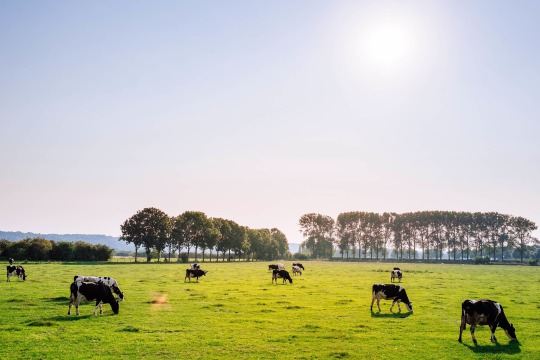
cows grazing in a field

I grew up in the country, on a gravel back road where the diary truck drove by to fill its tank at the local dairy farms. Those cows, I know now, were living the high life. Grazing idyllic in oak tree savanna fields, with miles of territory to wander. I knew the farmers’ kids. I even helped them with their chores, although not often because it wasn’t fun, even though they said it would be.

My assistance did result in my first taste of milk squirted straight from the udder! The term “Organic” was not used then, but now I know those were family owned organic farms in every sense of the term. No hormones. No cages. Hey, the farm kids even gave the cows names! At the time, my mom would buy name brand ice cream from the town’s market. My favorite was mint chocolate chip ice cream (the green kind). The flavor is super hip right now for being a “trashy” flavor. When I say hip and trashy, I mean in a weird nostalgic unhealthy food like tater tots and grilled cheese kind of way.  Some basic research reveals those cheap ice creams were, for their time, wholesome, waaaayyyy more wholesome than they are now.

Things have since changed in my hometown. Those family owned dairy farms are gone, replaced with mega dairy farms. And ice cream, especially my favorite trashy and hip flavor, has changed into what I consider to be really unhealthy in an environmentally unfriendly way. Palm oil. You might not know this, but palm oil is an ingredient in most frozen desserts and frozen dairy desserts (ice cream with a sub label). Palm oil is high in saturated fat and can affect cardiovascular health. The FDA does not require palm oil to be labeled, and instead the term vegetable oil is frequently substituted. Because most palm oil plantations are unsustainable, their spread across the landscape threatens rain forests, causes habitat loss for endangered species, violates human rights, and impacts climate change. Most name brand ice cream manufacturers currently use the stuff, but don’t want to be identified with its impacts. Carnegie Museum of Natural History’s Assistant Curator of Amphibians and Reptiles, and tropical conservation ecologist Jennifer Sheridan has some serious concerns about the palm oil industry and has witnessed firsthand its impacts on rainforest ecology. Check out her work here.

So how do I fix this? Or maybe, how do I get my chocolate mint chip ice cream fix?

First off, during the pandemic, I’ve been making homemade ice cream. I’ve been able to control the ingredients and add in special touches like fresh mint (growing out of control in my neighbor’s garden). Here’s a quick blender recipe I’ve used. When I need ice cream from the store for my movie binges, I choose companies that clearly label their ice cream to be palm oil free. Ben and Jerry’s does this very well. As the ice cream shops open up, I will go local.

bowl of mint chocolate chip ice cream with mint leaves and spoon
Homemade mint chocolate chip ice cream.

All of these options may seem high priced or too much work. Surprisingly the homemade recipes are really easy to make, and pretty cheap considering the quality of ice cream produced. The great thing is you can enjoy the process, sit back and not feel guilty about using palm oil, the really unhealthy and not cool ingredient in ice cream. And for me, it takes me back, to when ice cream had ingredients I could point to.

Asia Ward is CMNH Anthropocene Program Manager and Science Communication Fellow. Museum staff, volunteers, and interns are encouraged to blog about their unique experiences and knowledge gained from working at the museum.

Filed Under: Blog Tagged With: Anthropocene, Anthropocene Living Room, Anthropocene Section, Asia Ward, Museum from Home, Science News

May 19, 2020 by wpengine

Finding Resilience Through Plant Love

Feeling a little extra thankful for spring blooms? Taking extra care of your house plants? Urge to garden a little stronger than usual? People in Pittsburgh and across the US are turning to plants to find solace and a connection to nature this spring of COVID-19. Of course, people have always been drawn to plants, but this spring is different. If you’re not able to garden or are looking for some plant-y inspiration, look no further than PlantLoveStories.com. This is a project started in 2018 by a group of young women conservation scientists–including Dr. Sara Kuebbing, a professor at Pitt and collaborator with CMNH’s Mason Heberling, and me, a science communication fellow in the CMNH Anthropocene Section. At the site you’ll find first-hand stories about how plants have shaped people’s lives along with a sincere invitation for you to share a plant-based story of your own.

logo for Plant Love Stories
The Plant Love Stories logo designed by the author.

In the museum’s Anthropocene Section we believe that storytelling, emotions, and personal connections are keys to connecting with the public, communicating science, and empowering people to act. Plant Love Stories is a great example of these principles. Plant Love Stories was founded on the idea that plants tend to blend into the background and the public pays less attention to them than animals. We thought the public sharing of personal plant connections might lead, down the road, to greater awareness and funding for plant conservation.

The Plant Love Stories website is a blog, a collection of stories submitted by the public about the role of plants in shaping our lives, relationships, and, in a recent post involving swamp milkweed, resilience during the pandemic.

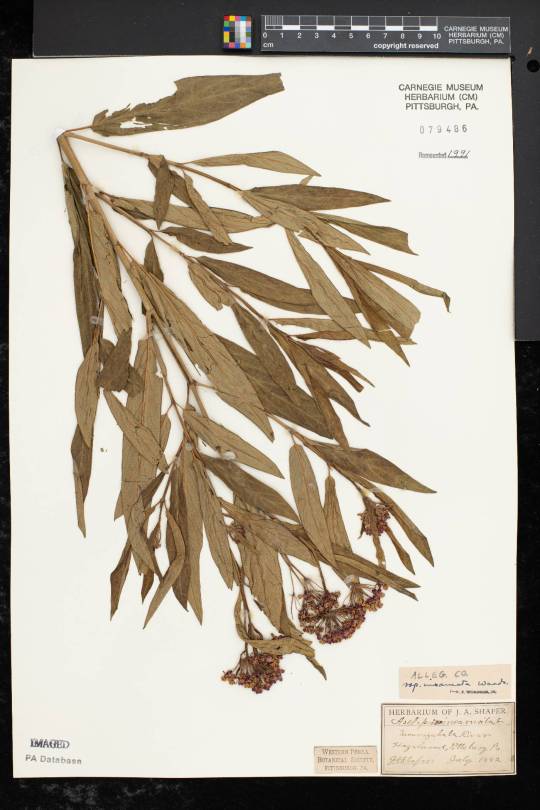
Plant Love Stories in the CMNH Herbarium: A swamp milkweed (Asclepias incarnata) specimen from the CMNH Herbarium collected in Allegheny County in 1882.

A number of Plant Love Stories have western PA roots (pun intended). We have a few stories written by Dr. Kuebbing’s Pitt students, including “Learning to Look Up” by Swapna Subramanian and “Fidel and the Hopeless, No-Good, Super Sad Raspberry Bush” by Fidel Anderson. I have posted two Plant Love Stories linked to Indiana County, where I grew up: one I wrote about how I did not break my brother’s arm (really, it wasn’t my fault), and one my aunt wrote about her grandmother, my great-grandmother, teaching her how to cook pokeweed. We also have a human love story from Butler County featuring flowering maple trees.

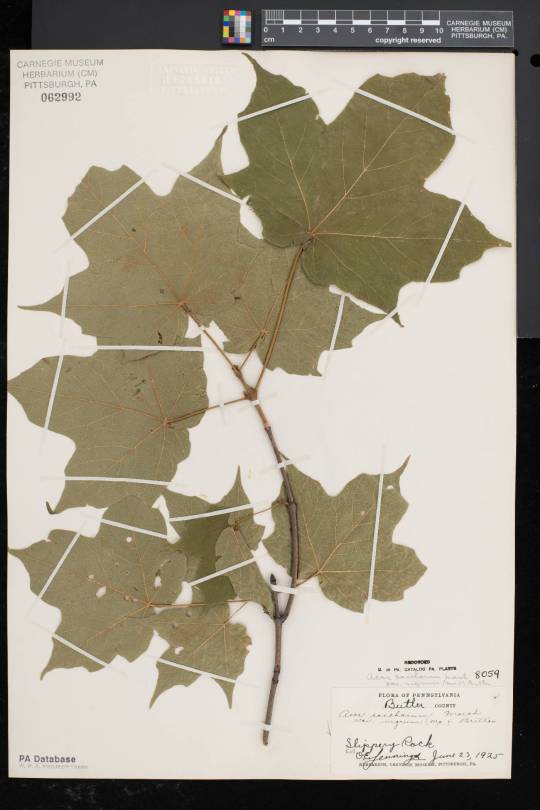
Plant Love Stories at the CMNH Herbarium: A sugar maple (Acer saccharum) specimen from the CMNH Herbarium collected in Butler County in 1925.

Whether you’re planting your biggest ever vegetable garden, tending a single tomato plant, or reading accounts posted on Plant Love Stories, try some plant love to help you get through this difficult time.

Bonnie McGill is a science communication fellow in the CMNH Anthropocene Section. Museum staff, volunteers, and interns are encouraged to blog about their unique experiences and knowledge gained from working at the museum.

Filed Under: Blog Tagged With: Anthropocene, Anthropocene Living Room, Anthropocene Section, Bonnie McGill, botany hall

May 18, 2020 by wpengine

Garden for the Birds (or bees, or butterflies, or creepy crawlies, or you get the picture)…

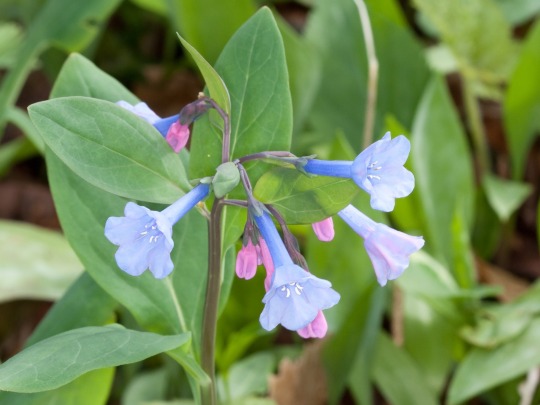
detail photo of blue and pink flowers

“What do I plant?” you may be wondering as spring starts to set in. Maybe you are a master gardener, or maybe you are a novice trying to fill the time during quarantine. Nevertheless, putting plants in the ground is on your mind. What if I told you that choosing native plants over non-native ornamentals does more than create a beautiful landscape – it creates habitat for native wildlife, connects our backyards to bigger natural landscapes, and can help mitigate negative impacts of environmental change.

photo of cedar waxwing on a serviceberry branch with a berry in its mouth

Native plants are the plants that occur naturally in the area, and they have evolved with the local environmental conditions and other plants and wildlife that occur in the area. Because of this, native plants often provide the necessary shelter and food needed for local wildlife while requiring little to no fertilizers, pesticides, or water after they are established. Having more native plants in your backyard increases wildlife habitat, reduces air pollution (no mowing required!), decreases erosion (choose plants with deep root systems over non-native grassy lawns), reduces chemicals and excess water use (easy maintenance!), and adds natural beauty to your very own backyard or patio!

Imagine a world where our backyards, patios, and shared spaces are full of native plants – creating a completely connected world full of beautiful plants and providing food and shelter for wildlife. Our landscapes don’t have to be “Developed” OR “Wild”. Our landscapes can be a mosaic of varying levels and sizes of native habitats and local ecosystems – but always with some habitat, connecting one place to the next.

If you want to know more about the benefits of native plants, the sites below are a good place to start.

Benefits of Native Plants for Birds and People

Where I found my inspiration to plant native 

What do I plant? 

Heather Hulton VanTassel, PhD is the Carnegie Museum of Natural History’s Assistant Director of Science and Research. Museum staff, volunteers, and interns are encouraged to blog about their unique experiences and knowledge gained from working at the museum.

Filed Under: Blog Tagged With: Anthropocene, Anthropocene Living Room, Heather Hulton VanTassel, Museum from Home, Science News, We Are Nature 2

  • « Go to Previous Page
  • Page 1
  • Page 2
  • Page 3
  • Page 4
  • Page 5
  • Page 6
  • Interim pages omitted …
  • Page 16
  • Go to Next Page »

sidebar

About

  • Mission & Commitments
  • Directors Team
  • Museum History

Get Involved

  • Volunteer
  • Membership
  • Carnegie Discoverers
  • Donate
  • Employment
  • Events

Bring a Group

  • Groups of 10 or More
  • Birthday Parties at the Museum
  • Field Trips

Powdermill

  • Powdermill Nature Reserve
  • Powdermill Field Trips
  • Powdermill Staff
  • Research at Powdermill

More Information

  • Image Permission Requests
  • Science Stories
  • Accessibility
  • Shopping Cart
  • Contact
  • Visitor Policies
One of the Four Carnegie Museums | © Carnegie Institute | Privacy Policy | Terms of Use | Accessibility
Rad works here logo