• Skip to primary navigation
  • Skip to main content
  • Skip to primary sidebar

Carnegie Museum of Natural History

One of the Four Carnegie Museums of Pittsburgh

  • Visit
    • Buy Tickets
    • Visitor Information
    • Exhibitions
    • Events
    • Dining at the Museum
    • Celebrate at the Museum
    • Powdermill Nature Reserve
    • Event Venue Rental
  • Learn
    • Field Trips
    • Educator Information
    • Programs at the Museum
    • Bring the Museum to You
    • Guided Programs FAQ
    • Programs Online
    • Climate and Rural Systems Partnership
  • Research
    • Scientific Sections
    • Science Stories
    • Science Videos
    • Senior Science & Research Staff
    • Museum Library
    • Science Seminars
    • Scientific Publications
    • Specimen and Artifact Identification
  • About
    • Mission & Commitments
    • Directors Team
    • Museum History
  • Tickets
  • Give
  • Shop

Bob Davidson

March 8, 2019 by wpengine

What are Seventeen-Year Cicadas and Why Does It Seem Like They Emerge More Than Once Every Seventeen Years?

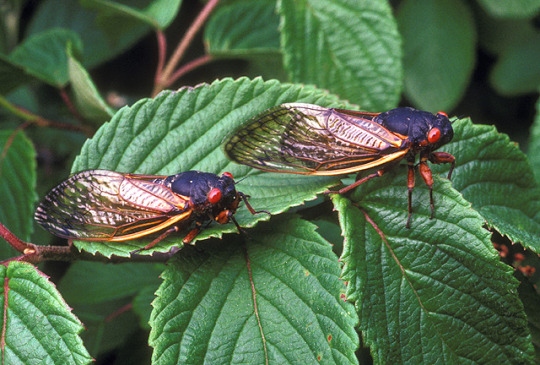
two cicadas on a leaf

There are different broods of periodical cicadas.  Any given brood has adults emerging only once in 17 years and has a defined range of occurrence.  The brood we will see in Allegheny County this year (2019) is Brood VIII.  It is a brood with a relatively small distribution, occurring mainly in eastern Ohio, the panhandle of West Virginia, and about a dozen counties in southwestern and western Pennsylvania.

Adults will emerge in a couple of months (mid-May, but with climate change issues this is becoming less predictable; when the subsurface soil reaches 64 degrees Fahrenheit, emergence will begin), females will lay eggs, nymphs will hatch 6-10 weeks thereafter, and those nymphs will drop to the ground, burrow into the ground below deciduous trees, tap into the roots to syphon the plant juices, and remain underground for the next 17 years.  The adults of this brood will not be seen for 17 years, emerging again in 2036.
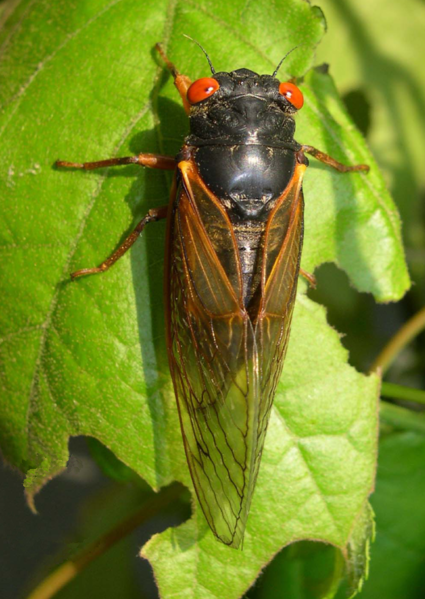
cicada on a leaf

Photo from Wikimedia Commons. 

Currently there are 12 broods of 17-year cicadas, each with a different aggregate distribution.  This means that in a 17-year period, adults will be emerging somewhere in 12 different years.  Some of these have a very small distribution; some have huge distributions.  For example, Brood X is nicknamed the Great Eastern Brood because it ranges from New York to Georgia, and west to Michigan. Brood X occurs over much of Pennsylvania, though not here in the southwest corner.  Its adults will emerge again in 2021 (and then 2038, etc.), but they are not related to or derived from the ones we will see this year. In a way, you can think of them as different clans or tribes that can’t interbreed or interact with one another because the adults are not in the same areas at the same time.

Of the 12 broods, 8 of them occur in Pennsylvania as a whole, though mostly to the east.  Here in the southwest, we get only 3 broods.  This means here in southwestern Pennsylvania, we will normally see adults emerging during 3 years out of 17.  Brood VIII, already mentioned, will be out this year and again in 2036.  Brood VII we saw here last year (2018), and it will be out again in 2035.  Both of these have been found in Allegheny County.  Brood V, last seen in 2016 and due again in 2033, has not officially been recorded from Allegheny County, but since it is known from nearby Greene, Washington, Westmoreland, and Fayette Counties, it is most likely here.

And, to be clear: there are other kinds of cicadas that come out every year.  These are usually called Annual Cicadas.  They don’t aggregate in big swarms, so there is just one here, one there.  Nymphs are underground only a year or two, so there are adults every year.  And they are active later in the season, mostly July-September rather than May-June. These are the solitary ones you hear singing in a tree in late summer.

Bob Davidson is Collection Manager of Invertebrate Zoology at Carnegie Museum of Natural History. Museum employees are encouraged to blog about their unique experiences and knowledge gained from working at the museum.
Filed Under: Blog Tagged With: Bob Davidson, Cicadas, Invertebrate Zoology, Robert Davidson

February 25, 2019 by wpengine

The Manticore

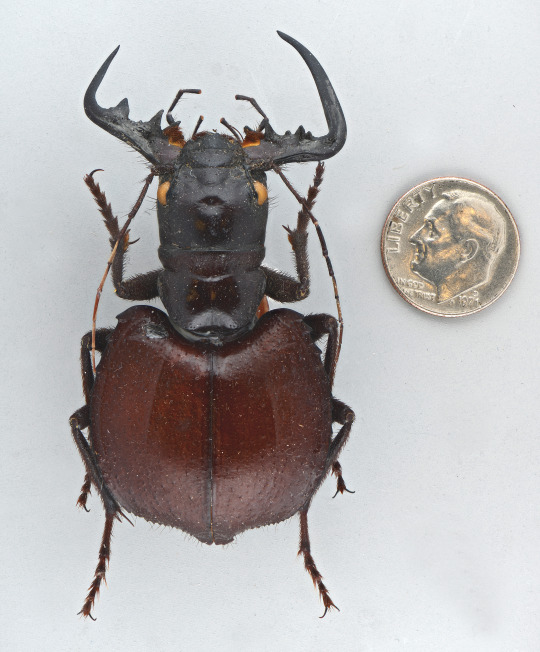
manticore specimen next to a dime for scale
Figure 1.  Adult male Manticora imperator, dorsal view (photo credit: V. Verdecia).

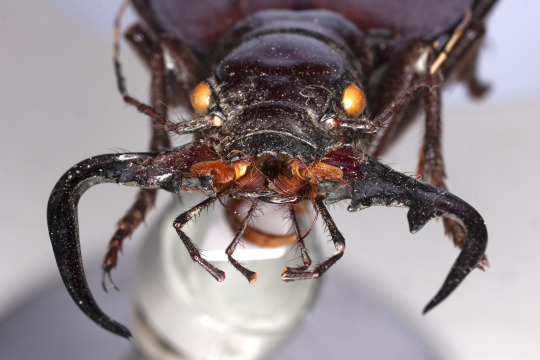
The Manticore.  In ancient Persia, a scary, man-eating monster with the head of a man, the body of a lion, and the tail and sting of a scorpion. In nature, one of the most spectacular of God’s favorite creatures, beetles (there are more beetle species than anything else living today).  The genus Manticora (“the one who devours men”) consists of 15 known species confined to the southern portions of Africa, mostly to the oldest geologic portions of that region, and mostly to open desert and dry savannah habitats. They are relatively primitive, flightless, predatory black tiger beetles of enormous size.  The males of some species are particularly spectacular, with huge asymmetrical mandibles, reaching the extreme in Manticora imperator, with a toothed left mandible and a larger right mandible bent like a sickle (Figures 1-2).  Mandibles in both sexes are used to attack prey, and, in males, also to combat other males and to clasp the female during copulation.

Figure 2.  Close-up of mandibles and maw of male M. imperator (photo credit: V. Verdecia).

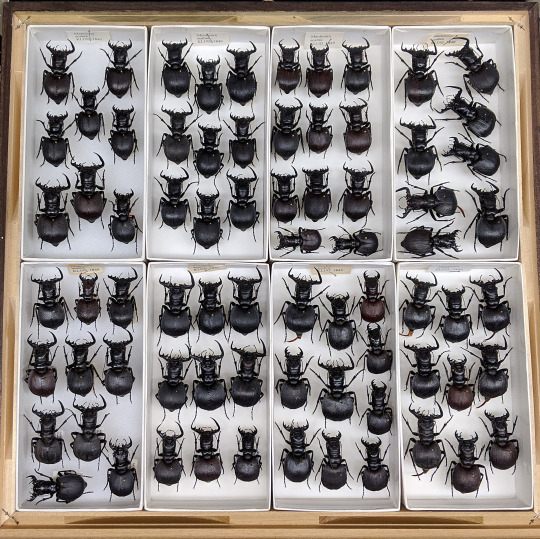
A recent donation gives Carnegie Museum of Natural History one of the best collections of these beetles in the world, nearly a thousand specimens, including all the species and subspecies.  This includes many of the types (specimens designated to represent the species when an author names a new animal or plant).  Long series of many of them (Figure 3) allows analysis of variation and distribution, addressing conservation issues, and has great potential for exhibit purposes.  Some of the species are now threatened, not by collecting, but by construction and development over their very limited habitats and ranges.

Figure 3.  Typical drawer from CMNH collection with several Manticora species (photo credit: V. Verdecia).

The larvae (Figure 4) look and behave more like tiger beetle larvae from other parts of the world, except that they are enormous.  They dig a vertical burrow up to a meter in depth, depending on substrate, which they can drop down into when disturbed.  The larval head is like a big armored plug with jaws attached.  In attack mode, they block the burrow entrance with the head (making the hole difficult to see) and wait.  There is also a large hook toward the rear on the larva’s back which makes it difficult for anything to dislodge it from the burrow. If something edible gets within striking distance, the larva throws its forebody out, grabs with its large jaws, and drags the prey into the burrow.

Figure 4.  Larva of M. mygaloides, antero-lateral view (photo credit: V. Verdecia).

Adults hibernate underground in a large chamber at the end of a tunnel that can be as much as a meter and a half in length.  Most are active from October to March after the summer rains, but they can wait a long time if necessary, until the unpredictable, erratic summer rains come. Activity is in the daytime, and they do not hesitate to attack other large armored beetles, or invertebrates that are larger than the attacker.  You have perhaps seen giant millipedes the size of a bratwurst in various insect zoos? There is a filmed instance of a Manticora finishing off and eating a 10-12 inch millipede, though the beginning of the event was missed, and it is possible the millipede was already injured. These are probably not the normal preferred prey of these aggressive beetles (the millipedes, that is, not the bratwursts, which are not known to occur in the wild).  But it still seems like quite a feat for an animal only about 20% the size of its dinner.

Bob Davidson is Collection Manager of Invertebrate Zoology at Carnegie Museum of Natural History. Museum employees are encouraged to blog about their unique experiences and knowledge gained from working at the museum.
Filed Under: Blog Tagged With: beetles, Bob Davidson, bugs, insects, Invertebrate Zoology

July 27, 2017 by wpengine

University of Pittsburgh’s Consuming Nature

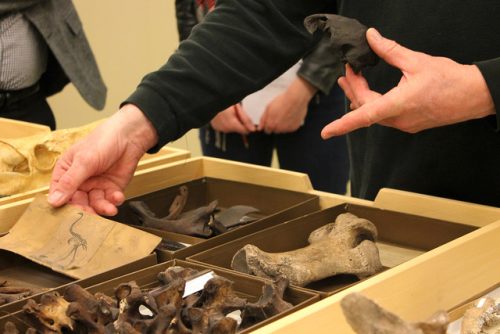
Albert Kollar, collection manager of the Section of Invertebrate Paleontology, spoke to Pitt students and faculty.

fossils in the hidden collection in the Section of Paleontology

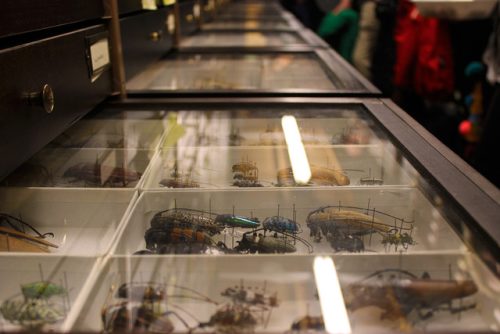
specimens in the Section of Invertebrate Zoology.

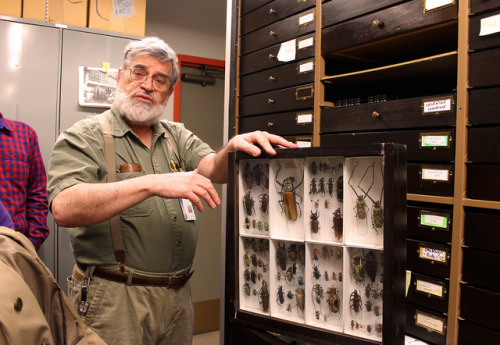
Collection Manager Bob Davidson shared pieces of the Invertebrate Zoology collection.

Last month, the staff at Carnegie Museum of Natural History hosted students and faculty from the University of Pittsburgh’s Consuming Nature group. We gave them an exclusive, behind the scenes look at the research collection.   Dr. Eric Dorfman, the Daniel G. and Carole L. Kamin Director of Carnegie Museum of Natural History, hosted the group, who visited the museum to develop ideas and gather information for future teaching and research projects.

Filed Under: Blog Tagged With: Albert Kollar, Bob Davidson

sidebar

About

  • Mission & Commitments
  • Directors Team
  • Museum History

Get Involved

  • Volunteer
  • Membership
  • Carnegie Discoverers
  • Donate
  • Employment
  • Events

Bring a Group

  • Groups of 10 or More
  • Birthday Parties at the Museum
  • Field Trips

Powdermill

  • Powdermill Nature Reserve
  • Powdermill Field Trips
  • Powdermill Staff
  • Research at Powdermill

More Information

  • Image Permission Requests
  • Science Stories
  • Accessibility
  • Shopping Cart
  • Contact
  • Visitor Policies
One of the Four Carnegie Museums | © Carnegie Institute | Privacy Policy | Terms of Use | Accessibility
Rad works here logo