• Skip to primary navigation
  • Skip to main content
  • Skip to primary sidebar

Carnegie Museum of Natural History

One of the Four Carnegie Museums of Pittsburgh

  • Visit
    • Buy Tickets
    • Visitor Information
    • Exhibitions
    • Events
    • Dining at the Museum
    • Celebrate at the Museum
    • Powdermill Nature Reserve
    • Event Venue Rental
  • Learn
    • Field Trips
    • Educator Information
    • Programs at the Museum
    • Bring the Museum to You
    • Guided Programs FAQ
    • Programs Online
    • Climate and Rural Systems Partnership
  • Research
    • Scientific Sections
    • Science Stories
    • Science Videos
    • Senior Science & Research Staff
    • Museum Library
    • Science Seminars
    • Scientific Publications
    • Specimen and Artifact Identification
  • About
    • Mission & Commitments
    • Directors Team
    • Museum History
  • Tickets
  • Give
  • Shop

Botany Blogs

These blogs are written about and by our Section of Botany researchers. The herbarium at the museum which contains approximately 3,000 type specimens--specimens that define an entire plants' species. These type specimens only represent about 0.6 % of the collection.

Mason Heberling, head of the section, regularly shares herbarium specimens that have been "Collected on this day" in history.

March 25, 2022 by Erin Southerland

For the Love of Dead Plants

by Koa Reitz

Reposted from Plant Love Stories.

One of my earliest memories as a child is my friend finding a big leaf when we were at the park, and me bursting into tears because I wasn’t the one who found it. Fall was my favorite season because as I walked around, there were plenty of things for me to pick up! I was absolutely captivated by the leaves that fell off of the trees, and would pick up as many as I could. I don’t remember why I was so attached to these leaves–the dead part of the plants around me–but I would always end up with a stack of leaves when I got home.

I think a big part of my obsession with collecting leaves was their colors. But sometimes I would find a particularly big leaf and, as a small child, I was absolutely dumbfounded at the leaf bigger than my head. I had to have them. When I brought the leaves home however, I never kept them, they would sit outside for a while until they would eventually blow away or decompose in the yard. This wasn’t exactly an issue for my young self, as object permanence had yet to fully develop. And there were always more leaves to find!
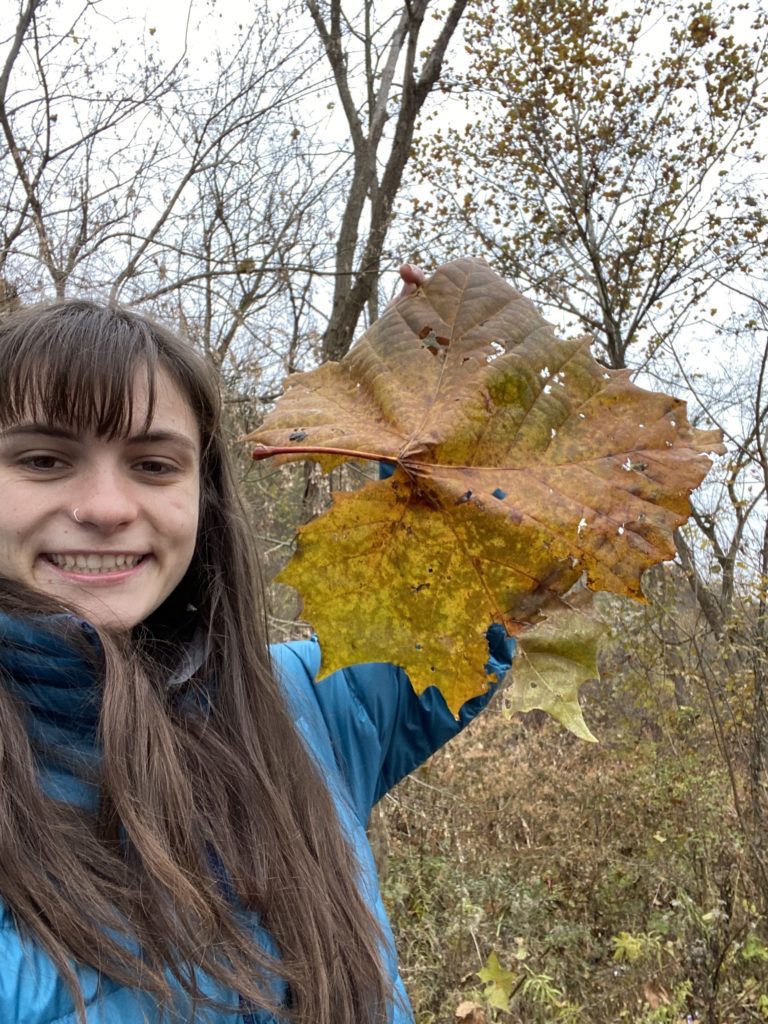
Person holding a leaf the size of their head.
The author can still find leaves larger than her head! Here, American sycamore (Platanus occidentalis)

As I grew up, I became less and less invested in picking up all of the leaves I saw. I think eventually I saw so many that it was hard to find a new color combination I had yet to see, so leaf searching had lost its allure. I would still stop to look at the leaves when there was a particularly vibrant red, or an exciting combination of green, yellow, and orange all in the same leaf, but I left the leaf where it stood. No more collecting for me.

Until recently, I had no reason to think that collecting plants could have any purpose, scientific or otherwise. Contrary to my thinking, there is a vast and important process of collecting and storing plants, of all kinds, to be used for reference and scientific research. Herbaria are collections of preserved plants dating as far back as hundreds of years ago. These specimens can be used for a variety of things including taxonomic classifications (scientific naming systems), DNA sequencing, and phenological observations. Phenology is the study of the time when certain things in the life cycle of a plant happen. For example, phenology can look at the time in a flowering plant’s life that it begins growing new leaves, when it grows flowers, when it develops its fruit, or when leaves turn colors in the Fall. Phenological data from herbaria have been used to look into the past in ways that wouldn’t be possible without a collection of old, dead, plants. A group of scientists at Boston University used herbarium specimens to determine that a warmer climate led to earlier flowering times. This conclusion has various implications including evidence that a warming planet has concrete impacts on the natural environment and changes how we look at climate science overall. It is important to look to the past if we’re going to make informed decisions about the future, and herbaria are full of accessible and valuable information that can help develop scientific claims of all different kinds. 
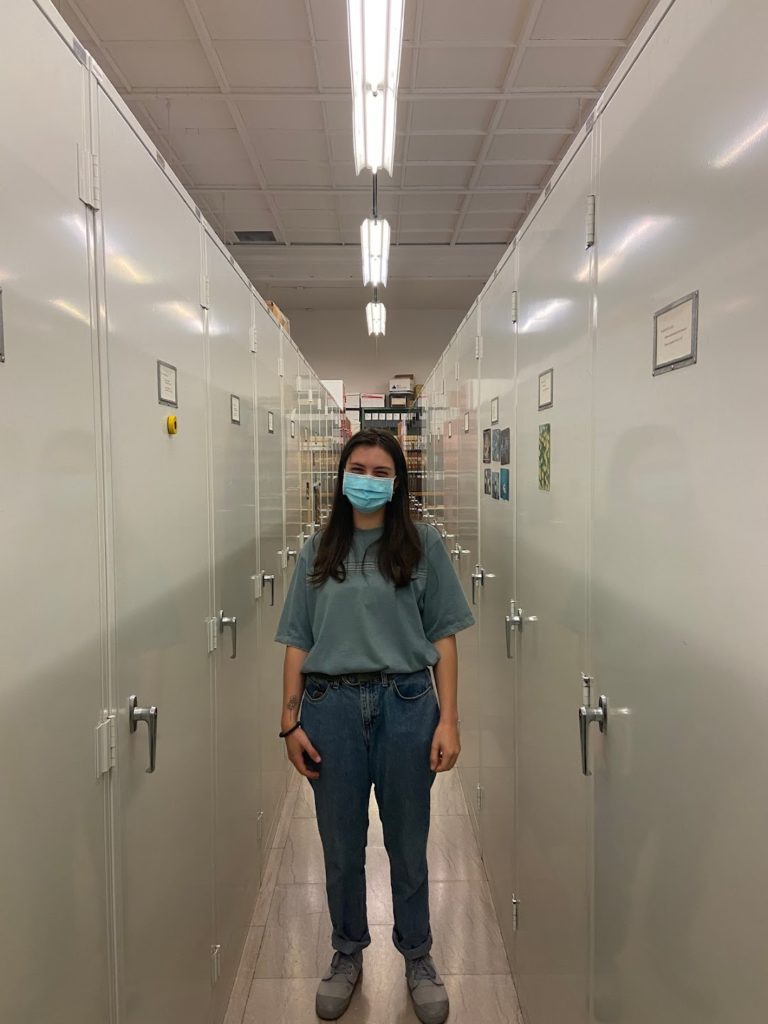
Person standing between metal cabinets.
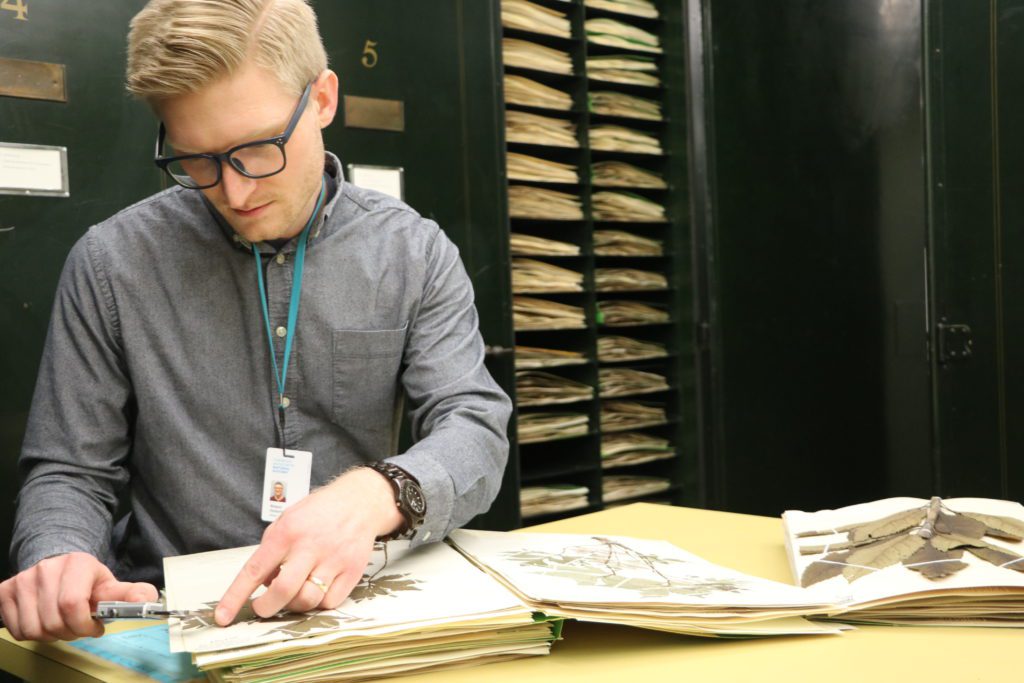
The author stands among the botanical collections at the Carnegie Museum of Natural History’s herbarium in Pittsburgh, PA.

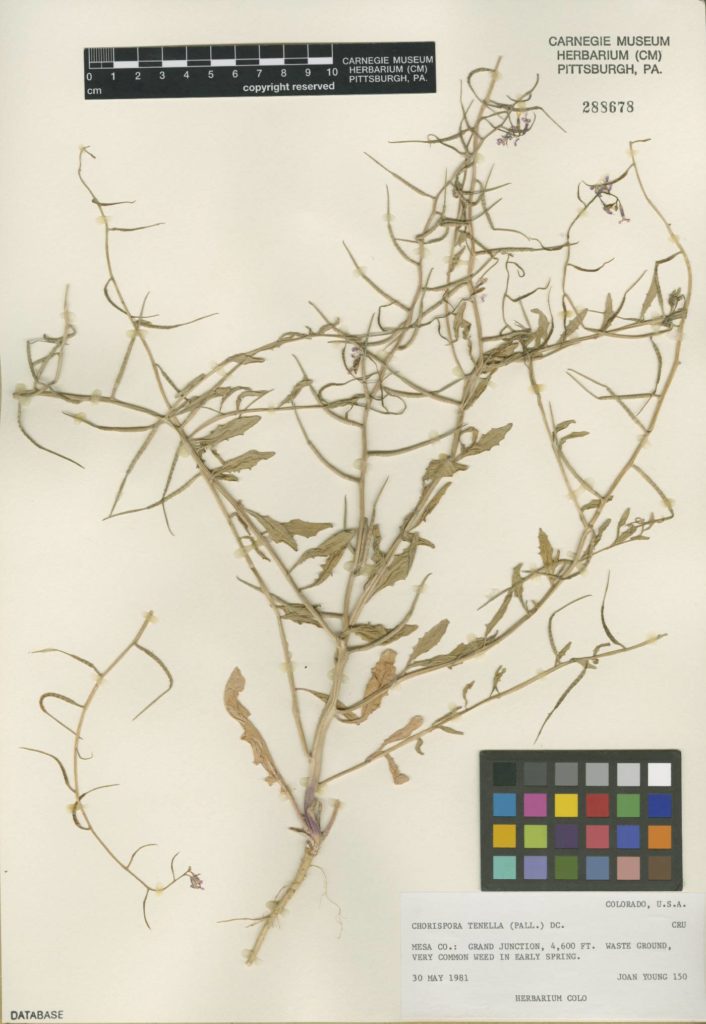
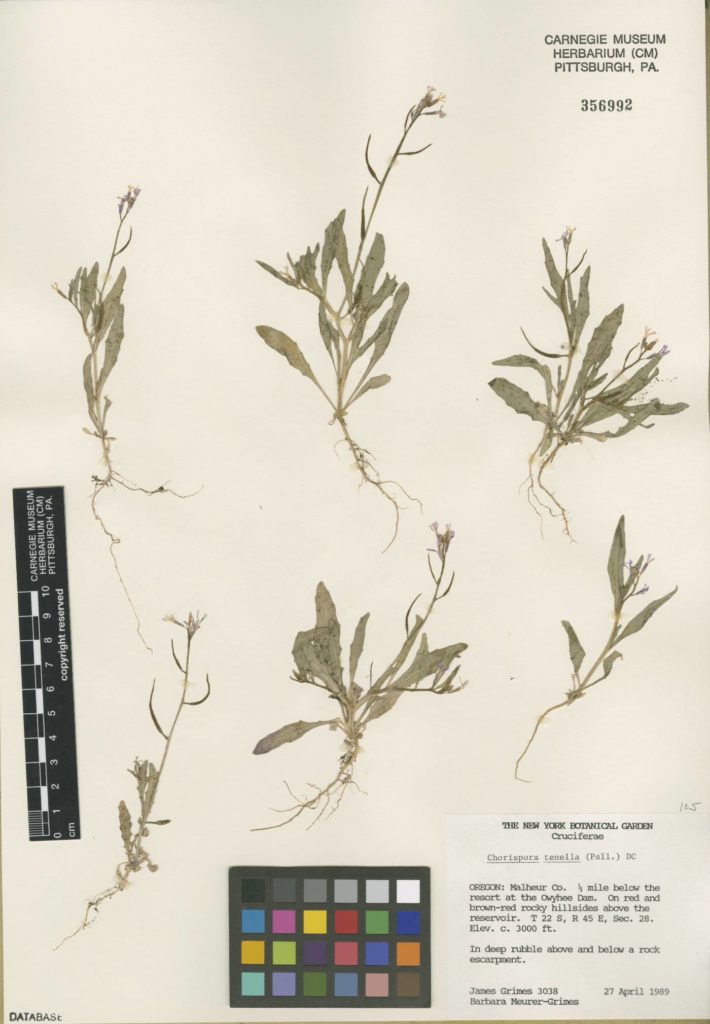
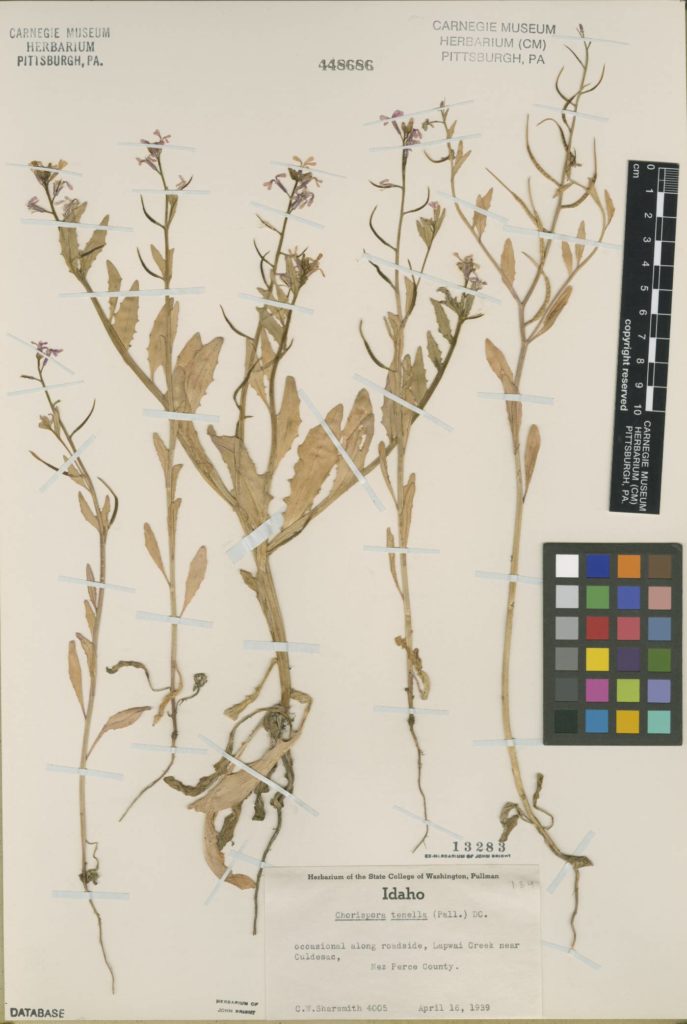
I am particularly interested in Herbaria because of my work in the Carnegie Museum of Natural History’s Herbarium. It was compelling to me to work with scads of cabinets full of dead plant specimens. Currently, I am working on a project where I look at digitized Chorispora tenella (purple mustard) specimens in the Carnegie Museum Herbarium, and herbaria from all over the US. Chorispora tenella is a plant that is invasive in parts of the Western US, and we are looking to see how the phenology has changed over the course of its invasion. There are endless questions about the timing of flowering or the spatial differences in flower or fruit number, just to name a few. I think I started to form a relationship with the plants, as I look at image after image and count the number of flower buds, flowers, and fruits, just as I had formed a relationship with the fallen leaves when I was young. 
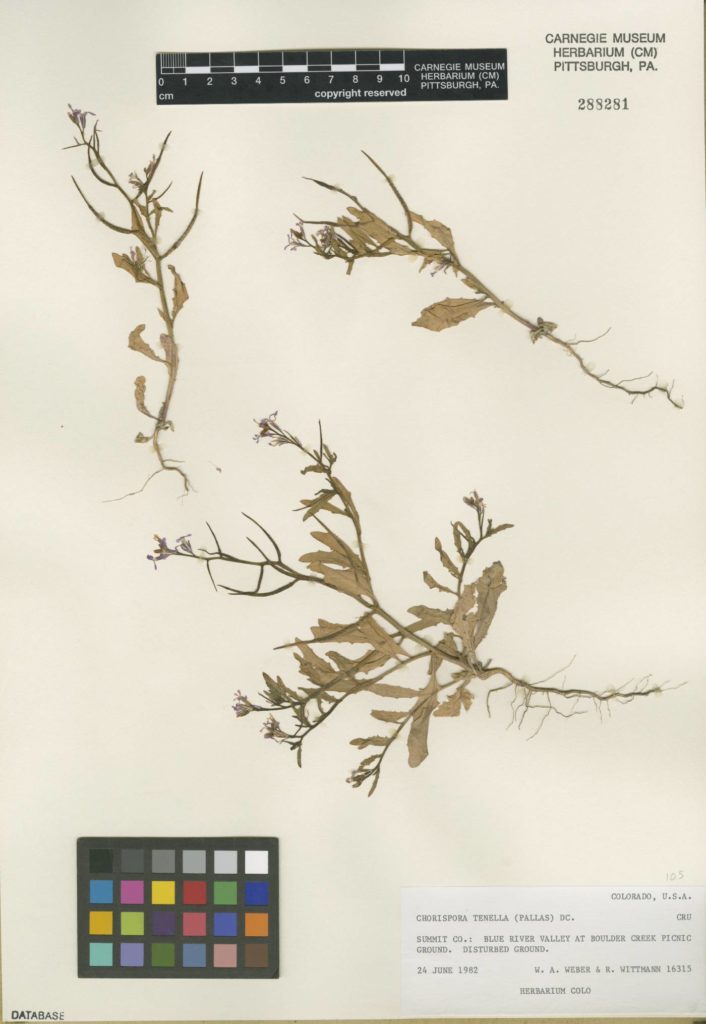
Above: purple mustard (Chorispora tenella ) botanical specimens stored at the Carnegie Museum of Natural History.**

There’s so much to learn from these seemingly simple and still specimens. When I do this work, it brings me back to when I was a child and had the (not so permanent) leaf collections of my own. I think there was a part of me as a child that wished to observe what I gathered further, but I had no method or resources to preserve my collections. Now, with herbaria, there’s access to thousands of species of plants that span all over the world. They open up countless lines of study and things to learn and explore, all from dead plants in cabinets. I even find myself collecting and questioning things again, renewing my sense of exploration. And I still make time to find leaves bigger than my head. 

Koa Reitz is an undergraduate student studying Ecology and Evolution at the University of Pittsburgh, and a research intern at the Carnegie Museum of Natural History. Museum employees, interns, and volunteers are encouraged to blog about their unique experiences and knowledge gained from working at the museum.

** To learn more about these natural history specimens, you can visit the Mid-Atlantic Herbaria Consortium. Specimens are as follows (left to right): CM356992 collected in 1989 in Oregon; CM448686 collected in 1939 in Idaho; CM288678 collected in 1981 in Colorado; and CM288281 collected in 1982 in Colorado.

Related Content

Collected On This Day in 1951: Bittersweet

Collected On This Day in 1934: European larch

Sharing Shipping Space with Amphibians and Reptiles

Carnegie Museum of Natural History Blog Citation Information

Blog author: Reitz, Koa
Publication date: March 25, 2022
Share this post!

  • Share on Twitter Share on Twitter
  • Share on Facebook Share on Facebook
  • Share on Pinterest Share on Pinterest
  • Share on LinkedIn Share on LinkedIn
  • Share on Reddit Share on Reddit
  • Share via Email Share via Email

Filed Under: Blog Tagged With: Botany, Koa Reitz, We Are Nature 2

February 1, 2022 by Erin Southerland

STUDY CALLS FOR “EXCITING NEW ERA” OF INCREASED USE OF PLANT SPECIMENS AS TRAIT DATA SOURCES

Dr. Mason Heberling, Assistant Curator of Botany at Carnegie Museum of Natural History. 

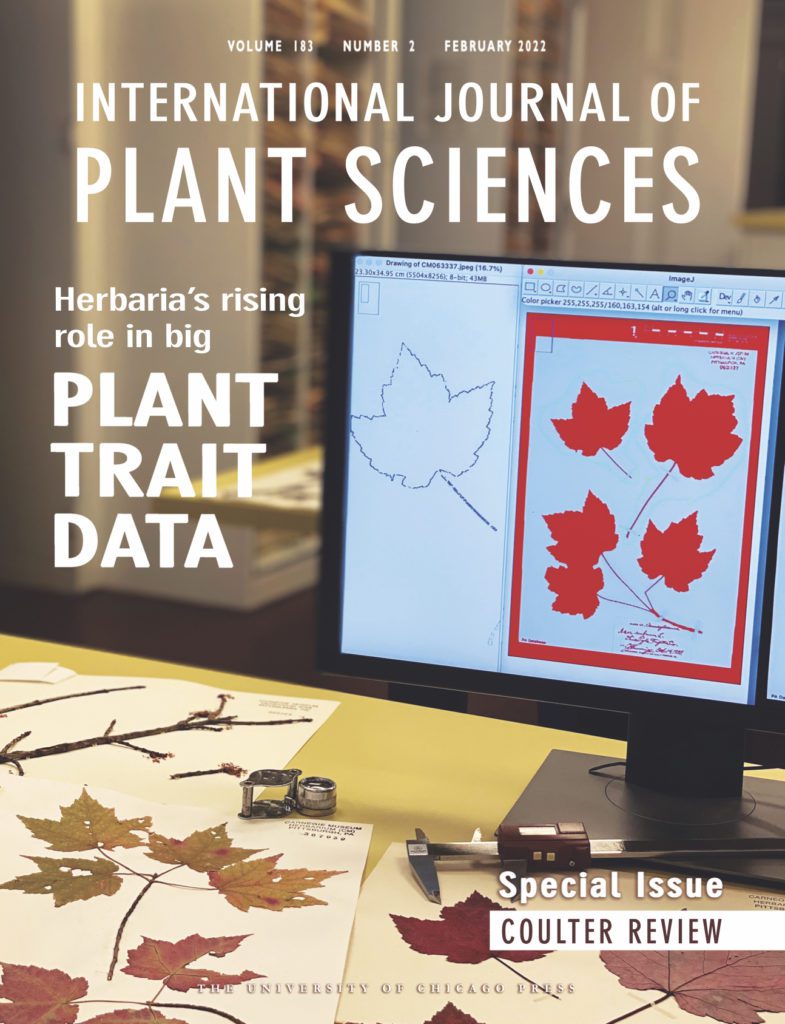
A new review by Dr. Mason Heberling, Assistant Curator of Botany at Carnegie Museum of Natural History (CMNH), cites diverse studies to synthesize past and current uses of plant specimens as trait data sources and to advocate for “an exciting new era” of potential future applications, bolstered by technology and digitization. The review, “Herbaria as big data sources of plant traits,” will be published as the most recent John M. Coulter Review and featured cover article in the February edition of the University of Chicago Press’s International Journal of Plant Sciences. The prestigious Coulter Review provides scientists in the forefront of their fields the opportunities to share insights on the latest developments of plant biology.

Cover of the February 2022 issue of International Journal of Plant Sciences.

Thanks to the digitization of museum specimens, more than 3,000 active herbaria worldwide, including CMNH’s herbarium, serve as increasingly connected scientific resources documenting botanical diversity through time and space. With 396 million specimens and counting, these collections represent all formally described plant species—an ongoing effort of many thousands of botanists on every continent for over four centuries. However, these specimens are only recently being recognized for their potential as sources of extensive data on plant functional traits. 

Traditionally, herbaria and collections have been used for a handful of disciplines, including taxonomy and systematics, floristics and biogeography, species identification, scientific vouchers, and education. However, recent applications of herbaria data demonstrate a scientific relevance that diversifies beyond these original uses. They include the extraction of genetic material from century-old specimens to quantify changing plant-insect interactions. New molecular methods like next-generation sequencing make the extraction of genetic material from herbarium specimens possible in the developing field of “museomics,” or genomics exclusively studying organisms found in museum collections. Such molecular advances provide new insights into extinct species and detect genetic changes of introduced species as they spread across the landscape. Herbarium applications unanticipated—and unimagined—even a few decades ago are now mainstream. 

“As an ecologist coming into the herbarium for the first time, I was struck by the richness and enormity of information in these collections, and much of it is unrealized outside of taxonomy,” Heberling writes. “Tapping into specimens for trait data is by no means new but spread across many studies and often on smaller scales. I spent years compiling these uses of specimens as sources for trait data and staring at specimens, asking, ‘What information can we get from the many millions of decades-old specimens collected across the globe?’ This review aims to foster an exciting new era for herbaria.”

However, scientists often discount herbarium specimens as unreliable because modern utilizations may test hypotheses for which the data were not originally intended. While conceding validity to these points, Heberling argues that “preconceived assumptions about data suitability for use can stifle innovation” and suggests retroactive and proactive solutions to potential herbaria limitations, including addressing collector bias, validating herbarium-derived trait measurements, addressing microsite variation, and solutions to collecting. 

Heberling proposes new collection practices that will require a new scientific culture surrounding herbaria with significant digital, physical, and human resource infrastructural investment for transformative change. “It is an exciting time for collections,” he concludes. “Bolstered by more than a decade of digitization and emerging initiatives, the role of herbaria in modern research should only strengthen. Herbaria should be embraced as centers for functional trait research, with their uses as diverse as the specimens they house.”

The International Journal of Plant Sciences has a distinguished history of publishing research in the plant sciences since 1875. IJPS presents high quality, original, peer-reviewed research from laboratories around the world in all areas of the plant sciences. Topics covered range from genetics and genomics, developmental and cell biology, biochemistry and physiology, to morphology and anatomy, systematics, evolution, paleobotany, plant-microbe interactions, and ecology. The International Journal of Plant Sciences established the John M. Coulter Review, in 2012 in honor of John Merle Coulter (1851–1928), who joined the University of Chicago in 1896 as the first Head Professor of Botany.

Filed Under: Press Release Tagged With: Botany, Mason Heberling

January 11, 2022 by Erin Southerland

Collected on this Day in 1951: Bittersweet

by Mason Heberling
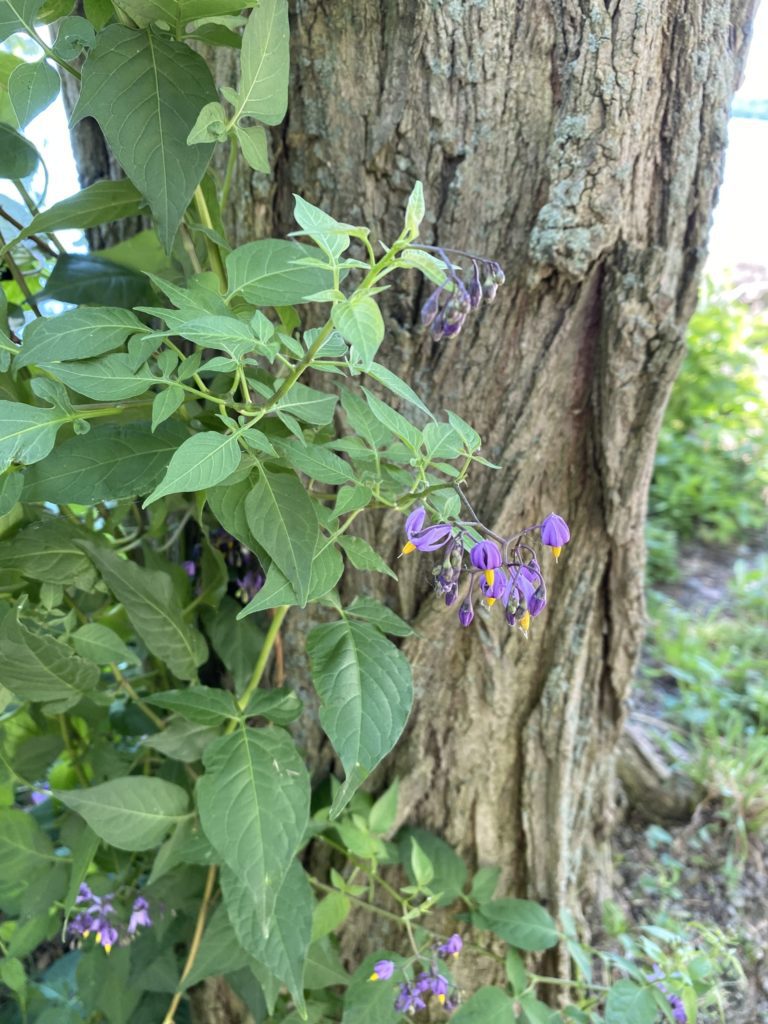
Bittersweet plant in spring

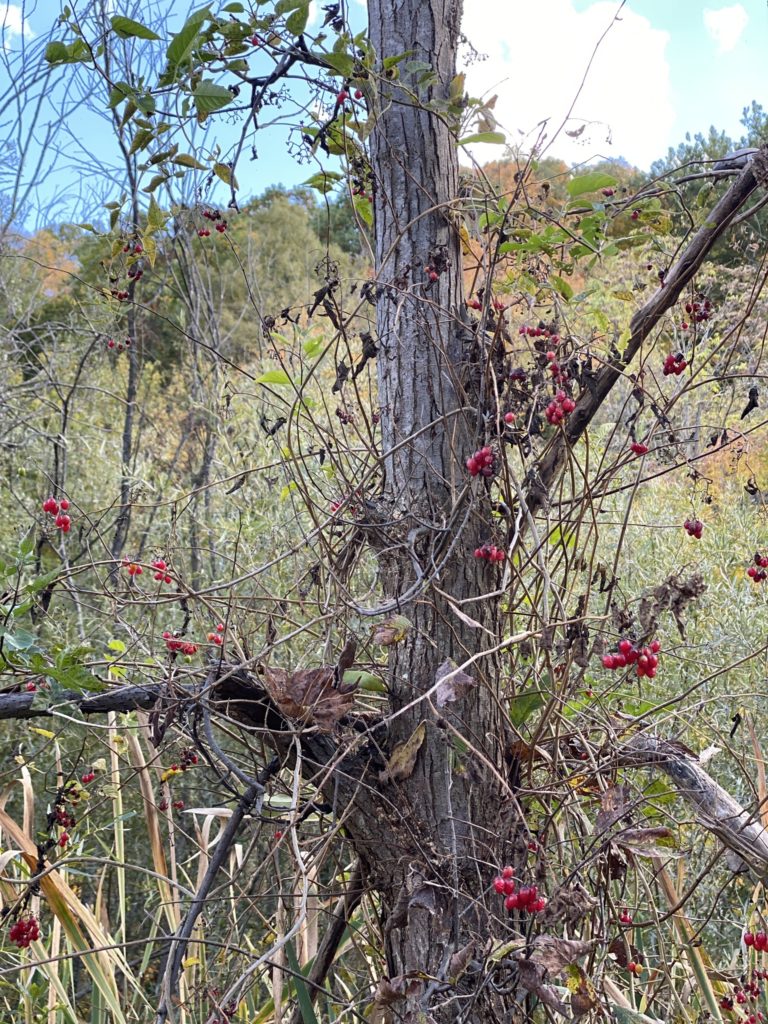
Leaves are gone, but fruits hang on

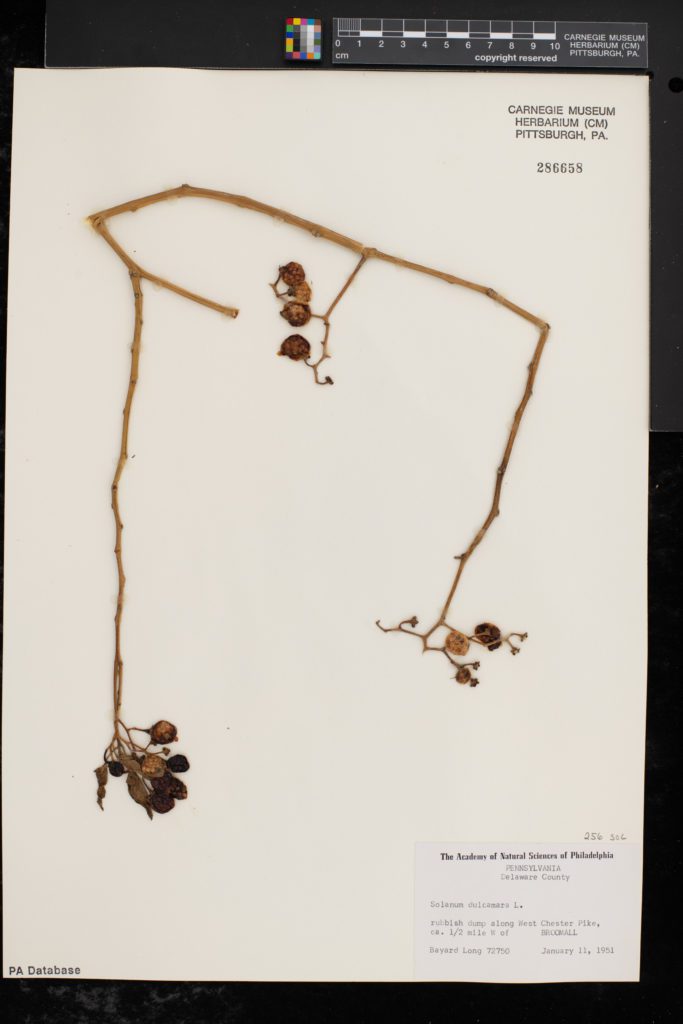
Bittersweet plant specimen on herbarium sheet

This specimen of bittersweet (Solanum dulcamara) was collected by Bayard Long on January 11, 1951 in a “rubbish dump” on West Chester Pike, near Broomall, Pennsylvania (outside of Philadelphia). Bayard Long (1885-1969) was a Philadelphia-area botanist and an active member of the Philadelphia Botanical Club (founded in 1891 and still an active organization). He was a prolific collector and for 56 years served as Curator of the Club’s Local Herbarium, which is housed at the Academy of Natural Sciences. 

Bittersweet nightshade (Solanum dulcamara) is in an herbaceous vine in the potato or nightshade family (Solanaceae), not to be confused with the similarly named Asian bittersweet (Celastrus orbiculatus), which is also a woody vine in the staff vine or bittersweet family (Celastraceae).

Bittersweet is an invasive species, introduced from its native range in Europe and Asia as early as the 1800s. It is common to see climbing along fences in urban areas and elsewhere across North America.

In the winter, its fleshy red berries are commonly still attached to the vines, long after the leaves are gone.

bittersweet plant in the fall

Find this specimen of bittersweet. 

Check back for more! Botanists at the Carnegie Museum of Natural History share digital specimens from the herbarium on dates they were collected. They are in the midst of a three-year project to digitize nearly 190,000 plant specimens collected in the region, making images and other data publicly available online. This effort is part of the Mid-Atlantic Megalopolis Project (mamdigitization.org), a network of thirteen herbaria spanning the densely populated urban corridor from Washington, D.C. to New York City to achieve a greater understanding of our urban areas, including the unique industrial and environmental history of the greater Pittsburgh region. This project is made possible by the National Science Foundation under grant no. 1801022.

Mason Heberling is Assistant Curator of Botany at Carnegie Museum of Natural History. Museum employees are encouraged to blog about their unique experiences and knowledge gained from working at the museum.

Related Content

Plants with Bladders?

Collected on this Day in 1998: Common Chickweed

Collected on this Day in 1925: A Flower with No Leaves?

Carnegie Museum of Natural History Blog Citation Information

Blog author: Heberling, Mason
Publication date: January 11, 2022

Share this post!

  • Share on Twitter Share on Twitter
  • Share on Facebook Share on Facebook
  • Share on Pinterest Share on Pinterest
  • Share on LinkedIn Share on LinkedIn
  • Share on Reddit Share on Reddit
  • Share via Email Share via Email

Filed Under: Blog Tagged With: Botany, Mason Heberling, Science News, Uprooted, We Are Nature 2

November 12, 2021 by Erin Southerland

Collected on this Day in 1930: Native…or Not?

by Mason Heberling

Though the supercontinent Pangea broke apart many millions of years ago, the Anthropocene is marked by a new kind of Pangea. The globalization of human activities has brought species from around the world into contact which otherwise would never interact. Though the seven continents as they are today may not be physically connected into a single landmass, they are perhaps more connected than they have ever been. 

Some species are intentionally moved from one continent to another, such as the plants in gardens, while other introductions are accidental, mere unintentional passengers of humans increasingly global activities. Introduced species can fundamentally alter the landscape and are regarded as one of the top threats to native biodiversity.

Invasive species are those introduced species which are non-native and spread without human intervention. Many invasive species alter ecosystem functioning and change regional biodiversity. Invasive plant species have become a common part of our landscape. Some were brought over hundreds of years ago by European colonists. Others have arrived much more recently. 

In Pennsylvania, the invasion of some plant species is obvious – that is, a unique species arrives, thrives, and become abundant. These invasive species have no record of being in the area and can spread rapidly, sometimes over the course of a human lifetime or shorter. Many invasive species are still actively spreading across the landscape. For instance, garlic mustard (Alliaria petiolata) is a well-known forest herb from Europe introduced to North America in the mid-1800s. After more than a century, the plant is now common across Pennsylvania’s forests. Another obvious example is giant knotweed (Reynoutria sachalinensis), a native to parts of East Asia, first recorded in western Pennsylvania in the 1920s, and since spread to line many of Pennsylvania’s rivers and streams. You can’t go far in the Pittsburgh region without seeing invasive knotweed.

Other species invasions are less obvious. These so called “cryptic invasions” are the introductions of very closely related species or subspecies which originated elsewhere. 

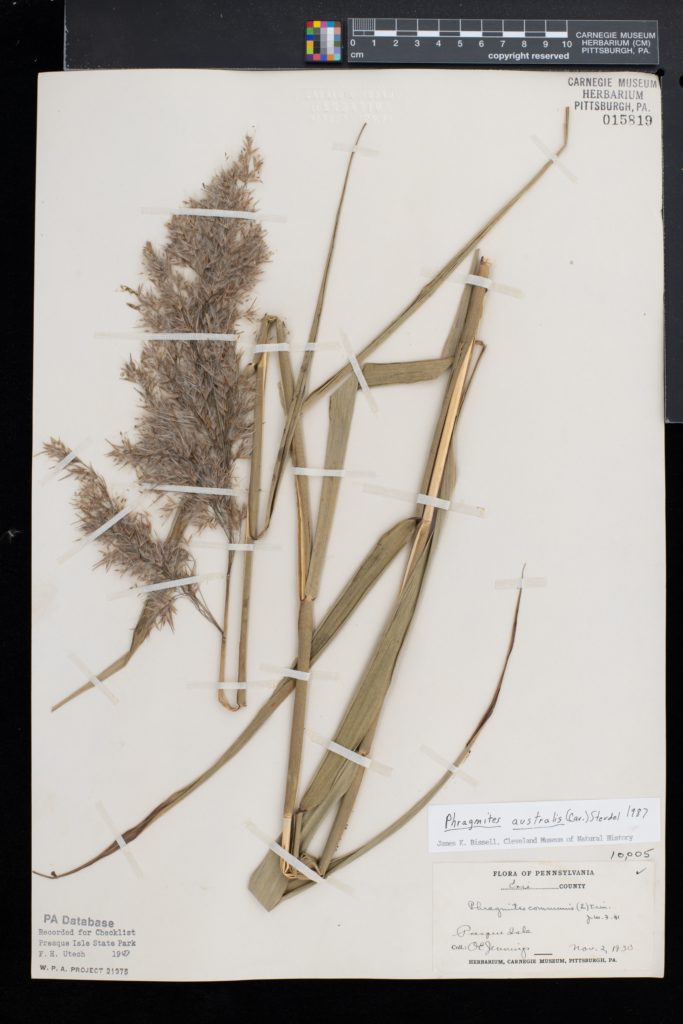
specimen of common reed on an herbarium sheet

This specimen of common reed (Phragmites australis) tells the tale of a widespread cryptic invasion. The specimen was collected by Carnegie Museum botany curator Otto Jennings on November 2, 1930 along the shores of Lake Erie at Presque Isle, Pennsylvania. Common reed is a major problematic invasive species, crowding out native species in this unique habitat at Presque Isle. When this specimen was collected over 90 years ago, it was not nearly as abundant as it is now. 

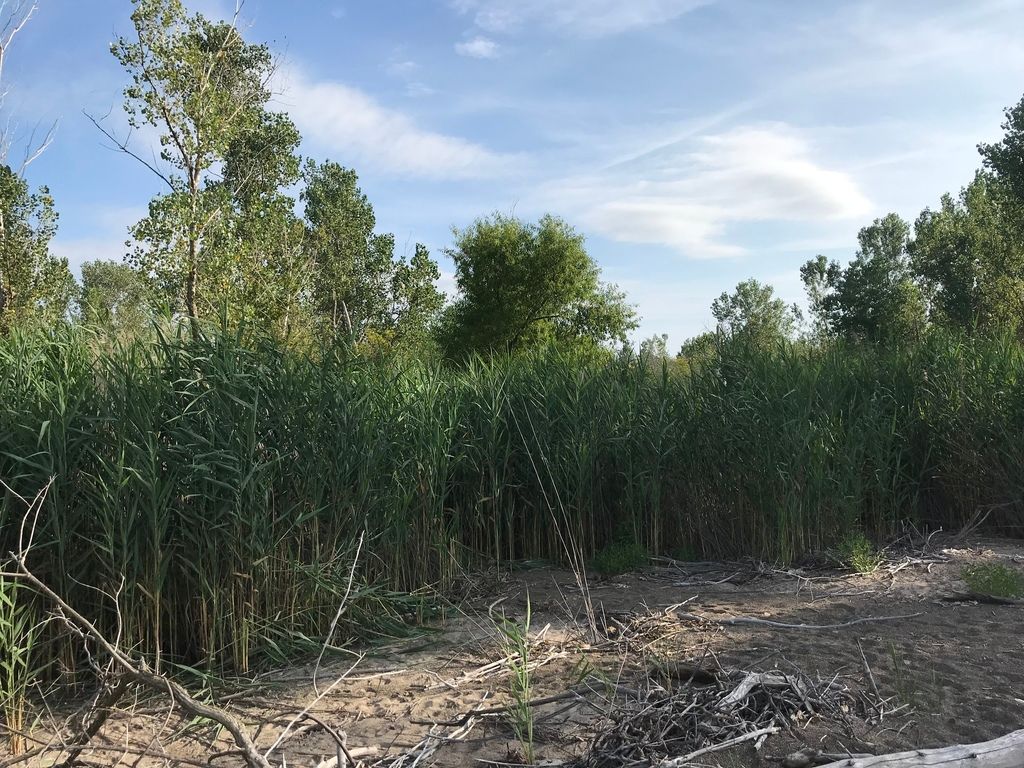
common reed plants with trees outside
A large stand of Phragmites at Presque Isle State Park, August 2019.

But is it non-native? Common reed, or often simply called Phragmites, has a very widespread distribution, found in wetlands and shores across all continents except Antarctica. It is even a common site along wet areas near highways. Common reed is among the most widely distributed plants in the world.

Reed is non-native to the United States…well, mostly. In the 1800s, botanists considered Phragmites to be a relatively uncommon plant. Evidence from fossils and paleoecological research show that the species has indeed been in North America for many thousands of years. However, it didn’t start to become abundant until the early 1900s and after. Some botanists suggested the sudden success of the species could be due to human disturbance.  A pioneering herbarium-based study from 2002 published in PNAS by Dr. Kristin Saltonstall sequenced DNA from herbarium specimens collected before 1910 and recent collections to show that the spread of Phragmites in the United States was due to the introduction of a non-native strain of the species that originated from Europe. 

Pretty cool, huh? And this finding was made possible with herbarium specimens.

So, is this particular specimen native or not? I don’t actually know, but with expert examination and genetic analysis, we could find out! 

Find this specimen and 149 more in the Carnegie Museum herbarium here.

Check back for more! Botanists at the Carnegie Museum of Natural History share digital specimens from the herbarium on dates they were collected. These scientists are in the midst of a three-year project to digitize nearly 190,000 plant specimens collected in the region, making images and other data publicly available online. This effort is part of the Mid-Atlantic Megalopolis Project (mamdigitization.org), a network of thirteen herbaria spanning the densely populated urban corridor from Washington, D.C. to New York City to achieve a greater understanding of our urban areas, including the unique industrial and environmental history of the greater Pittsburgh region. This project is made possible by the National Science Foundation under grant no. 1801022.

Mason Heberling is Assistant Curator of Botany at Carnegie Museum of Natural History. Museum employees are encouraged to blog about their unique experiences and knowledge gained from working at the museum.

Related Content

The Circle of Life…and Invasion

Ask a Scientist: How do you find rare plants? [Video]

Collected on This Day in 1982: One specimen isn’t always enough!

Carnegie Museum of Natural History Blog Citation Information

Blog author: Heberling, Mason
Publication date: November 12, 2021

Share this post!

  • Share on Twitter Share on Twitter
  • Share on Facebook Share on Facebook
  • Share on Pinterest Share on Pinterest
  • Share on LinkedIn Share on LinkedIn
  • Share on Reddit Share on Reddit
  • Share via Email Share via Email

Filed Under: Blog Tagged With: Botany, collected on this day, Mason Heberling, Science News, Uprooted, We Are Nature 2

September 24, 2021 by wpengine

What Do Botanists Do On Saturday?

by Sarah C. Williams

Here in the section of Botany we’ve adapted in some strange ways, just like plants do, to the changes of the past year and a half. Let’s learn about the off days of some of our Super Scientists in the Section of Botany!

Mason Heberling, Assistant Curator of Botany

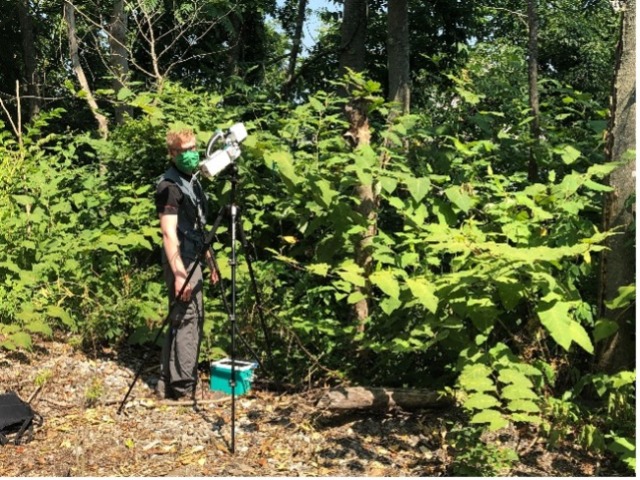
Collecting specimens has become a focus as more time was able to be spent in the field when we weren’t allowed to be at the museum. As our new Botany Hall entrance video shows, Assistant Curator of Botany, Mason Heberling and Collections Manager Bonnie Isaac collect plant specimens on a pretty regular basis. They also snag iNaturalist observations for these plants, taking photos that show what the plant and habitat looked before being picked and pressed.

Mason studies forest understory plants, in particular, introduced species and wildflowers in our changing environment. Mason has a bunch of fun projects going on this summer, ranging from coordinating seed collections of an uncommon native grass to send to Germany for a large greenhouse study to working with a team of students to study the effects of climate change and introduced shrubs on our forest wildflowers.

In addition to work in the field, the herbarium has been a busy place this summer too! Mason has been working with Alyssa McCormick, an undergraduate research intern from Chatham University, to examine stomata (the pores on leaves for air exchange for plants to “breathe”) and leaf nutrients in everyone’s favorite plant – poison ivy!  Poison ivy has been previously shown to grow bigger and cause nastier skin rashes with increasing carbon dioxide in our air due to fossil fuel emissions. Alyssa is using specimens collected as long ago as the 1800s to examine long term changes in poison ivy.

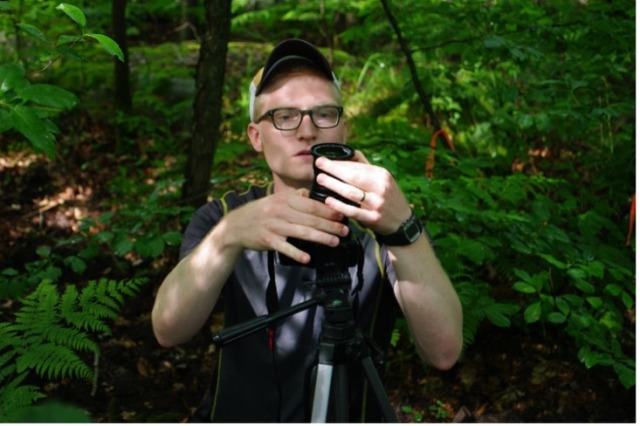
Man outside in a forested area
Man setting up equipment in a forested area

Mason, where can we find you on a Saturday?

“This summer has been a lot of going to various places around western PA like Presque Isle or Idlewild to get out and enjoy the fresh air with my family. I can also be found most Saturdays around the house doing chores!”

Bonnie Isaac, Collection Manager

Bonnie, one of CMNH’s TikTok celebrities, and All-Star in the Mid-Atlantic plant world, has spent a lot of the past year doing fieldwork. Her PA Wild Resource Grant involved looking at most of the populations for 10 Pennsylvania rare species. She and husband Joe Isaac spent many days on the road and a few in the bog! You can see some of her videos about these unique Pennsylvania finds on Carnegie Museum of Natural History’s Tiktok account: @carnegiemnh.

She diligently keeps track of various data points from latitude and longitude and elevation, to flower color, size, and associated species within a habitat. In addition to trying to make sure the plant names in our database are correct, she has also been busy georeferencing some of our specimens so that we can see on a map where each one was collected.

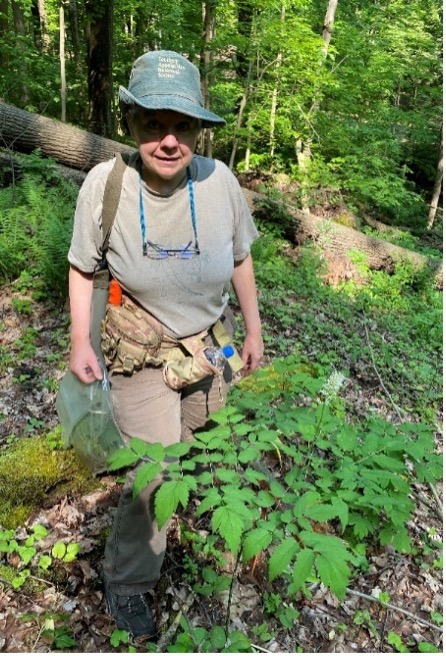
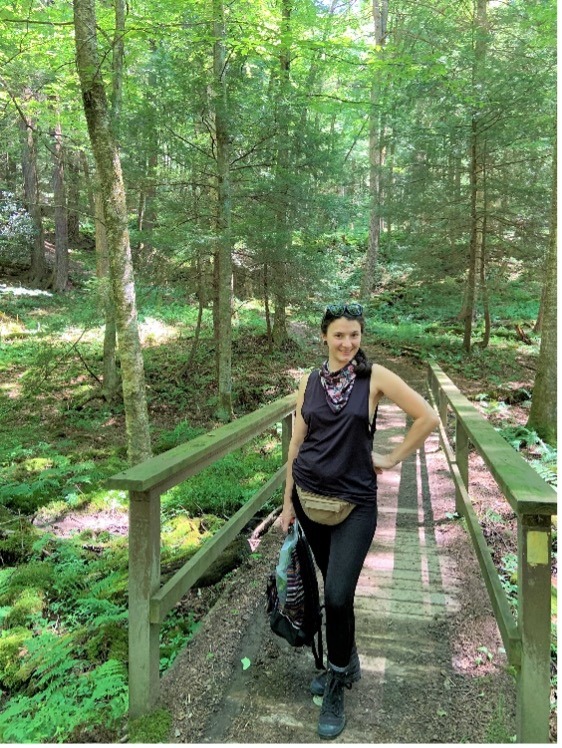
Woman walking in the woods
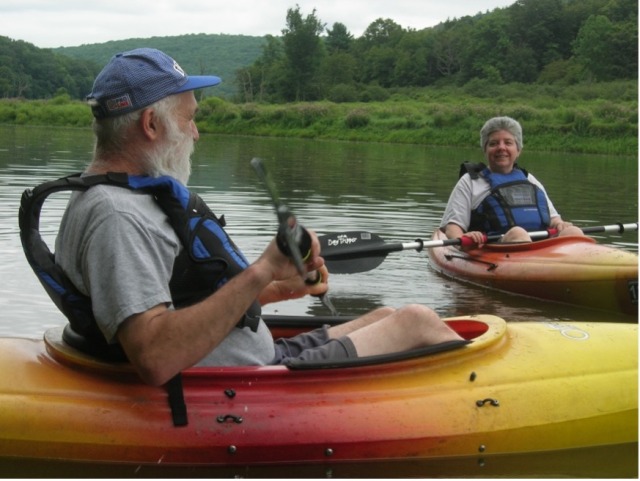
Two people in kayaks on the water

Bonnie, where can we find you on a Saturday?

“On most Saturdays I am either home taking care of my many chickens or getting some exercise in one of my kayaks with my spousal unit, Joe. I sometime even take a fishing pole for a ride or see how many different kinds of plants I can find on a hike. As long as I can get outside with Joe, I’m happy.”

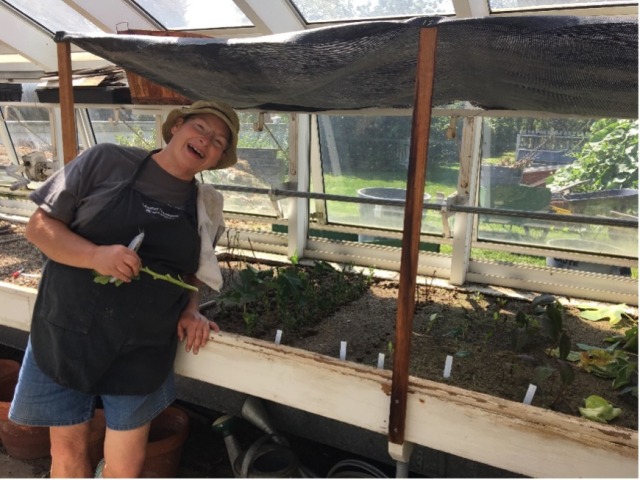
Cynthia Pagesh, Herbarium Assistant

Specimens make their way home to the museum, where we assure they’re bone dry, flat as a pancake, and have been frozen twice to get rid of any pests. They then find their way into the nimble hands of Cynthia Pagesh, our resident plant mounter. Cynthia has luckily been able to do some mounting both onsite and at home over this past year, really honing her craft. She uses Elmer’s glue, dental and sculpture tools, linen tape, and a paintbrush akin to a magic wand: transforming roots, stems, flowers, and fruits into scientific and artistic renderings on an 11.5×16.5” archival herbarium sheet.

Mounting can be very detailed and challenging: wrangling a dry and brittle rare plant you want to salvage every detail from, or an oversized leaf ‘how-will-this-all-fit?’ ordeal, or finessing a delicate petal that glue is especially heavy on. Bulky bits, crumbly bits, spiky no nos: Cyn handles them all. Her work is just as much an art as it is a science. When she’s not making masterpieces, she’s probably doing something with plants.

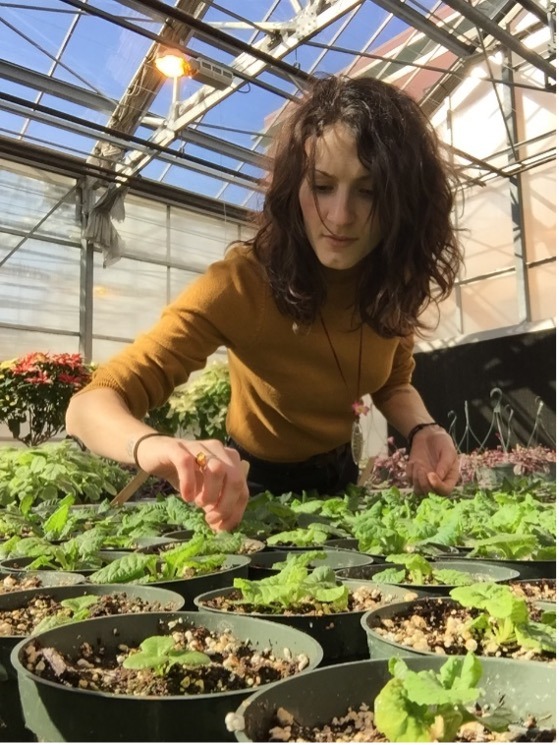
Person in a greenhouse
Person in the woods

Cyn, where can we find you on a Saturday?

“You can find me on Saturdays helping prune young trees in my community, collecting wildflower seeds or in my kitchen making preserves or homemade pasta noodles.  I volunteer in vegetable, herb and flower gardens.  I have a pollinator garden at home and raise Monarch caterpillars.  I tag and release them to migrate south.

There are lots of Community Science projects for people of all ages: ask someone to help you find one related to a subject you have an interest in.  I have an interest in pollinators including bees.  I participate in a Community Science Project every Summer that counts types of bees on certain plants when they bloom.”

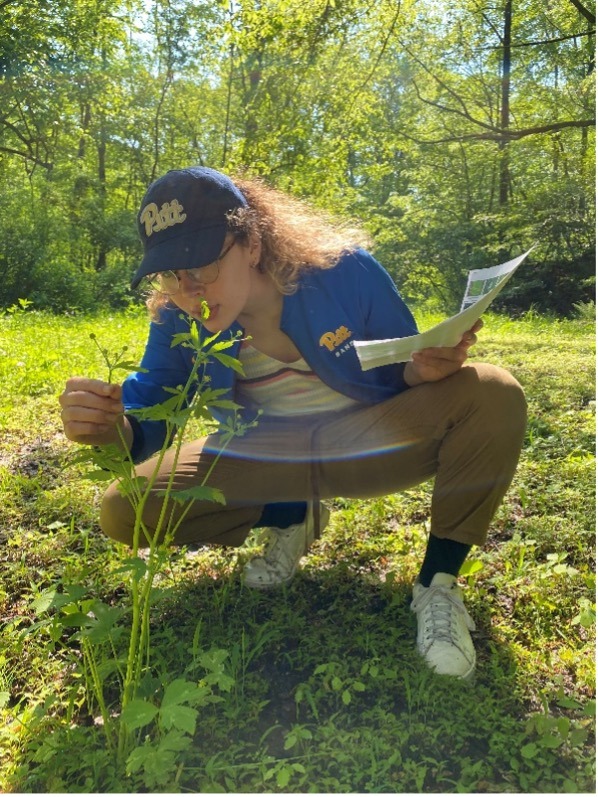
Iliana DiNicola

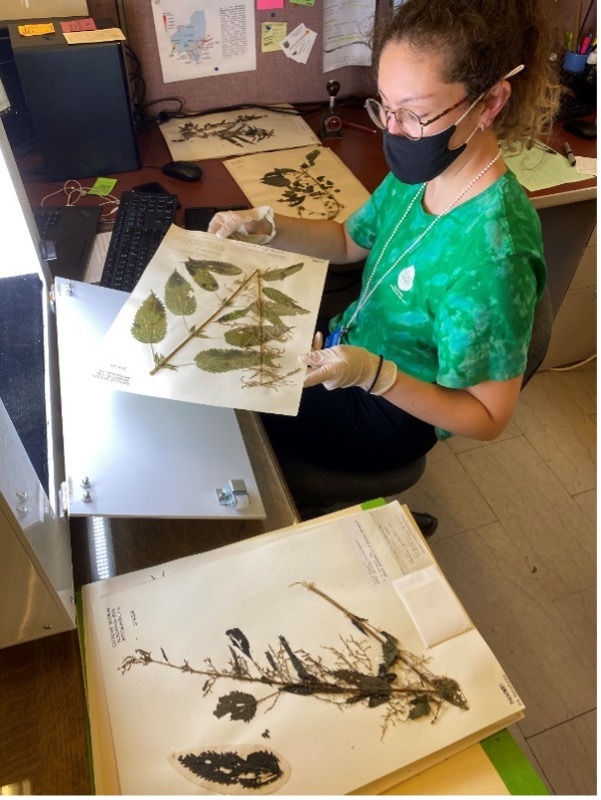
After another stint in the freezer for bugs-be-gone, it’s everyone’s favorite day: Picture Day! Each plant: sturdy and mounted, all data logged and super official, makes their way to the imaging station to spend some time under the bright lights. Since 2018, students, interns, and volunteers have lovingly held these plants’ hands as they get their close ups. We take high definition photos using a specially made lightbox and special software.

While this is part of a limited project, called the Mid-Atlantic Megalopolis, we are still hard at work going into our last year of the time we were given. This past schoolyear and summer, former Pitt student, Iliana DiNicola was taking pictures for us on the regular while also interning with the Pittsburgh Parks Conservancy. She just graduated and I’m excited to hear what she does on her Saturdays in the future.

Woman looking at a plant outdoors
Woman working with herbarium sheets

Iliana, where can we find you on a Saturday?

“I just graduated from the University of Pittsburgh with a degree in Environmental Studies, and I am now on the lookout for any jobs related to the environment back in my hometown of Phoenix, Arizona. I am interested in working with anything from sustainability, to policy or political work, or maybe even something more related to ecology and outdoor work.

On a Saturday, I am definitely helping clean my house since I am a semi-clean freak, I love to go hiking if the weather isn’t too hot, enjoy drawing and working on any art projects, or work on my future hydroponics garden.

As somebody who interned for Pittsburgh Parks Conservancy, I highly recommend participating in any camps or activities the conservancy has to offer. It was super fun learning more about Pittsburgh’s history and ecology and getting to teach kids about these topics, alongside participating in fun outdoor activities.”

Sarah Williams, Curatorial Assistant

Next up, Sarah Williams, the Curatorial Assistant in the Section of Botany, is overseeing the digitization project, morphing the photos from raw camera files into smaller files for sharing and detailed files for archival storing using Adobe Lightroom. She takes the images from the newly photographed specimens and makes sure they get uploaded onto the Mid-Atlantic Herbaria Consortium’s website to be shared far and wide across the world.

There is also a lot she does in sorting, filing, and taking care of the specimens as well. She does a bunch of scheduling, hiring, and training of work study students, interns, and volunteers. We consider her a jack of all trades.

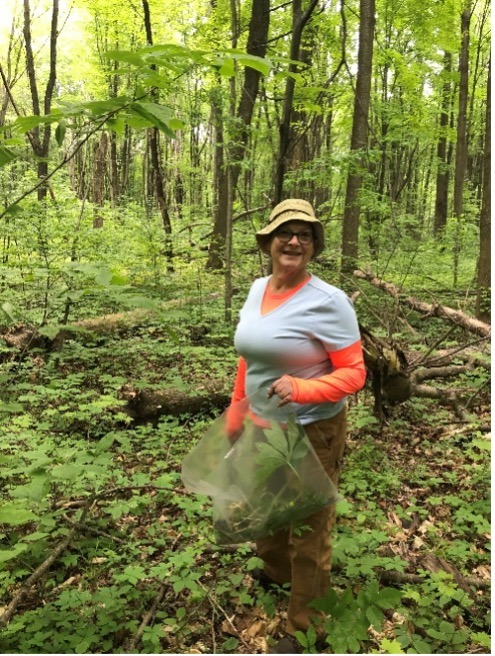
Woman in the woods
Woman in a greenhouse

Sarah, where can we find you on a Saturday?

“Most weekends I work with a local catering company called Black Radish Kitchen. I usually end up serving delicious vegetable and farm focused meals at least one day a week, commonly Saturdays because they’re prime for celebrations. The re-start up since the pandemic has been cautious, and I’m excited to be amongst people and help them to make mouthwatering memories again. I’ve worked in the restaurant industry for over a decade and the skills I’ve learned doing it as well as the friends I’ve made are matchless. It has a big piece of my heart.

I also moved into a new house this year about five minutes from my mom, so if I’m not running to say hi to her and ‘borrow’ some groceries, I’m doing laundry, dusting and yardwork… but only after I sleep in, eat some delicious breakfast with my partner, and hang out with our two cats, Santi and Gil.”

We hope you enjoyed getting to know us here in the Section of Botany, look forward to updates and more introductions in the future as we continue to host volunteers, federal work-study students, and interns on their journeys to learn even more about the plant kingdom.

Sarah Williams is Curatorial Assistant in the Section of Botany at Carnegie Museum of Natural History. Museum employees are encouraged to blog about their unique experiences and knowledge gained from working at the museum.

Related Content

How Do You Preserve a Giant Pumpkin?

Fall Blooms Rival Those of Spring

A Deeper Look at Dioramas

Carnegie Museum of Natural History Blog Citation Information

Blog author: Williams, Sarah C.
Publication date: September 24, 2021

Share this post!

  • Share on Twitter Share on Twitter
  • Share on Facebook Share on Facebook
  • Share on Pinterest Share on Pinterest
  • Share on LinkedIn Share on LinkedIn
  • Share on Reddit Share on Reddit
  • Share via Email Share via Email

Share this post!

  • Share on Twitter Share on Twitter
  • Share on Facebook Share on Facebook
  • Share on Pinterest Share on Pinterest
  • Share on LinkedIn Share on LinkedIn
  • Share on Reddit Share on Reddit
  • Share via Email Share via Email

Filed Under: Blog Tagged With: Botany, plants, Sarah Williams, Science News, ssstakeover

July 30, 2021 by wpengine

Collected on this Day in 1925: A flower with no leaves?

by Mason Heberling
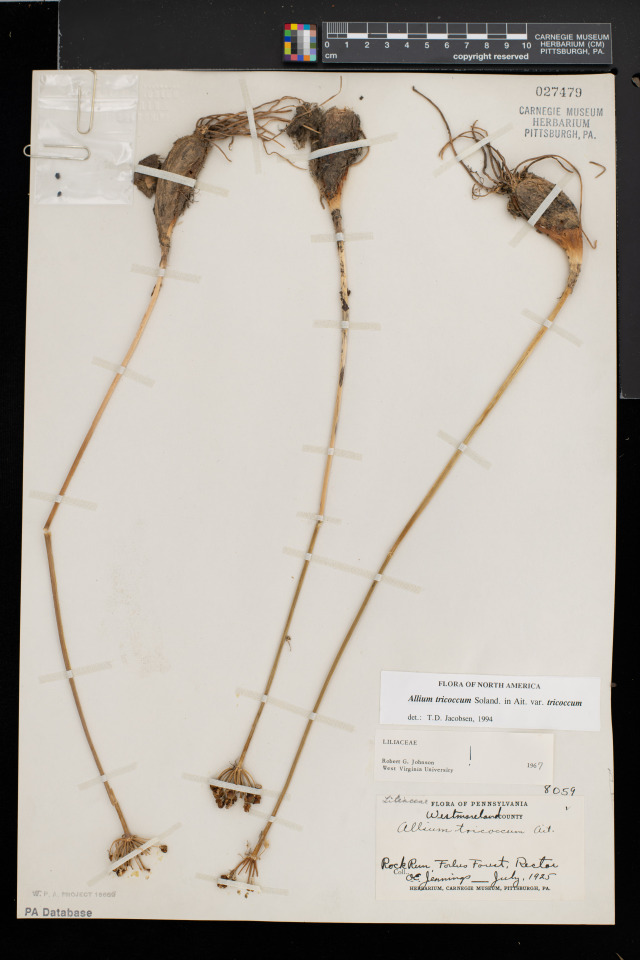
Dried allium specimen on an herbarium sheet.

This leafless specimen was collected in July 1925 in Rock Run, Forbes State Forest in Rector, Pennsylvania. This site is not far from what would only a few decades later became Powdermill Nature Reserve, the field station of Carnegie Museum of Natural History.

This specimen was collected by Otto Jennings, an influential botanist and curator at Carnegie Museum. Jennings had many roles during his 60 years at the museum (1904 until his death in 1964), including Director of Education, and even Director of the museum. He was also a professor at the University of Pittsburgh, serving as the Head of the Department of Botany, and later as Head of the newly formed Department of Biological Sciences in 1935. On top of that, Jennings somehow was a prolific plant collector. He ranks among the top contributors to the Carnegie Museum Herbarium with nearly 35,000 specimens, and additional plants he collected are preserved in herbariums across the world.

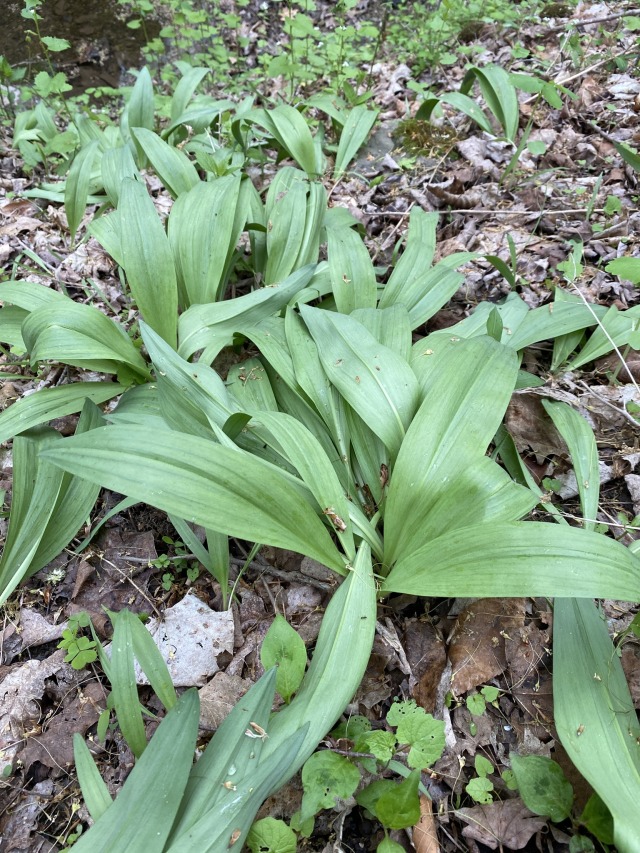
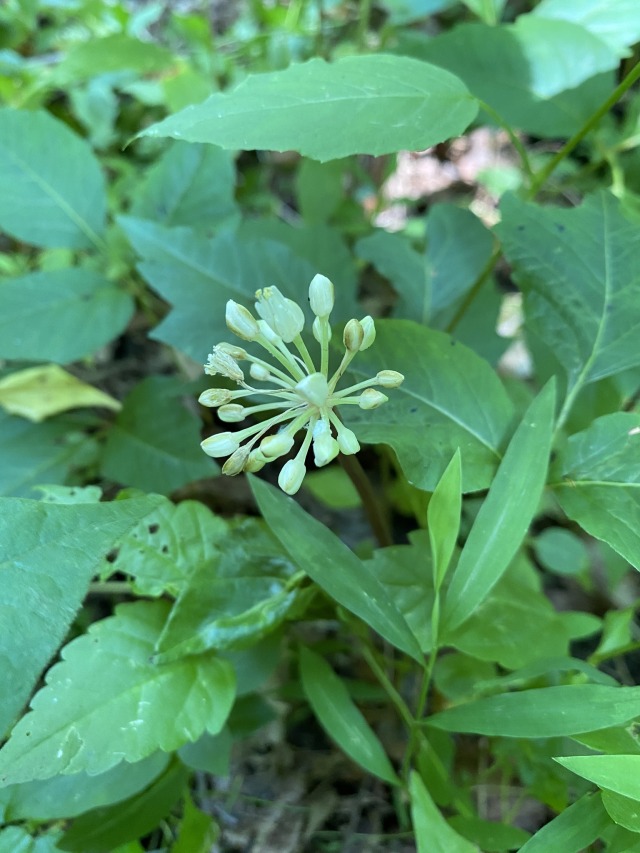
So, where’d the leaves go on this specimen? No, it isn’t parasitic. Wild leeks (also called ramps), Allium tricoccum, have a unique phenology, or timing, of leaf out and flowering. The species emerges very early in the spring, among the earliest in our woods. In this way, the species is a typical “spring ephemeral.” The long leaves soak up the sun before being shaded out by tree canopies a month or two later. At that point, the leaves die back. However, unlike other spring ephemerals, wild leek does not flower in the spring. Instead, months later, in July, the leafless plants send up a solitary flowering stalk. This is quite unusual – a flower coming out of the ground in the middle of the woods, with no signs of leaves.

Wild leeks in early spring.

The leaves of wild leeks carpeting the forest floor in early spring.

Flowering wild leek in summer.

The solitary flower stalks poking through other vegetation in mid-summer.

Wild leeks or ramps are in the onion family (Amaryllidaceae, formerly Alliaceae), forming bulbs with a distinctive onion flavor and ball-shaped flower heads typical in the onion family. Ramps are edible, with a long history of human use by Native people and European settlers. Ramp festivals are common throughout Appalachia to this day. However, the species is prone to exploitation and overharvesting, so never harvest without permission, and where harvesting is allowed, follow sustainable practices to protect the plant population.

The species is often treated as having two varieties: var. tricoccum (wild leek) and var. burdickii (narrow leaved wild leek). It depends who you ask, but more studies are now more clearly showing that this species may in fact be multiple species based on very distinct phenology (timing of flowers) and leaf traits (color, width). This case highlights the importance of herbarium specimens in documenting our flora and understanding the complexities of biological diversity.

Also note the small label added to this particular specimen recording this specimen was used in the taxonomic treatment of the species in the Flora of North America, identified by T.D. Jacobsen who co-authored the treatment. Dr. Jacobsen is the current director of the Hunt Institute for Botanical Documentation at nearby Carnegie Mellon University.

Keep an eye out for those leafless flower stalks in the woods!

Find this ramps specimen and 174 more in the Carnegie Museum Herbarium here: https://midatlanticherbaria.org/portal/collections/list.php?db=328&taxa=Allium+tricoccum&usethes=1&taxontype=2

Check back for more! Botanists at the Carnegie Museum of Natural History share digital specimens from the herbarium on dates they were collected. They are in the midst of a three-year project to digitize nearly 190,000 plant specimens collected in the region, making images and other data publicly available online. This effort is part of the Mid-Atlantic Megalopolis Project (mamdigitization.org), a network of thirteen herbaria spanning the densely populated urban corridor from Washington, D.C. to New York City to achieve a greater understanding of our urban areas, including the unique industrial and environmental history of the greater Pittsburgh region. This project is made possible by the National Science Foundation under grant no. 1801022.

Mason Heberling is Assistant Curator of Botany at Carnegie Museum of Natural History. Museum employees are encouraged to blog about their unique experiences and knowledge gained from working at the museum.

Related Content

Collected On This Day in 1957: Coltsfoot

Plants with Bladders?

Collected On This Day in 1982: One Specimen Isn’t Always Enough!

Carnegie Museum of Natural History Blog Citation Information

Blog author: Heberling, Mason
Publication date: July 30, 2021

Share this post!

  • Share on Twitter Share on Twitter
  • Share on Facebook Share on Facebook
  • Share on Pinterest Share on Pinterest
  • Share on LinkedIn Share on LinkedIn
  • Share on Reddit Share on Reddit
  • Share via Email Share via Email

Share this post!

  • Share on Twitter Share on Twitter
  • Share on Facebook Share on Facebook
  • Share on Pinterest Share on Pinterest
  • Share on LinkedIn Share on LinkedIn
  • Share on Reddit Share on Reddit
  • Share via Email Share via Email

Filed Under: Blog Tagged With: Botany, collected on this day, Mason Heberling

  • « Go to Previous Page
  • Page 1
  • Page 2
  • Page 3
  • Page 4
  • Page 5
  • Interim pages omitted …
  • Page 28
  • Go to Next Page »

sidebar

About

  • Mission & Commitments
  • Directors Team
  • Museum History

Get Involved

  • Volunteer
  • Membership
  • Carnegie Discoverers
  • Donate
  • Employment
  • Events

Bring a Group

  • Groups of 10 or More
  • Birthday Parties at the Museum
  • Field Trips

Powdermill

  • Powdermill Nature Reserve
  • Powdermill Field Trips
  • Powdermill Staff
  • Research at Powdermill

More Information

  • Image Permission Requests
  • Science Stories
  • Accessibility
  • Shopping Cart
  • Contact
  • Visitor Policies
One of the Four Carnegie Museums | © Carnegie Institute | Privacy Policy | Terms of Use | Accessibility
Rad works here logo