by Vanessa Verdecia
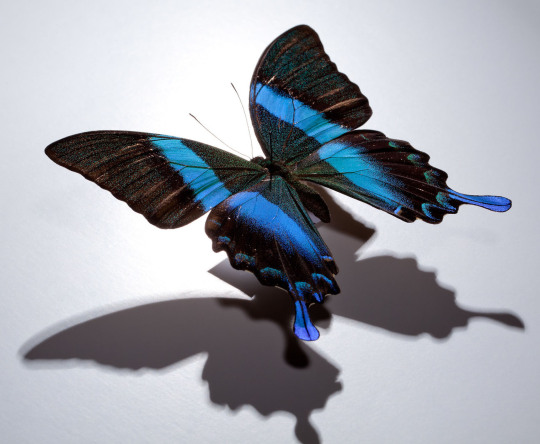
An image of a beautiful “blue” butterfly. What kind is it, they asked me? That’s not always an easy question to answer. The first thing I knew was that this butterfly was in the family Papilionidae. That determination was made based on the tails seen on the hindwings, giving the family its common name of Swallowtail butterflies. It’s a good thing the Carnegie has a wonderful reference collection of butterfly specimens that is also complemented with an extensive library of scientific literature that should give me a good shot at figuring out what this beautiful specimen might be.
I started with some of the amazing picture books in the library because all I had was a single image of a specimen to identify with no visible clues from the image that might show what region of the world the specimen was collected from. After searching through the historical collection for curated and identified specimens to compare to the image, and perusing through dozens of drawers of mixed swallowtail butterflies that might contain similar specimens, I was almost certain the specimen in the picture was a Papilio blumei, also known as the Green Swallowtail. Hmmm, the Green Swallowtail? The wing shape and pattern of the markings on the wings were a match, but the picture I had was of a butterfly with blue markings, not green! All the specimens of this species in the collection looked green.
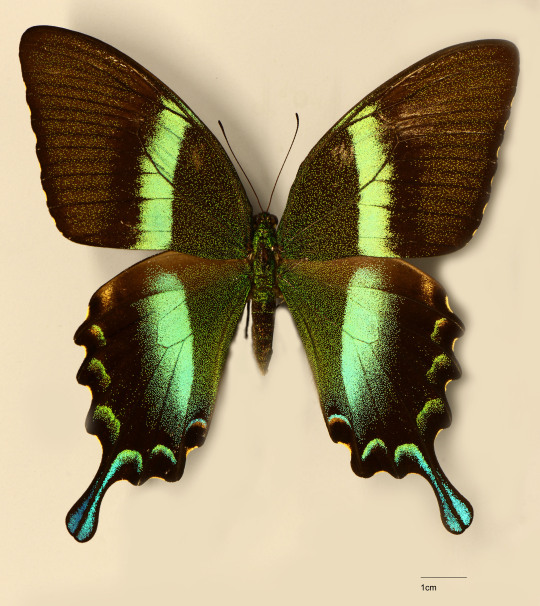
Then I thought: I bet this unusual color has something to do with the structural coloring in the scales of the wings. The reason the butterfly looked blue in the image was because the picture was taken in the dark and the photo was shot at an angle. This caused the butterfly to appear blue because the microscopic scales of the wings are structured in such a way that they interfere with visible light. When I held my hand over the specimen and cast a shadow on it, the green bands then appeared blue, just like in the picture. Structural coloring like this is seen in many insects and other animals, and can often be iridescent.
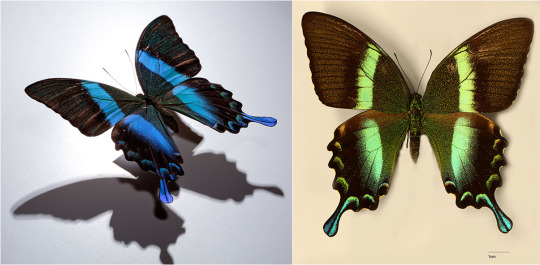
The next step was to confirm the identification with Dr. Rawlins, our expert on Lepidoptera (moths and butterflies). This is where it got tricky. According to the literature, Papilio blumei consists of four distinct subspecies that represent geographical variants of that species. When looking at specimens in the collection, there are subtle differences in the width of the blue bands on the wings. The photograph I had matched specimens that were identified in the collection as Papilio blumei. This species is only known from the island of Sulawesi (Indonesia). Differences found among specimens from different regions of the island appear to correspond with the different subspecies. A careful detailed study would have to be done in order to revise this species complex.
Sorting out all this tricky stuff is the science of taxonomy, which is the branch of science that deals with the classification and naming of organisms. Species are classified according to the various characteristics they have in common, which helps scientists to understand how organisms are related to one another. A deeper understanding of these different characters and how they evolved over time and in concert with a species life history, is what constitutes the study of systematics, which is the field of study that deals with evolutionary relationships among organisms.
There are over 1 million described insect species on earth, and many more sitting in collections all over the world, still waiting to be “discovered”. Some of these specimens hidden away in the collections are known to be new species and are in the process of “getting a name”—a common phrase heard around museum insect collections that refers to the process of describing in detail the defining characteristics of the species, assigning a Latin name to the specimen(s), and formally publishing the name in the scientific literature. Getting to put a name on a new species is one of the best things about working in a museum. Knowing how many specimens there are to work on, or the possibility of stumbling across a lost or forgotten species someday while working in the collection is truly exciting. In a collection containing an estimated 30,000 drawers and roughly 14.5 million specimens, you never know what you might find!
Vanessa Verdecia is a collection assistant in the museum’s Invertebrate Zoology Section. Museum employees are encouraged to blog about their unique experiences and knowledge gained from working at the museum.