• Skip to primary navigation
  • Skip to main content
  • Skip to primary sidebar

Carnegie Museum of Natural History

One of the Four Carnegie Museums of Pittsburgh

  • Visit
    • Buy Tickets
    • Visitor Information
    • Exhibitions
    • Events
    • Dining at the Museum
    • Celebrate at the Museum
    • Powdermill Nature Reserve
    • Event Venue Rental
  • Learn
    • Field Trips
    • Educator Information
    • Programs at the Museum
    • Bring the Museum to You
    • Guided Programs FAQ
    • Programs Online
    • Climate and Rural Systems Partnership
  • Research
    • Scientific Sections
    • Science Stories
    • Science Videos
    • Senior Science & Research Staff
    • Museum Library
    • Science Seminars
    • Scientific Publications
    • Specimen and Artifact Identification
  • About
    • Mission & Commitments
    • Directors Team
    • Museum History
  • Tickets
  • Give
  • Shop

Debra Wilson

June 28, 2024 by Erin Southerland

Mineral Gazing

by Debra Wilson

Have you ever gazed up at the sky and noticed a cloud that looks like a face, or an animal, or an object? You can apply the same concept when you visit Hillman Hall of Minerals and Gems! Many minerals on display have nicknames because of how they resemble certain animals, objects, or even characters from movies or TV shows. As you walk through the exhibits, let your imagination wander and search for minerals that look like things. Here are some to get you started.

Silver mineral that looks like an American flag
“The Flag” – Silver in the Native Elements case of the Systematic Mineral Collection
Image of the American flag that says "we here highly resolve that these dead shall not have died in vain...rememeber Dec. 7th!"
Photo credit: Allen Saalburg, Public domain, via Wikimedia Commons.
Nessie silver mineral
“Nessie” – Silver in Minerals from the Former Soviet Union exhibit
Loch Ness monster sculpture in the water
Photo credit: Immanuel Giel, Public domain, via Wikimedia Commons
snowball calcite on quartz
“Snowball” – Calcite on quartz in the Maramures District of Romania exhibit
snowball held in mitten-covered hands
Photo from Shutterstock.
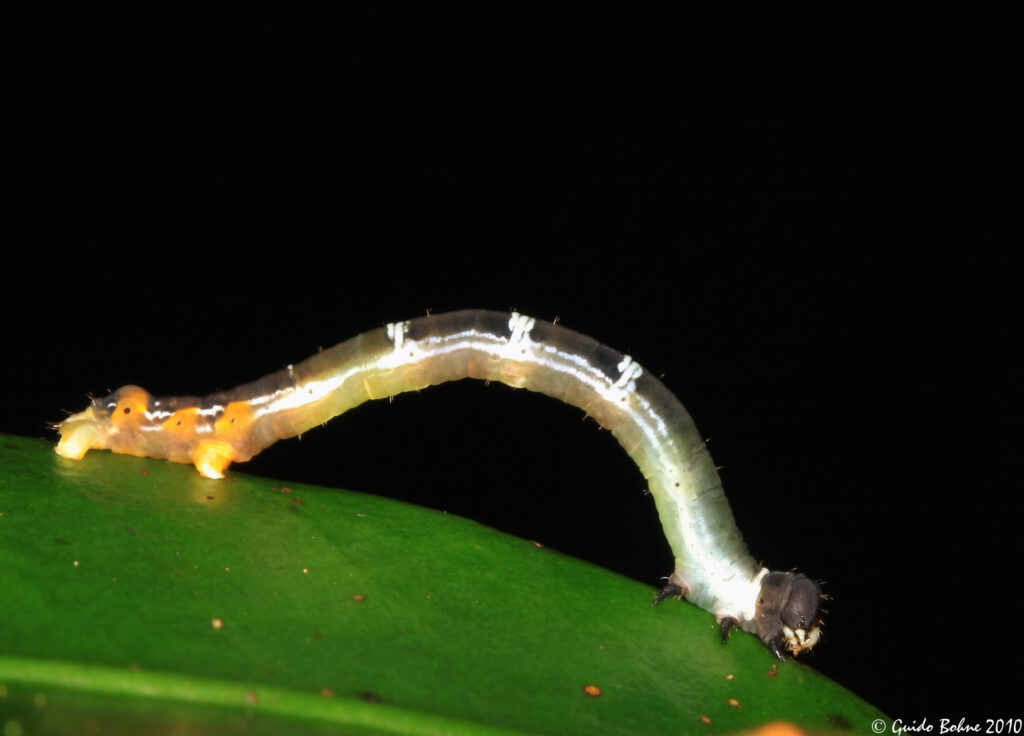
Inch Worm berthierite on quartz
“Inch Worm” – Berthierite on quartz in The Maramures District of Romania exhibit
photo of an inch worm
Photo credit: gbohne from Berlin, Germany, CC BY-SA 2.0, via Wikimedia Commons
The Scream septarian concretion
“The Scream” – Septarian concretion in the Weathering Processes exhibit
"The Scream" painting
Image credit: Edvard Munch, Public domain, via Wikimedia Commons
the oyster natrolite on quartz
“The Oyster” –  Natrolite on quartz in the Deccan Plateau of India exhibit
oyster shell with a pearl
Photo from Shutterstock.
French fries laumontite
“French Fries” – Laumontite in Masterpiece Gallery
cup of French fries
Image by ha11ok from Pixabay.

As you enter Hillman Hall, check out the minerals in the Entrance Cube, their nicknames are on the labels. There are many more minerals on display throughout the hall that have acquired nicknames. Here’s just a handful of other nicknames for minerals in the exhibits, see if you can find them. Good luck and enjoy your mineral gazing!

NicknameExhibit
The BatIgneous Rocks
Polar BearWeathering Processes
Sea SlugThe Maramures District of Romania
The ChariotsThe Maramures District of Romania
Smog MonsterThe Maramures District of Romania
Sea SerpentPennsylvania Minerals and Gems
Pine Trees On a CliffOxides
BBQ ChipsMasterpiece Gallery
Cookies and CreamMasterpiece Gallery

Debra Wilson is Collection Manager for the Section of Minerals at Carnegie Museum of Natural History.

Related Content

How Do Minerals Get Their Names?

What Does Pittsburgh Have in Common with Mount Vesuvius?

Master of Optical Illusion

Carnegie Museum of Natural History Blog Citation Information

Blog author: Wilson, Debra
Publication date: June 28, 2024
Share this post!

  • Share on Twitter Share on Twitter
  • Share on Facebook Share on Facebook
  • Share on Pinterest Share on Pinterest
  • Share on LinkedIn Share on LinkedIn
  • Share on Reddit Share on Reddit
  • Share via Email Share via Email

Filed Under: Blog Tagged With: Deb Wilson, Debra Wilson, Hillman Hall, Hillman Hall of Minerals and Gems, minerals, Science News

November 21, 2022 by Erin Southerland

What Does Pittsburgh Have in Common with Mount Vesuvius?

by Debra Wilson

In the mid 18th century, it was popular amongst the wealthy elite of Europe to take a “Grand Tour” of cities like Paris, Rome, Venice, Florence, and Naples. During these tours they traveled with a tutor and would learn about the culture, languages, geography, art, and architecture of the cities. A must-see when passing through Naples was the volcano, Mount Vesuvius, probably because of the fascination of the famous 79 A.D. eruption that destroyed the cities of Pompeii and Herculaneum.

Back then, to reach the top of Vesuvius one had to climb on foot, ride on horseback, or be carried by sedan-chair. And just like modern day travelers, they liked to take home souvenirs. What better souvenir of making it to the summit of a volcano could there be than a piece of lava? And not just any piece, but one that would commemorate your adventure. Thus, the creation of the lava medallion.

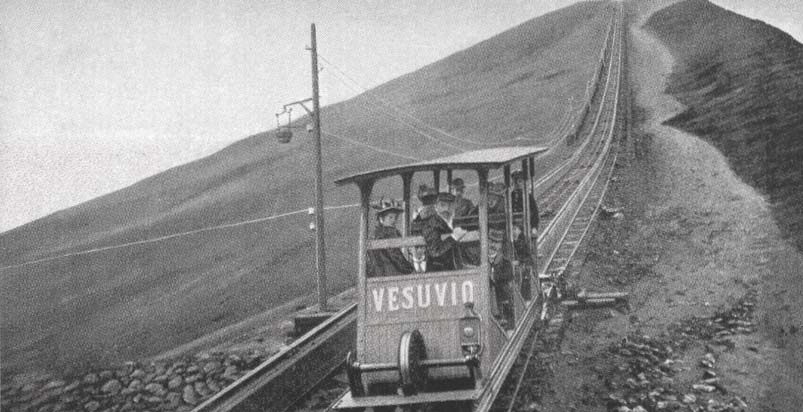
To make a medallion, some brave soul would retrieve molten lava on a stick, which was then molded, stamped out with engraved steel plates, cooled in a bucket of water, and then sold to the tourists. To increase the tourist trade and make it easier and more comfortable for tourists to visit the summit of Mount Vesuvius, it was determined that a funicular should be built on the 4,190-foot-high volcano. So, what’s a funicular you say? It’s a cable railroad designed to transport people and cargo up and down steep slopes. The ascending and descending cars are counterbalanced, meaning both cars are permanently connected to the opposite ends of the same cable, known as a haul rope. This haul rope runs through a system of pulleys at the upper end of the line. The first funicular on Mount Vesuvius opened on June 6, 1880 and ran, with some interruptions, until it was destroyed by the March 1944 Vesuvius eruption. The two cable cars were named “Etna” and “Vesuvio.”

Black and white image of a funicular car named Etna.
Stereokarte: Knackstedt & NätherScan: Claus-Peter Enders im Team mit Bernd Schwabe im Wikipedia-Büro HannoverCropp: Pechristener, Public domain, via Wikimedia Commons
Black and white image of a funicular car named Vesuvio.
Unknown author, Public domain, via Wikimedia Commons

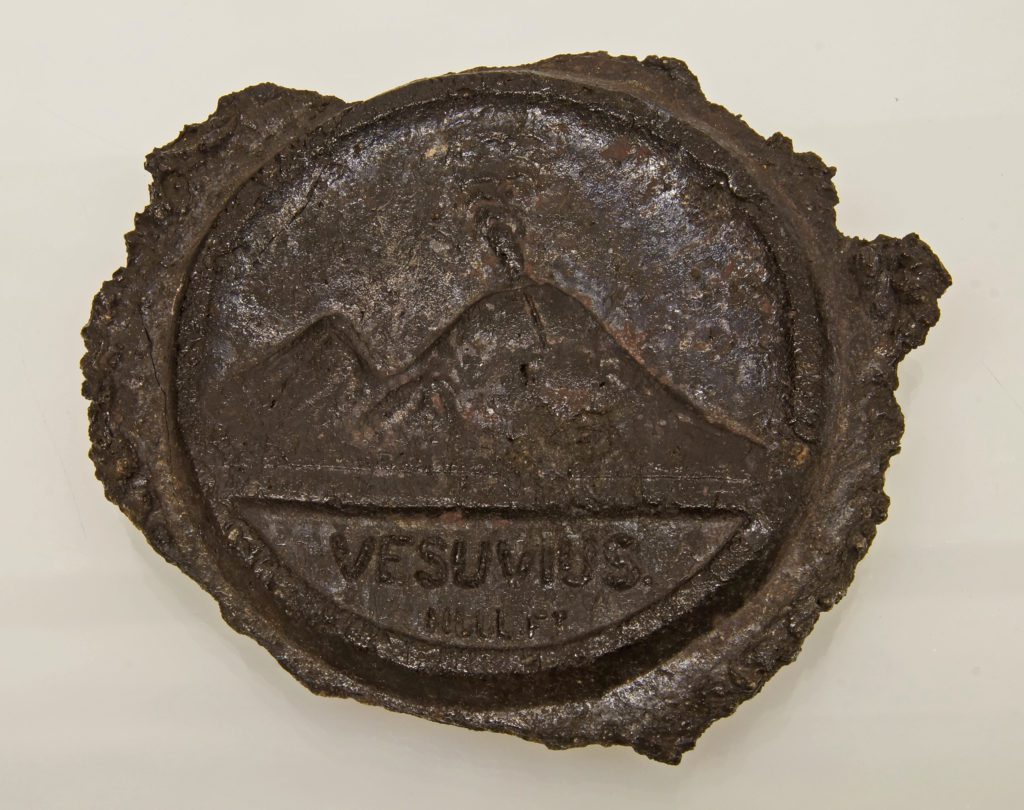
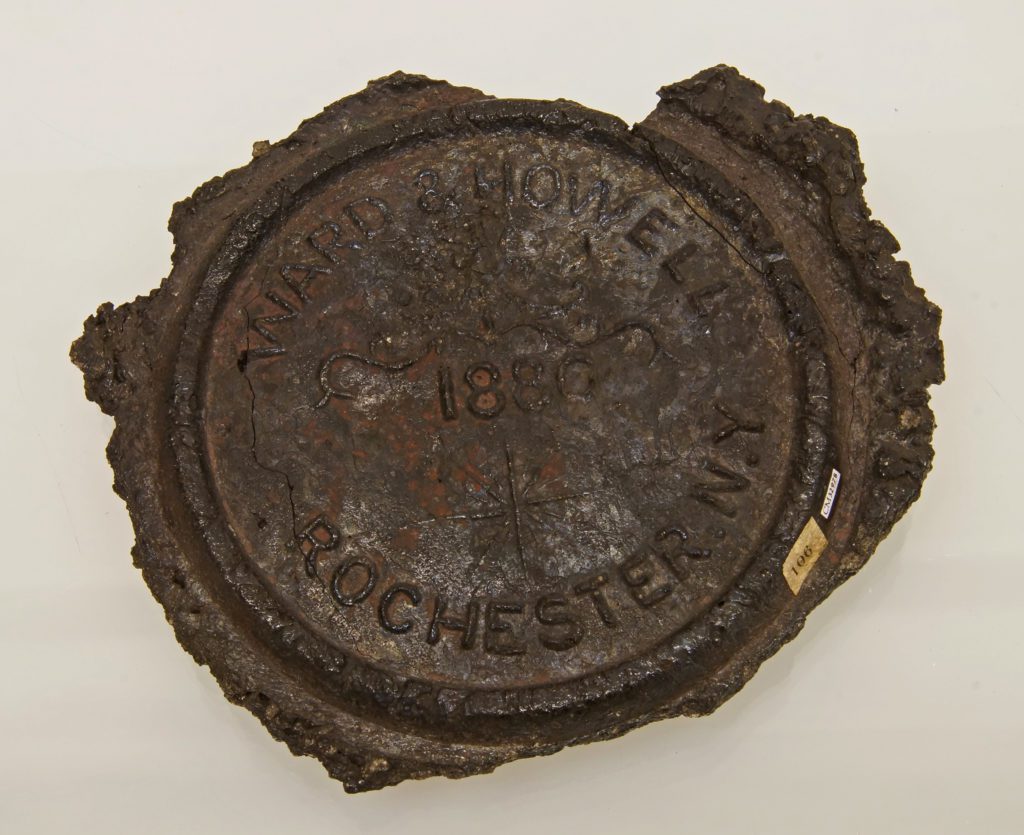
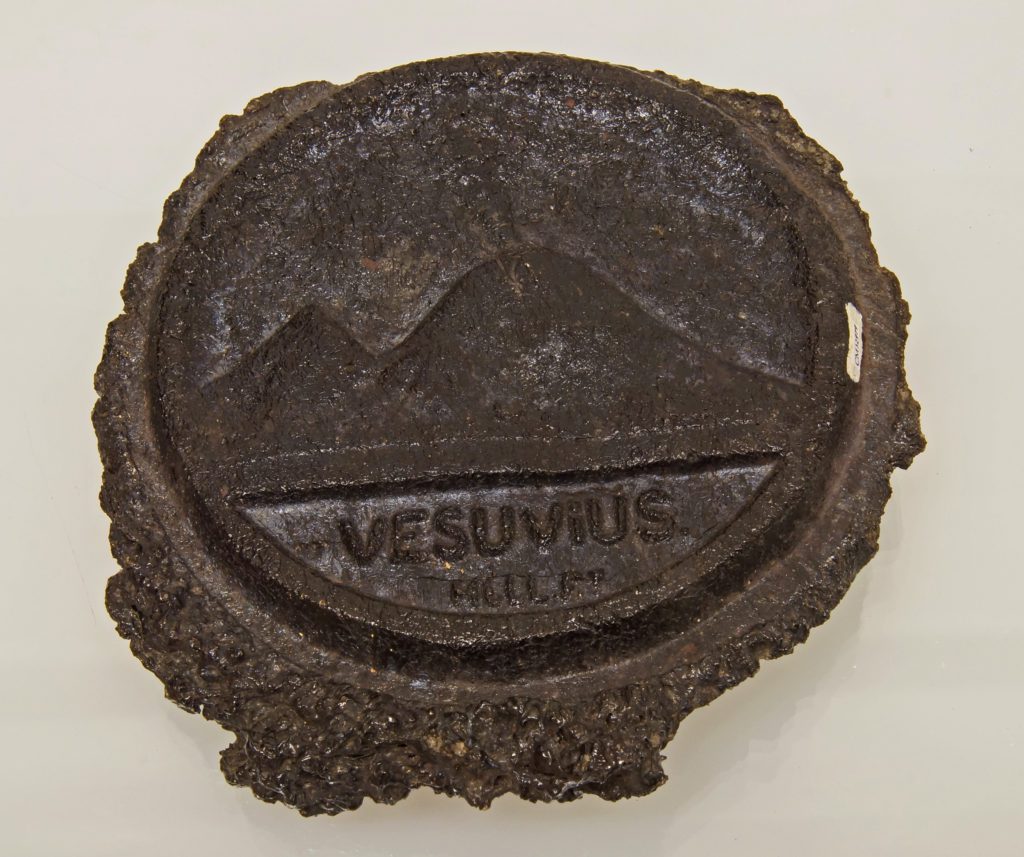
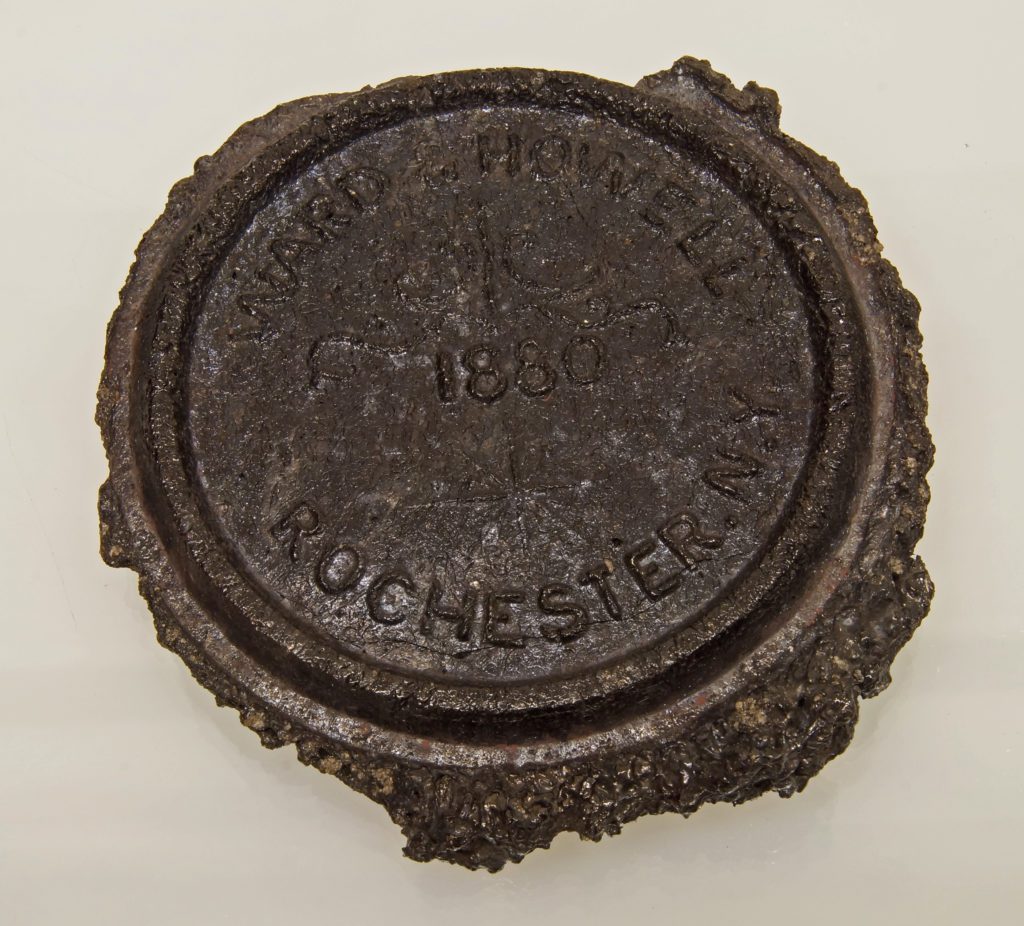
To commemorate the opening, some very special lava medallions were made. Our collection contains two such medallions among the roughly 30,000 specimens not on public view in the museum. These lava medallions were produced by Ward & Howell, the company that sold minerals for Ward’s Natural Science Establishment of Rochester, New York from 1875 to 1891. Each medallion has Mount Vesuvius stamped on the front, and the year 1880 on the back along with Ward & Howell Rochester, N.Y. If you look closely, you can make out the funicular rails on Vesuvius. Notice that no two medallions are alike, depending on how the lava squeezed out between the steel plates.

Mount Vesuvius lava medallion
CM32978 lava medallion, 18.3 x 14.4 x 2.6 cm   
Mount Vesuvius laval medallion
Back of the medallion
CM32979 lava medallion, 16.1 x 14.6 x 3.2 cm
Back of the medallion.

There was something else very special created to commemorate the 1880 opening of the funicular. The famous song “Funiculi, Funiculà” (which means funicular up, funicular down) was written by composer Luigi Denza, with lyrics by Peppino Turco. The Neapolitan tune is about a young man who compares his love for his sweetheart to a volcano and invites her to ride up to the summit on the funicular. As the funicular rises up, so does his courage to ask for her hand in marriage. The song became so popular that by 1881 the sheet music had sold one million copies. If you are unfamiliar with the tune listen to one or both of these:

For those of you who love the popular Girls Und Panzer anime series, which depicts competition between girls’ high schools practicing tank warfare as a sport, you might recognize this tune as one of the theme songs for the Sensha-dō  team of Anzio High School (an Italian-style private academy from Aichi Prefecture in Japan) commanded by “Duce” Anchovy. Here is a video of the Girls Und Panzer version of “Funiculi, Funiculà” with lyrics shown in both the original language and English:

So, what is the Pittsburgh connection?

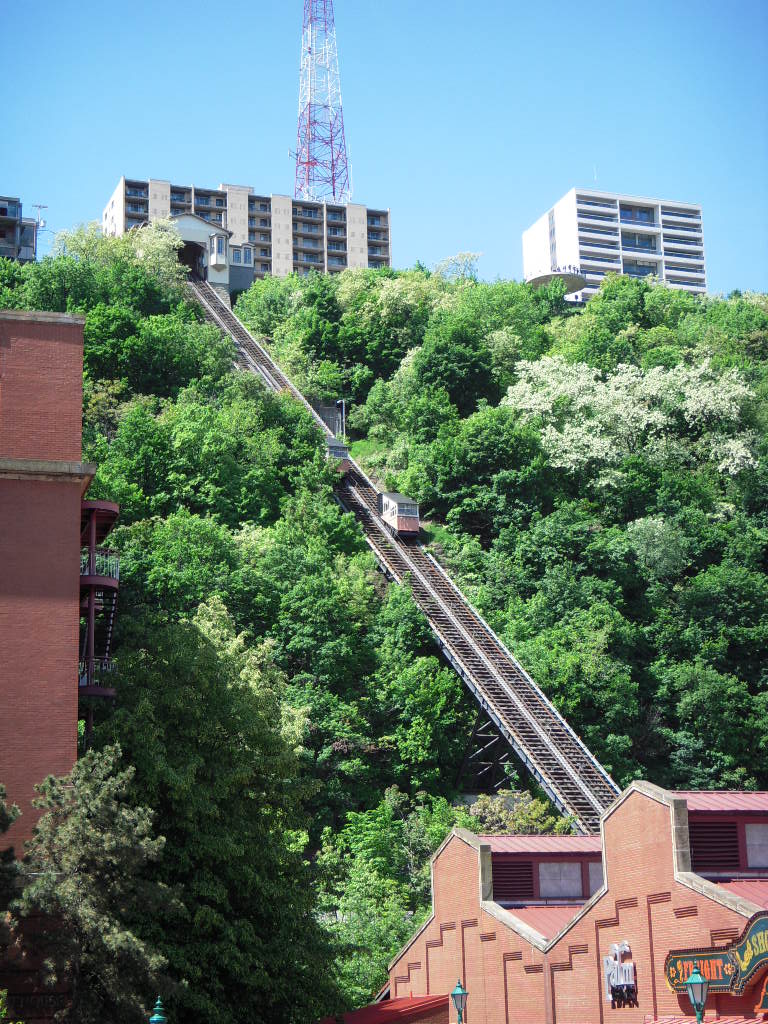
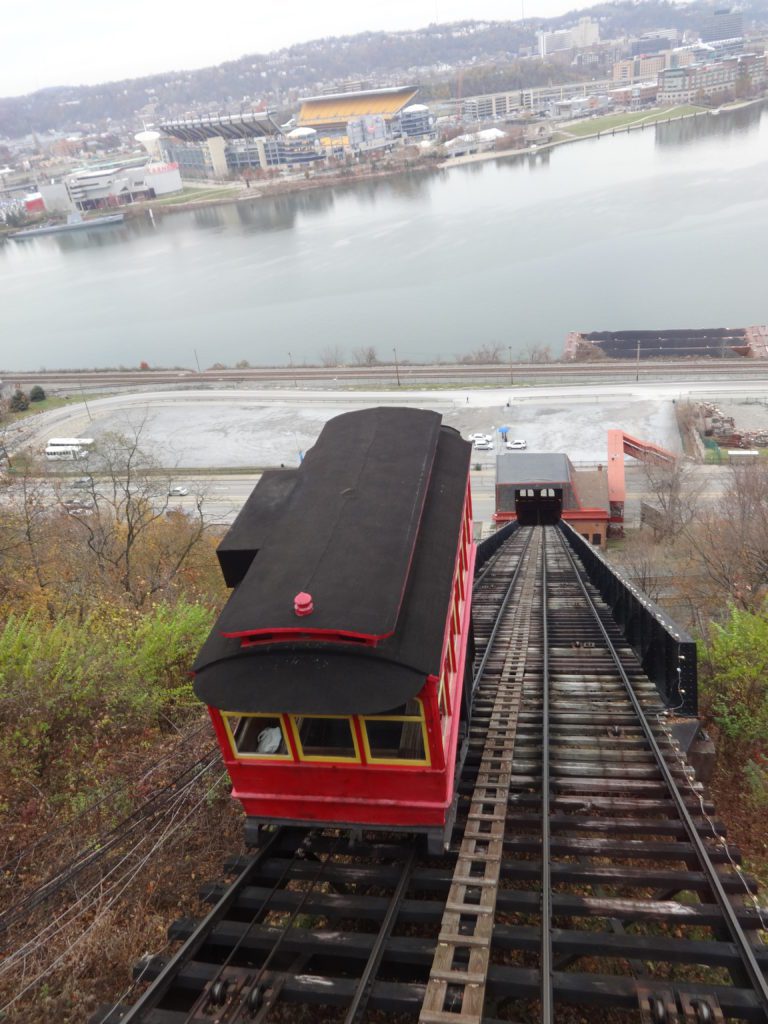
Now you know what a funicular is, but did you know that Pittsburgh has two funiculars? It’s not surprising since here in Pittsburgh we have just a few steep slopes around! We refer to these funiculars as inclines, and at one time there were 17 of them operating on the hilly topography carved by the Monongahela and Allegheny rivers. They were originally built to transport cargo up and down Mount Washington. Then with the influx of workers during the expansion of the coal and steel industries, more inclines were built to transport the employees of the mills and factories to their places of residence up on Mount Washington and other hilltop neighborhoods. Most of these inclines closed as more roads were built and the use of automobiles increased. The two inclines that are still in operation today were both in service on Mount Washington even before the funicular on Mount Vesuvius opened in 1880. The Monongahela Incline opened on May 27, 1870 and is the oldest continually operating funicular in the United States. The Duquesne Incline opened on May 17, 1877. Of course, you can’t get a lava medallion as a souvenir, but the next time you ride up and down one of our inclines, how about breaking out in a song, you know the one I mean…”Funiculi, Funiculà!”

Monongahela Incline. Image credit: pennsyloco, CC BY 3.0, via Wikimedia Commons
Duquesne Incline. Image credit: Bohemian Baltimore, CC BY-SA 4.0, via Wikimedia Commons

Debra Wilson is the Collection Manager for the Section of Minerals at Carnegie Museum of Natural History.

Related Content

Beauty From the Ashes

Manhattan Project Glass

Born to the Purple

Carnegie Museum of Natural History Blog Citation Information

Blog author: Wilson, Debra
Publication date: November 21, 2022

Share this post!

  • Share on Twitter Share on Twitter
  • Share on Facebook Share on Facebook
  • Share on Pinterest Share on Pinterest
  • Share on LinkedIn Share on LinkedIn
  • Share on Reddit Share on Reddit
  • Share via Email Share via Email

Filed Under: Blog Tagged With: Debra Wilson, minerals, minerals and earth sciences, minerals and gems, Science News

March 9, 2021 by wpengine

Section of Minerals and Earth Sciences Celebrates Being Lucky!

The etymology, or origin, of the word ‘luck’ is centuries old and has strong roots in minerals and mining. Although the exact origin is unknown, the verb “lukken,” meaning to “happen by chance” or “happen fortunately,” first appeared in Old English literature sometime in the mid 15th century and is thought to be associated with gambling. According to several sources, this meaning was likely borrowed from earlier Middle Dutch (“gheluc”) or Germanic (“gelücke”) speakers, who applied these words to good fortune and happiness associated with it.

Not long afterwards, beginning around the late 16th century, the traditional German miner’s greeting, “Glück auf!”, which translates to “luck to!” or “luck on!” became popular among many European miners. It describes a hope for good fortune to find ore that will bring riches, and was likely also directed to having luck in safety on their shift underground, since underground mining during that time was extremely dangerous.

The traditional German miner’s greeting, Glück auf.


The more modern term “luck of the Irish” also has likely origins in mining, since Irish immigrants and Irish American miners were considered to be some the most successful and famous prospectors during the gold and silver rush in the Western U.S. in the mid 1800s.

Miners sometimes encountered “unlucky” minerals underground that, at the time, were worthless and not considered pay dirt. Around the 1600s, silver miners in the Bohemia region of Czech Republic and Germany often encountered a dark and dense mineral that they referred to as “pechblende,” or bad-luck ore. This pechblende was actually the mineral uraninite, a major ore of the radioactive element uranium that would later become a hotly contested resource of developing nuclear nations.

Nowadays, good luck is linked to many minerals, including gold, mythical pots of which receive attention around St. Patrick’s Day. Gold is considered lucky because of its association with wealth and fortune, but did you know that the reason gold is used for money is linked to its mineralogy? Consider gold’s properties as a mineral: it’s very stable (doesn’t spontaneously burst into flames or corrode), melts at a relatively low temperature, and is easily malleable (hammered or pressed). Gold was an ideal candidate to be used as money for early civilizations. Matching all those requirements, plus being the right balance of rare, but not too rare, means that out of over 100 elements in the periodic table, gold hits the sweet spot for monetary value.

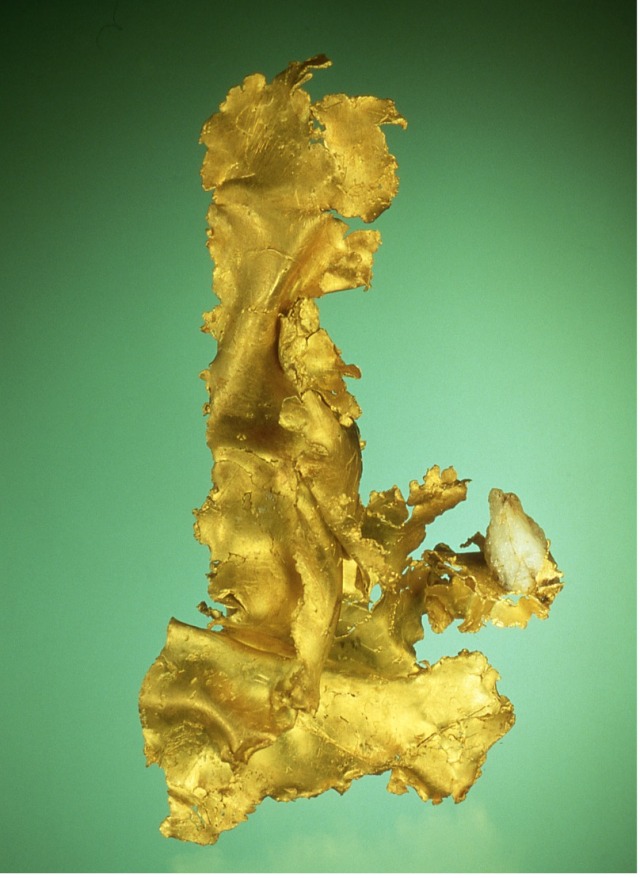
A 2.5 ounce leaf gold standing 12.5 cm tall from Tuolumne County, California, on display in the Masterpiece Gallery of Hillman Hall of Minerals and Gems. Photo: Harold and Erica Van Pelt.

Carla Rosenfeld is the Assistant Curator of Earth Sciences, Travis Olds is Assistant Curator of Minerals, and Debra Wilson is Collection Manager of Minerals at Carnegie Museum of Natural History. Museum employees are encouraged to blog about their unique experiences and knowledge gained from working at the museum.

Related Content

Ask a Scientist: Why do some minerals glow?

What’s a Shamrock?

The Connemara Marble: A Cross-Atlantic Connection Between Ireland and Pittsburgh

Share this post!

  • Share on Twitter Share on Twitter
  • Share on Facebook Share on Facebook
  • Share on Pinterest Share on Pinterest
  • Share on LinkedIn Share on LinkedIn
  • Share on Reddit Share on Reddit
  • Share via Email Share via Email

Carnegie Museum of Natural History Blog Citation Information

Blog author: Rosenfield, Carla; Olds, Travis; and Wilson, Debra
Publication date: March 9, 2021

Share this post!

  • Share on Twitter Share on Twitter
  • Share on Facebook Share on Facebook
  • Share on Pinterest Share on Pinterest
  • Share on LinkedIn Share on LinkedIn
  • Share on Reddit Share on Reddit
  • Share via Email Share via Email

Filed Under: Blog Tagged With: Carla Rosenfeld, Debra Wilson, minerals, Science News, Travis Olds

July 15, 2019 by wpengine

Master of Optical Illusion

Michael Dyber, known as the Master of Optical Illusion, is among the world’s foremost lapidary artists today. He began working in metal and wood at the age of nine and won his first design competition while still in grade school. After earning his BA degree in Fine Arts and Humanities from New England College, he moved from metal and wood into jewelry design.  He opened his own shop in New Hampshire but began to feel restricted by the pre-cut gemstones available for his artwork. He then turned his artistic focus toward handcrafting his own unique gems. He started by acquiring top quality gem rough and instead of using standard carving and polishing equipment, Michael built his own specialized tools.

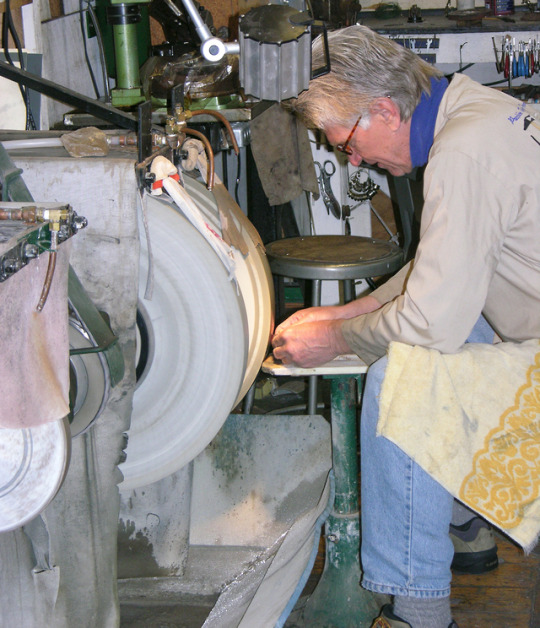
Michael Dyber at work in his studio.

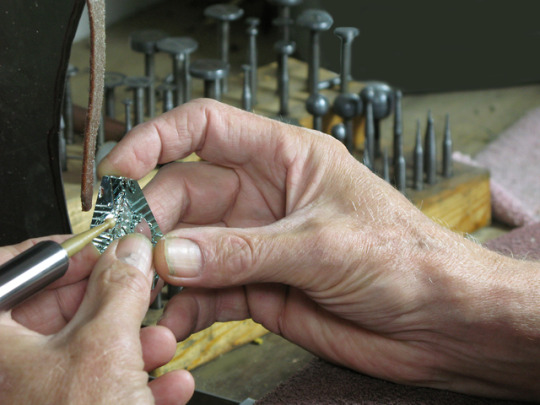
Using these custom-made tools enabled Michael to invent his own unique techniques to create the optical illusions you see within the stones. He calls them the Dyber Optic DishTM, LuminairesTM, Photon PhacetsTM, and ChannelsTM. Each artwork is a one-of-a-kind signed original, based on the characteristics of the individual gem, the hand-crafting skills like the old masters, and the added bonus of Michael’s unique artistic vision. To quote Michael, “My work is asymmetrical, but visually balanced, my goal is to go beyond what has been done, to create infinite designs.”

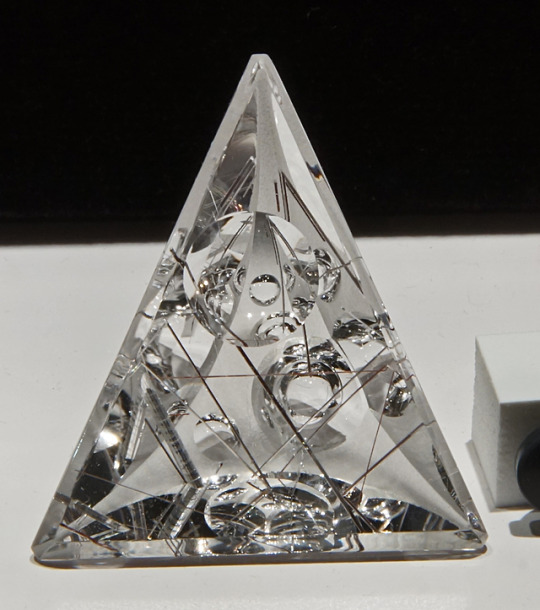
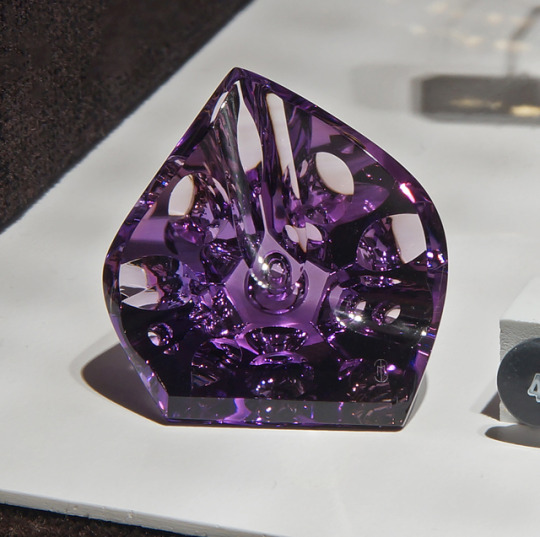
Wertz Gallery: Gems and Jewelry can now boast of having four pieces of lapidary art on display that were carved by the Master of Optical Illusion, Michael Dyber. Two carvings were purchased in anticipation of a new gem and jewelry gallery and were put on display when Wertz Gallery opened in 2007, one in the Birthstones exhibit and the other in the Quartz as a Gemstone exhibit.

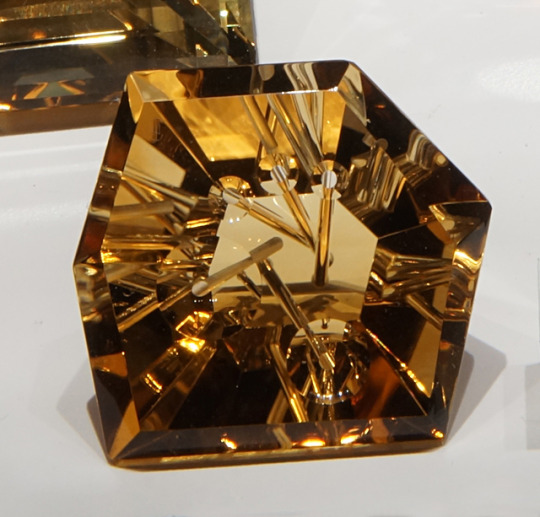
95.45 carat quartz variety citrine entitled “Straw” in the November section of the Birthstones exhibit.
74.15 carat rutilated quartz entitled “Sliders” in the Quartz as a Gemstone exhibit.

The third was on temporary display in 2014 (May 31st thru August 31st) during the special exhibit in Wertz Gallery that featured all of Michael’s twenty-three award-winning carvings and some of his new creations. We purchased one of his new creations after the exhibit and put it on permanent display later that year in the Quartz as a Gemstone exhibit.

86.41 carat quartz variety amethyst entitled “Twist” in the Quartz as a Gemstone exhibit.

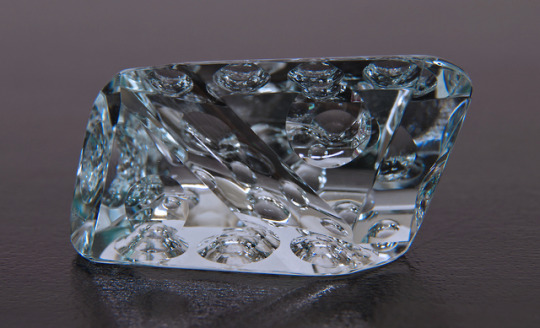
The fourth carving was put on display just last month (June 18th) in the Birthstones exhibit. It was donated to the museum by Michael in 2015.

32.95 carat beryl variety aquamarine (untitled) in the March section of the Birthstones exhibit.

These carvings began with gem rough from Brazil and they utilize three of the four techniques that Michael has created. Straw has Dyber Optic DishesTM and LuminairesTM; Sliders has Dyber Optic DishesTM ; Twist and the untitled carving have Dyber Optic DishesTM and ChannelsTM. Eventually we would like to add to the collection a piece of lapidary art that has his Photon PhacetsTM technique. It will be exciting to see what new technique Michael comes up with next!

Debra Wilson is the Collection Manager for the Section of Minerals at Carnegie Museum of Natural History. Museum employees are encouraged to blog about their unique experiences and knowledge gained from working at the museum.

Filed Under: Blog Tagged With: Deb Wilson, Debra Wilson, Michael Dyber, minerals, minerals and gems, Section of Minerals

June 4, 2019 by wpengine

Roll Out the Beryl

four beryl gemstones

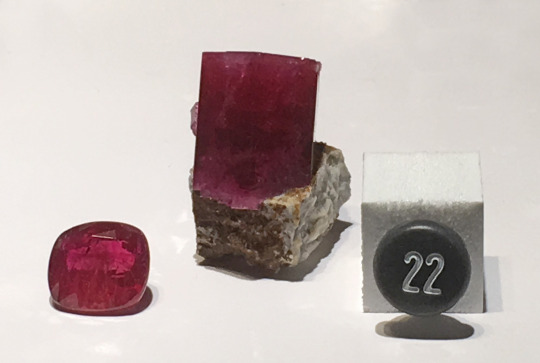
Beryl has many different varieties that you may be familiar with, the most recognized being: Emerald (green), Heliodor (yellow), Morganite (pink), and Aquamarine (blue or blue-green). One that you may not be familiar with is Red Beryl, a very rare variety of the species. The red is due to the trace element manganese. Red Beryl occurs in only a few places in the world and of those localities, only one of them produces crystals of the size and quality suitable for cutting gemstones, namely the Ruby Violet claims in the Wah Wah Mountains in Beaver County, Utah. For over a dozen years the Section of Minerals & Earth Sciences staff have been on the lookout for a faceted Red Beryl to put on display in the Beryl as a Gemstone exhibit in Wertz Gallery: Gems and Jewelry. But, alas, most of the Red Beryl gemstones on the market are very small because nearly all the gem rough that is produced is less than a carat in size. Faceting rough of that size usually yields gemstones of only ¼ to ½ carat, which would be too small to use in the exhibit. Occasionally we have come across gemstones of around one carat, but they were not of high enough quality for the exhibit due to poor color, poor cut, or numerous inclusions. But, as luck would have it, in March of this year I was able to acquire from Pala International a worthy, cushion cut Red Beryl gemstone with the amazing size of 2.45 carats! Together with the crystal from the same locality (acquired two years ago from Collector’s Edge) we now have a stunning rough & cut pair to represent the variety Red Beryl in the Beryl as a Gemstone exhibit.

Cut gemstone & crystal of Red Beryl from Utah

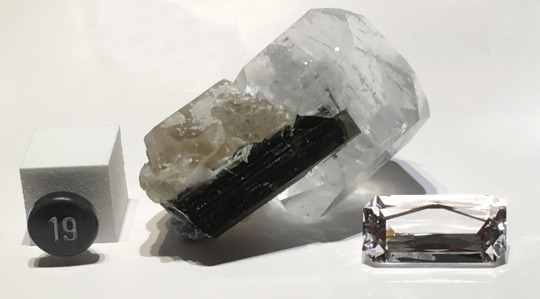
Another lesser known variety of Beryl is Goshenite, which is colorless. When Wertz Gallery opened in September of 2007 the Beryl as a Gemstone exhibit had a nice crystal of Goshenite on display from Pakistan but lacked a cut gemstone from Pakistan to go with it. In May, I acquired a beautiful 5.06 carat emerald cut Goshenite from Dudley Blauwet Gems to complement the crystal. Now every crystal on display in that exhibit has an accompanying gemstone.

Crystal & cut gemstone of Goshenite from Pakistan

Both of these new gemstones were placed on exhibit in Wertz Gallery on June 4, 2019, so stop by and see them in the Beryl as a Gemstone case!

Debra Wilson is the Collection Manager for the Section of Minerals at Carnegie Museum of Natural History. Museum employees are encouraged to blog about their unique experiences and knowledge gained from working at the museum.

Filed Under: Blog Tagged With: Deb Wilson, Debra Wilson, gems and minerals, Hillman Hall, Hillman Hall of Minerals and Gems, minerals, Section of Minerals, Wertz Gallery

May 7, 2019 by wpengine

Everything Pennsylvania

On May 10th a new temporary exhibit is scheduled to be installed in Wertz Gallery: Gems and Jewelry that will feature gemstones, cabochons, polished spheres and carvings made from minerals unearthed in our own state of Pennsylvania. While we may be known as a coal producing state, there are lapidary and faceting grade minerals that are found in Pennsylvania as well. And, believe it or not, one of the polished pieces in the exhibit is a type of coal known as JET.

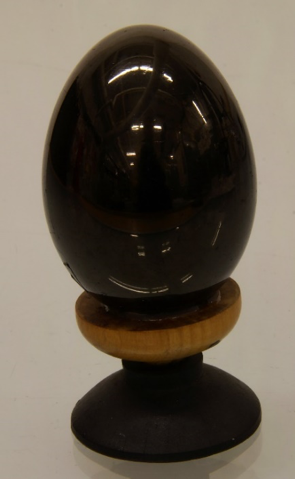
A carved egg made from JET, a type of LIGNITE which is a precursor to COAL.

The English noun “Jet” derives from the French word for the same material: jaiet (modern French “jais”). The adjective “jet-black,” meaning as dark a black as possible, derives from this material.

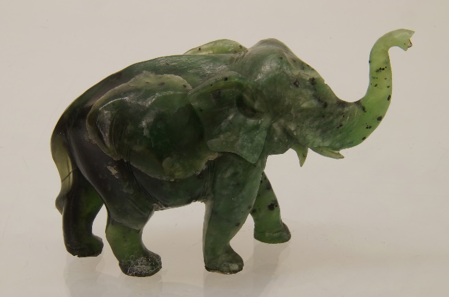
Another unusual piece in the exhibit is a carving of an elephant made from a translucent variety of ANTIGORITE known as WILLIAMSITE which is found in the State Line Chromite District in Lancaster County.

Elephant carved from WILLIAMSITE found at Lowe’s Chromite Mine in Fulton Township.

WILLIAMSITE was named in 1848 in honor of its discoverer, Lewis White Williams, a mineralogist and geologist of West Chester, Pennsylvania.

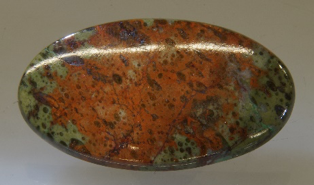
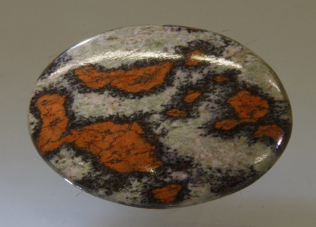
I don’t want to give away too much because I want you to come the museum to see the exhibit in person, but I will reveal two other pieces. They were personally collected at the Bingham Mine in Hamiltonban Township, Adams County, by the 1988 Carnegie Mineralogical Award winner, John Sinkankas, who also cut and polished them. The colors in these cabochons are due to the epidote and cuprite in the META-RHYOLITE, which is a silicified, or metamorphosed, RHYOLITE (an extrusive igneous rock).

META-RHYOLITE cabochons purchased from John Sinkankas in 1990.

Besides those pieces mentioned here, you will also see faceted gemstones of QUARTZ, AMETHYST, SMOKY QUARTZ, AQUAMARINE, and TITANITE; cabochons of MALACHITE, BLUE QUARTZ, SUNSTONE, and AMAZONITE; and polished spheres of COPPER & QUARTZ, and BLUE QUARTZ. The Cut and Polished Pennsylvania Gems and Minerals will be on exhibit in Wertz Gallery at least through the end of summer. Don’t miss it!

Debra Wilson is the Collection Manager for the Section of Minerals at Carnegie Museum of Natural History. Museum employees are encouraged to blog about their unique experiences and knowledge gained from working at the museum.

Filed Under: Blog Tagged With: coal, Deb Wilson, Debra Wilson, gems, gems and minerals, Hillman Hall, Hillman Hall of Minerals and Gems, minerals, pennsylvania, Wertz Gallery

  • Page 1
  • Page 2
  • Go to Next Page »

sidebar

About

  • Mission & Commitments
  • Directors Team
  • Museum History

Get Involved

  • Volunteer
  • Membership
  • Carnegie Discoverers
  • Donate
  • Employment
  • Events

Bring a Group

  • Groups of 10 or More
  • Birthday Parties at the Museum
  • Field Trips

Powdermill

  • Powdermill Nature Reserve
  • Powdermill Field Trips
  • Powdermill Staff
  • Research at Powdermill

More Information

  • Image Permission Requests
  • Science Stories
  • Accessibility
  • Shopping Cart
  • Contact
  • Visitor Policies
One of the Four Carnegie Museums | © Carnegie Institute | Privacy Policy | Terms of Use | Accessibility
Rad works here logo