• Skip to primary navigation
  • Skip to main content
  • Skip to primary sidebar

Carnegie Museum of Natural History

One of the Four Carnegie Museums of Pittsburgh

  • Visit
    • Buy Tickets
    • Visitor Information
    • Exhibitions
    • Events
    • Dining at the Museum
    • Celebrate at the Museum
    • Powdermill Nature Reserve
    • Event Venue Rental
  • Learn
    • Field Trips
    • Educator Information
    • Programs at the Museum
    • Bring the Museum to You
    • Guided Programs FAQ
    • Programs Online
    • Climate and Rural Systems Partnership
  • Research
    • Scientific Sections
    • Science Stories
    • Science Videos
    • Senior Science & Research Staff
    • Museum Library
    • Science Seminars
    • Scientific Publications
    • Specimen and Artifact Identification
  • About
    • Mission & Commitments
    • Directors Team
    • Museum History
  • Tickets
  • Give
  • Shop

dinofest

July 11, 2018 by wpengine

The Two-Headed Dinosaur

Apatosaurus is a sauropod, or long-necked plant-eating dinosaur, that lived in western North America during the late Jurassic Period roughly 150 million years ago. In the early 20th century, scientists couldn’t agree on what kind of head Apatosaurus had. No skull had ever been found attached to a neck of this dinosaur. So, when Carnegie Museum of Natural History mounted its most complete Apatosaurus skeleton in 1915, it did so without including a skull.
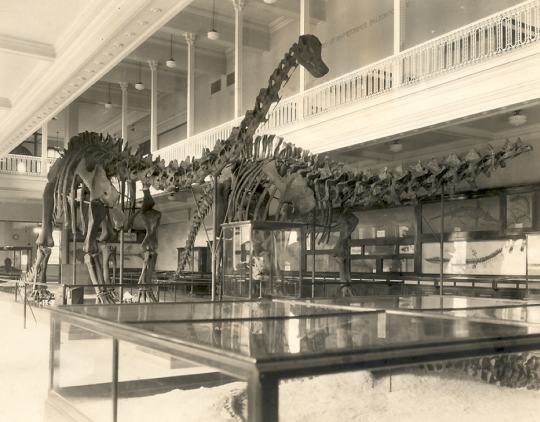
Apatosaurus louisae (right) as it was originally mounted in 1915, without a skull. At left is the skeleton of its relative Diplodocus carnegii.
Carnegie Museum of Natural History’s skeleton of Apatosaurus louisae (right) as it was originally mounted in 1915, without a skull. At left is the skeleton of its relative Diplodocus carnegii, better known as ‘Dippy.’ Credit: Carnegie Museum of Natural History.

The mount stood headless until 1932, when the museum followed prevailing scientific opinion of the day and placed a blunt-snouted, broad-toothed skull on the Apatosaurus. It remained there for another 47 years.
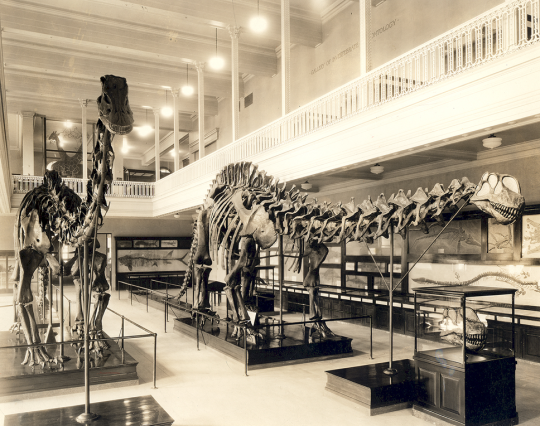
Apatosaurus and Diplodocus skeletons
Apatosaurus (right) and Diplodocus, ca. 1932, after a skull of the blunt-snouted sauropod Camarasaurus lentus had been mounted on the Apatosaurus skeleton. Credit: Carnegie Museum of Natural History.

In 1978, however, Carnegie Museum of Natural History paleontologist Dave Berman and museum research associate Jack McIntosh reasoned that a very different, more Diplodocus-like skull found with the Apatosaurus skeleton back in 1910 was most probably the correct one. A subsequent discovery of a still-connected Apatosaurus skull and neck proved them correct. In 1979, the museum’s Apatosaurus louisae was finally fitted with its proper skull – more than seven decades after its discovery! It remains that way today, on public exhibit in the museum’s dinosaur gallery, Dinosaurs in Their Time.
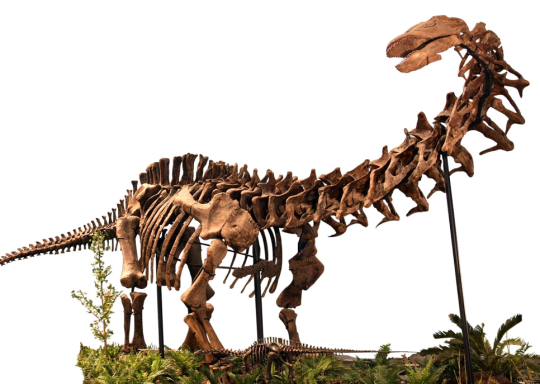
Apatosaurus Louise
Apatosaurus as it looks today, displayed with its correct skull, which closely resembles that of its relative, Diplodocus. Credit: Melinda McNaugher, Carnegie Museum of Natural History.

Matt Lamanna is a paleontologist and the principal dinosaur researcher at Carnegie Museum of Natural History in Pittsburgh.  Museum employees are encouraged to blog about their unique experiences and knowledge gained from working at the museum.

Related Content

Ask a Scientist: What kind of dinosaur was a megaraptorid?

Mesozoic Monthly: Dreadnoughtus

The Strange Saga of Spinosaurus, the Semiaquatic Dinosaurian Superpredator
Filed Under: Blog Tagged With: dinofest, dinosaur, dinosaurs in their time, diplodocus carnegii, fossils, Matt Lamanna, Vertebrate Paleontology

January 29, 2018 by wpengine

The Dinosaur of a Lifetime

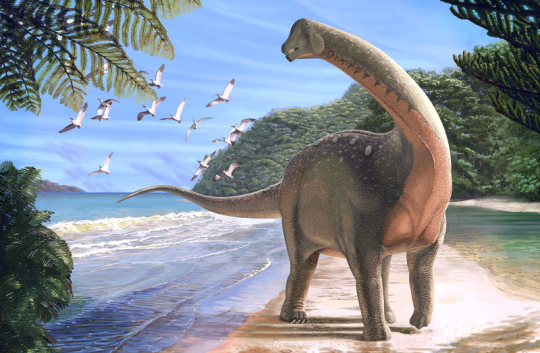
color drawing of a dinosaur on a beach
(Image credit: Carnegie Museum of Natural History / Andrew McAfee)

By Matt Lamanna

January 29, 2018

It might sound a little strange to say, but African dinosaurs have been an important part of my life for a long time. Almost two decades ago, when I was in graduate school at the University of Pennsylvania, and a few years before I took a job here at Carnegie Museum of Natural History, I participated in fossil-hunting expeditions to the Sahara Desert of Egypt. Along with our advisor, my beloved “Boss” Peter Dodson, my fellow students and I had a lot of success, discovering among other fossils the only known skeleton of a new, ~95 million-year-old species that we named Paralititan stromeri in 2001. With a humerus, or upper arm bone, that’s almost as tall as I am, Paralititan is still one of the biggest dinosaurs known to science.

But as fun as those discoveries were to be a part of, some of our team’s most sought-after finds never materialized. In going to Egypt, part of our aim was to find dinosaurs from roughly 80 to 66 million years ago – dinosaurs from the very end of the Cretaceous Period, the third and final time period of the Age of Dinosaurs. Dinosaur fossils of this age are exceedingly rare on all of continental Africa (i.e., Africa excluding the island of Madagascar), not just in Egypt. Surprisingly, however, this has not stopped paleontologists from speculating as to what kinds of dinosaurs might have inhabited Africa at the end of the Cretaceous. Some have proposed that African latest Cretaceous dinosaurs were close relatives of, and therefore similar to, those living on neighboring landmasses at the same time. Other scientists have argued that Africa was an island continent at the end of the Cretaceous, and, because it was cut off from other land areas, it was home to unique dinosaurs that had evolved for millions of years along their own distinctive evolutionary pathways.

Until recently, no one had ever found a reasonably complete dinosaur skeleton from the end of the Cretaceous anywhere on continental Africa. A few isolated bones and minor parts of skeletons had been discovered, but these didn’t tell us much about the dinosaurs to which they belonged – as you can imagine, the more pieces one has of a fossil skeleton, the more one can typically learn about the animal it represents. This, in turn, prevented paleontologists from figuring out whether African latest Cretaceous dinosaurs were truly unique or whether they had close kin on other landmasses. But all of that changed in late 2013, when my friend and colleague Dr. Hesham Sallam of Mansoura University in Egypt—along with his talented students Iman El-Dawoudi, Sanaa El-Sayed, and Sara Saber—discovered the skeleton of a sauropod (long-necked plant-eating dinosaur) at an ~80 million-year-old site in the Dakhla Oasis of the Egyptian Sahara. The dinosaur I’d dreamed about for virtually all of my professional life had finally been found! Even better, Hesham and the team—which also included my close friends Pat O’Connor and Eric Gorscak, plus several other Egyptian and American scientists—invited me to be a part of the study. We soon realized that the creature had a lot to say about the nature of Africa’s last dinosaurs, as its bones suggested close relationships to species living in Europe and Asia at about the same time. These hypotheses were borne out by more rigorous analyses, showing that African latest Cretaceous dinosaurs weren’t island-dwelling weirdos after all – rather, they had close cousins in Eurasia. Today, our team gave the dinosaur its formal scientific name, Mansourasaurus shahinae, and for me, it’s the culmination of a search that’s occupied almost half my life.

Matt Lamanna is a paleontologist and the principal dinosaur researcher at Carnegie Museum of Natural History in Pittsburgh. 

Museum employees are encouraged to blog about their unique experiences and knowledge gained from working at the museum.

Read more about this news on Gizmodo.

Filed Under: Blog Tagged With: dinofest, dinosaur, Matt Lamanna, Vertebrate Paleontology

  • « Go to Previous Page
  • Page 1
  • Page 2

sidebar

About

  • Mission & Commitments
  • Directors Team
  • Museum History

Get Involved

  • Volunteer
  • Membership
  • Carnegie Discoverers
  • Donate
  • Employment
  • Events

Bring a Group

  • Groups of 10 or More
  • Birthday Parties at the Museum
  • Field Trips

Powdermill

  • Powdermill Nature Reserve
  • Powdermill Field Trips
  • Powdermill Staff
  • Research at Powdermill

More Information

  • Image Permission Requests
  • Science Stories
  • Accessibility
  • Shopping Cart
  • Contact
  • Visitor Policies
One of the Four Carnegie Museums | © Carnegie Institute | Privacy Policy | Terms of Use | Accessibility
Rad works here logo
