• Skip to primary navigation
  • Skip to main content
  • Skip to primary sidebar

Carnegie Museum of Natural History

One of the Four Carnegie Museums of Pittsburgh

  • Visit
    • Buy Tickets
    • Visitor Information
    • Exhibitions
    • Events
    • Dining at the Museum
    • Celebrate at the Museum
    • Powdermill Nature Reserve
    • Event Venue Rental
  • Learn
    • Field Trips
    • Educator Information
    • Programs at the Museum
    • Bring the Museum to You
    • Guided Programs FAQ
    • Programs Online
    • Climate and Rural Systems Partnership
  • Research
    • Scientific Sections
    • Science Stories
    • Science Videos
    • Senior Science & Research Staff
    • Museum Library
    • Science Seminars
    • Scientific Publications
    • Specimen and Artifact Identification
  • About
    • Mission & Commitments
    • Directors Team
    • Museum History
  • Tickets
  • Give
  • Shop

dinosaurs

October 13, 2025 by

Daniel G. And Carole L. Kamin Hall of Dinosaurs

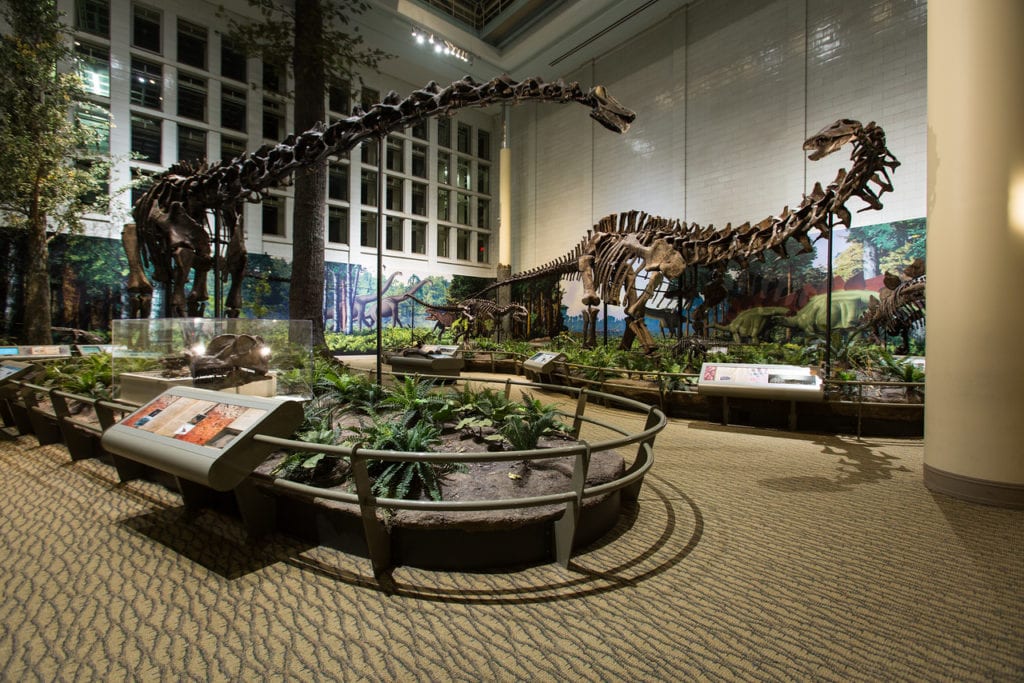
Plan an expedition to the Kamin Hall of Dinosaurs—Carnegie Museum of Natural History’s core exhibition featuring real dinosaur fossils.

This exhibition is home to dozens of original fossils from throughout the Mesozoic Era displayed in scientifically accurate reconstructions of their ancient habitats.

Are the Dinosaur Fossils on Display Real?

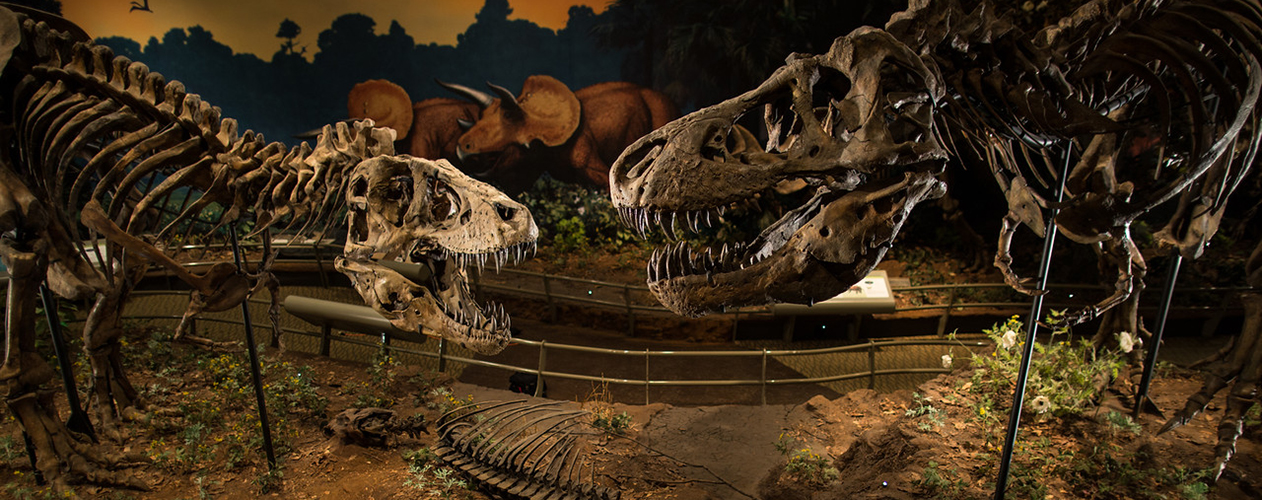
About 75% of the more than 230 objects on display are original fossils from one of the finest paleontological collections in the world, and most of the exhibition’s dinosaur skeletons are real, not replicas. Several of these skeletons—including those of the iconic dinosaurs Apatosaurus louisae, Diplodocus carnegii, and Tyrannosaurus rex—are holotypes, the original specimens upon which their respective species are based.

In the many decades since the discovery of Diplodocus, scientific interpretations of dinosaurs and their lifestyles have changed dramatically. This exhibition uses up-to-date paleontological evidence—much of which has been provided by the museum’s own scientists—to accurately reconstruct the appearance and behavior of these colossal creatures.

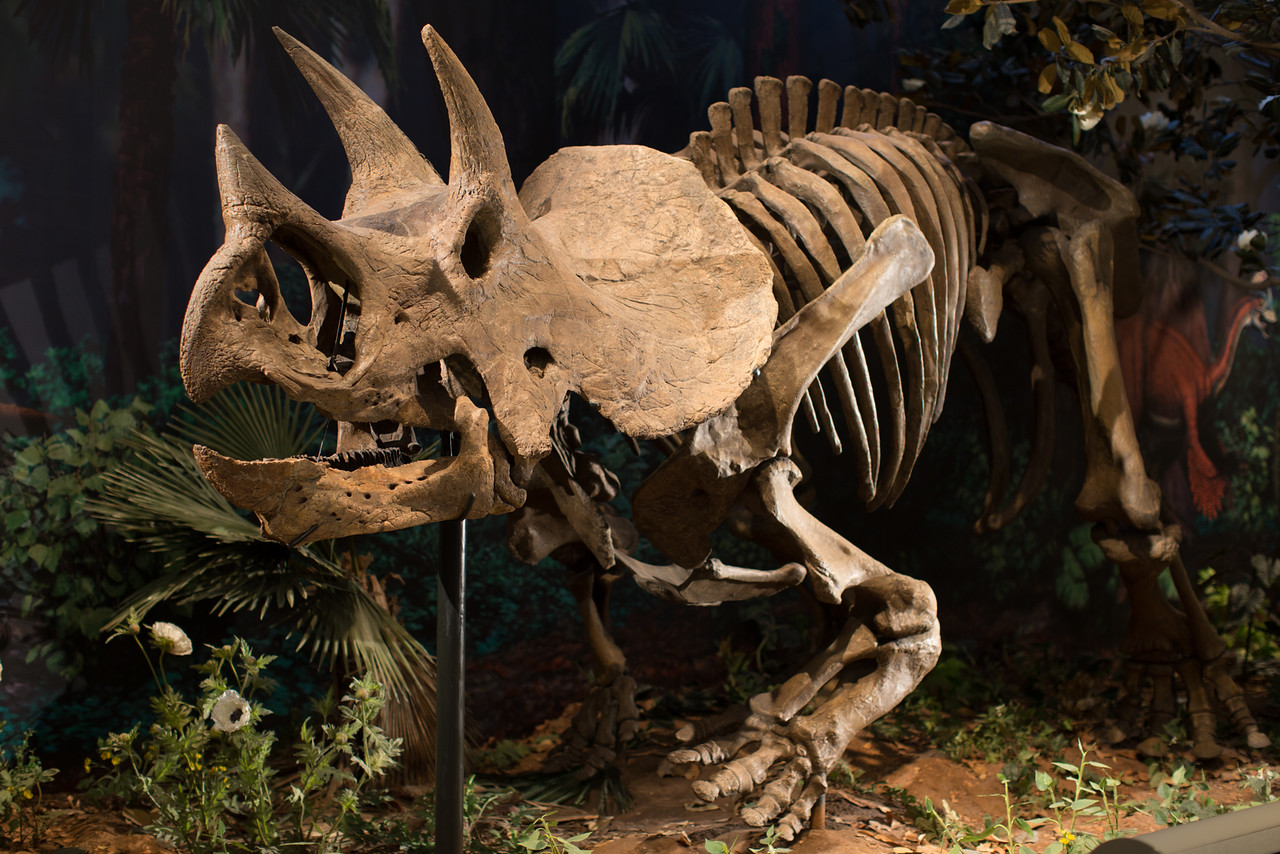
For instance, we now know that Apatosaurus and Diplodocus (two famous long-necked dinosaurs) did not spend their lives wallowing in swamps and that predatory dinosaurs such as T. rex walked with their tails held off the ground and their backs horizontal. The three-horned Triceratops may have used its famous headgear more for display than for fighting, whereas some theropod dinosaurs (such as Anzu wyliei, the notorious “Chicken from Hell”) would have closely resembled their modern descendants—modern birds.

Dinosaur Exhibition Layout

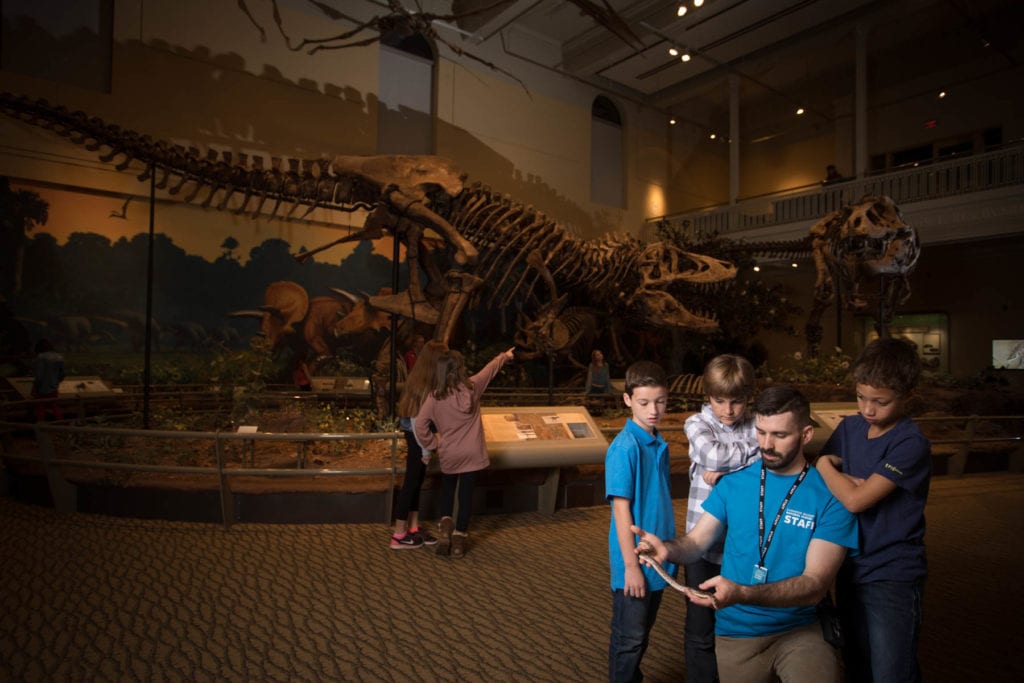
Many museum exhibitions group extinct species according to geologic time, but this exhibition takes this concept several steps further. In this exhibition, dinosaurs and other Mesozoic animals are shown in extraordinarily detailed reconstructions of their respective environments. Like the dinosaurs themselves, the habitats in this exhibition are firmly grounded in scientific evidence.

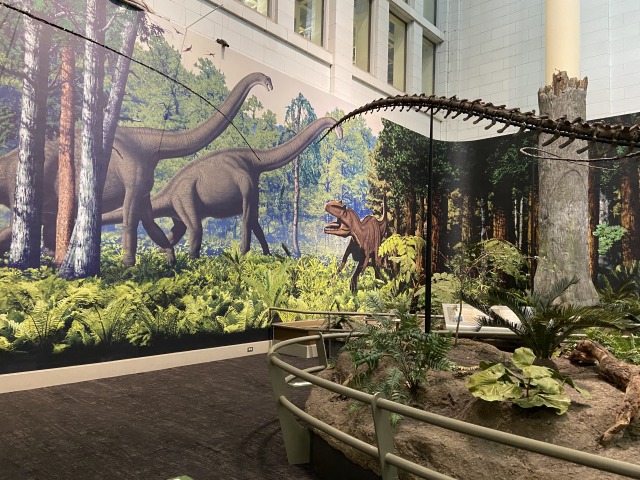
A panicked Apatosaurus smashes a small tree known from fossils found in the same Jurassic-aged rocks. A sculpted trackway of a hungry T. rex is based directly on the only known footprint of this terrifying meat-eater. The cat-sized Cretaceous mammal Didelphodon angrily confronts a much larger Triceratops. In short, in our museum’s exhibition, when dinosaur species are exhibited together, they actually lived together—their fossils are found in the same rock formations, and in many cases, the same quarries.
  • First Floor
triceratops
Visitors in Dinosaurs in their Time
herbivores in Dinosaurs in their Time

Meet our Vertebrate Paleontologists

Lamanna, Matt

Matt Lamanna, Ph.D.

Mary R Dawson Associate Curator

Learn More

sarah davis

Sarah Davis, Ph.D.

Collection Manager

Learn More

Meet the rest of the Fossil Vertebrate (Vertebrate Paleontology) Section
  • Stepping Back in Time

    Stepping Back in Time

    by Suzanne Nuss I grew up in the silent Canadian Arctic, so sounds switch me to alertness. Once alert, I pause to …
  • Jurassic Days: Icarosaurus

    Jurassic Days: Icarosaurus

    by Zach Lyons-Weiler Both visitors and staff love Carnegie Museum of Natural History’s Dinosaurs in Their Time exhibition for many reasons. For …
  • What Did Dinosaurs Sound Like?

    What Did Dinosaurs Sound Like?

    A Brief Foray into Paleoacoustics in Science and Film by Niko Borish and Caroline Lee Did Dinosaurs Roar? When you think about …
  • MESOZOIC MONTHLY: Volaticotherium

    MESOZOIC MONTHLY: Volaticotherium

    by Lindsay Kastroll Once again, spring has sprung. Prepare to see the gorgeous forests of Pennsylvania launch back into action. I, for …
Filed Under: Uncategorized Tagged With: dinos, dinosaurs, dinosaurs in their time

May 22, 2024 by Noelle Swart

Dippy & Friends: A Virtual Event

Join Curator Matt Lamanna online to learn about the dinos and animals that shared Dippy’s world.

It’s the 125th anniversary of the discovery of Carnegie Museum of Natural History’s beloved Dippy, the giant sauropod dinosaur Diplodocus carnegii, and we’re throwing a ‘gotcha day’ party! What other dinosaurs would Dippy invite? Which would be left off the guest list? Join CMNH dinosaur curator Matt Lamanna to learn about Apatosaurus, Stegosaurus, Allosaurus, and other amazing animals that shared Dippy’s world some 150 million years ago in what’s now the Rocky Mountain region of North America.

Tuesday, July 23, 7:00-8:00 p.m. EDT

Register Now


Speaker:

Matt Lamanna, Mary R. Dawson Curator of Vertebrate Paleontology, Carnegie Museum of Natural History


Tagged With: dinosaurs, Dippy 125, virtual

May 22, 2024 by Noelle Swart

Symposium – Discovering Dippy: The Dinosaur That Changed the World

Enjoy a day of talks about our beloved mascot by scientists, historians, and museum professionals.

Become an expert on the past, present, and future of research and discovery of Pittsburgh’s favorite dinosaur – the one and only Dippy! Talks by leading scientists, historians, and museum professionals will get you acquainted with a whole new side of Carnegie Museum of Natural History’s beloved mascot.

Speakers include, Tom Rea, the author of Bone Wars: The Excavation and Celebrity of Andrew Carnegie’s Dinosaur, Dr. John Whitlock, one of the world’s experts on Diplodocus carnegii and its relatives, Dr. Aja Carter, a postdoctoral fellow at Carnegie Mellon University who uses robots to investigate the biology of extinct animals, Phil Fraley, the renowned artist and museum professional who led the remounting of Dippy, T. rex, and more for our Dinosaurs in Their Time exhibition, and our very own dinosaur researchers Dr. Sarah Davis and Dr. Matt Lamanna.

Come for one lecture or stay for the day! All dino-enthusiasts, aspiring scientists, natural history lovers, and friends of the museum are welcome to help us celebrate Dippy’s discovery 125 years ago.

Friday, July 12, 10:00 a.m.-5:00 p.m.

Register Now


Schedule:

10-10:30 a.m. – Check-in

10:30-10:40 a.m. – Welcome remarks

10:40-11:30 a.m. – “Boneheads and Brilliant Men: The Discovery and Celebrity
of Andrew Carnegie’s Dinosaur” – Tom Rea, Author/journalist (retired)

11:30 a.m.-12:20 p.m. – “Resurrecting a Titan: What We Know About the Life of Dippy,
and How We Know It” John Whitlock, Associate Professor, Mount Aloysius College

12:20-1:10 p.m. – Lunch break

1:10-2:00 p.m. – “Motion from Stone: The Dawn of Paleobionics” –  Aja Carter, Postdoctoral fellow, Carnegie Mellon University

2:00-2:50 p.m. –  “Reimagining the Carnegie Dinosaurs” –  Phil Fraley, Founder/owner/CEO (retired), Phil Fraley Productions

2:50-3:10 p.m. – Coffee break

3:10-4:00 p.m. – “How Colorful Was Dippy? Deciphering the Appearance of Extinct Dinosaurs” – Sarah Davis, Collection Manager of Vertebrate Paleontology, Carnegie Museum of Natural History

4:00-4:50 p.m. – Where the Wild Things Are: The Strange Southern Hemisphere Cousins of Diplodocus carnegii” – Matt Lamanna, Mary R. Dawson Curator of Vertebrate Paleontology, Carnegie Museum of Natural History

4:50-5:00 p.m. – Closing remarks


Tagged With: dinosaurs, Dippy 125, paleontology

May 22, 2024 by Noelle Swart

Dippy’s Birthday Party for Members

*Sold out* Carnegie Museums of Pittsburgh members are invited to a birthday celebration for everyone’s favorite dinosaur, Diplodocus carnegii (Dippy). Discovered 125 years ago during an expedition funded by Andrew Carnegie, Dippy ignited popular imagination worldwide and inspired the global dinosaur craze that still thrives today.

You are invited to enjoy birthday treats, face painting, and other family-friendly activities in honor of a Pittsburgh icon with an international impact. Dinosaur-themed clothing and costumes are encouraged for members of all ages!

Dippy’s Birthday Party for Members

Friday, July 12, 2024, 6 p.m. to 9 p.m.


Tagged With: dinosaurs, Dippy 125, members, paleontology

July 30, 2021 by wpengine

Jurassic Days: Icarosaurus

by Zach Lyons-Weiler
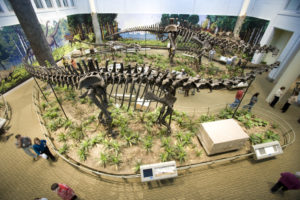
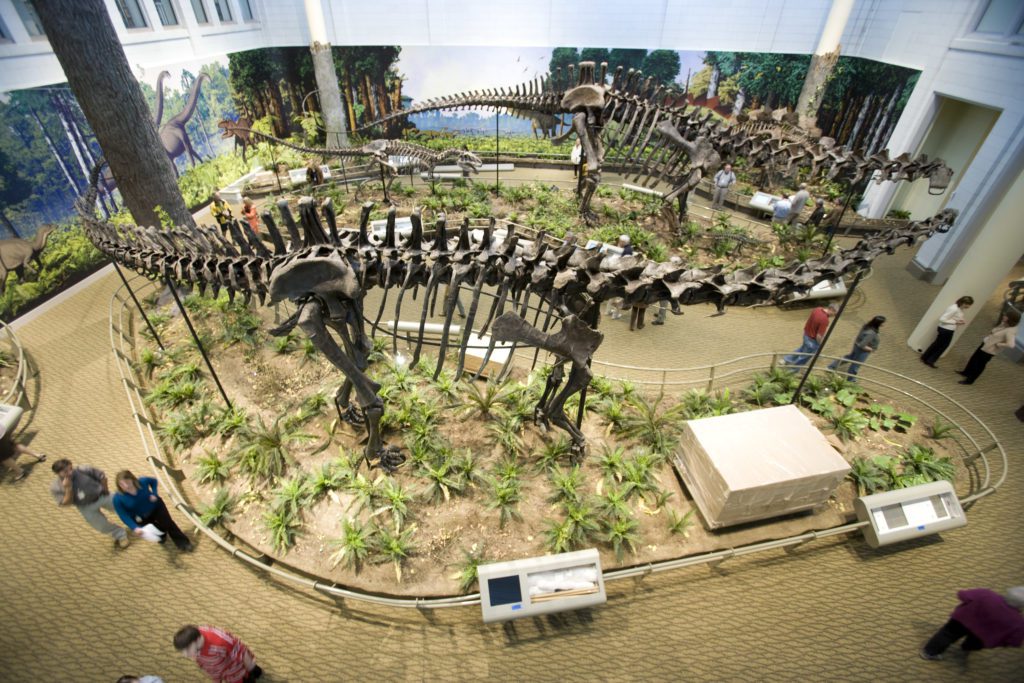
View of Dinosaurs in Their Time exhibition from above
Image credit: Joshua Franzos, Treehouse Media

Both visitors and staff love Carnegie Museum of Natural History’s Dinosaurs in Their Time exhibition for many reasons. For some people, it is the huge dinosaurs such as Tyrannosaurus and Diplodocus that capture the imagination. For others, it is the Quetzalcoatlus that soars above the latest Cretaceous display, or the cute Psittacosaurus with its strange tail ornamentation. But for me, my favorite specimen is a rather obscure fossil replica hidden in plain sight in the Triassic and Early Jurassic area of the hall. Its name is Icarosaurus, and it is quite possibly one of the strangest animals that we have on display. When one first sees it, it looks like a cast of a jumble of bones on a background of dark shale. However, as you will come to realize, Icarosaurus is far more than just that!

The Carnegie Museum’s Icarosaurus (which is a high-quality replica of the only known original fossil) is displayed in a glass case alongside many other casts and fossils from what is known as the Newark Supergroup, a large deposit of rocks that snake their way from South Carolina to New Brunswick and Nova Scotia. These rocks were deposited during the Triassic and early Jurassic periods, or from roughly 230 to 190 million years ago. The sedimentary rocks here are intermittently intruded by younger volcanic rocks, indicating that this area was undergoing tremendous geological change at this time. During the Triassic and Early Jurassic, the supercontinent Pangaea was in the process of splitting up. The eastern coast of North America was rifting from western Africa, opening a furrow that would become the Atlantic Ocean. Before it was ocean, though, the rift was filled with lakes that were similar to Lake Victoria and Lake Tanganyika in today’s Great Rift Valley in Africa. The climate was warmer, too, and so the environment was wet and tropical. Due to climatic changes and natural oscillations in Earth’s orbit, these ancient rift environments would go through stages, from deep lakes to mudflats. Each layer preserved the remains of life that lived during that specific interval. Layers of rock deposited in deep lakes often contain abundant fossils of fishes, invertebrates, and reptiles. Other layers preserve footprints of early dinosaurs and other animals. Still others preserve the remains of cynodonts, which were the forerunners of mammals.

Dating to the late Triassic Period, the remains of Icarosaurus were discovered in one of the deep lake deposits by three teenagers in a quarry near North Bergen, New Jersey, which is just outside New York City. Upon discovering the fossil, they realized its importance and donated it to New York’s American Museum of Natural History, where it was named in 1966 as Icarosaurus siefkeri. This is, to this day, the only known specimen of this reptile, so it is of tremendous scientific value. Other lizard-like reptiles had been found in these deposits, but what made Icarosaurus so unique were the extremely long and unusual ribs that extended from its body. These ribs are similar in form to those of lizards in the extant genus Draco, which have elongated ribs connected by membranes of skin that they extend to glide between trees in their Southeast Asian rainforest homes. Because the rib anatomy of this modern group is so similar to that of Icarosaurus, scientists reasoned that the latter would have glided between trees in a comparable manner.

Icarosaurus was not the first reptile to have evolved this trait, though. During the Permian Period, around 260 million years ago, reptiles such as Coelurosauravus had adapted to a gliding lifestyle. Other extinct reptiles that evolved gliding morphologies include Mecistotrachelos from the Triassic of Virginia and Xianglong from the Cretaceous of China. The extreme similarity between these distantly related reptile groups is a remarkable example of convergent evolution, which is a process where organisms evolve the same traits due to their populations facing similar selective pressures. Other examples of convergent evolution that can be seen in the Triassic and Early Jurassic exhibits in Dinosaurs in Their Time are the phytosaurs Redondasaurus and Rutiodon, which resemble their distant relatives, crocodiles, and ichthyosaurs such as Ichthyosaurus and Stenopterygius, which bear an uncanny resemblance to dolphins.

The high school students that discovered Icarosaurus were lauded for their donation, and the discovery of such an odd animal made headlines in both the local and national news. Unfortunately, though, the fame and unique nature of the fossil caused some issues. The man for whom Icarosaurus siefkeri was named, Alfred Siefker, repossessed the fossil to put it in his personal collection in 1989. It stayed there until 2000, when he tried to sell it at auction. Understandably, the scientific community was upset with this decision, because if the fossil were to be sold into a private collection then it would be unavailable for scientific study. It was bought at the auction for well under its appraised value, and the buyer, Dick Spight, donated it back to the American Museum that same year. The original Icarosaurus specimen is currently on display at that venerable New York institution.

Overall, Icarosaurus is a remarkable little animal that deserves more attention than it gets. Look for it and other unique prehistoric animals the next time you visit the Dinosaurs in Their Time exhibition.

Zach Lyons-Weiler is a Gallery Experience Presenter in CMNH’s Life Long Learning Department. Museum staff, volunteers, and interns are encouraged to blog about their unique experiences and knowledge gained from working at the museum.

Further reading:

Colbert, Edwin Harris. “The Triassic gliding reptile Icarosaurus.” Bulletin of the American Museum of Natural History; v. 143, article 2. (1970). https://www.scientificamerican.com/article/icarosaurus-home-to-roost/

Colbert, Edwin Harris. “Adaptations for gliding in the lizard Draco.” American Museum Novitates; no. 2283. (1967).

Related Content

Folded Forest: Defining the Jurassic Period

Real Dinosaurs vs. Reel Dinosaurs: Film’s Fictionalization of the Prehistoric World

Jurassic Days: Tyrannosaurus rex

Carnegie Museum of Natural History Blog Citation Information

Blog author: Lyons-Weiler, Zach
Publication date: July 30, 2021

Share this post!

  • Share on Twitter Share on Twitter
  • Share on Facebook Share on Facebook
  • Share on Pinterest Share on Pinterest
  • Share on LinkedIn Share on LinkedIn
  • Share on Reddit Share on Reddit
  • Share via Email Share via Email

Share this post!

  • Share on Twitter Share on Twitter
  • Share on Facebook Share on Facebook
  • Share on Pinterest Share on Pinterest
  • Share on LinkedIn Share on LinkedIn
  • Share on Reddit Share on Reddit
  • Share via Email Share via Email

Filed Under: Blog Tagged With: dinosaurs, dinosaurs in their time, sssjurassic, Super Science, Vertebrate Paleontology, Zach Lyons-Weiler

July 29, 2021 by wpengine

Folded Forest: Defining the Jurassic Period

by Jane Thaler

What’s in a Name?

Derived from the words for “middle life” in Greek, the Mesozoic Era consisted of three geological periods: the Triassic, Jurassic, and Cretaceous. While many of us might be aware of all three, the term “Jurassic” has seeped into our everyday lives in a way that the Triassic and Cretaceous have not. We can attribute much of this ubiquity to the wildly popular Jurassic Park books by Michael Crichton and their subsequent film adaptations, but have you ever wondered what “Jurassic” actually means and how scientists define the period’s geological boundaries?

Coining “Jurassic”

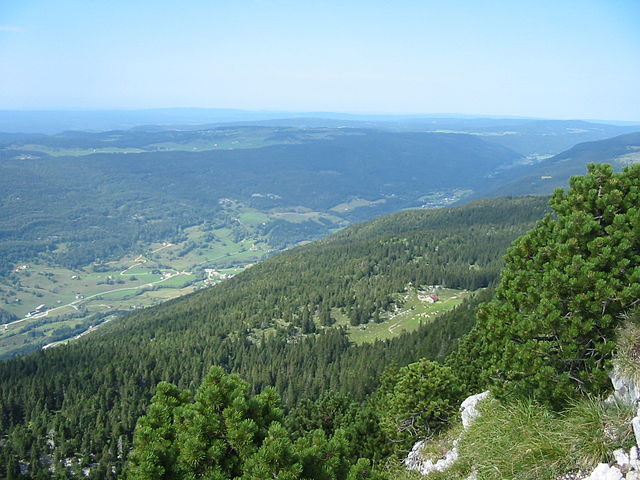
The “Jura” in Jurassic refers to the Jura Mountains that run along a large portion of the Swiss and French border. Named for the ancient Celtic word for forest, the Jura Mountains are known for their tree-covered peaks and the folded rocks that comprise them (Jones, 2020, p. 94).

Mountains covered in a combination of green forests and lush grassy fields.
Jura Mountains from Wikimedia Commons.

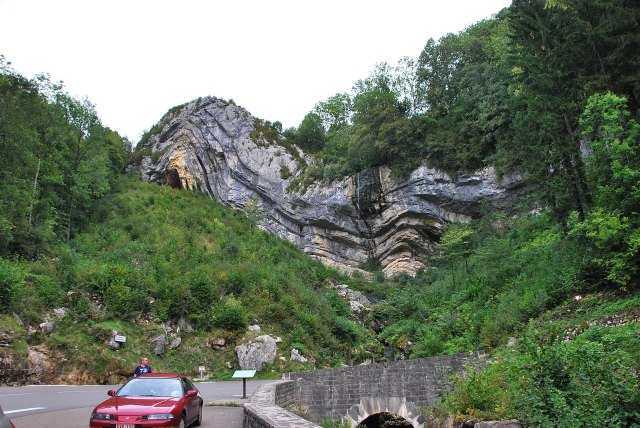
It was here in 1795 that Alexander von Humboldt, a Prussian explorer and naturalist, documented a series of carbonate shelf deposits from the period now known as the Jurassic and dubbed them the “Jura Kalstein.” Alexander Brongniart, a French scientist known for arranging and describing the geologic formations of the Tertiary Period (66.0 to 2.6 million years ago), coined the term “Terrains Jurassiques” to refer to all Jurassic strata in 1829. In 1832, German geologist Leopold von Buch established the three-fold subdivision of epochs based on the folds of limestone in the Jura: the Lias (Early Jurassic), the Dogger (Middle Jurassic), and the Malm (Late Jurassic). This arrangement remains the basic framework for our geological understanding of the Jurassic to this day (Ogg et al., 2012b, p. 732; Encyclopedia Britannica, 2021a).

Car parked in front of rock formation that appears to have folds in it.
Jura Mountain fold known as the “Chapeau de Gendarme” from Wikimedia Commons.

Beginning of the Jurassic

Nestled between the Triassic and Cretaceous periods, the Jurassic spanned from 201.3 million years ago to 145 million years ago (National Park Service, 2020). The end of the Triassic (so named because it is a group of three strata) and the beginning of the Jurassic is marked by the Triassic–Jurassic (Tr–J) extinction event, sometimes called the end-Triassic extinction. The fourth of five major extinction episodes on Earth (or sixth if you count the current, anthropogenic extinction), the Tr–J extinction wiped out around 75 percent of all marine and terrestrial life (Encyclopedia Britannica, 2021b).

Current evidence suggests that the Tr–J extinction was initially set into motion by movements of the Earth’s crust. As the all-encompassing mega-continent Pangea began to break apart, the associated tectonic shifts caused significant volcanic activity that spewed carbon dioxide into the atmosphere. The resulting global warming disrupted the Earth’s carbon cycle and contributed to ocean acidification (Fuge, 2020).

The ecological niches left open by the Tr–J extinction were quickly filled by remaining species of pterosaurs, crocodilians, turtles, mammals, many species of plants and invertebrates, marine life, and dinosaurs. Though many species died out during the extinction event, the wet and warm climate of the Jurassic in many places encouraged the growth of lush vegetation along with the proliferation and diversification of fauna. Oceans teemed with life, forests flourished, and dinosaurs became the dominant forms of backboned animal life on land during this time (Encyclopedia Britannica, 2021b).

Mural of dinosaurs during the Jurassic Period.
Jurassic landscape in the Dinosaurs in Their Time exhibition at Carnegie Museum of Natural History.

End of the Jurassic Period

The end of the Jurassic is a bit of a mystery as the geological boundary between it and the Cretaceous Period (the latter name derived from the Latin for “chalk”) remains formally undefined. In fact, the Cretaceous is the only period in the Phanerozoic Eon (541 million years ago to present day) that “does not yet have an accepted global boundary definition” (Ogg et al., 2012a, p. 795). This definitional challenge is due to a number of factors but is mostly attributed to the concept of provincialism or provinciality, which means that plant or animal populations were restricted to a particular area or group of areas (Gale et al., 2020). This resulted in endemic populations, particularly of ammonites, which left uneven or unclear fossil markers in the stratigraphic record (Wimbledon, 2017; see Énay, 2019 for more detail on the J/K boundary debates).

We do know that the end of the Jurassic was marked by the Tithonian–early Barremian cool interval, which began 150 million years ago and continued well into the Early Cretaceous (Ogg et al., 2012a). During this time, some groups of animals did go extinct or become less diverse, like the dinosaurian subgroup Stegosauria that included Stegosaurus, while others increased in abundance, like some ammonite subgroups who survived the Tr–J event. Plants were also developing in important ways during this time. Around 130 million years ago, angiosperms (flowering plants) began to diversify, and they became increasingly dominant throughout the Cretaceous (Friis et al., 2010). Taking the unknowns and variables into account, the end of the Jurassic is currently placed at 145 million years ago.

Naming Geological Periods

Many of the names we still use for geological periods went through a similar process to that of the Jurassic: a scientist named a phenomenon based on the strata they were studying and the nomenclature (the system of names) developed from there. Nowadays, defining and naming geological units is left to the International Commission on Stratigraphy of the International Union of Geological Sciences. The process by which this happens feels about as long as the geologic periods themselves, at least to those of us watching from outside the commission. This is, of course, an exaggeration, but it does take years of work and rounds of voting to arrive at an official stratigraphic boundary designation.

Check out https://stratigraphy.org for the latest updates on humanity’s understanding of geologic time.

Jane Thaler is a Gallery Experience Presenter and Floor Captain in CMNH’s LifeLong Learning Department. Museum staff, volunteers, and interns are encouraged to blog about their unique experiences and knowledge gained from working at the museum.

References:

enay, Raymond (2019). The Jurassic/Cretaceous System Boundary is at an impasse: Why not go back to Oppel’s 1865 original and historic definition of the Tithonian? Cretaceous Research. https://doi.org/10.1016/j.cretres.2019.104241.

Encyclopedia Britannica (2021a). Alexandre Brongniart. https://www.britannica.com/biography/Alexandre-Brongniart

Encyclopedia Britannica (2021b). End-Triassic extinction. https://academic-eb-com.pitt.idm.oclc.org/levels/collegiate/article/end-Triassic-extinction/474417

Fuge, L. (2020). Volcano link to end of Triassic extinction. Cosmos. https://cosmosmagazine.com/history/palaeontology/volcano-link-to-end-of-triassic-extinction/

Friis E. M., Pedersen K. R., Crane P. R. (2010). Diversity in obscurity: fossil flowers and the early history of angiosperms. Philosophical Transactions of the Royal Society B, 365. https://doi.org/10.1098/rstb.2009.0227

Gale, A. S., Mutterlose, J., Batenburg, S., Gradstein, F. M., Agterberg, F. P., Ogg, J. G., Petrizzo, M. R. (2020). The Cretaceous Period. In The Geologic Time Scale 2020 (Gradstein, F. M., Ogg, J. G., Schmitz, M. D., & Ogg, G. M., Eds.). Elsevier. https://doi.org/10.1016/B978-0-12-824360-2.00027-9

Gore, R. (n.d.), The rise of mammals. In National Geographic. https://www.nationalgeographic.com/science/article/rise-mammals

Ogg, J. G., Hinnov, L. A., Huang, C. (2012a). Cretaceous. In The Geologic Time Scale 2012 (Gradstein, F. M., Ogg, J. G., Schmitz, M. D., & Ogg, G. M., Eds.). Elsevier.

Ogg, J. G., Hinnov, L. A., Huang, C. (2012b). Jurassic. In The Geologic Time Scale 2012 (Gradstein, F. M., Ogg, J. G., Schmitz, M. D., & Ogg, G. M., Eds.). Elsevier.

Jones, P. (2020). Jura Mountains, France/Switzerland. In Around the World in 80 Words. University of Chicago Press. https://doi.org/10.7208/9780226682822-026

National Park Service (2020). Geologic time scale. https://www.nps.gov/subjects/geology/time-scale.htm

Pfiffner, O. A. (2006). Thick-skinned and thin-skinned styles of continental contraction. Special Paper of the Geological Society of America, 414.

Sauquet, H., von Balthazar, M., Magallón, S. et al. (2017). The ancestral flower of angiosperms and its early diversification. Nature Communications, 8. https://doi.org/10.1038/ncomms16047

Scotese, C. R., Song, H., Mills, B. J. W., van der Meer, D. G. (2021). Phanerozoic paleotemperatures: the Earth’s changing climate during the last 540 million years. Earth-Science Reviews, 215. https://doi.org/10.1016/j.earscirev.2021.103503

Wimbledon, W. A. P. (2017). Developments with fixing a Tithonian/Berriasian (J/K) boundary. Volumina Jurassica, XV. https://doi.org/10.5604/01.3001.0010.7467

Related Content

Super Science Saturday: Jurassic Day (July 31, 2021)

Real Dinosaurs vs. Reel Dinosaurs: Film’s Fictionalization of the Prehistoric World

What Did Dinosaurs Sound Like?

Carnegie Museum of Natural History Blog Citation Information

Blog author: Thaler, Jane
Publication date: July 29, 2021

Share this post!

  • Share on Twitter Share on Twitter
  • Share on Facebook Share on Facebook
  • Share on Pinterest Share on Pinterest
  • Share on LinkedIn Share on LinkedIn
  • Share on Reddit Share on Reddit
  • Share via Email Share via Email

Share this post!

  • Share on Twitter Share on Twitter
  • Share on Facebook Share on Facebook
  • Share on Pinterest Share on Pinterest
  • Share on LinkedIn Share on LinkedIn
  • Share on Reddit Share on Reddit
  • Share via Email Share via Email

Filed Under: Blog Tagged With: dinosaurs, Jane Thaler, sssjurassic, Super Science

  • Page 1
  • Page 2
  • Page 3
  • Interim pages omitted …
  • Page 9
  • Go to Next Page »

sidebar

About

  • Mission & Commitments
  • Directors Team
  • Museum History

Get Involved

  • Volunteer
  • Membership
  • Carnegie Discoverers
  • Donate
  • Employment
  • Events

Bring a Group

  • Groups of 10 or More
  • Birthday Parties at the Museum
  • Field Trips

Powdermill

  • Powdermill Nature Reserve
  • Powdermill Field Trips
  • Powdermill Staff
  • Research at Powdermill

More Information

  • Image Permission Requests
  • Science Stories
  • Accessibility
  • Shopping Cart
  • Contact
  • Visitor Policies
One of the Four Carnegie Museums | © Carnegie Institute | Privacy Policy | Terms of Use | Accessibility
Rad works here logo