• Skip to primary navigation
  • Skip to main content
  • Skip to primary sidebar

Carnegie Museum of Natural History

One of the Four Carnegie Museums of Pittsburgh

  • Visit
    • Buy Tickets
    • Visitor Information
    • Exhibitions
    • Events
    • Dining at the Museum
    • Celebrate at the Museum
    • Powdermill Nature Reserve
    • Event Venue Rental
  • Learn
    • Field Trips
    • Educator Information
    • Programs at the Museum
    • Bring the Museum to You
    • Guided Programs FAQ
    • Programs Online
    • Climate and Rural Systems Partnership
  • Research
    • Scientific Sections
    • Science Stories
    • Science Videos
    • Senior Science & Research Staff
    • Museum Library
    • Science Seminars
    • Scientific Publications
    • Specimen and Artifact Identification
  • About
    • Mission & Commitments
    • Directors Team
    • Museum History
  • Tickets
  • Give
  • Shop

dinosaurs

July 27, 2018 by wpengine

My Guildey Pleasure

By Andrew McAfee

As the Scientific Illustrator for the Section of Vertebrate Paleontology at Carnegie Museum of Natural History, I spend most of my time in the museum interpreting and representing the paleontologists’ work in visual form. Most of this work takes place at a desk with a computer. But as a member of the Guild of Natural Science Illustrators (GNSI), I spend one week per year away from the desk, learning new techniques in the field and sharing a few of my own.

The GNSI is an organization of scientists and science illustrators founded in 1968 by illustrators at the Smithsonian Institution in Washington, DC. The purpose of the GNSI is to advance science illustration by facilitating the exchange of ideas, knowledge, and techniques among its members.

Every year around July, the GNSI has a conference that brings members from all around the world together for a week of plenary speakers, technique expositions, lectures, and workshops. It’s a wonderful opportunity to commune with colleagues in the field of scientific illustration and acquire new perspectives and technical abilities.
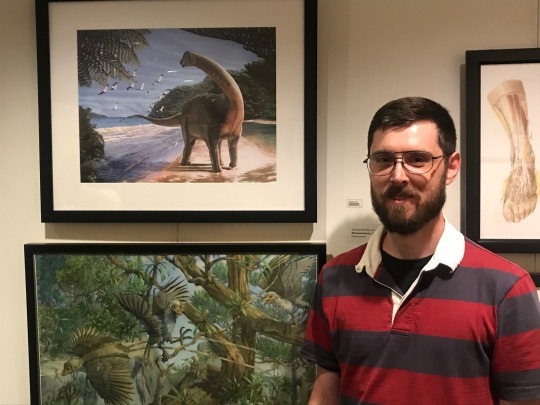
Andrew McAfee with his digital painting of Mansourasaurus 
Andrew McAfee with his digital painting of Mansourasaurus (upper left) on display in GNSI’s 50th anniversary exhibition, Visualize: Art Revealing Science, at AAAS headquarters. Photo: Reid Psaltis.

I joined the GNSI in 2013 and have not missed a conference since. This year’s event marked the 50th anniversary of the Guild’s formation and represented a homecoming, returning to Washington, DC. As a part of our anniversary celebration, the American Association for the Advancement of Science (AAAS)—known for, among other things, publishing one of the world’s foremost scientific journals, Science—hosted our annual members’ juried exhibition.

This year I was honored to have two pieces selected for exhibition in the show: my reconstructions of the recently-named dinosaurs Mansourasaurus shahinae and Tratayenia rosalesi, both completed at Carnegie Museum of Natural History under the guidance of paleontologist Matt Lamanna. I was proud to represent the museum and it was gratifying to see my work sharing walls with the stellar work of my colleagues in the AAAS gallery.

Visualize: Art Revealing Science, the 50th anniversary GNSI exhibit, will be on display at AAAS headquarters until October 15, 2018.

Andrew McAfee is Scientific Illustrator for the Section of Vertebrate Paleontology at Carnegie Museum of Natural History. Museum employees are encouraged to blog about their unique experiences and knowledge gained from working at the museum.
Filed Under: Blog Tagged With: Andrew McAfee, dinosaur, dinosaurs, dinosaurs in their time, paleontology, Vertebrate Paleontology

May 7, 2018 by wpengine

Dippy’s Looking Good in Our Museum Store

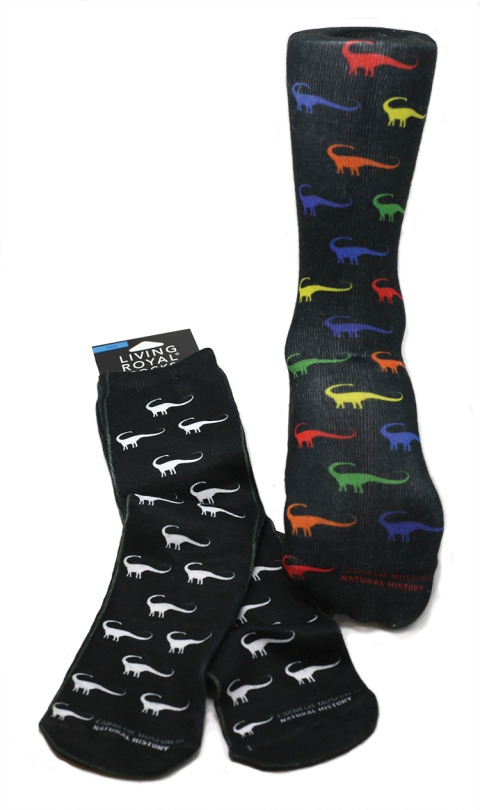
Thanks to our visitors for helping us to rebrand last year! You asked, and we listened: we are featuring Dippy on everything from coffee mugs to socks…

Socks with Dippy logo

We adore the socks and hope you will, too. The multi-colored Dippy’s bring a burst of fun to your wardrobe. The black and white ones are classy enough to pair with your wedding tux!

The Dippy silhouette is truly a community-created design that reflects our most famous (and first!) dino in Dinosaur Hall. Thank you for your role in bringing Diplodocus carnegii to life in a fresh, new way.

Did you get some Dippy swag? Take a selfie and tag us in it on Instagram @carnegiemnh! We’d love to see you loving Dippy.

Filed Under: Blog Tagged With: dinosaurs, diplodocus carnegii, dippy, gift shop

October 23, 2017 by wpengine

Dryosaurus altus

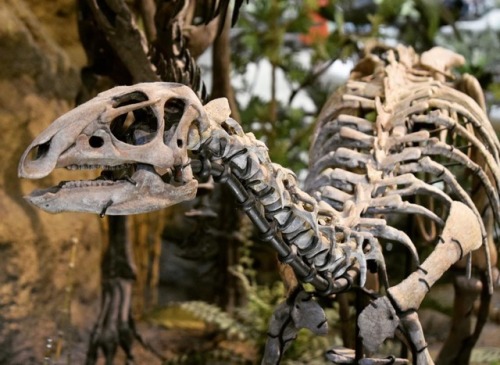
Dryosaurus altus was a Jurassic plant eater that could be found in the forests and fern prairies of North America 150 million years ago. As a small dinosaur, measuring about 10 feet long, this dinosaur’s best defense against predators was its speed.

Dryosaurus altus was a Jurassic plant eater that could be found in the forests and fern prairies of North America 150 million years ago. As a small dinosaur, measuring about 10 feet long, this dinosaur’s best defense against predators was its speed.

Filed Under: Blog Tagged With: dinosaurs, dinosaurs in their time

October 5, 2017 by wpengine

Tyrannosaurus rex

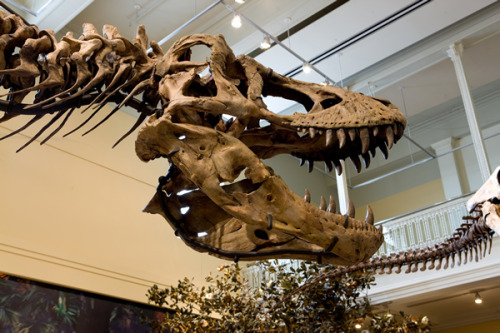
Tyrannosaurus rex was one of the largest predators to ever walk the Earth. Growing up to 46 feet in length and standing 13 feet high at the hips, this meat-eater could weigh up to seven tons.

T. rex was more than just enormous, it was ferocious. It had massive hind legs with three-toed feet, small, strong arms the size of a man’s, and a huge, heavy tail that was used as a counterbalance.

head of a T.rex skeleton
Credit: Joshua Franzos for Carnegie Museum of Natural History

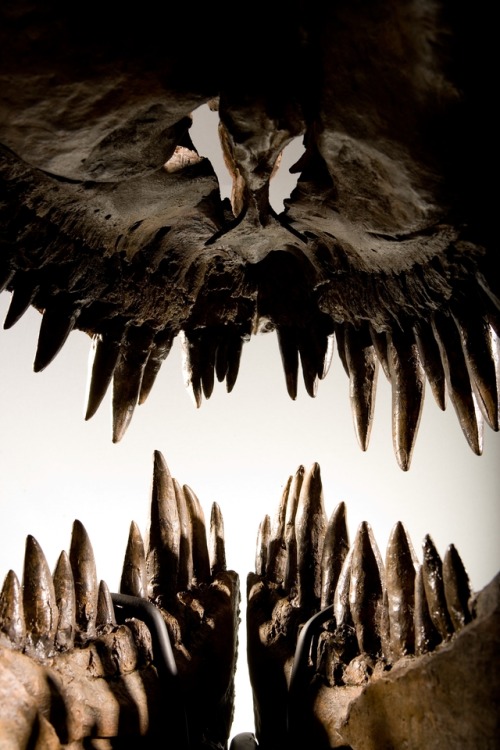
Its skull grew to five feet long and housed strong jaws that created a bone-crushing bite. It had nearly 60 serrated, razor-sharp teeth that grew up to six inches in length. With a name that means “tyrant lizard king,” this dinosaur feasted on the large herbivores of its time.

view of T.rex teeth from inside the dinosaur's mouth
Credit: Joshua Franzos for Carnegie Museum of Natural History

T. rex roamed the western United States and southwestern Canada during the late Cretaceous Period, about 66 to 68 million years ago. The specimen on display at Carnegie Museum of Natural History was discovered in 1902 by Barnum Brown and sent to the American Museum of Natural History. It was bought by the Carnegie Museum in 1941.

This specimen is extremely important because it is the holotype of the species. A holotype is a specimen upon which a given species is based. So, in other words, Carnegie Museum of Natural History’s T. rex is the ‘gold standard’ to which all potential fossils of this notorious meat-eater must forever be compared. Although a few specimens that are now known to belong to T. rex were found prior to the discovery of the holotype, the holotype was, by definition, the first fossil of the species to be recognized by science. Therefore, it can be considered the world’s first specimen of the world’s most famous dinosaur.

Filed Under: Blog Tagged With: dinosaur, dinosaurs, dinosaurs in their time, Matt Lamanna, t-rex, Tyrannosaurus Rex, Vertebrate Paleontology

October 5, 2017 by wpengine

Carnegie History: T. Rex Mural

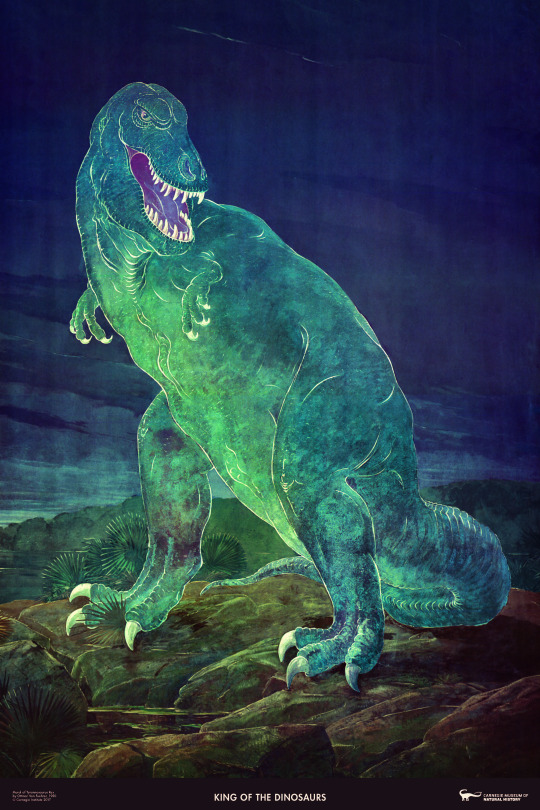
painted mural of a T. Rex dinosaur in blues and greens

Do you remember when this mural towered over Carnegie Museum of Natural History’s Dinosaur Hall?

It brought one of our fiercest specimens to life when the museum’s chief artist Ottmar von Fuehrer painted it on the south
end of the hall in 1950. Von Fuehrer recognized the value that art brought to science and paid enormous attention to detail in order to give a face and an environment to the ferocious fossilized skeleton that stood nearby. As he painted, visitors returned to the museum month after month to watch, sometimes offering feedback and asking questions.

Though the mural is no longer in the hall, you can take home new merchandise inspired by a vintage piece of Carnegie history.

Filed Under: Blog Tagged With: dinosaurs, gift shop

October 5, 2017 by wpengine

Who is Dr. Matt Lamanna?

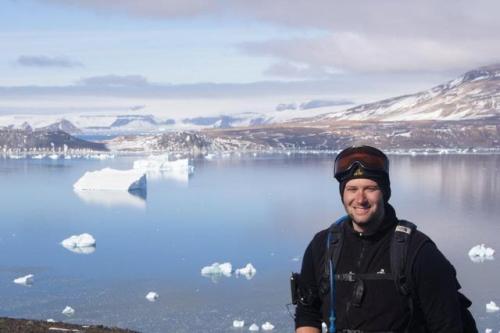
Matt Lamanna on expedition in Antarctica

Did you know that Section of Vertebrate Paleontology curator Matt Lamanna has discovered dinosaur fossils on all seven
continents, including Antarctica?

Dr. Lamanna leads the Antarctic Peninsula Paleontology Project, an international team of scientists investigating the end
of the Mesozoic Era (”Age of Dinosaurs”) in Antarctica, and also leads or co-leads research projects studying dinosaurs in Patagonia (Argentina), the Sahara (Egypt), and the Australian Outback.

Lamanna has named or co-named 15 new species of dinosaurs and fossil birds, including Anzu wyliei and three of the largest land animals known to science—the titanosaurian sauropods Dreadnoughtus schrani, Notocolossus gonzalezparejasi, and Paralititan stromeri. Each of these massive sauropods is estimated to have weighed more
than 40 tons, roughly equivalent to eight adult elephants.

Lamanna has co-authored two papers in the preeminent journal Science and appeared on television programs for PBS (NOVA), the Discovery Channel, the History Channel, A&E, the Science Channel, and more. Recently, he assisted the US Department of Homeland Security in their investigation of a dinosaur fossil that had been illegally smuggled out of China.

Filed Under: Blog Tagged With: Antarctic Peninsula Paleontology Project, dinosaurs, Matt Lamanna, Vertebrate Paleontology

  • « Go to Previous Page
  • Page 1
  • Interim pages omitted …
  • Page 5
  • Page 6
  • Page 7
  • Page 8
  • Page 9
  • Go to Next Page »

sidebar

About

  • Mission & Commitments
  • Directors Team
  • Museum History

Get Involved

  • Volunteer
  • Membership
  • Carnegie Discoverers
  • Donate
  • Employment
  • Events

Bring a Group

  • Groups of 10 or More
  • Birthday Parties at the Museum
  • Field Trips

Powdermill

  • Powdermill Nature Reserve
  • Powdermill Field Trips
  • Powdermill Staff
  • Research at Powdermill

More Information

  • Image Permission Requests
  • Science Stories
  • Accessibility
  • Shopping Cart
  • Contact
  • Visitor Policies
One of the Four Carnegie Museums | © Carnegie Institute | Privacy Policy | Terms of Use | Accessibility
Rad works here logo