• Skip to primary navigation
  • Skip to main content
  • Skip to primary sidebar

Carnegie Museum of Natural History

One of the Four Carnegie Museums of Pittsburgh

  • Visit
    • Buy Tickets
    • Visitor Information
    • Exhibitions
    • Events
    • Dining at the Museum
    • Celebrate at the Museum
    • Powdermill Nature Reserve
    • Event Venue Rental
  • Learn
    • Field Trips
    • Educator Information
    • Programs at the Museum
    • Bring the Museum to You
    • Guided Programs FAQ
    • Programs Online
    • Climate and Rural Systems Partnership
  • Research
    • Scientific Sections
    • Science Stories
    • Science Videos
    • Senior Science & Research Staff
    • Museum Library
    • Science Seminars
    • Scientific Publications
    • Specimen and Artifact Identification
  • About
    • Mission & Commitments
    • Directors Team
    • Museum History
  • Tickets
  • Give
  • Shop

dinosaurs

February 19, 2019 by Kathleen

Dinosaurs Tour

Dinosaurs in their TimeDiscover the fascinating stories behind the dinosaurs in our renowned hall Dinosaurs in Their Time! Meet the real Dippy (Diplodocus carnegiei) type specimen that sparked people’s interests in paleontology around the world as well as a beloved Apatasaurus Andrew Carnegie named after his own wife.

Some of the most unique fossils can be found at Carnegie Museum of Natural History—let us guide you to them!

This tour typically meets at Paleolab on the first floor by the T. rex skull.

Tagged With: dinosaurs

January 24, 2019 by wpengine

“Amazing, just like a dinosaur!”

Exclamations like this are common among bird biologists, especially when face-to-face with a Pileated Woodpecker or a ferocious Chickadee. Decades of Jurassic Park films have caught us in a tautological trap where birds remind us of dinosaurs—because Hollywood models dinosaurs on birds. From the coordinated flock movements of chickens foraging to the reptilian eyes of a Heron, I often catch myself wanting to say, “Amazing, just like a dinosaur!” But, I restrain myself because my source is mostly Stephen Spielberg.

At the Carnegie Museum of Natural History something that makes the Section of Birds special is its proximity to a world-class collection of dinosaur fossils and the paleontologists they attract. PhD students, like Sam Gutherz from Ohio University, use our collections to study the pulmonary tissue and skeleton of birds to address questions regarding the evolution of the respiratory system in a range of archosaurs.
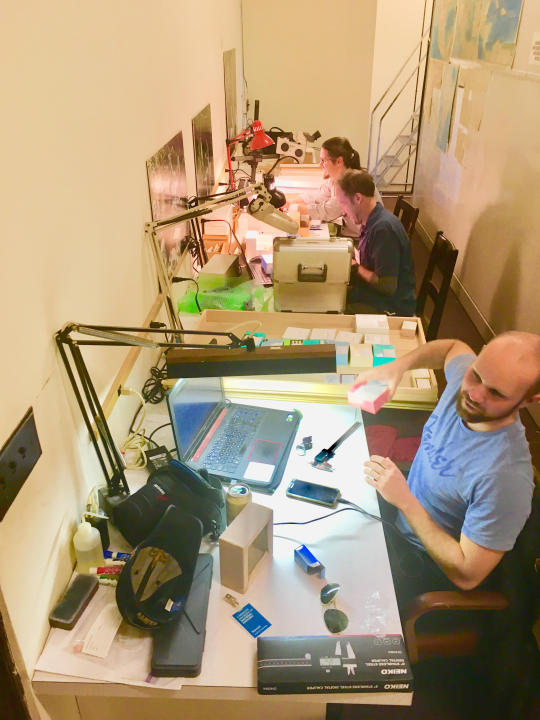
three people working at desks
Sam Gutherz and colleagues from Ohio University measure bird skeletons at the Carnegie Museum of Natural History to better understand the biology of dinosaurs.

Sam visits natural history museums for both the birds and the dinosaurs—systematically measuring bones and testing questions that ultimately support or refute the connection between birds and dinosaurs. Decades of work by scientists like Sam and his colleagues have built a case using multiple lines of evidence that birds evolved from dinosaurs. In fact, paleontologists have been so successful that bird biologists and Hollywood producers stand on their shoulders.

Chase Mendenhall is Assistant Curator of Birds, Ecology, and Conservation at Carnegie Museum of Natural History. Museum employees are encouraged to blog about their unique experiences and knowledge gained from working at the museum.


Filed Under: Blog Tagged With: bird hall, Birds, Chase Mendenhall, dinosaurs, Hall of Birds, paleontology

November 8, 2018 by wpengine

Ask a Scientist – How Are Birds Like Dinosaurs?

How are birds like dinosaurs? Assistant Curator of Birds, Chase Mendenhall, and Urban Bird Conservation Coordinator, Jonathan Rice, introduce the bird collection in the latest Ask a Scientist. Learn how the Section of Birds works with paleontologists to understand dinosaur behavior.

Ask a Scientist is a video series where we ask our research staff questions about the millions of amazing objects and specimens stored in our museum collection. Tune in on YouTube, and submit your own questions via Twitter @CarnegieMNH!

Filed Under: Blog Tagged With: Ask a Scientist, Birds, Chase Mendenhall, dinosaurs, Section of Birds

October 22, 2018 by wpengine

This is not about the Anthropocene, or is it?

by Gil Oliveira

“How many times do you need to see the evidence? How many times must the point be made? We’re causing our own extinction. Too many red lines have been crossed. […] We’re going to have to adjust to new threats we can’t even imagine. We’ve entered a new era.”

This is not about climate change, mass extinction, or ocean acidification. Rather, this quote comes from the closing scene of the recent movie Jurassic World: Fallen Kingdom. It’s about the beginning of a new fictional Jurassic-Age, where humans and dinosaurs must learn to coexist.

sunset

The final scene is visually spectacular. But what really caught my attention was the idea connecting dinosaurs and a new era. Similarly, the Anthropocene is a newly proposed time period when geological and human timescales are colliding. It entails Earth’s distant past, and also invites us to consider our actions and decisions in light of their effects long into the future. In order to link past, present and future, and make sense of it, humans construct narratives.

In a time of uncertainty, when we are indeed crossing red lines at the planetary scale in real life, one can’t help but wonder what will the future look like? What narratives do we need to live better in this new world? At their most fundamental level, narratives speak about the human condition (and its limits), so how can we better understand the role of humans as actors capable of affecting the entire Earth System?

Yuval Noah Harari, the author of Sapiens. A Brief History of Humankind, posits that humans rule the world because they are the only animal that can cooperate flexibly in large numbers (see Harari’s website). But, he asks, what is the mysterious glue that enables millions of us to cooperate seemingly more effectively than other animal societies. The glue, he argues, is the stories we tell ourselves. It is our ability to create and believe in fiction. As Jonathan Gottschall puts it: sapiens are “the great ape with the storytelling mind.”

Humans use stories to understand the world. You and I think in them. Today, dominant cultural narratives gravitate around unlimited technology, endless progress and growth, and ferocious competition. Museums have not been spared. They too have been telling stories, focused on the law of the jungle and the survival of the fittest, on nature as a realm distinct from human life, on the progress of evolution and humans as its most highly evolved product. These imaginaries have contributed to shape our representations of the world. They shape our attitudes, our beliefs, our behaviors.

Coming back to Jurassic World: Fallen Kingdom, the last scene shows a scientist appearing before a congressional committee and declaring that “Humans and Dinosaurs are now going to be forced to co-exist. These creatures were here before us and if we’re not careful they’re going to be here after.” This new pretend era seems to be characterized by a dependence between dinosaurs and humans, and humility regarding the human place in the world.

This moral may have relevance to the Anthropocene. The stories we tell and consume shape us profoundly. Stories can help us connect with the non-human world. Like science fiction, museums too are powerful spaces for storytelling. They hold great potential for generating new stories and sensibilities that may help adapt our understanding and connection to nature to better serve us in confronting the challenges of the Anthropocene.

Gil Oliveira is a postgraduate student working as an intern in the section of the Anthropocene at the Carnegie Museum of Natural History. Museum employees are encouraged to blog about their unique experiences working at the museum.

Filed Under: Blog Tagged With: Anthropocene, climate change, dinosaurs, extinction

October 1, 2018 by Kathleen

Scientists Live: Matt Lamanna

Lamanna, MattAssistant Curator and Head of Vertebrate Paleontology Dr. Matt Lamanna will broadcast on Facebook Live to share details of his upcoming research trip to Croatia. Discovered in the 1990s, the site of Kolone/Porto Colonne on the coast of Istria, Croatia preserves ~130-million-year-old dinosaur bones in shallow water on the bed of the Adriatic Sea. During the time these dinosaurs were alive, this area of Croatia was part of a large island or long peninsula in the middle of an ancient ocean. Despite its probable significance, the site has never been systematically explored by paleontologists. Lamanna and a team of Croatian, Italian, and US paleontologists, geologists, and scientific divers will conduct a five-day underwater reconnaissance of Kolone/Porto Colonne from October 8–13, to discover additional fossils, map the site in detail, and form a comprehensive plan for future research.
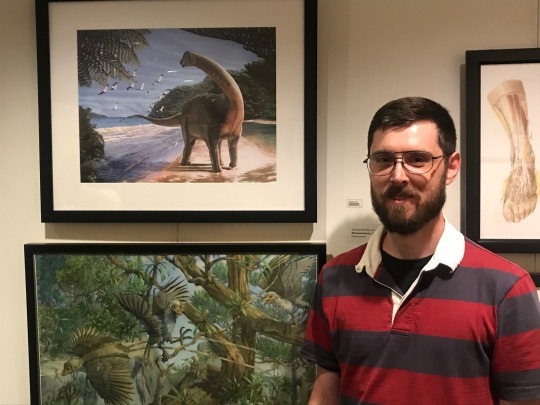
The broadcast will begin at 10:30 a.m. and will include a question and answer segment.

Tune in at facebook.com/carnegiemnh. A recording will be posted later for those unable to watch live.


Tagged With: dinosaurs, Matt Lamanna, Scientists Live, Vertebrate Paleontology

September 11, 2018 by wpengine

Ask A Scientist – What Kind of Dinosaur is a Megaraptorid?

Are megaraptors really raptors? Assistant Curator and Head of Vertebrate Paleontology Dr. Matt Lamanna discusses what paleontologists know about the dinosaur family Megaraptoridae in our latest Ask a Scientist! See a life-sized replica of a megaraptorid thumb claw from Patagonia up close and find out how a claw like that led researchers to give megaraptorids their name.

 Ask a Scientist is a video series where we ask our research staff questions about the millions of amazing objects and specimens stored in our museum collection. Tune in on YouTube, and submit your own questions via Twitter @CarnegieMNH!

Filed Under: Blog Tagged With: Ask a Scientist, dinosaur, dinosaurs, Matt Lamanna, paleontology, Vertebrate Paleontology

  • « Go to Previous Page
  • Page 1
  • Interim pages omitted …
  • Page 4
  • Page 5
  • Page 6
  • Page 7
  • Page 8
  • Page 9
  • Go to Next Page »

sidebar

About

  • Mission & Commitments
  • Directors Team
  • Museum History

Get Involved

  • Volunteer
  • Membership
  • Carnegie Discoverers
  • Donate
  • Employment
  • Events

Bring a Group

  • Groups of 10 or More
  • Birthday Parties at the Museum
  • Field Trips

Powdermill

  • Powdermill Nature Reserve
  • Powdermill Field Trips
  • Powdermill Staff
  • Research at Powdermill

More Information

  • Image Permission Requests
  • Science Stories
  • Accessibility
  • Shopping Cart
  • Contact
  • Visitor Policies
One of the Four Carnegie Museums | © Carnegie Institute | Privacy Policy | Terms of Use | Accessibility
Rad works here logo